
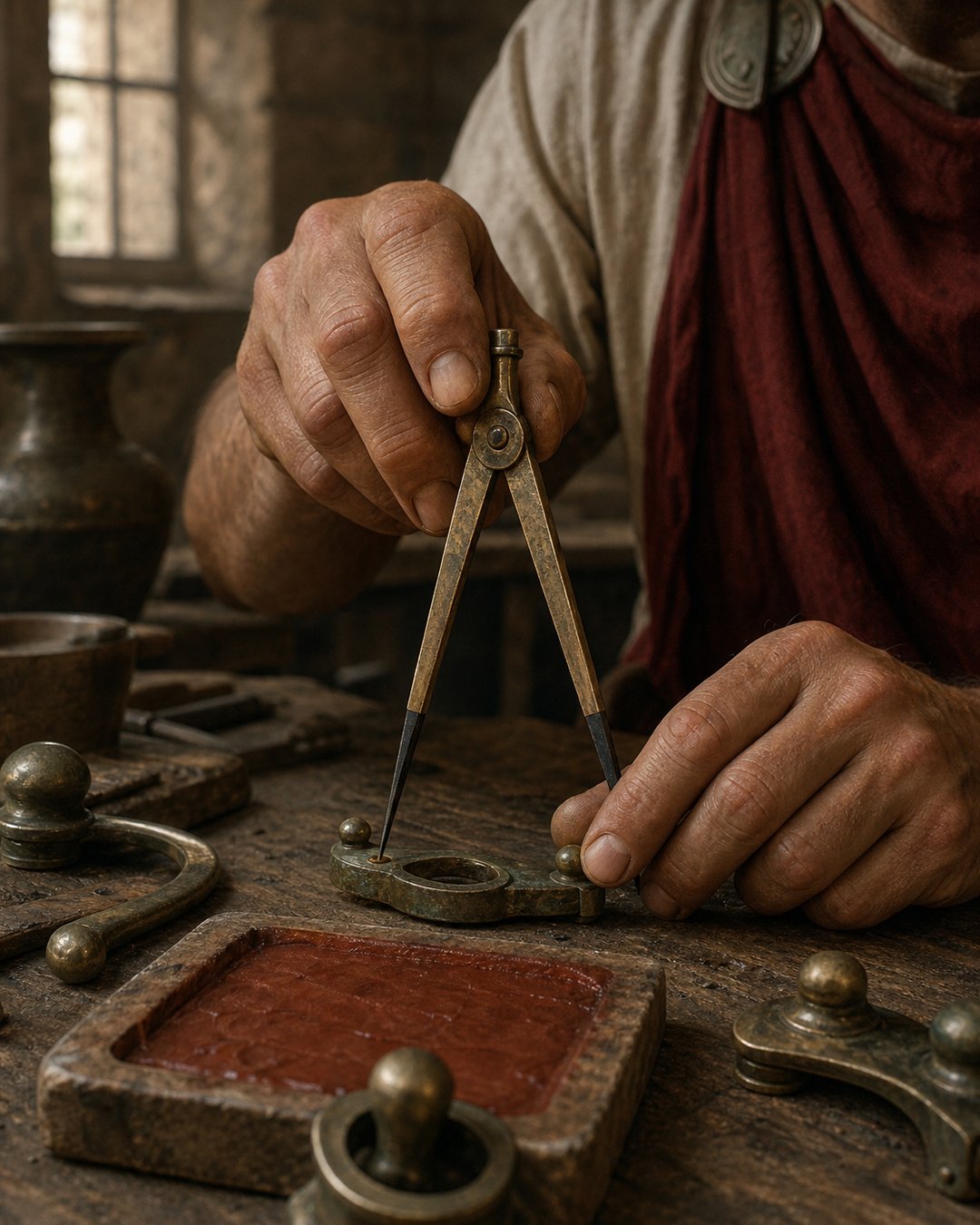
A number is not the only way to remember a distance. A Roman craftsperson could open two pointed arms across the width of a fitting, lift the instrument away and carry that exact span to another piece. Nothing had to be called six fingers or copied from a ruler. The distance survived physically between the points.
Dividers made comparison direct. They could test whether two circles shared a radius, whether repeated holes sat at matching intervals, or whether a replacement part agreed with an original. One point could remain fixed while the other scratched an arc. The same joint that preserved a gap also turned that gap around a center.
A Roman copper-alloy pair excavated at Usk is only 61 millimetres long. Museum Wales records that its arms were split to receive inserted iron terminals, one surviving with traces of an iron plate and a rivet. That mixed construction reveals the tool’s logic: a workable body, harder points and a joint able to carry a decision.
The Gap Between the Points Became a Portable Standard
A drawing compass uses two joined arms to inscribe circles or arcs; used as dividers, the points also transfer distance. The operator sets the span against a model, mark or existing feature, then moves the instrument without disturbing the pivot. When the points meet the next surface, agreement or error becomes visible immediately.
A span could also survive between tasks. If a second part had to match one made earlier, the dividers let the first object become its own standard. The craftsperson did not need to reconstruct an intended number from memory; the successful feature itself could reopen the points and govern its companion.
This method still demanded care at the tips. Blunt or bent points shifted the effective span, and deep punctures could enlarge a center mark. The instrument worked best when contact was light, the pivot stable and the surfaces clean enough for both touches to be felt rather than guessed.
This method avoids a chain of translation. Reading a graduated rule requires deciding which mark aligns, remembering a number and finding the corresponding mark elsewhere. Dividers preserve the interval itself. A craftsperson can compare opening to opening even when no shared numerical scale is convenient or when an object’s feature falls between familiar units.
The principle complements the archive’s article on Roman land surveyors. Surveying projected long alignments across terrain. Workshop dividers carried short spans across wood, metal, wax, plaster or stone. Both practices made geometry repeatable, but one crossed fields while the other fitted inside a palm.
A Pivot Had to Hold Without Becoming Frozen
The central joint defined the instrument’s reliability. If it moved too freely, lifting the dividers changed the setting. If it seized, small adjustments became difficult and the arms could bend under force. The ideal pivot allowed deliberate movement while resisting accidental closure or spread during transfer.
The Usk example has a head 28 millimetres long and measures 11 millimetres across that head. Those proportions concentrate material where the arms meet. The surviving object is incomplete, yet its substantial joint still makes the mechanical priority clear: two points are useful only when their relationship remains controlled.
Wear would announce itself as uncertainty. A loose pair might produce a different circle each time around. A craftsperson could tighten, peen or otherwise maintain a riveted joint, then test it by stepping repeated marks or returning the points to a known span. Calibration began with noticing whether the tool remembered what the hand had set.
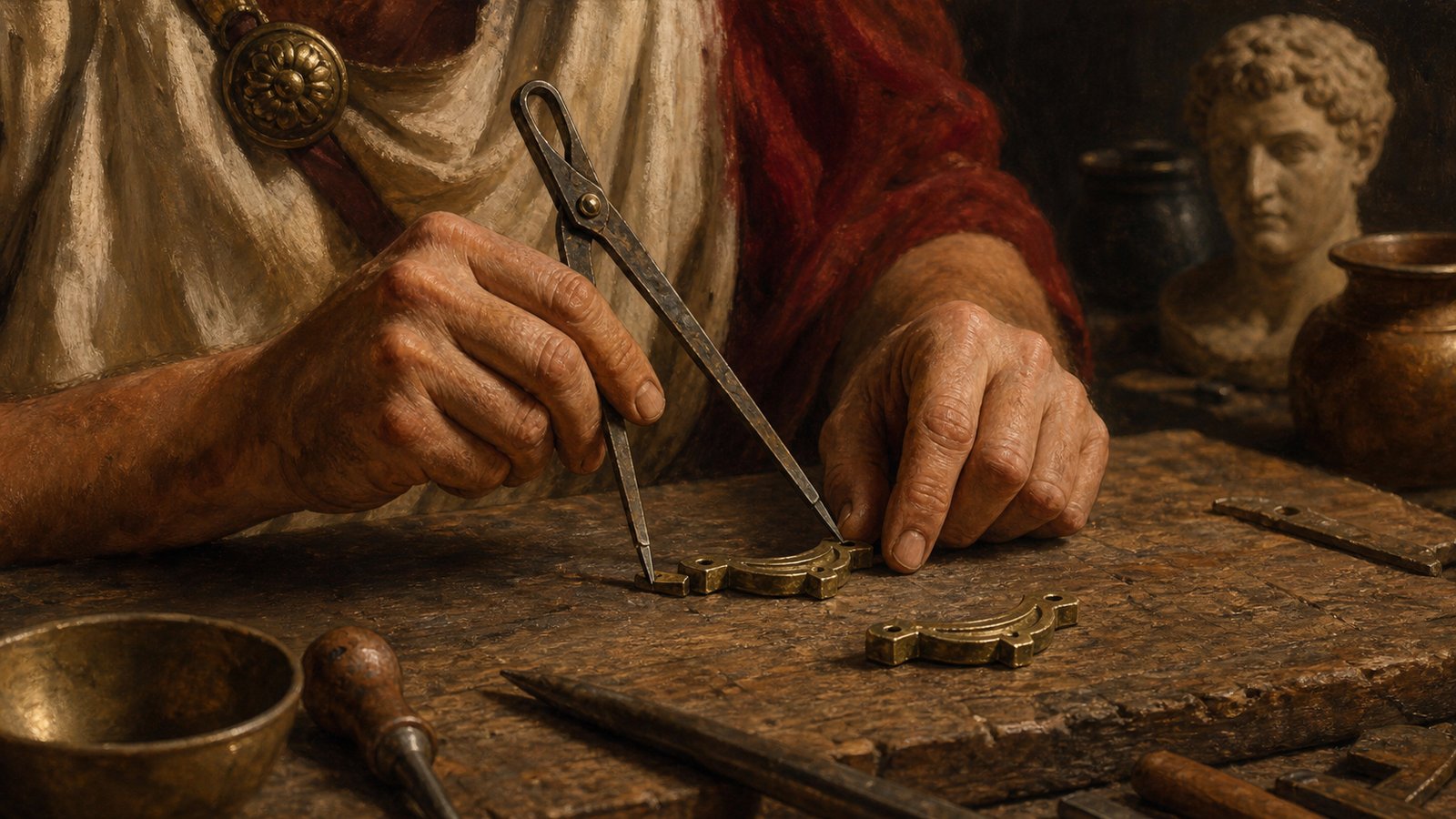
Copper-Alloy Arms Carried Harder Iron Tips
Museum Wales describes the Roman dividers as copper alloy with arm ends split to take inserted iron terminals. One arm is broken at the junction; the other retains traces of iron plate, and a rivet shows how the insert was secured. The construction assigns different tasks to different materials.
Copper alloy could form the arms and pivoting body, while iron supplied points better suited to repeated contact and scratching. The insert arrangement also concentrated wear in a component rather than requiring the whole arm to be one material. A damaged point still threatened accuracy, but the body and its carefully formed joint retained value.
The object turns a generic diagram of compasses into workshop evidence. It is not merely two lines meeting in a textbook. It has thickness, rivets, a broken junction and missing iron. Accuracy depended on edges that wore and fastenings that could fail. Geometry entered Roman work through an artifact exposed to the same maintenance as other tools.
One Fixed Point Could Make a Circle Appear
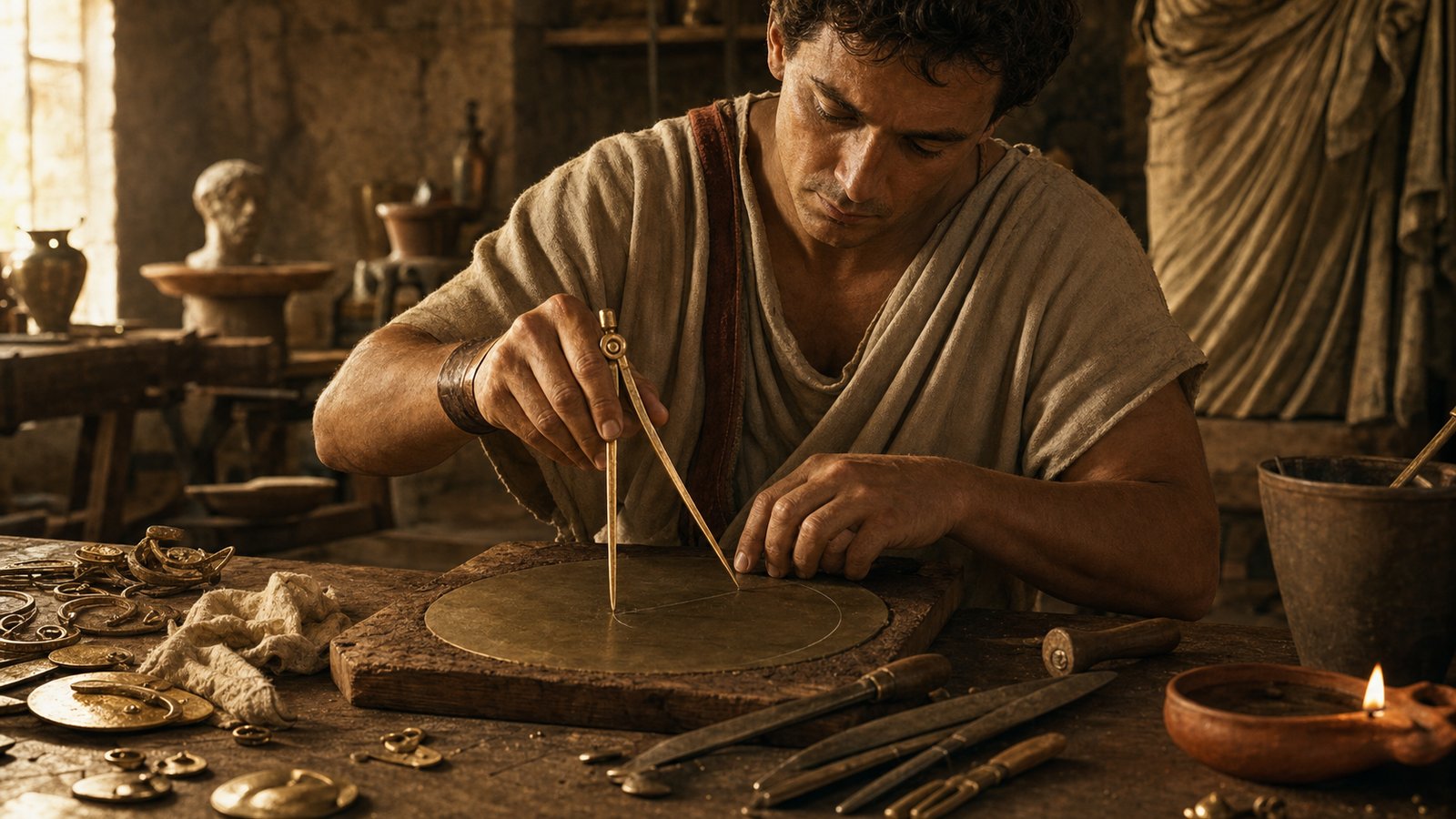
When one tip stayed planted, the other could rotate around it and scribe an arc. The radius was simply the held span. A full turn created a circle; partial turns found intersections or laid out rounded boundaries. The tool converted one stable distance into every point equidistant from a chosen center.
The mini-scene begins with a small sheet or fitting on a bench. The maker presses one point into a center mark, adjusts the opening against a model, then inclines the second point enough to scratch. The pivot turns. A faint curved line appears, and the hand returns to strengthen it without changing the center.
This direct generation of symmetry links naturally to Roman lathes. A lathe made the workpiece rotate against a cutting edge; dividers made a marking point rotate around the workpiece. In both cases, rotation disciplined irregular hand movement by organizing it around a center.
Stepping a Span Turned Repetition into a Test
Dividers could also walk across a line. Set to one interval, the points alternated as the tool stepped from mark to mark. A row of equal divisions emerged without reading a fresh measurement each time. If the final step overshot a boundary, the accumulated error exposed either a poor setting or an unsuitable division.
Repeated spans mattered wherever parts met. Hole spacing, border patterns, circular subdivisions and paired components all benefit when one interval can be imposed more than once. The tool did not guarantee that the chosen interval was correct. It guaranteed that the same choice could confront each repetition.
The archive’s Roman mosaics article shows how many small units built a designed field. Dividers would not place tesserae automatically, yet the broader workshop habit is comparable: repeated local relationships allowed a larger pattern to remain coherent without relying on one uninterrupted gesture.
The Usk Find Preserves Both Capability and Uncertainty
The dividers were excavated in 1970 at the Usk Detention Centre site and were recorded as unstratified. That means the museum can identify the Roman artifact and its construction while remaining cautious about a precise depositional story. The honest boundary matters. An object can demonstrate technology without proving who held it on a particular morning.
At 61 millimetres long, the surviving pair was suited to relatively small spans. It reminds us that Roman precision was not only monumental. A short tool could govern details that had to fit, repeat or turn around a center. Larger dimensions could be built through templates and other instruments, while these points concentrated on work close to the hand.
Two Roman points could carry one distance because the pivot made space persistent. The tool did not need numerals engraved along its arms to make comparison rigorous. It allowed a maker to ask the strongest workshop question—does this match that?—and receive the answer as two simultaneous touches.
Sources & Further Reading
- Museum Wales, “Roman copper alloy dividers”
- The Metropolitan Museum of Art, “Compass or divider, fragment”
- Wikipedia, “Compass (drawing tool)”