
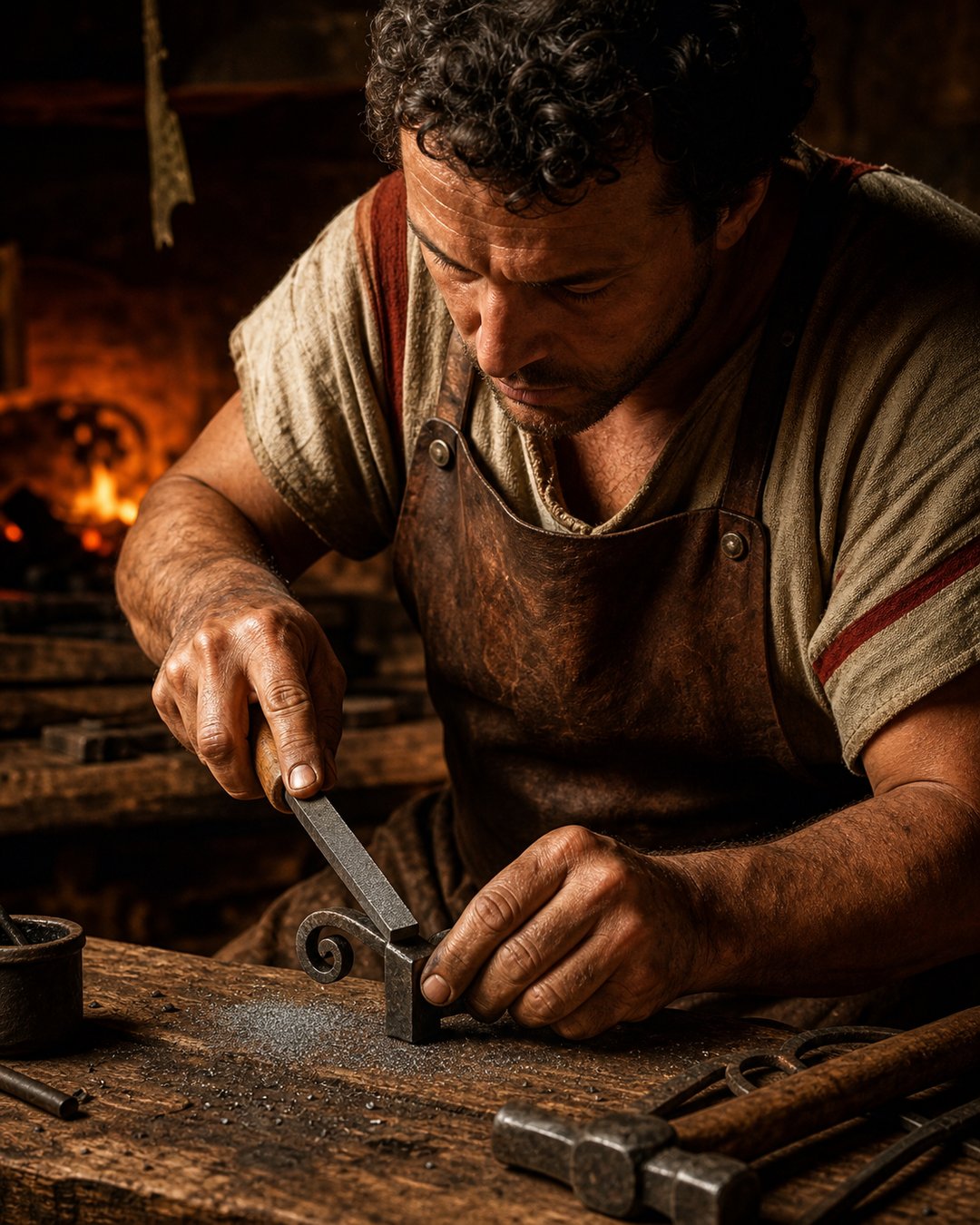
Forging gets the sparks, but fitting decides whether the object works. A Roman smith could hammer a bar close to shape and still find that a joint bound, an edge stood proud or a pin refused its opening. One more heavy blow might bend the part or undo an hour of work. The remaining error was too small for drama and too important to ignore.
A file attacked that problem with many tiny cutting edges. Each stroke removed only a fine amount of material, but the losses accumulated exactly where the craftsperson chose. High spots disappeared first. Burrs surrendered. A square opening could be persuaded toward a square fit without the violence of splitting away a large chip.
Museum Wales preserves a Roman iron file from the Whitton Villa site. It is 115 millimetres long, slightly tapering and square in cross-section, with surviving traces of teeth on all four faces. The object makes precision physical: four modest abrasive surfaces carried on a bar small enough to guide by hand.
Teeth Divided One Cut into Many Small Cuts
A file is a tool for removing fine amounts of material from a workpiece. Its working surfaces carry sharp, generally parallel teeth. Instead of concentrating force into one chisel edge, the file distributes contact across repeated projections. The hand supplies a stroke; the teeth convert it into a sequence of small bites.
That division changes risk. A large cut can cross the intended line before the maker has time to react. Filing approaches the line gradually. The craftsperson can stop, inspect, test the fit and resume. Accuracy grows through alternating removal and comparison rather than through one perfectly judged blow.
The mechanism differs from the archive’s Roman plane. A plane guides one blade to create a controlled shaving, principally in wood. A file presents many teeth and can work edges, corners and hard materials where a broad sole or continuous shaving would be impractical.
Four Faces Let One Small Bar Address Several Surfaces
The Whitton file has a square cross-section, and Museum Wales notes slight remains of teeth on all four faces. A square form gives the user flat working surfaces and defined corners. The same tool can bear against a broad face, enter a rectangular space or concentrate contact nearer an edge as orientation changes.
The bar tapers slightly. Taper affects where the tool can enter and how much surface engages. A narrower end can begin in a confined opening before a broader portion follows. The maker reads both resistance and the marks left behind, turning or shifting the file so removal remains where it is needed.
Direction mattered because file teeth do not remove material equally under every motion. A guided working stroke and lighter return protected both the surface and the maker’s control. The exact technique varied with tooth form, but repeated inspection mattered more than speed when only a narrow allowance remained.
Waste itself offered evidence. Bright filings showed that contact was occurring, while the scratch pattern revealed whether the tool reached the intended region. Cleaning the surface between trials prevented loose particles from disguising a high spot or scoring an area already brought to size.
This was not careless scraping. Holding a consistent angle determined whether a face became flat or rounded. Pressure had to remain controlled across the stroke. If one end dug in repeatedly, the file could create a hollow instead of removing a high spot. The tool magnified steady hands as effectively as it magnified small teeth.
The Tang Put the Cutting Bar Behind a Safer Grip
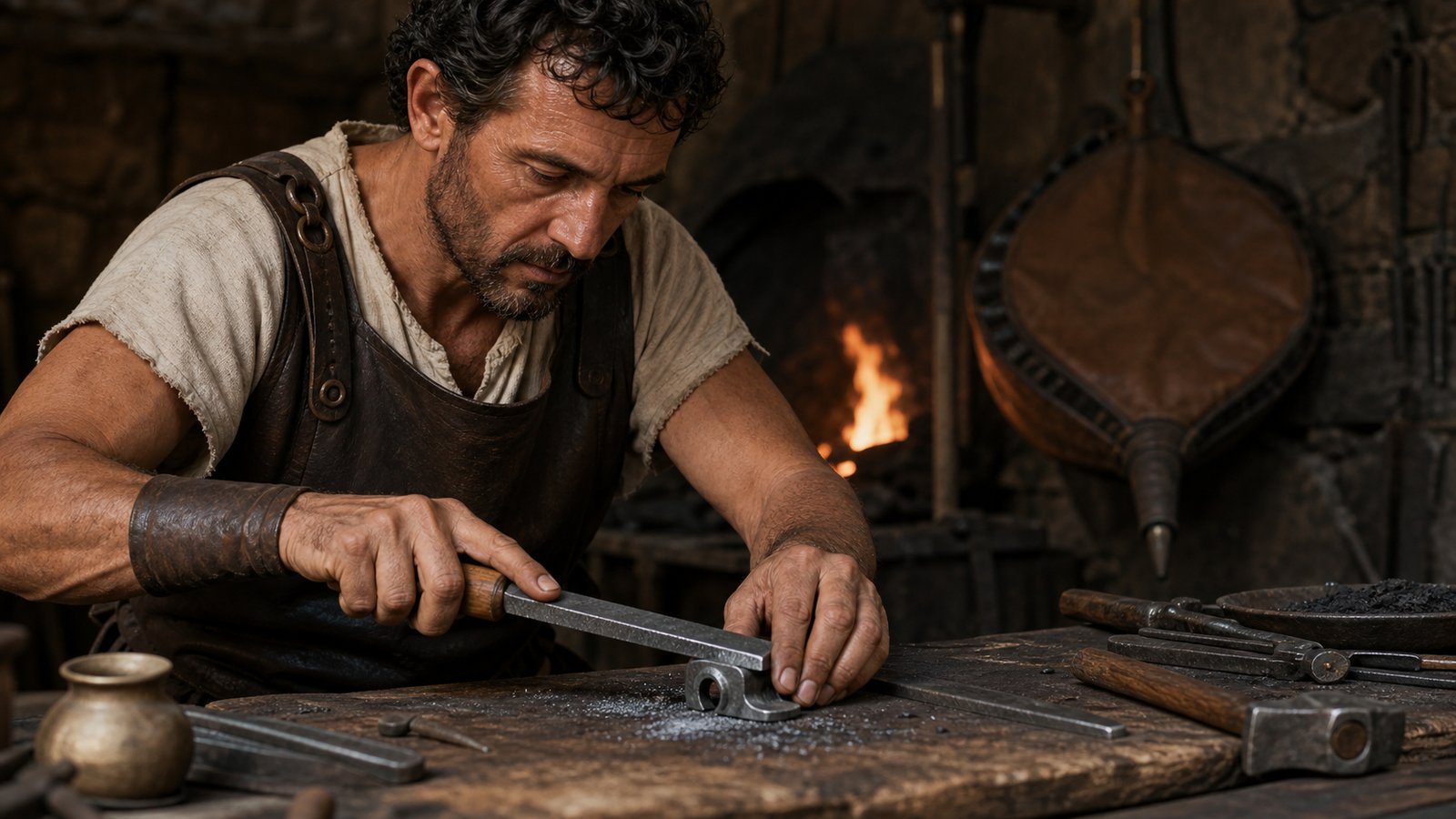
Hand files commonly narrow into a pointed tang at one end so a handle can be fitted. On the Whitton example, slight notches on all four edges near one end probably demarcate blade from tang. That boundary separates the toothed working length from the portion intended to transmit force from the hand.
A handle gives leverage and keeps the palm away from the narrow iron end. It also helps align the push with the bar. Without a secure grip, the hand may twist as resistance changes, rounding a corner or driving skin onto the tang. The missing organic handle is therefore part of the original operating system even when only iron survives.
The distinction between blade and tang also organized manufacture. Teeth belonged on the region meant to contact work; the handle connection needed a different surface and shape. One iron object carried cutting geometry, structural spine and interface with wood, each zone prepared for a separate task.
Fitting Happened in a Rhythm of Stroke, Dust and Trial
Picture a small iron fitting that almost enters a prepared slot. Soot-dark scale and a bright high spot mark the obstruction. The craftsperson braces the piece, pushes the file across that point, lifts or eases it for the return and repeats. Fine particles collect below while parallel scratches replace the proud surface.
After several strokes, the filing stops. The fitting is brushed clean and offered to the slot. It enters farther but catches at one corner. A rub mark identifies the next target. The maker returns to the file, this time changing its angle rather than attacking the entire edge. Progress comes from the evidence produced by each trial.
This mini-scene places the file downstream from Roman forge bellows. Bellows help create heat for shaping iron; filing begins when the object is cool enough to measure and close enough to form that heat and hammering would be excessive. The quiet bench preserves the value created at the loud hearth.
A File Could Correct Castings, Tools and Assemblies
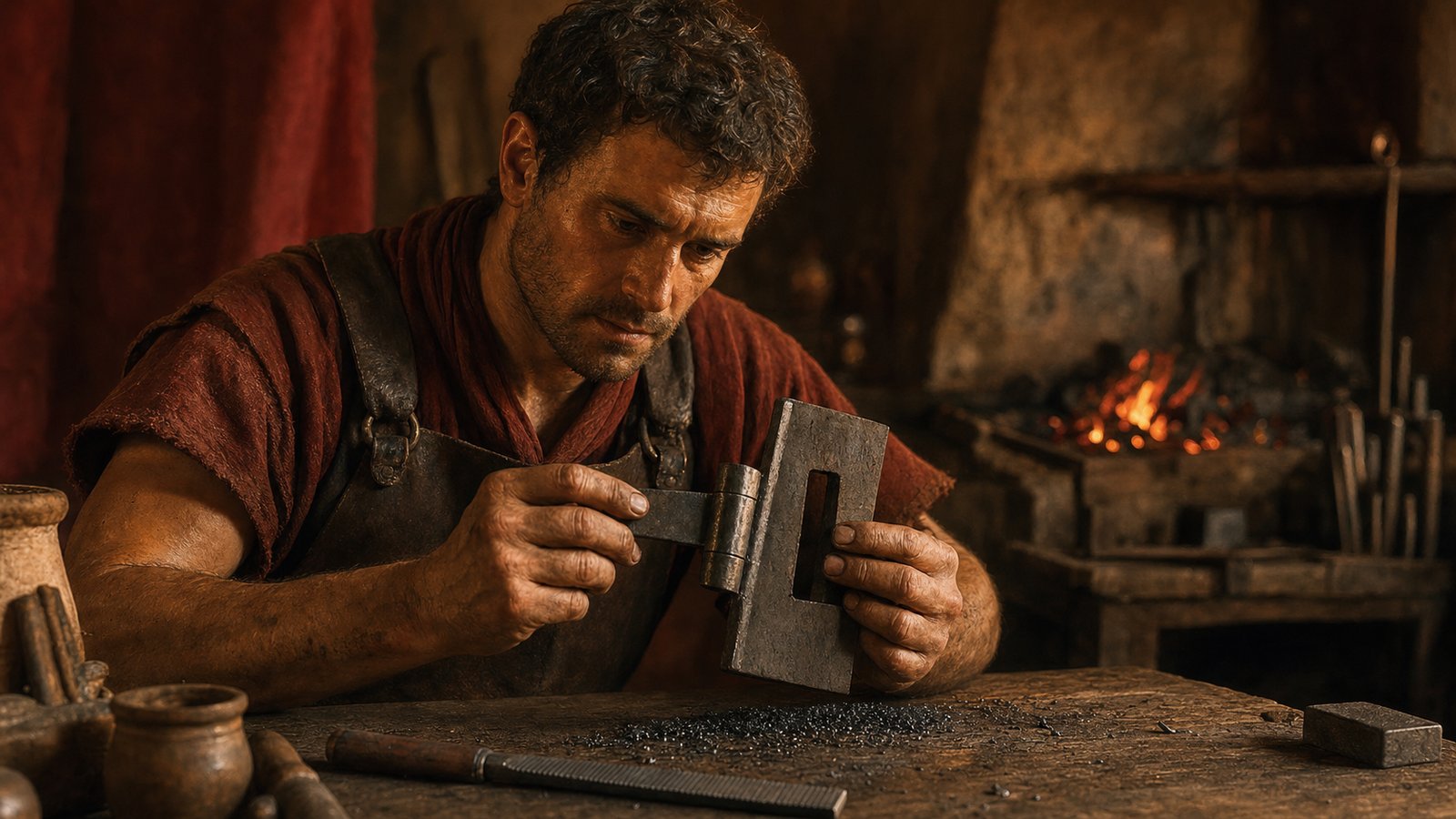
The file’s general principle suited many materials and trades, including metalworking and woodworking. In a Roman workshop, its value lay less in one named product than in the recurring need to remove a little. Cast edges could carry seams, forged parts could retain scale, and drilled openings could need local correction before assembly.
The archive’s Roman lost-wax casting article ends when bronze has replaced a wax model, but a casting still has gates, seams and surfaces to finish. A file could participate in that later transition from successfully cast object to object ready to fit, move or be seen closely.
Tools themselves also needed maintenance. A damaged edge might require smoothing before resharpening; a replacement handle or fitting had to meet an existing tang; a hinge, buckle or weapon component could demand clearance without looseness. The file served the last fraction of distance between “made” and “works.”
The Whitton Artifact Records Use More Honestly Than Perfection
Museum Wales records the file from excavations at Whitton Villa undertaken between 1965 and 1970, while noting that the object was unstratified. It was cut at one end, its teeth survive only slightly, and its original handle is gone. None of that prevents the artifact from preserving square section, taper, tang boundary and working faces.
The worn condition is appropriate evidence for a consumable cutting tool. Teeth become blunt, iron corrodes, handles decay and bars can be shortened or broken. A pristine modern diagram explains the ideal form; the archaeological object shows a tool after time has removed some of the very details that once removed material from other things.
The Roman file won by taking almost nothing at each stroke. That modest action protected work already invested in forging, casting, drilling and assembly. Precision was not a final flash of genius. It was the willingness to remove one high spot, test again and stop before the correction became a new mistake.
Sources & Further Reading
- Museum Wales, “Roman iron file”
- Wikipedia, “File (tool)”
- Encyclopaedia Britannica, “File”