
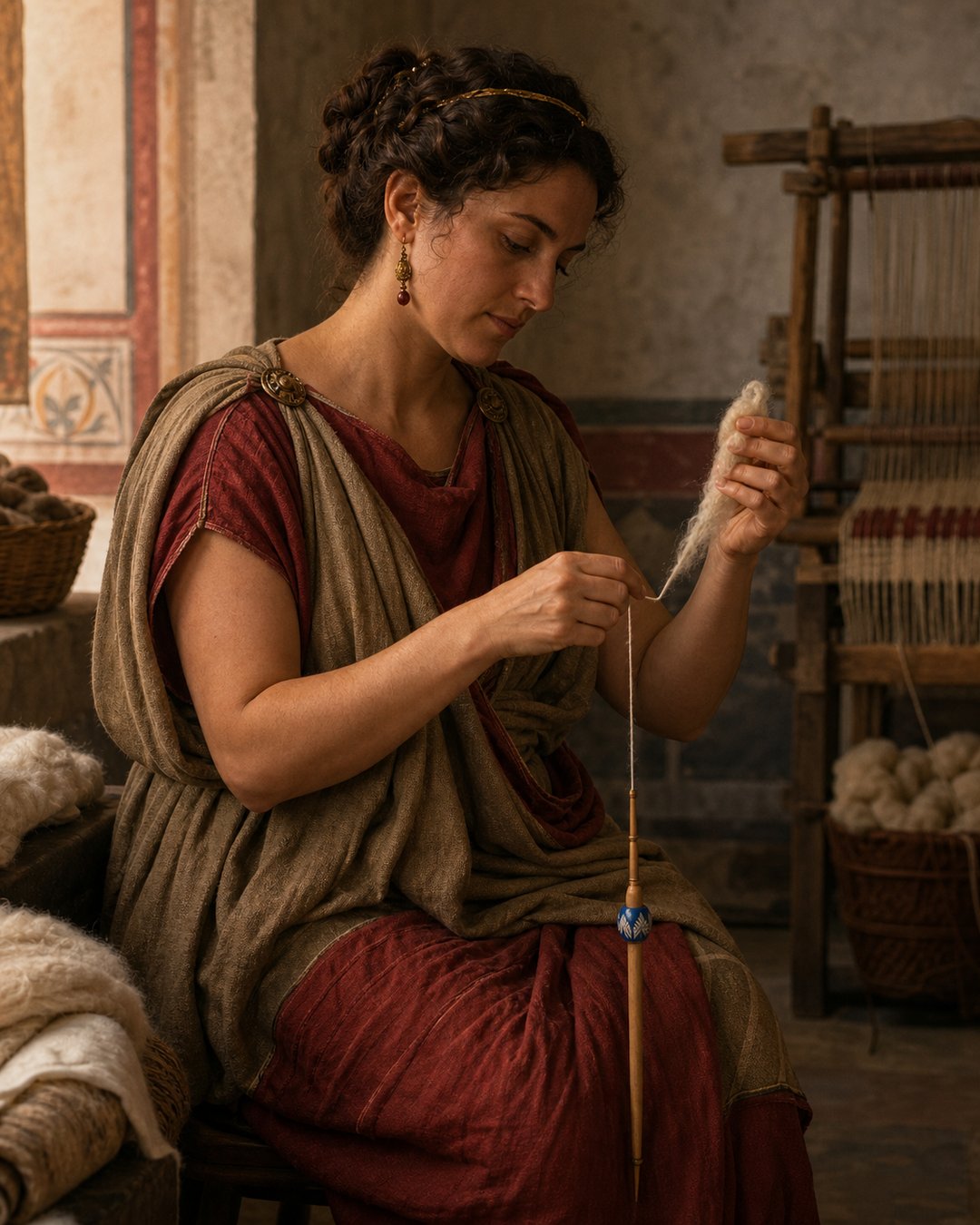
A Roman spinner did not turn a heap of wool into thread by pulling it thinner. Untwisted fibers can slide apart almost as easily as they can be drawn out. The decisive change came when the emerging strand began to rotate. Twist made neighboring fibers press and wind against one another, converting a loose cloud into something that could be wound, carried and placed under tension.
The tool that sustained that rotation was small enough to disappear in a palm. A straight spindle passed through a perforated weight called a whorl. The spinner set the shaft turning, let it hang, and used the interval of continued motion to draw out more fiber. One gesture became several useful seconds because the rotating mass resisted an immediate loss of speed.
A Roman glass whorl in the Metropolitan Museum dates to the first or second century CE. It is only 1 centimetre high and 2.2 centimetres wide, yet it was made in translucent cobalt blue glass with an opaque white feathered trail. The object joins mechanics and care: a practical rotating weight could also be an ornament worth shaping, coloring and keeping.
Loose Fiber Needed Twist Before It Could Behave Like Thread
A spindle is a straight spike used to spin and twist fibers such as wool, flax and hemp into yarn. The spinner first prepares a supply of fibers, then draws a narrow group away from it. Drawing controls thickness, but twist supplies cohesion. As the spindle rotates, the turn travels upward into the drafted section and binds overlapping fibers into a strand.
The process depends on a boundary. Twist must not run unchecked into the whole fiber supply, or drafting becomes difficult; neither can the newly drawn section remain untwisted, or it may separate under the spindle’s weight. Fingers pinch, release and draft in a rhythm that decides where rotation is allowed to enter.
This is the stage before thread reaches a Roman loom’s controlled tension. A loom organizes many threads, but each thread first had to survive being stretched between beams and beaten into cloth. The spindle made that tensile material one short length at a time.
The Whorl Stored Motion in a Small Disc
A spindle can be weighted near its top, middle or bottom. The added mass changes how it turns and helps the shaft continue rotating after the hand’s initial impulse. A whorl does not create energy. It stores more of the gesture as rotational motion, buying the spinner time to draft before friction and air resistance bring the spindle to rest.
That persistence is useful only when controlled. A very light spindle may accelerate easily but lose speed quickly. A heavier arrangement can turn longer yet pull harder on a weak strand. The spinner therefore works with fiber length, spindle weight, whorl position and desired yarn thickness as one system rather than treating the disc as decoration.
The Met whorl makes compactness measurable. Its overall dimensions are 3/8 by 7/8 inch, or 1 by 2.2 centimetres. A vertical hole passes through the domed body and is larger at the bottom. That hole is the mechanical center: the decorated glass mattered as a whorl because a shaft could pass through it and carry its mass into rotation.
A Blue Glass Object Preserved a Roman Spinner’s Scale
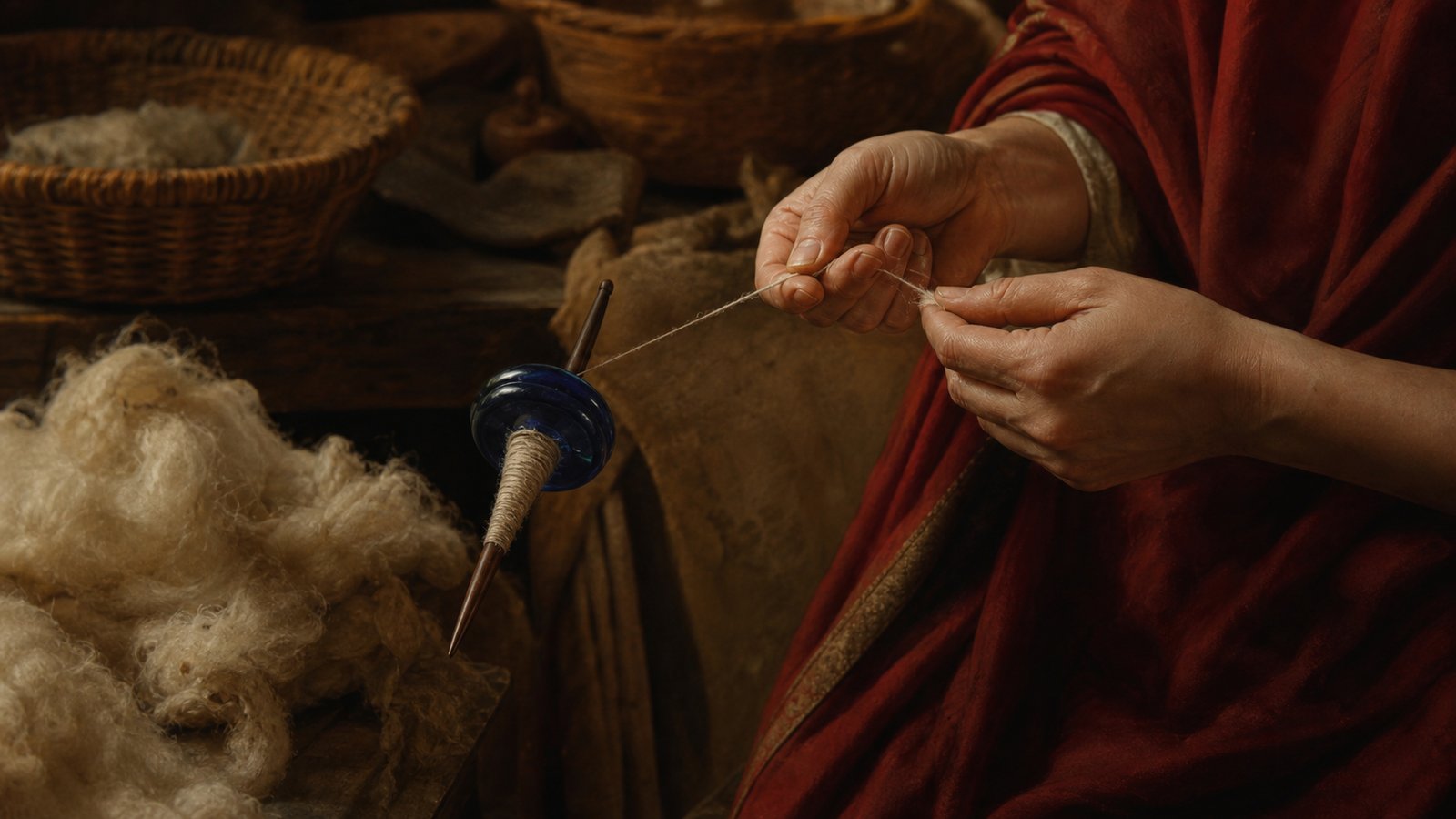
The museum dates the whorl to the early to middle Imperial period, about the first to second century CE, and identifies its culture as Roman. It is translucent cobalt blue with an opaque white trail. The trail was wound in a spiral around a rod and tooled with seven unevenly spaced downward strokes to create a feather pattern.
The whorl survives intact, though its lower edge and bottom have chips. Dulling, pitting and faint iridescent weathering mark the glass. Those conditions matter because they return the object from an ideal diagram to use and burial. Its central opening, compact diameter and worn edge belonged to something handled, fitted and repeatedly set in motion.
Imagine the object at the bottom of a suspended spindle. Blue glass flashes, then blurs as the shaft turns. The spinner’s upper fingers draw wool while the lower hand is briefly free. Speed declines; the shaft begins to wobble; the strand is pinched, wound onto the spindle and started again. Production advances through many small decelerations rather than one uninterrupted spin.
Drafting and Winding Divided One Cycle into Distinct Jobs
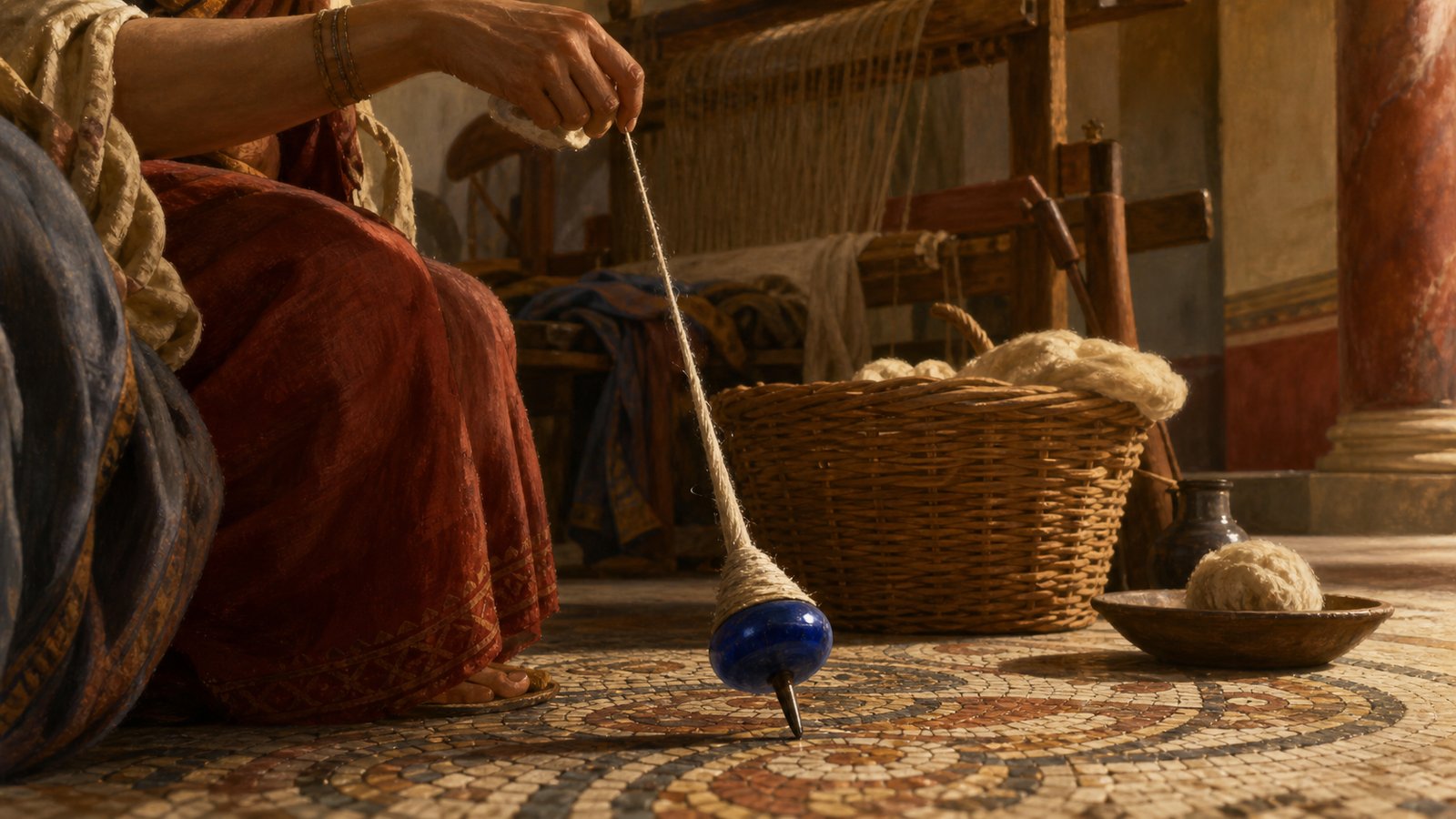
New twist cannot continue forever down an ever-lengthening strand while the spindle approaches the floor. The spinner periodically stops, winds completed yarn around the shaft and begins another length. The spindle therefore serves both as twisting instrument and temporary storage for the thread it has made.
The sequence rewards consistency. Too much drafting before enough twist leaves a weak, uneven place. Too much twist in a short section creates hardness or kinks. Winding too loosely allows finished yarn to slip; winding carelessly can interfere with the next rotation. Skill appears in transitions that an excavated whorl cannot perform by itself.
This repetitive control resembles the measured intervals in Roman workshop dividers. Dividers preserve one span; the spindle preserves motion long enough to establish one length of yarn. Both tools let a fleeting hand decision persist beyond the instant of contact.
Material Changed More Than the Whorl’s Appearance
Whorls could be made in many forms and materials, while spindles themselves were commonly wood. A dense glass disc can place useful weight in a narrow diameter. Its smooth perforation and balanced shape affect how steadily the shaft rotates. An uneven mass would encourage wobble, wasting motion and disturbing the tension on the forming strand.
The Met object’s domed top and flat bottom show deliberate geometry. Its seven feathering strokes are unevenly spaced, but decorative irregularity is not the same as destructive imbalance. The maker could decorate the rotating body while retaining a central hole and compact circular mass. Beauty occupied the same component that governed momentum.
Glass also makes the economic story visible without proving the owner’s identity. The record does not name the spinner who used it or say whether it was made for household work, specialist production or display. What it safely shows is that Roman material culture could invest a humble textile tool with cobalt color and worked white trails.
Thread Was Manufactured Time, Stored on a Shaft
Finished cloth encourages the eye to skip backward over yarn. Yet every woven surface depends on an enormous accumulation of drafted and twisted lengths. The article on Roman shears follows cutting after fiber and cloth had gained form. The whorl occupies the earlier moment when loose material first became continuous.
The surviving disc also restores movement to museum glass. Its present stillness is misleading. The hole, weight and circular body were designed for repetition: accelerate, suspend, draft, slow, wind and begin again. Chips could change balance; a loose fit could let the shaft slip; a broken spindle could leave the durable whorl awaiting another wooden partner.
Roman textile production was not powered by the whorl alone, and the object should not romanticize the labor. Hands prepared fiber, maintained tension and repeated the cycle for hours. Its achievement was narrower and more important: it made each flick last. In that extended rotation, fibers had time to become thread before gravity pulled the unfinished strand apart.
Sources & Further Reading
- The Metropolitan Museum of Art, “Glass spindle whorl”
- Wikipedia, “Spindle (textiles)”