
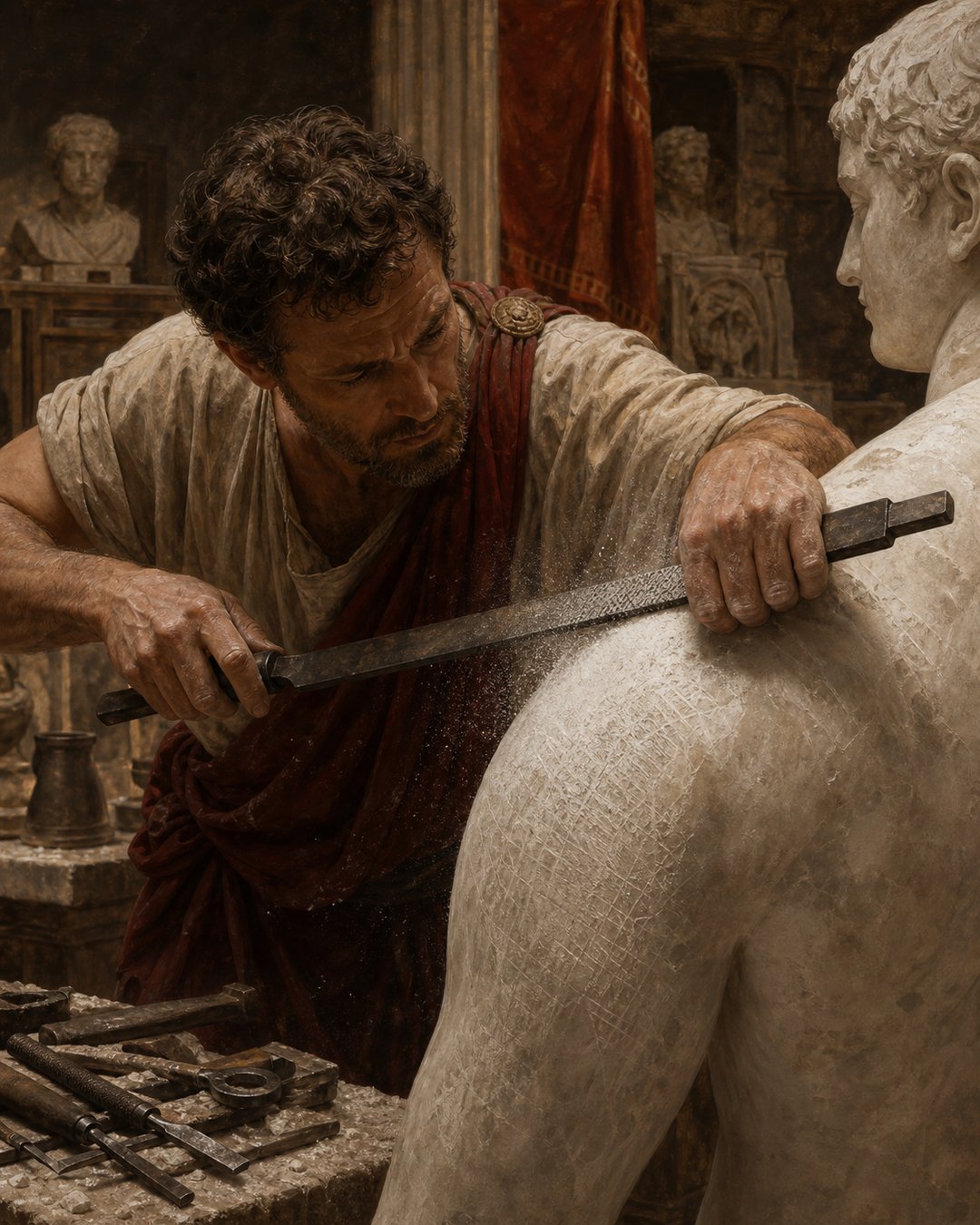
A Roman marble carver could make a surface smoother by covering it with more marks. The rasp did not polish by erasing every trace at once. Its flattened ends carried fields of sharp points, and every rubbing stroke laid fine scratches across the stone. Later passes crossed and overlapped them until the rougher evidence of the chisel lost its authority.
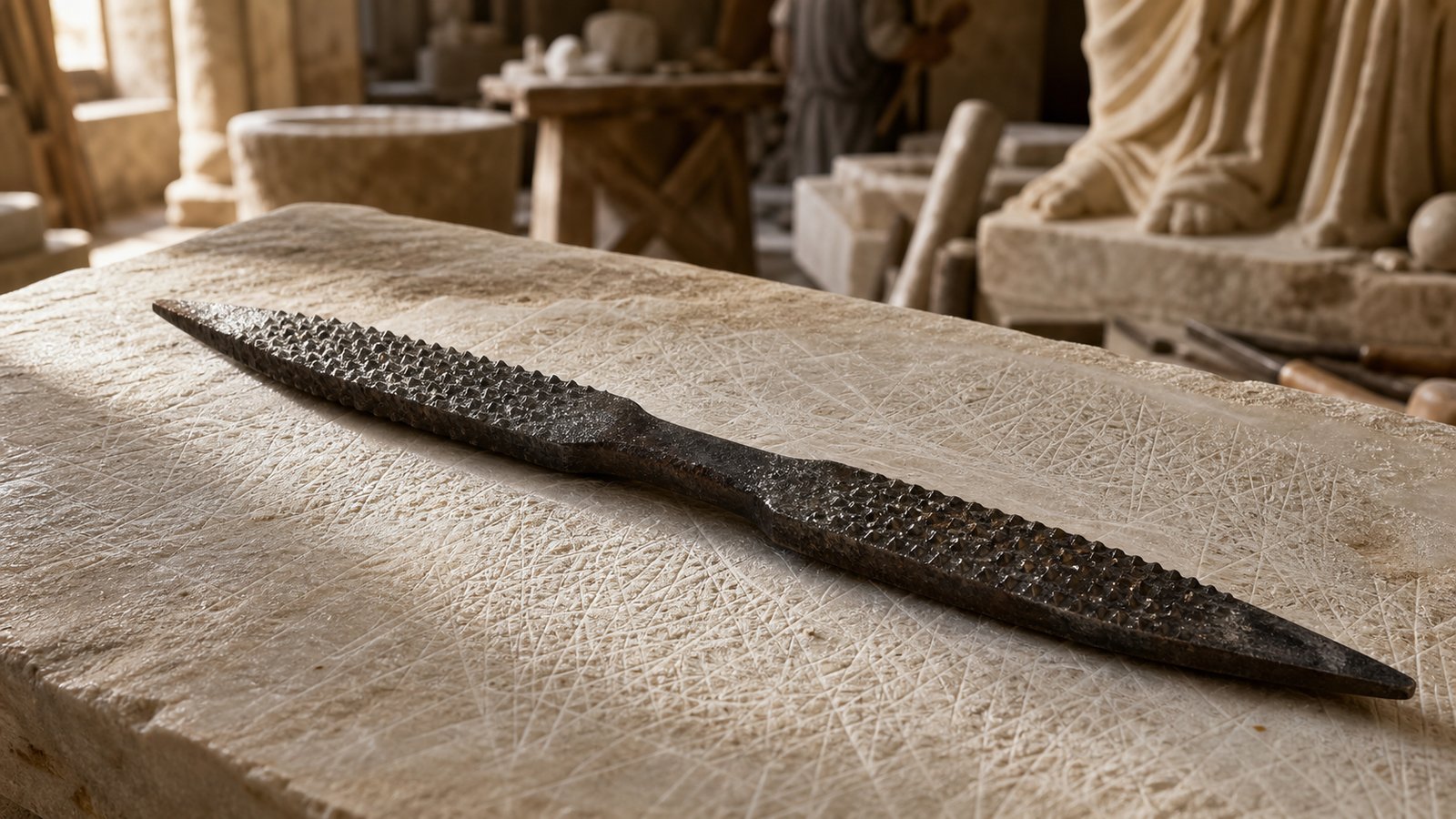
This was a double-ended tool, twelve to forty centimetres long, with a shaft in the middle. Either end might be squared, rounded or pointed, flat or curved. Point density varied according to the fineness sought. One implement could therefore reach a broad plane, turn around a rounded limb or enter a confined transition without pretending those surfaces were geometrically alike.
The rasp belonged mainly to marble. Granite resisted it; softer stones could be smoothed more easily with scrapers. Its useful range sat between cutting and polish, where the emerging form was already recognizable but still carried ridges, facets and corners left by sharper tools.
Twelve to Forty Centimetres Joined Two Working Ends
Art of Making describes rasps ranging from twelve to forty centimetres. A central shaft gave the hand a place to hold, while both flattened ends became working surfaces covered in sharp points. The tool was not a file with only one useful direction; it offered two choices without being put down.
The length range suggests different reaches and leverage rather than one mandatory workshop size. A short rasp could stay near a small detail. A longer one could bridge more of a broad curve and give both hands room when pressure or stability required it. The source does not assign exact sizes to exact tasks, so that boundary remains cautious.
Double-ended construction also economized the tool roll. Ends could differ in outline, curvature or tooth density. Turning the shaft around changed the contact immediately. A worker moving from a rounded shoulder to a narrow fold needed another surface, not necessarily another trip across the workshop.
This portability resembles the Roman file’s patient correction of metal, but the materials and evidence differ. Here the secure source concerns stone, especially marble, and a double-ended pointed surface whose scratches often remain legible on ancient carving.
Squared, Rounded and Pointed Ends Followed Different Forms
Rasp ends could be squared, rounded or pointed. They could also be flat or curved. These paired choices matter because a statue rarely offers one continuous plane. Drapery rises, anatomy rounds, hair opens into channels and architectural details move between straight boundaries and recessed transitions.
A squared flat end can spread contact across an accessible surface. A rounded end can follow convex or concave movement without letting a sharp corner dig first. A pointed end narrows access where neighboring stone must remain untouched. The source records the shapes; their geometric consequences explain their flexibility without inventing an exclusive ancient recipe.
Curvature also changes how pressure is distributed. On a flat end, several points may meet together. On a strongly curved end, contact begins in a smaller zone and moves as the wrist rolls. The carver learns which part is active from resistance, scratch pattern and the light crossing the stone.
The same problem appears earlier in the roundel’s curved cutting edge. The roundel is struck and removes discrete chips. The rasp is rubbed and replaces those larger cuts with networks of smaller scratches. Similar access geometry serves a different stage and motion.
Point Density Set the Fineness of the Finish
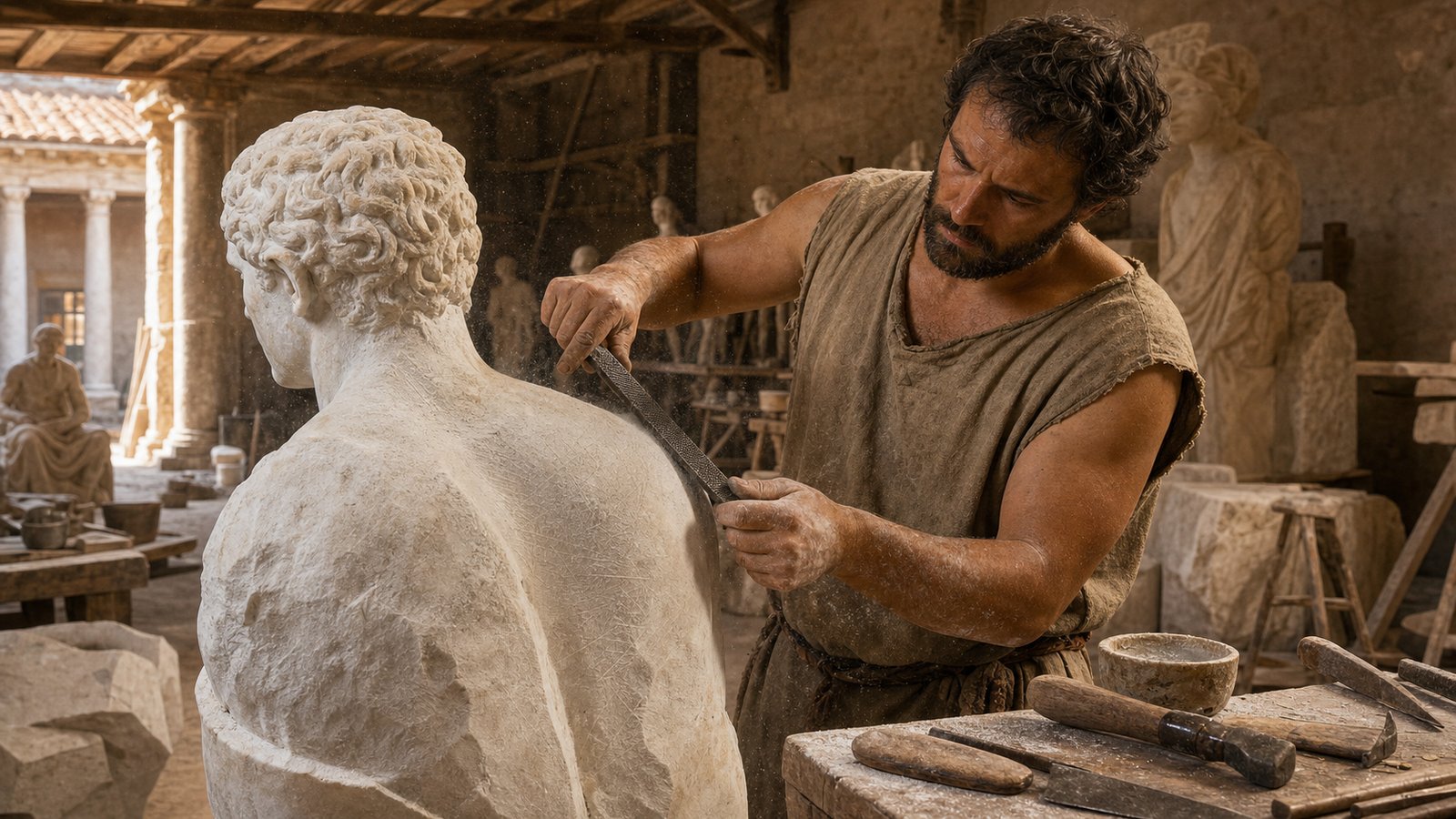
Not every rasp carried points at the same density. Art of Making links density to the fineness of the finish sought. Widely spaced aggressive points can bite more distinctly; a denser field divides contact among more small projections, producing a finer texture when other conditions remain comparable.
This makes the rasp a staged family rather than a single final surface. A carver can begin after the flat chisel or roundel with a tool able to reduce their ridges, then move toward finer contact. Each pass prepares a surface that the next can read more evenly.
Density does not work alone. Pressure, direction, stone, clogging and end shape all affect the mark. The surviving scratches cannot yield every workshop decision with certainty. They can, however, show that smoothing was a cumulative mechanical process, not a mysterious leap from chiselled block to luminous skin.
The principle differs from loose abrasive grains building polish. Abrasive particles can roll, fracture and move under a pad. Rasp points remain fixed to metal, giving the hand a repeatable field of tiny cutting contacts until another tool takes over.
Rubbing Replaced the Blow with Continuous Pressure
The rasp was rubbed across stone rather than struck. That change removed the separate hammer from the action and let the holding hand supply direction, pressure and repetition directly. The worker felt high spots through the shaft as the points dragged over uneven ground.
A long stroke can cross several ridges and gradually lower their peaks. A short stroke can stay beside a delicate boundary. Direction is reversible, and repeated passes can approach from more than one angle. The rasp therefore works by accumulation: no single scratch needs to carry the ambition of a chisel blow.
Continuous contact also creates friction and debris. Fine stone powder gathers among the points and on the surface. The source does not specify an ancient cleaning method, so the article should not assign one. What can be said is that clogged contact and hidden dust would change how clearly the points reached stone.
The physical scene is quieter than rough quarrying but not effortless. Fingers hold a metal shaft through repeated resistance; shoulders guide overlapping arcs; reflected light reveals whether a ridge remains. Smoothing transfers drama from impact to endurance, where small corrections become convincing only after many returns.
Marble Responded Where Granite Barely Did
Rasps were mainly used by marble carvers. Art of Making says they would have little effect on granite. The contrast marks a material limit: a field of small hand-driven points can cut and scratch marble effectively, while very hard granite resists the same rubbing action.
That limit protects the article from treating “Roman stonework” as one technique. Granite point chisels were driven near ninety degrees to shatter a hard surface; a rasp approaches marble through distributed sliding contact. Tool choice follows the failure behavior of the material, not only the shape imagined by the carver.
At the softer end, scrapers were easier to use for smoothing soft stones. The rasp therefore occupied a middle territory where marble accepted its teeth but still rewarded their controlled pattern. It was not universally superior; it was efficient within a particular relationship among hardness, point and hand pressure.
Material also affected preservation of marks. A surface later polished, painted, weathered or recut may conceal its rasping. Where scratches survive, they record both the tool and the decision not—or not yet—to erase them. An unfinished recess can preserve workshop sequence more honestly than a celebrated outer face.
Crisscross Scratches Turned Rough Form into Continuous Skin
Rasp marks consist of fine scratches that crisscross the stone and often overlap. One direction lowers certain projections and leaves parallel evidence; a crossing direction attacks the remaining relief from another angle. The network makes isolated grooves cooperate in leveling the larger surface.
Overlap is essential. If strokes merely sat beside one another, ridges could survive between their paths. Crossing lets the worker test whether a high point belongs to the stone’s intended form or only to the previous tool. Light moving across the scratches reveals discontinuities that fingertips also detect.
The rasp could also perform fine shaping on selected details. This does not turn every scratch into finishing. It means a shaped end could refine an edge or transition while smoothing it, gently changing volume without the abrupt local loss caused by a hammer-driven chisel.
A Roman rasp made marble smoother by first making its surface busier. Twelve to forty centimetres of double-ended iron carried different shapes and point densities around complex forms. The finished statue may hide that labor, but surviving crosshatching preserves the method: continuity emerged from thousands of tiny intersecting cuts.
Sources & Further Reading
- Art of Making, “Tool: Rasp”
- Wikipedia, “Rasp”