
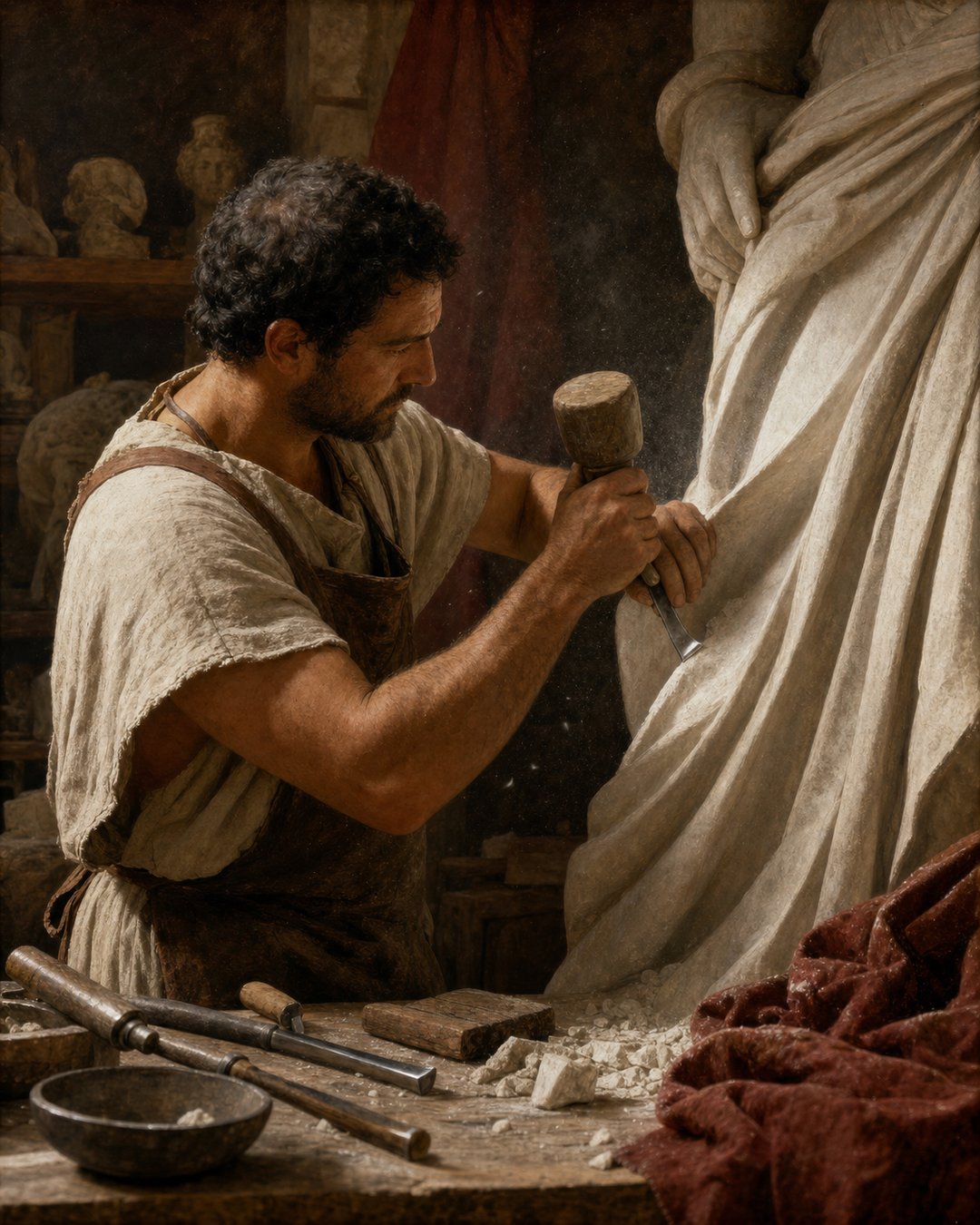
A flat chisel carries two corners into every cut. On an open surface they help define a clean edge; inside a hollow, either corner can bite before the centre arrives. Roman stone carvers had another option. The roundel replaced the straight cutting edge with a curve, from an obvious semicircle to one so slight that it nearly resembled a flat chisel.
Art of Making describes a metal hand tool fifteen to twenty-five centimetres long and one to two centimetres in diameter, struck by hammer or wooden mallet. Its absence of catching corners made it useful in delicate carving, and its curved profile naturally suited recesses.
The roundel could rough, smooth and texture. It was common on softer stones, used on marble, and almost never used on granite. Those choices reveal a tool defined not only by shape but by the spaces and materials in which that shape could move safely.
A Curved Edge Changed Which Part Touched First
The roundel shares the basic body of a flat chisel: a hand-held metal shaft receives blows at one end and presents a cutting edge at the other. The decisive change is that the edge bows forward. Contact begins near the curve’s leading area rather than across a straight line with two corners.
Art of Making gives a broad range of curvature. Some roundels approach a semicircle, while others show only a slight arc. That variation lets a workshop choose how narrowly the edge should enter a hollow and how broadly it should spread each controlled removal.
There is consequently a fine boundary between a roundel and a flat chisel whose corners have merely been rounded. Ancient tool categories do not always obey modern labels. What matters at the stone is how much corner has disappeared and what trace the remaining curve leaves.
The distinction becomes clearer beside the Roman flat chisel. A straight edge favors planes and crisp continuous cuts. The roundel sacrifices that straight registration so it can meet curved ground without letting an outer corner dictate the contact.
Fifteen to Twenty-Five Centimetres Kept the Curve in the Hand
The recorded shaft length of fifteen to twenty-five centimetres places the roundel close to the work. A carver could orient it with one hand while a metal hammer or wooden mallet supplied energy with the other. The short system supported repeated changes of direction around complex relief.
A diameter of one to two centimetres gave the shaft enough body to transmit blows while remaining maneuverable. The cutting curve still needed support behind it; too thin a neck would flex or fail, while excessive bulk would stop the tool entering the very recess it was chosen to address.
Hammer and mallet offered different striking relationships. The source records both without assigning a single universal sequence. Whatever the striker, the holding hand had to keep the edge aligned so the useful central curve entered before either shoulder rubbed the neighboring stone.
Control came from small corrections between impacts. A roundel does not follow a curve automatically. The carver rotates, tilts and advances it, using the previous mark to judge whether the next blow should deepen the hollow, widen it or stop short of a fragile ridge.
No Corners Meant Fewer Accidental Catches
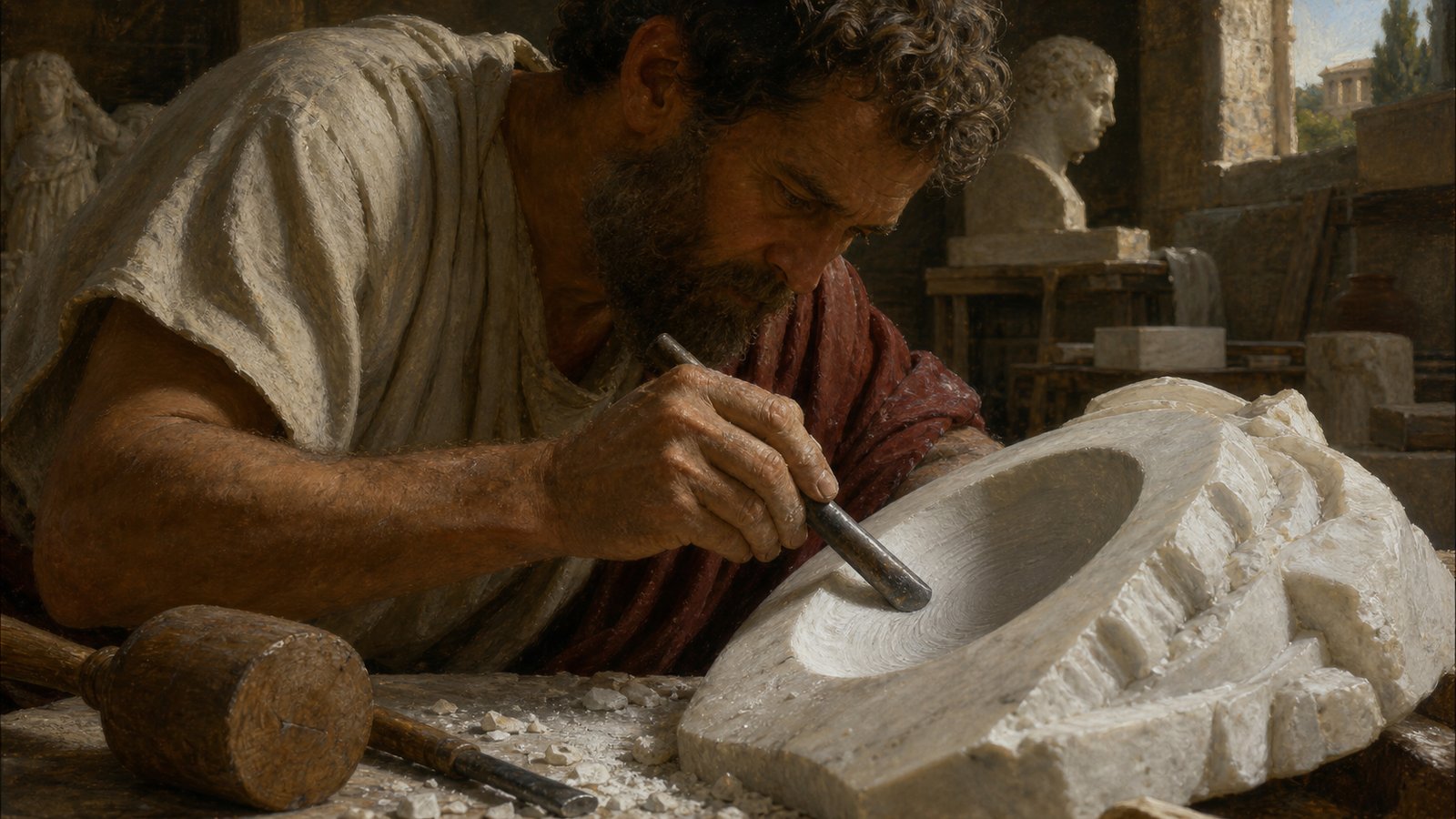
Art of Making emphasizes that the roundel is well suited to delicate areas because it has no corners that might catch. A flat corner can encounter a projecting fold or edge while the intended centre of the chisel is still correctly placed. The result may be a chip beyond the planned cut.
The curved edge narrows that danger. Contact changes progressively across the tool rather than beginning suddenly at an outer point. The carver can work beside raised detail with a smaller chance that the chisel’s extremity hooks material that was meant to remain.
This is risk management, not immunity. A heavy blow, poor angle or blunt edge can still bruise or fracture stone. The roundel reduces one specific failure mode—the catching corner—while leaving the operator responsible for force, support and grain.
Delicate work often happens late, when earlier labor has already accumulated in the object. A small mistake near a finished fold can destroy many hours. Choosing a corner-free edge therefore protects not just one fragment of marble but the value already invested in surrounding surfaces.
Hollows Welcomed an Edge That Matched Their Curves
The roundel’s shape fits concave forms. Inside a hollow, a straight edge tends to bridge the curve: its ends touch high while its centre cannot reach low, or one end digs as the tool is tilted. A rounded edge can enter more nearly along the local profile.
This mattered in drapery, hair, foliage, vessel interiors and recessed architectural ornament. The source does not claim one exclusive subject. It identifies a geometry: where stone turns inward, the tool should avoid fighting that turn with unnecessary corners.
The roundel complements Roman drilling. A drill opens depth through rotation and can establish a dark recess quickly. The roundel can then travel along and shape the walls of a hollow, replacing a circular entry with a controlled flowing channel.
As the cavity develops, visibility falls. Dust collects in the low point and shadows conceal the edge. Brushing, changing light and reading the tool’s resistance become part of the process. The curved mark offers tactile evidence when the eye cannot see the whole contact.
Thirty-Five to Sixty Degrees Directed the Cut Sideways
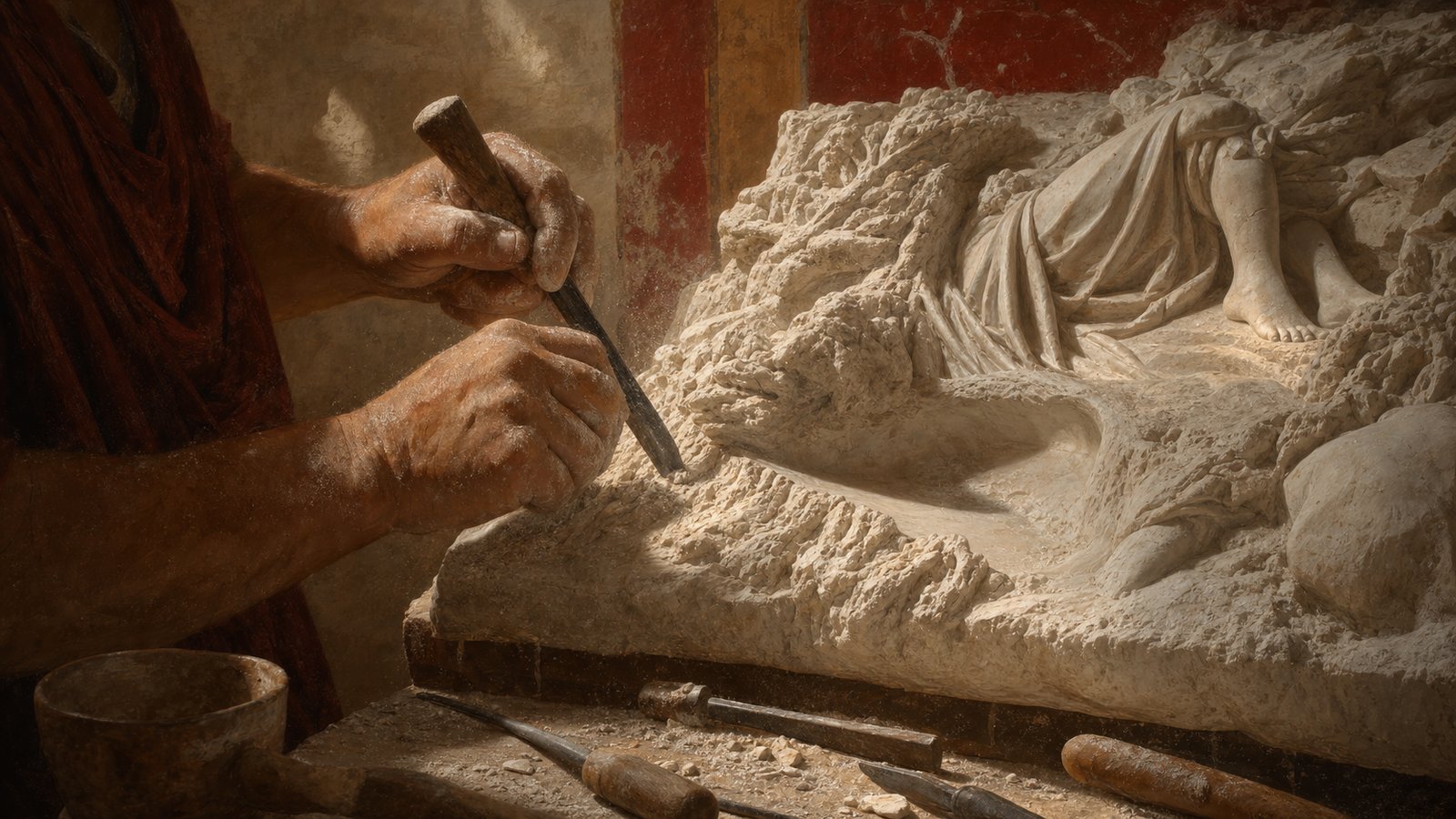
Like flat and tooth chisels, the roundel was usually held at roughly thirty-five to sixty degrees to the stone. The oblique posture turns the blow into a cutting action that travels across the surface rather than a purely vertical punch.
Angle affects depth and length. Near the steeper end, the curve can enter more firmly; shallower placement encourages a longer, lighter removal. The carver adjusts within the range according to stone softness, edge sharpness, desired texture and proximity to vulnerable detail.
The curved edge also changes the footprint as angle changes. Tilting can make only a narrow portion meet first, useful in a confined recess, or bring more of the arc into work for smoothing a broader hollow. One tool contains several practical widths depending on orientation.
Repeated strokes must overlap without building unintended scallops. If each blow ends in a deep isolated scoop, the next finishing stage inherits a corrugated surface. A controlled rhythm makes the individual curved bites cooperate into one continuous form.
Soft Stone Accepted the Roundel More Readily Than Granite
Art of Making says roundels were often used on marble and were very common on softer stone, but almost never on granite. The distribution reflects contact mechanics. A curved edge must bite and travel; very hard granite can resist that action and punish the edge or simply make another tool more effective.
The roundel could serve rough and smooth work. On soft stone, broader curved cuts remove early mass, while lighter overlapping passes refine the hollow. Tool identity does not fix one stage; force, angle and edge condition determine whether a blow roughs or finishes.
Carvers sometimes used it for surface texture, especially on natural forms such as trees or rocks. A sequence of curved traces can imitate irregular bark or broken ground more convincingly than a polished plane. Here the mark is not erased evidence but part of the intended visual surface.
The roundel solved a quiet problem: how to remove stone next to stone that must stay. Its fifteen-to-twenty-five-centimetre shaft, variable curve and oblique working angle gave Roman carvers a way to enter hollows without taking flat corners with them. What looks like a softened edge was a precise choice about access.
Sources & Further Reading
- Art of Making, “Tool: Roundel”
- Wikipedia, “Chisel”