
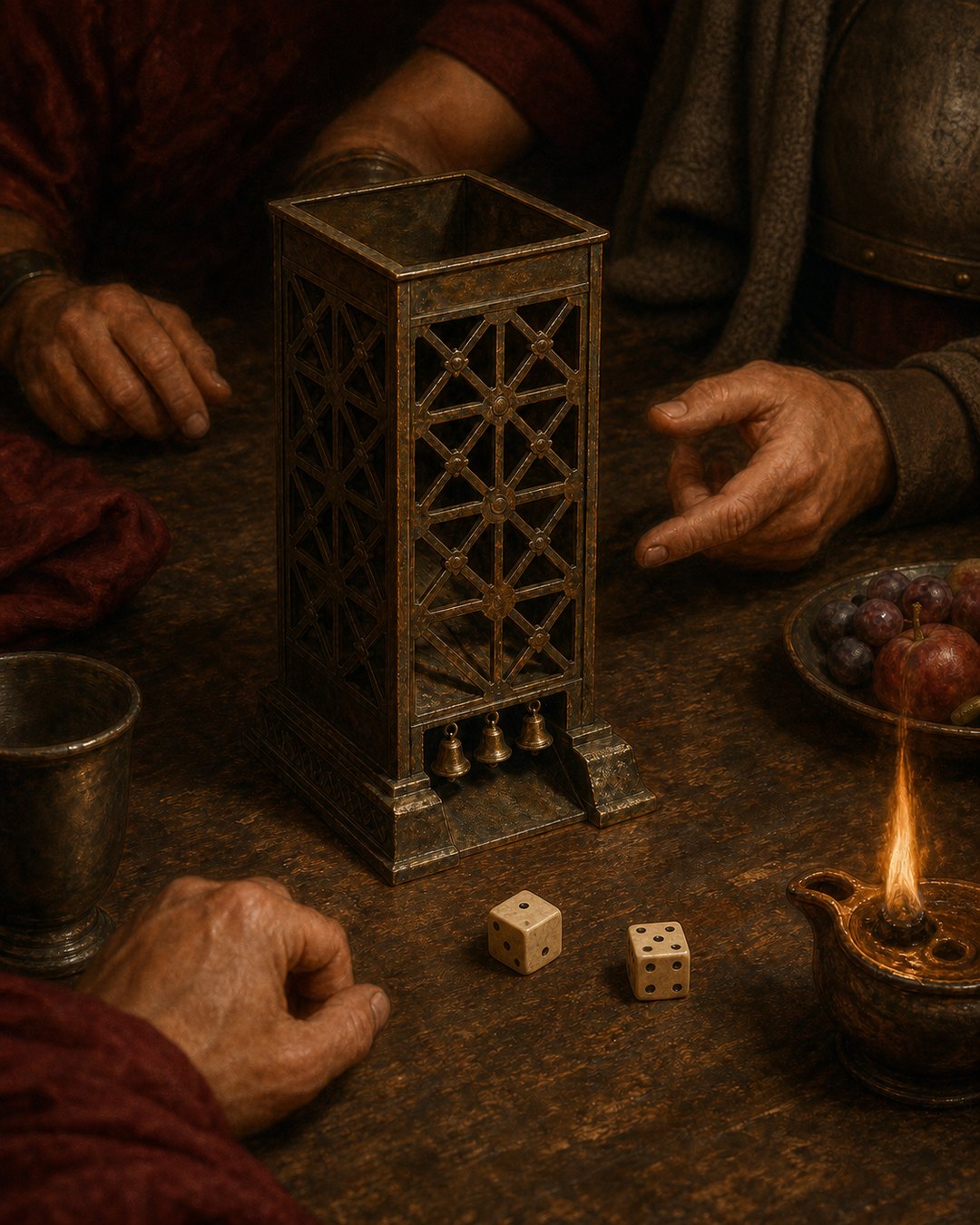
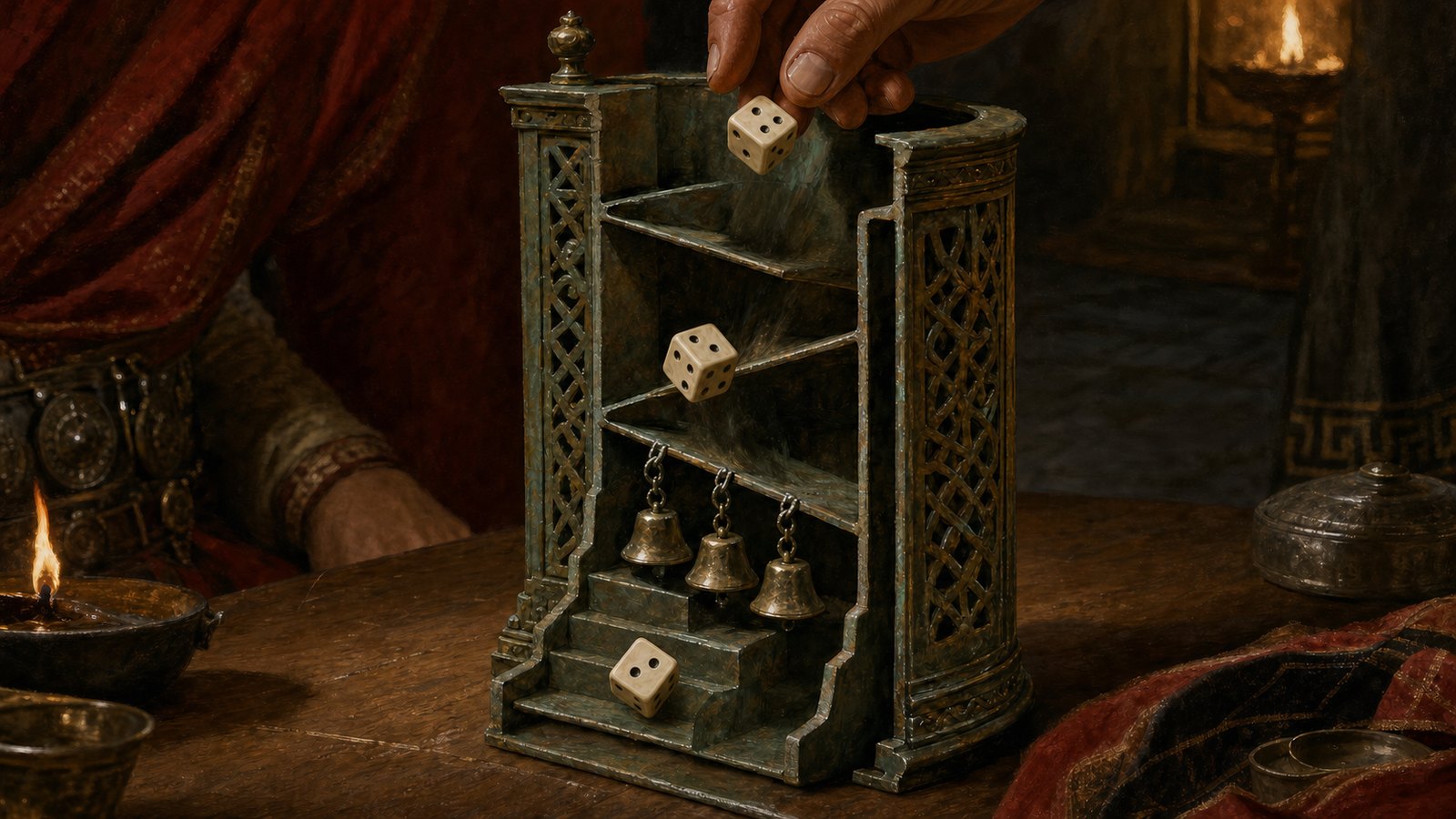
The die did not travel directly from a player’s fingers to the table. It vanished into the open top of a copper-alloy tower, struck one sloping shelf, crossed to another and fell again. At the bottom it descended a miniature staircase. Three small bells waited above the exit. A throw that began in concealment ended with a metallic announcement.
This remarkable object was found in 1985 near Vettweiss-Froitzheim in western Germany, at the site of a Roman villa not far from Cologne. It belongs to the fourth century CE and is now preserved in the Rheinisches Landesmuseum Bonn. Archaeologists call it a dice tower; a Roman writer used the diminutive turricula, “little tower,” for the same kind of gaming device.
The tower’s purpose was practical enough to understand across seventeen centuries. A player could manipulate a cast made directly from the hand. Inside this box, hidden baffles repeatedly redirected the dice before anyone saw the result. Yet its maker did not stop at engineering. Pierced metalwork, a victory boast and ringing bells transformed an anti-cheating device into a small piece of frontier theatre.
A Villa Near Cologne Kept a Frontier Game
The tower emerged from a Roman villa site near the modern settlements of Vettweiss and Froitzheim in North Rhine-Westphalia. In antiquity the district belonged to the lower Rhine zone, with Cologne as a major civic and military centre. The find therefore came from a landscape where farms and houses sat behind one of the empire’s most heavily organized frontiers.
Its date in the fourth century places it in a world very different from the marble Rome of Augustus. Imperial command was divided, Rhine armies remained politically important and northern war crowded official language. The tower is domestic in scale, but its decoration makes no effort to isolate play from that military setting.
The surviving object is built from copper-alloy plate as a tall hollow cuboid. Pierced geometric panels lighten its sides without hiding the overall form. It had to stand level on a table, accept dice through the top and leave enough room inside for repeated impacts. Decoration and function occupy the same thin metal surfaces.
It may have been presented as a gift. That suggestion fits the care invested in an object whose basic task could have been performed by a plain box. A gift for gaming displayed the giver’s metalwork, wit and confidence before the first stake was agreed. The recipient received both an instrument and a conversation piece.
Three Baffles Took the Throw Away from the Hand
Inside the tower, three projecting baffles interrupt a straight fall. A die dropped through the opening cannot simply preserve the orientation chosen by the fingers above. It strikes a shelf, changes direction, falls toward another obstruction and changes again. The repeated collisions make a controlled landing much harder to arrange.
This is the narrow mechanical problem at the heart of the object. A suspicious throw is not suspicious merely because someone dislikes the number. It becomes suspicious when the player’s hand appears able to guide the outcome. The tower inserts metal and gravity between gesture and result, giving every participant the same visible procedure.
The earlier account of Roman dice and public luck follows cubes and knucklebones across tavern and household play. Vettweiss preserves something rarer: not just the pieces, but a machine designed to answer the accusation that a practiced hand could make those pieces obey.
Martial knew such a device centuries earlier. In Book 14 of his Epigrams, among brief labels for gifts, he addresses a turricula and contrasts it with a dishonest hand capable of arranging the dice. The poem is tiny, but the joke depends on readers recognizing the tower as an obstacle to manipulation. The archaeological mechanism gives that literary punch line metal walls.
A Staircase and Bells Made the Result Public
After the final baffle, the dice did not shoot through an undecorated hole. They emerged over a miniature flight of steps. Above that exit hung three bells, one of which survives intact. The falling pieces would strike or disturb the fittings as they arrived, adding sound to the visible tumble.
The bells were not needed to randomize the dice. They served the social moment after randomization. A quiet hand can conceal a piece, delay a release or claim that others looked away. A ringing exit calls attention to the instant when the result becomes available for inspection. The machine makes its own witness signal.
Roman bells already carried meanings beyond music. The site’s article on tiny bells at Roman doorways examines sound as warning and protection. Here the chime belongs to play rather than an entrance, but it performs a related task: it announces movement through a boundary, from hidden fall to public result.
The staircase slows that transition just enough to be legible. Dice appear one after another, bounce down hard edges and settle beyond the player’s reach. Sound, delay and motion turn a simple number into an event. Fairness is not proved by an abstract rule alone; it is staged where the whole table can see and hear it.
The Inscription Brought the Picts to the Gaming Table
The front carried a boast in irregular Latin: PICTOS VICTOS HOSTIS DELETA LVDITE SECVRI. It is commonly understood along the lines of “The Picts are defeated, the enemy destroyed; play without worry.” Around the upper parts of the other faces ran UTERE FELIX VIVAS, a wish that the user enjoy the object and live happily.
The grammar is rough enough that translations should not pretend to classical polish. The message nevertheless joins three ideas clearly: victory over northern enemies, safety and play. A gaming throw becomes carefree because a frontier threat has supposedly been removed. Political reassurance is miniaturized for companions gathered around a table.
The reference to the Picts is unusually early in surviving material culture. It does not identify one certain campaign, commander or owner, so attaching the tower to a particular victory would exceed the evidence. Its value lies instead in the way a military formula travelled. News and boasting did not remain on monumental arches or official coinage; they could decorate leisure equipment.
The line also deepens the anti-cheating joke. “Play secure” can mean safe from enemies outside, but the tower simultaneously promises protection from the dishonest hand inside the room. Imperial security and gaming trust reinforce one another on the same face. A player reads victory while using a device built because companions might not trust him.
The Little Tower Preserved a Negotiation About Trust
No surviving rulebook tells us who owned the tower, what game was underway or how much anyone wagered. The villa context does not turn every player into a soldier, and the Pictish boast does not prove that the gift commemorated one named campaign. Those absences matter. The object is specific about mechanism and deliberately vague about biography.
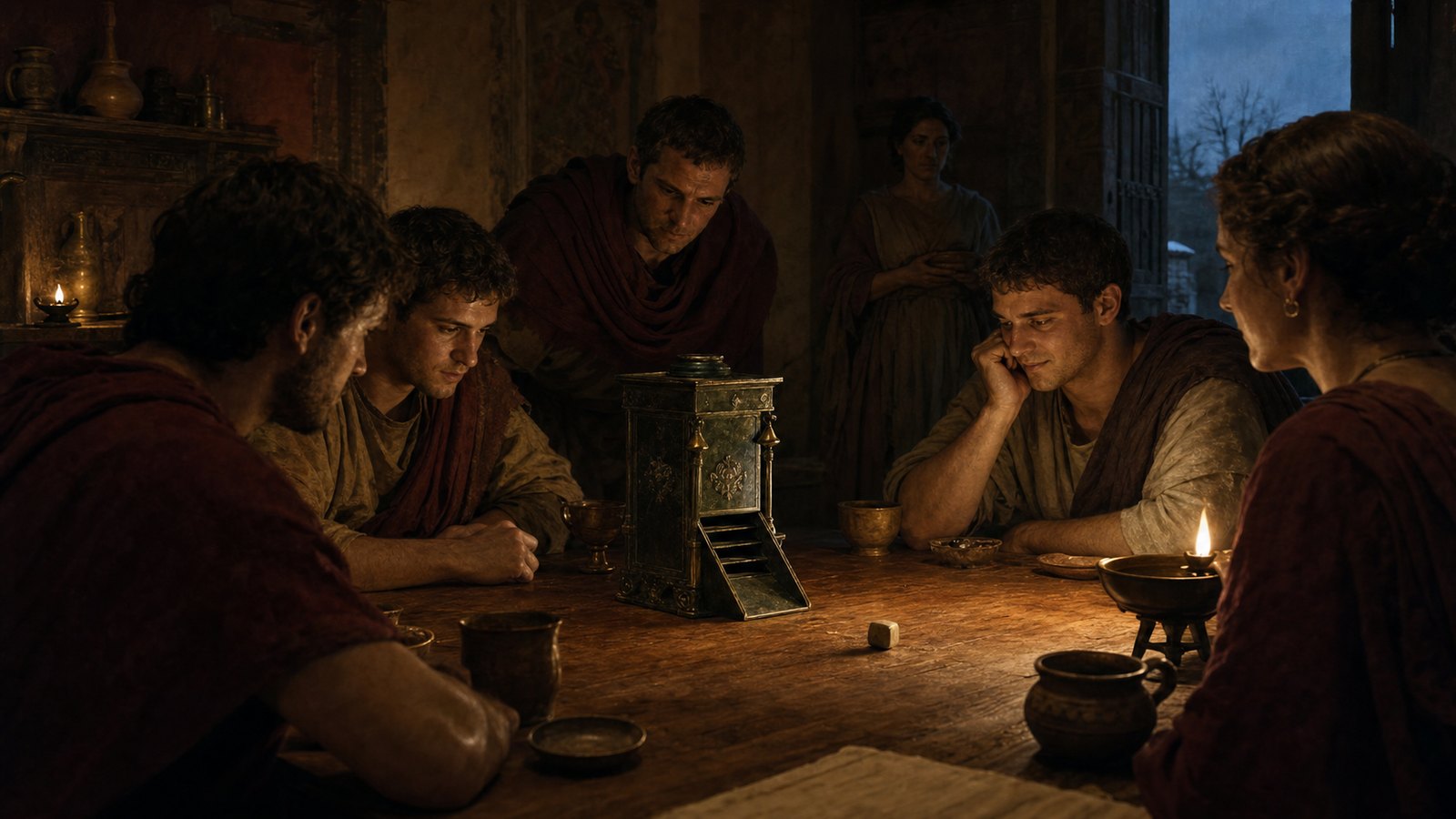
Its wear and construction still recover a sequence of actions. Someone set the tower upright. A player released one or more dice at the top. The pieces struck three baffles, crossed the steps and disturbed the bells. Only then did hands reach toward the result. Every stage limited what one participant could control while enlarging what the group could observe.
That sequence explains why the device is more revealing than a loose die. A die records possibility; the tower records mistrust managed through design. Romans did not need modern probability theory to recognize that repeated collisions frustrated a prepared throw. They understood that a credible game required procedures as well as pieces.
The tower also refuses a neat division between serious frontier history and trivial leisure. Its inscription boasts about defeated Picts, its metalwork displays money and craft, and its interior solves a quarrel familiar to any gaming table. The language of empire enters the room on the inscription, suspicion is answered by engineering, and the bells bring both claims to a finish.
The three small chimes make the instant of release difficult to hide and impossible to keep silent. The throw belongs to the player only at the opening; after that, bronze shelves, gravity, steps and sound take over. Vettweiss preserved a Roman answer to cheating because its maker turned trust into something companions could watch happen.