
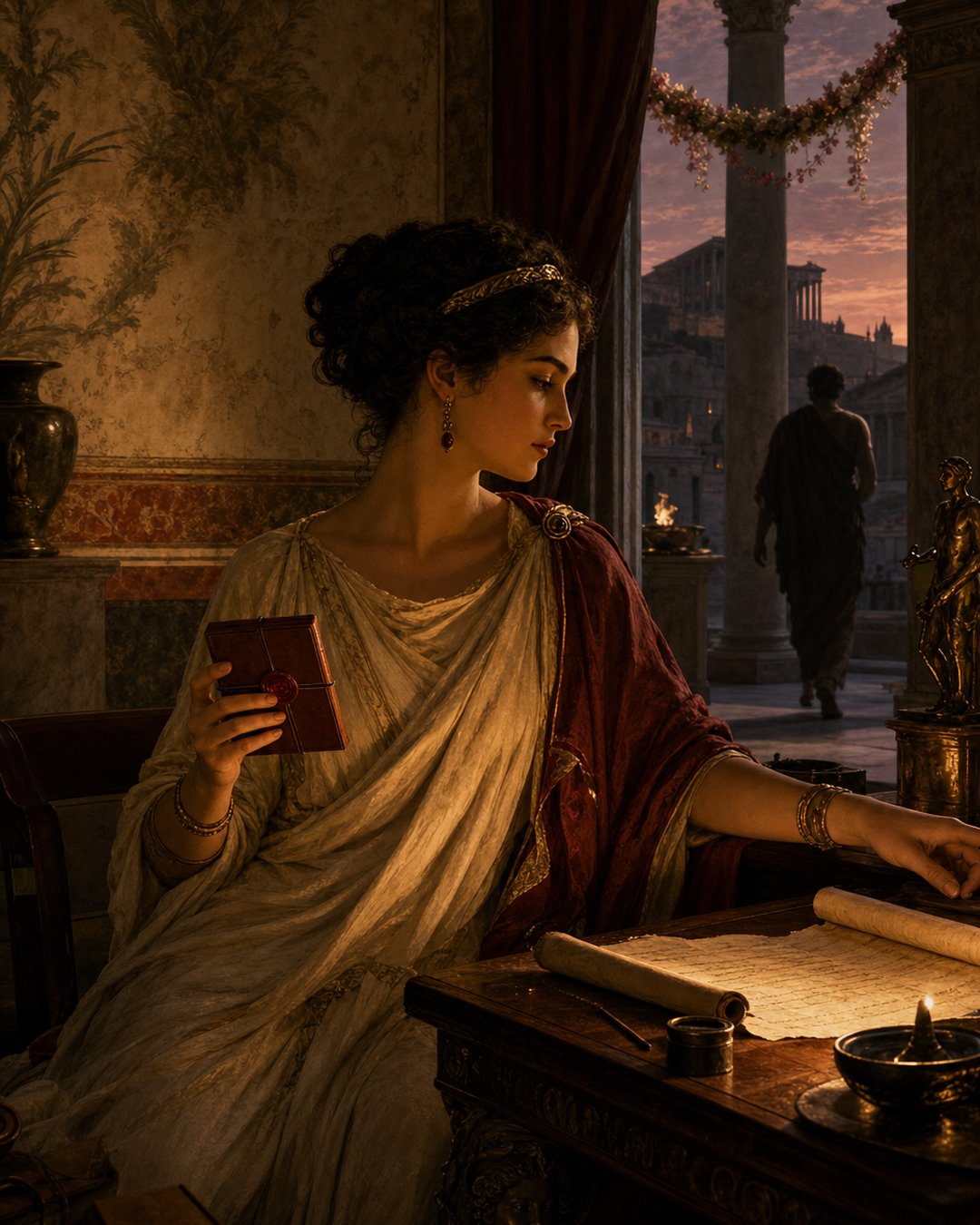
“At last love has come.” The surviving sequence attributed to Sulpicia begins not with a description of the beloved but with a decision about disclosure. Hiding her affair, the speaker says, would bring more shame than revealing it. She refuses to entrust the story to sealed tablets for one private reader. Reputation will carry it instead.
That declaration occupies only ten Latin lines, each compressed around exposure, desire and the social cost of being known. Five more short elegies follow in the third book transmitted with Tibullus, roughly forty lines altogether. They name a lover called Cerinthus, complain about a birthday trip away from Rome, celebrate its cancellation, flare into jealousy, admit illness and end with regret for having seemed indifferent.
The scale is astonishingly small. An entire literary identity rests on six compressed moments preserved inside another poet’s corpus. Yet compression is not silence. The sequence makes secrecy, guardianship and public judgment its materials. Whether every line was composed by the historical woman called Sulpicia remains debated, but the voice built by the poems is unmistakably occupied with controlling who tells her story.
The First Poem Treats Disclosure as the Main Event
The opening elegy says Venus, moved by the speaker’s poetry, delivered love into her lap. The conventional goddess matters, but the striking action belongs to publication. The speaker prefers the report that she has been with someone worthy to the performance of a respectable face that conceals desire.
Sealed writing tablets represent a narrower option. A private message could reach the beloved before anyone else saw it. Sulpicia’s speaker rejects that control because concealment would make the affair smaller than the joy it produced. The poem turns gossip, usually dangerous for an elite woman, into a chosen carrier.
This is not a modern confession dropped unchanged into antiquity. Roman elegy already possessed literary poses, learned allusions and pseudonymous lovers. The name Cerinthus may itself be a poetic construction. The achievement lies in how the poem uses those conventions: a female first person claims the right to define exposure rather than merely suffer it.
The sequence therefore begins at a threshold. Private feeling becomes text, and text anticipates reputation. The reader is not peeking at an accidentally opened diary. The speaker has announced that being read is part of what she wants.
A Birthday Journey Makes Guardianship Physically Felt
The second poem changes scale from fame to a travel plan. An unwelcome birthday approaches in the countryside, away from Cerinthus. Rome feels sweeter than a chilly river and rural estate. The speaker addresses Messalla, calls him an over-attentive relative and complains that the journey denies her control over herself.
Diotima’s notes identify Messalla as her guardian. Marcus Valerius Messalla Corvinus was also a leading patron associated with the literary circle in which Tibullus wrote. The poem thus places domestic authority and literary context in the same name. A guardian can arrange movement; a patron’s corpus can preserve protest against it.
The third poem abruptly cancels the problem. The sad journey has been lifted from the girl’s mind, and she may celebrate her birthday in Rome. The tiny follow-up is almost administrative in its brevity. Because the previous complaint established emotional stakes, cancellation becomes a scene of regained proximity.
The account of women challenging the Oppian Law in Rome follows collective pressure in public. Sulpicia’s scale is private and literary. She cannot repeal guardianship in eight lines, but she can make its interference sound unreasonable and preserve her own evaluation of the trip.
Cerinthus Appears Through Jealousy, Neglect and Illness
The fourth poem sharpens the lover’s outline through rivalry. The speaker sarcastically praises Cerinthus for feeling secure enough to risk her sudden fall. She contrasts herself, the daughter of Servius, with a woman associated with the toga and a basket, language often interpreted as marking a lower-status sexual rival.
The attack is socially harsh. It draws force from rank rather than escaping it. That discomfort prevents the sequence from becoming an easy emblem of modern liberation. Sulpicia’s speaker resists constraints placed on her while also using elite lineage as a weapon against another woman.
The fifth poem moves to sickness. The speaker asks whether Cerinthus cares that fever exhausts her body. She does not want recovery if he does not wish it. Elegy turns physical weakness into a test of attention: illness matters because it reveals whether desire is reciprocal.
The sixth then looks backward. She says her greatest regret is having left him alone the previous night and disguised her passion. The final note reverses the opening problem. At first, concealment threatened public truth; at the end, a performance of indifference threatens intimacy. Across six poems, hidden feeling repeatedly creates the danger.
Forty Lines Build a Sequence Larger Than Their Page
The poems are usually identified as Corpus Tibullianum 3.13–18, though older numbering systems can label them differently. Together they total only about forty lines. Their order supplies much of their power: declaration, separation, reprieve, jealousy, illness and regret create movement that no isolated epigram could carry.
Compression forces concrete details to work hard. A sealed tablet stands for secrecy. A birthday fixes emotion to a date. Rome and the cold Arrentine river make desire geographical. Fever gives neglect a bodily measure. A single night of feigned distance becomes the closing wound.
The sequence also plays with elegiac convention. Male Roman elegists often portray themselves enslaved, excluded or wounded by love. Here a female speaker occupies that desiring position while facing restrictions shaped by guardianship and reputation. Familiar literary machinery changes when the social risks of the first person change.
The earlier article on Galen’s lost books and the fragility of textual survival shows a vast library disappearing. Sulpicia offers the opposite scale: a handful of lines survives because scribes kept copying a larger collection. Smallness became a shelter.

The Authorship Debate Cannot Erase the Poems’ Chosen Voice
Traditional scholarship identifies Sulpicia as an elite woman connected with Messalla’s family, often reconstructed as the daughter of Servius Sulpicius Rufus and Messalla’s ward. The poems themselves supply the names Servius and Messalla, but building a complete biography from literary clues requires caution.
Some modern scholars have challenged female authorship, proposing male ventriloquism or more complicated editorial construction. Others defend the attribution and emphasize how assumptions about what women could write have shaped skepticism. The surviving manuscript heading cannot settle every stage between Augustan composition and later collection.
The responsible conclusion is neither to suppress the debate nor let it consume the work. These poems create a speaker who identifies as Servius’s daughter, addresses Cerinthus and understands elite female reputation from inside the dramatic situation. Whoever arranged the corpus expected readers to encounter that voice as Sulpicia’s.
Transmission adds another irony. The opening speaker refuses to hide love on sealed tablets; centuries of copying then preserve her disclosure inside books bearing Tibullus’s name. The route to modern readers depended on attachment to a larger male-authored corpus, but the six poems never behave like a timid appendix.
The sequence ends without marriage, reconciliation or biographical closure. It leaves a woman regretting that she acted less passionate than she felt. That unresolved honesty is exactly the pattern announced at the start. Concealment, not desire, is the mistake the poems refuse to let remain secret.