
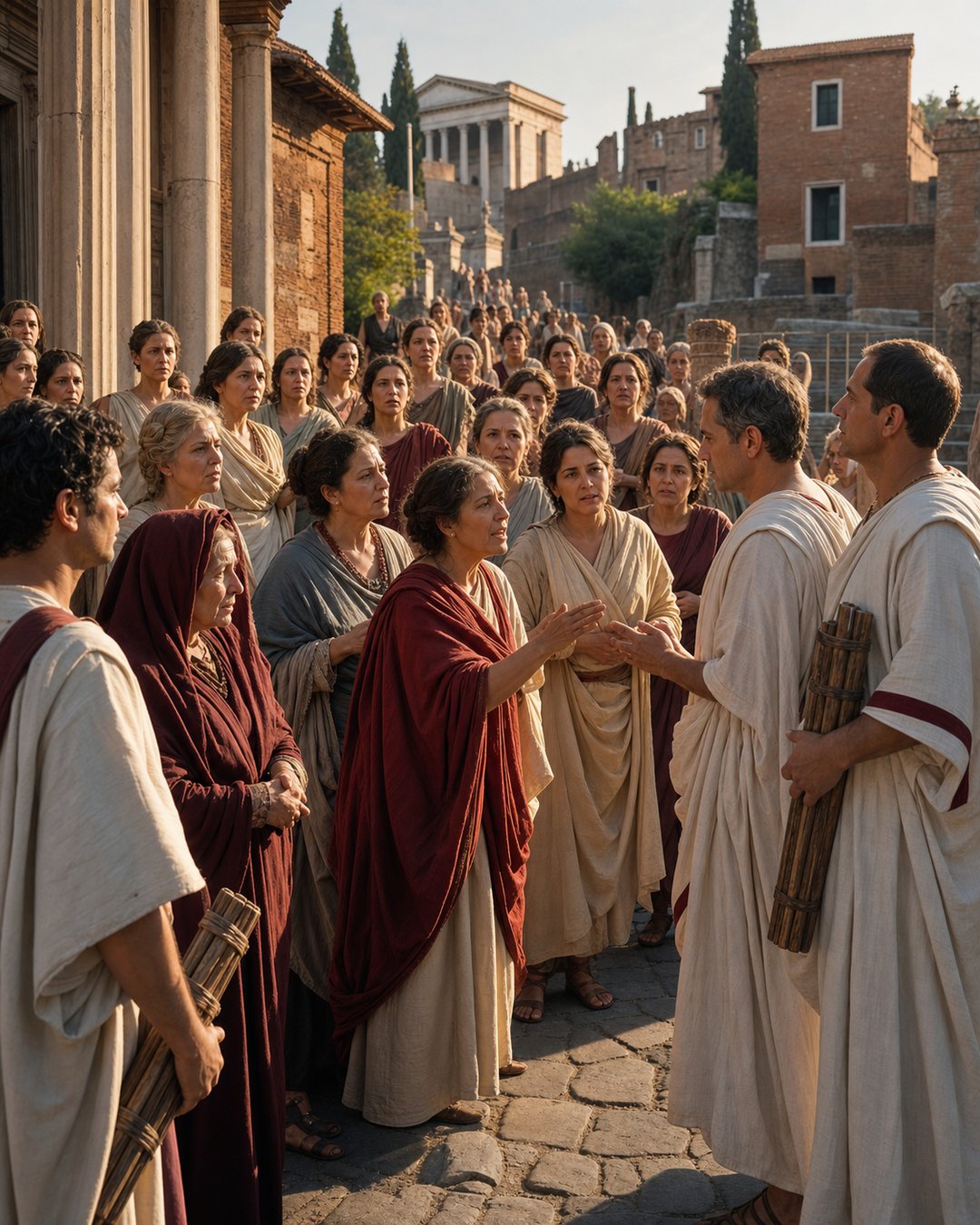
In 195 BC, Roman magistrates found the approaches to public business occupied by people who could not cast a ballot. Women stood in streets and at entrances, intercepted men on their way to the Forum and pressed a question that Rome had postponed for twenty years. A wartime law still controlled the gold they could own, the colors they could wear and the carriages they could use.
The law was the Lex Oppia, passed in 215 BC while Hannibal’s war had stripped Roman households of men, money and confidence. Its repeal produced a debate remembered by Livy in Book 34 of his History of Rome. The historian gives the opposing positions to the consul Marcus Porcius Cato and the tribune Lucius Valerius. Outside that male debate, the women created pressure of their own.
They did not gain office, a formal assembly or a new constitutional right. They did something more immediate: they made delay politically uncomfortable. Their campaign reveals how emergency restrictions survive, how public space can become leverage and how Romans argued about women whenever the deeper subject was who controlled the return to normal life.
A Defeat at Cannae Still Hung Over the Law
The Lex Oppia belonged to the darkest phase of the Second Punic War. It was proposed by the tribune Gaius Oppius and enacted in 215 BC, one year after the catastrophe at Cannae. Roman armies had been destroyed, allied loyalty was uncertain and the state was demanding extraordinary resources from its citizens. A restriction on visible private wealth could be presented as part of a shared emergency.
Livy’s account gives the law three concrete limits. A woman could not possess more than half an ounce of gold. She could not wear a multicolored garment. She could not ride in a horse-drawn vehicle within a city or within one mile of it, except for a public religious rite. The measure therefore reached property, appearance and movement at once.
Those clauses did more than suppress luxury. Gold could be stored wealth; dyed cloth communicated rank; a carriage changed how far and how visibly a person moved through a crowded city. The law converted each into a public sign of restraint. A woman crossing Rome in a vehicle or wearing expensive color could be read as refusing a sacrifice demanded by war.
Rome survived the Hannibalic crisis, defeated Carthage in 201 BC and emerged with new power abroad. Yet the Lex Oppia remained. By 195 BC, its supporters had to defend not the first emergency decision but its afterlife. The argument shifted from what citizens owed during disaster to who had authority to announce that the disaster was over.
The Crowd Worked Around a Constitution That Excluded It
Women had no vote in the tribal assembly that would decide repeal. Livy nevertheless describes them entering the political landscape in organized numbers. They could not be kept at home by the authority of husbands or by the modesty expected of Roman matrons. They occupied every street and the approaches to the Forum, asking men how the state could now prosper while women alone remained marked by wartime austerity.
The gathering widened beyond Rome. Livy says women came from nearby towns and market centers. That detail turns a spontaneous crowd into something closer to a network. Travel required information, preparation and a reason to believe that physical presence could affect officials before the vote.
Their method used access rather than office. A senator, tribune or voter still held the legal power, but he had to walk through the city to exercise it. Doorways, streets and approaches became points where private persuasion accumulated into a public fact. The women did not imitate a formal assembly; they surrounded the routes through which an assembly functioned.
This pressure makes a useful contrast with the voting bridges that channeled male citizens toward a ballot. The Lex Oppia campaign happened outside that controlled path. Its participants made themselves visible precisely because the official mechanism contained no place for them.
Cato Turned Repeal into a Crisis of Male Command
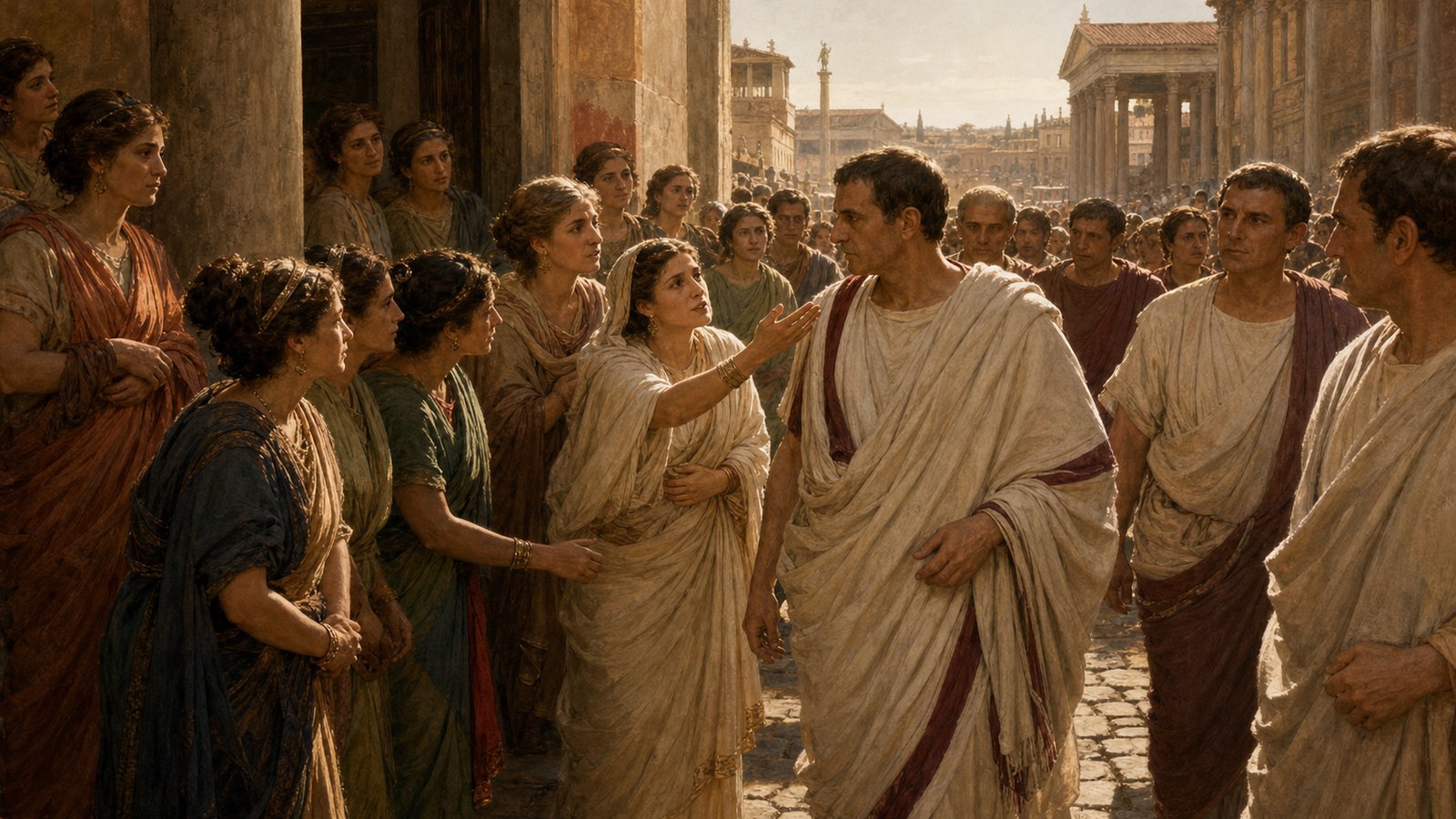
Livy places the most famous speech against repeal in the mouth of the consul Marcus Porcius Cato. It should not be treated as a stenographic transcript. Livy wrote long after the event and shaped speeches to expose political arguments. What matters is the anxiety his Cato represents: once women crossed the household threshold together, the issue no longer looked like jewelry.
Cato complains that men had failed to restrain wives individually and now faced them collectively. He imagines female equality becoming female domination, and treats the crowd itself as evidence that repeal would reward insubordination. The logic transforms a limited law into a barrier protecting the hierarchy of the household and the state.
He also argues that luxury spreads through rivalry. If one woman displays gold and purple, another feels poverty in comparison and pressures her household to match it. In this telling, law protects families from a competition that private discipline cannot contain. The object under debate is cloth or metal; the feared mechanism is status moving from one body to another in public view.
The speech reveals why wartime rules can be difficult to remove. Their defenders need not prove that the original emergency still exists. They can redefine compliance as virtue and repeal as surrender. Twenty years of restriction become evidence that restriction is normal, while the demand to end it becomes the disruptive act.
Valerius Asked Why Victory Had Not Restored Ordinary Life
The tribune Lucius Valerius answers by returning the law to its date. Earlier generations had lived without it. The measure arose from a specific emergency and had no claim to be an ancestral foundation of Rome. If the danger that justified a law had passed, repeal could honor success rather than insult sacrifice.
Livy’s Valerius also catalogs occasions when Roman women had acted for the commonwealth. His examples belong to Roman moral memory, and his purpose is argumentative: a group praised when it donated wealth or aided the state could not be dismissed as a mob when it requested relief. He makes service during crisis part of the case for restoration afterward.
The debate was not a modern declaration of equal citizenship. Valerius accepts a world of male guardianship and female distinction. He argues within that structure that husbands and fathers can regulate households without a permanent national restriction. Repeal would transfer judgment away from one emergency statute, not abolish Roman patriarchy.
That limited argument matters. The women’s success did not depend on every speaker sharing their understanding of freedom. Different motives could converge: resentment of obsolete law, defense of household authority, celebration of victory and discomfort with a growing crowd. Political change often arrives through such an unstable coalition.
Two Tribunes Discovered That a Veto Had a Front Door
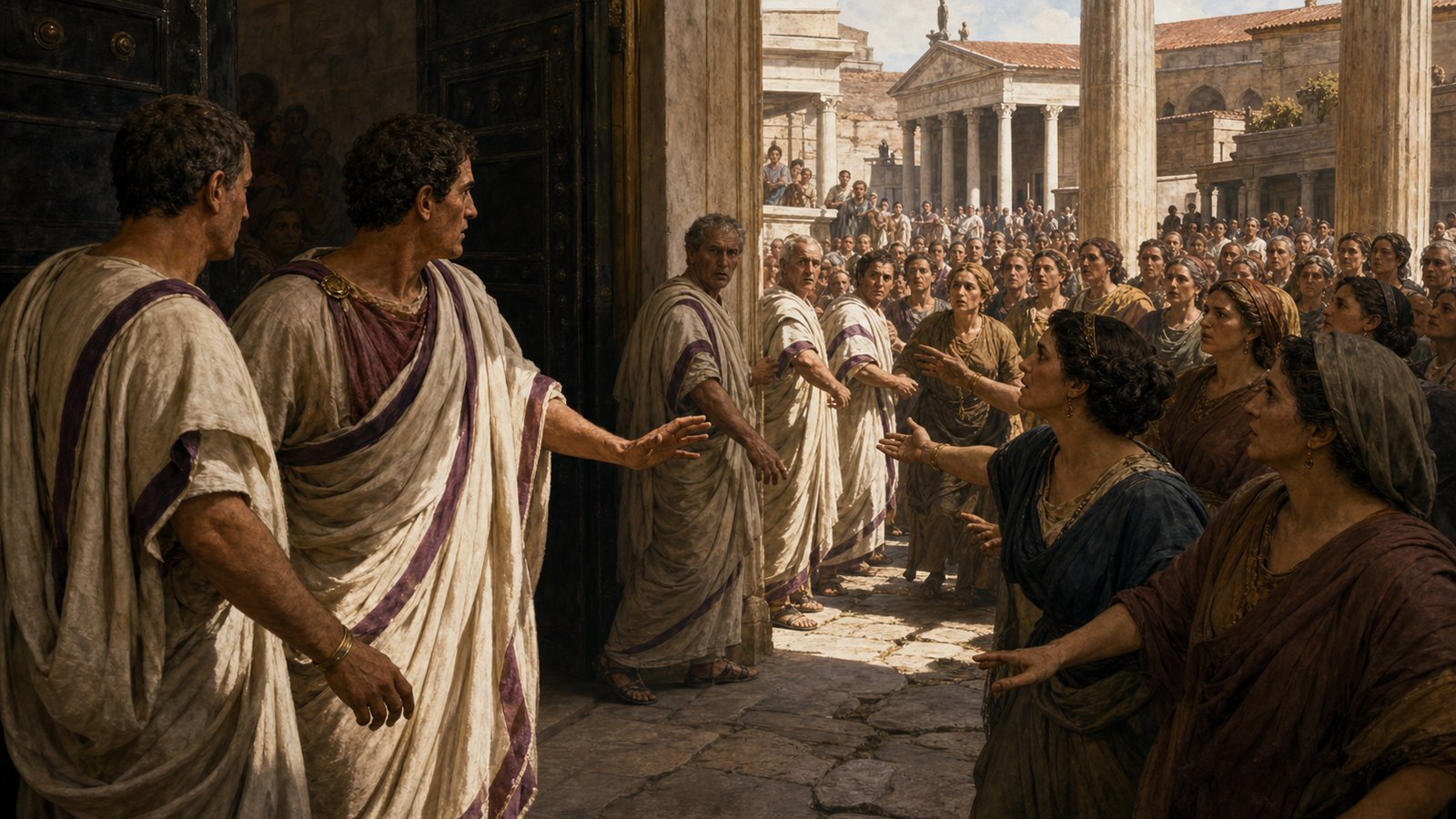
The immediate obstacle was procedural. Marcus and Publius Junius Brutus, tribunes of the plebs, had announced that they would veto repeal. A veto could stop the proposal even if public support had grown. The women therefore concentrated on the men whose intervention could close the formal route.
Livy says the matrons beset the doors of the Bruti and did not stop until the tribunes withdrew their opposition. It is the sharpest mini-scene in the episode: an abstract constitutional power located at a household entrance, a crowd waiting outside and two officeholders discovering that obstruction had a daily social cost.
Once the threatened veto disappeared, all the tribes voted for repeal. The Lex Oppia ended in 195 BC, twenty years after its enactment. The sequence does not prove that street pressure alone determined every vote, but Livy deliberately connects persistence at the doors with the removal of the procedural block.
Public female influence in Rome often appeared through family, patronage, religion or wealth rather than a ballot. Eumachia’s building and inscription at Pompeii show another route by which a woman could become monumental in civic space. The Oppian campaign was more temporary and confrontational: presence itself became the instrument.
Repeal Changed the Law, Not the Whole Social Order
It is tempting to call the episode a march for women’s rights and stop there. That language catches the collective action but can flatten the ancient dispute. The campaign concerned a particular law affecting women with access to gold, decorated clothing and carriages. Poor women did not gain those assets because a restriction on possessing or displaying them disappeared.
Livy’s narrative is also a literary construction. His women speak as a group, while Cato and Valerius receive developed speeches. We cannot recover the planning meetings, individual words or exact size of the crowd. The account tells us that later Romans found the public action memorable and politically intelligible, not that every dramatic sentence is a transcript.
Even with those limits, the mechanism remains unusually clear. People excluded from the deciding vote identified the routes, entrances and officials on which the decision depended. They widened participation geographically, sustained pressure through a threatened veto and forced defenders of an old emergency law to explain why victory had not ended it.
The Lex Oppia had made women’s bodies carry the memory of national danger. Its repeal showed that ending an emergency can require a second political struggle, because restraint acquires defenders, habits and moral language of its own. Rome’s women did not rewrite the constitution in 195 BC. They made the existing constitution answer them from the street.