
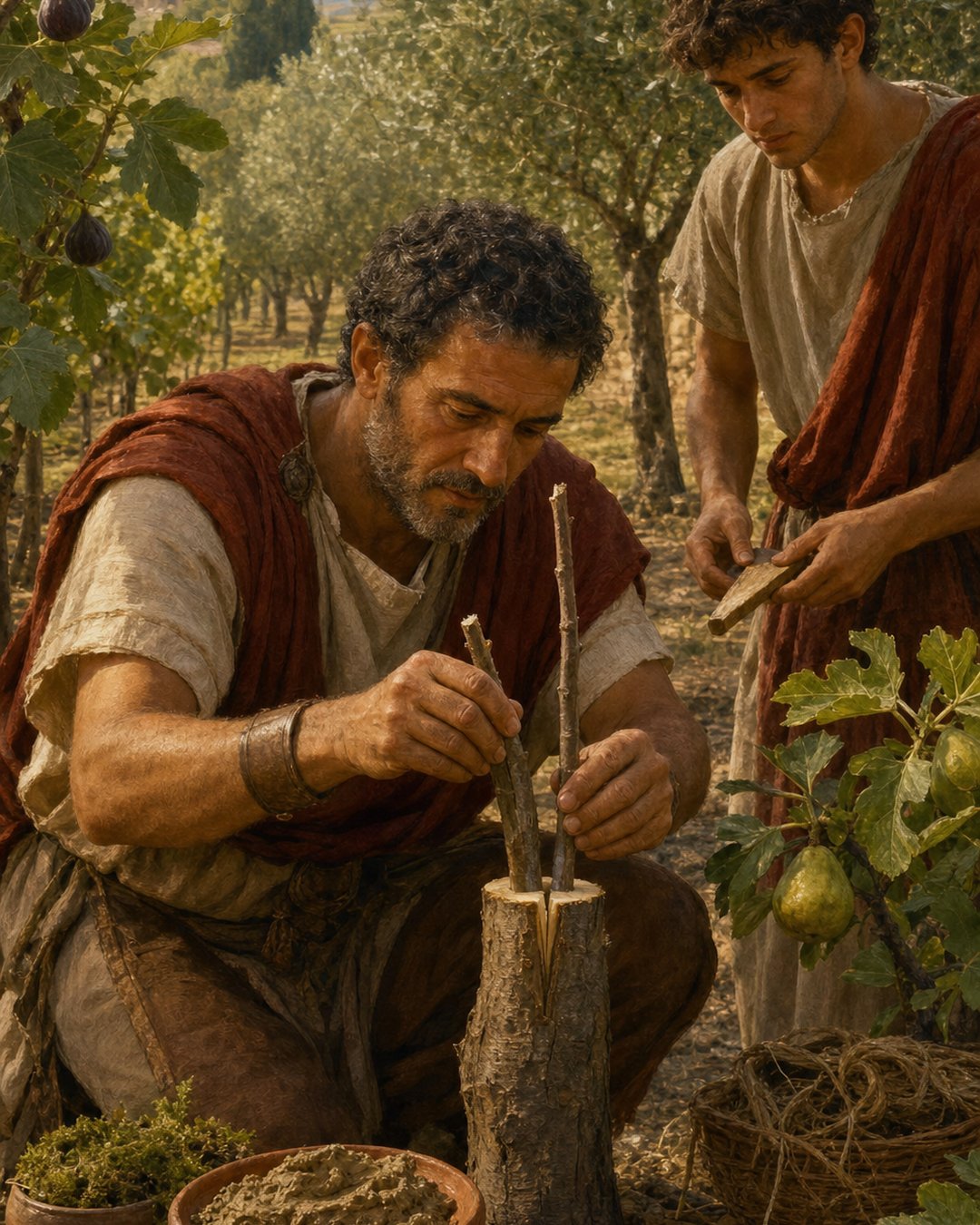
A Roman orchard keeper could change a tree without uprooting it. The operation began with removal: a saw took off the stock, a knife smoothed the wound, and a wedge opened living wood. Then came the more delicate act. A young shoot from another tree had to be pared, fitted and bound so closely that its bark met the bark carrying sap below.
Columella describes this work in Book 5 of On Agriculture with the attention of someone writing for hands as well as minds. He specifies the age and thickness of a scion, the direction from which it should be taken, the depth of a cut, the material laid over the wound and even the day when one kind of binding should come off. Grafting was not a single gesture. It was a managed injury followed by protection and waiting.
His chapter also contains an argument. Earlier authorities, he says, limited successful unions to trees that resembled one another in bark, rind and fruit. Columella first teaches those cautious methods, then announces a procedure meant to defeat the old boundary. The orchard becomes both workshop and experiment: knife, clay and time decide whether one tree can carry the future of another.
A Useful Scion Began as a Carefully Chosen Branch
Before any cut joined two plants, the orchard keeper had to choose the right material. Columella recommends a young, fruitful donor tree. The shoot should be a one-year branch facing the rising sun, sound, frequently knotted and about as thick as a little finger. It should carry two or three promising points. Those details turned selection into a forecast of growth rather than a search for any convenient twig.
Timing mattered because the plant itself supplied the force that would close the wound. Most trees were to be grafted as their buds began to swell in spring; the olive received a narrower recommendation around the spring equinox and into April. Bud grafting belonged to summer. The calendar was therefore read through bark, sap and swelling buds, not merely through a fixed festival date.
The nursery had its own delay. Columella says seedlings should be reduced to a single stem in their first year, protected from cold with reed coverings, and left until they could safely be transplanted or grafted after twenty-four months. An orchard was planned over seasons. The moment of cutting depended on earlier protection and training.
This controlled attention to small living systems also appears in Roman beekeeping instructions. In both cases, the agricultural writer makes production depend on observing a living cycle and intervening at the least damaging moment. The desired result came from timing labor to the organism rather than simply applying more force.
The Cleft Had to Bring Bark Against Bark
One inherited method used a stock that had been cut and split. Columella tells the worker to choose a healthy, unscarred section, saw it carefully and smooth the wound with a sharp iron tool. A wedge held a cleft roughly three inches deep. The scions were pared on both sides and inserted so that their bark met the bark of the stock.
That bark contact was the centre of the operation. A branch could look firmly lodged and still fail if its living edge did not correspond with the receiving tree. Columella does not use modern anatomical vocabulary, but his repeated insistence on matching bark shows practical knowledge of where union had to occur. Strength without alignment was not enough.
Once the scions were fitted, the wedge came out and the stock was bound. The wound and spaces around the graft were daubed with clay while enough of each scion remained exposed. Moss went over the clay, and a binding kept rain from seeping into the join. On a smaller tree, earth could be heaped around the graft to protect it from wind and heat.
The materials were ordinary but their sequence was exact: iron opened and smoothed, wood held the gap, bark met bark, fiber stabilized, clay sealed, moss shielded. The use of prepared lime in Roman mortar making belonged to a different craft, yet both procedures depended on understanding that a join survives only when surfaces, moisture and covering are controlled together.
A Patch of Bark Could Move One Living Bud
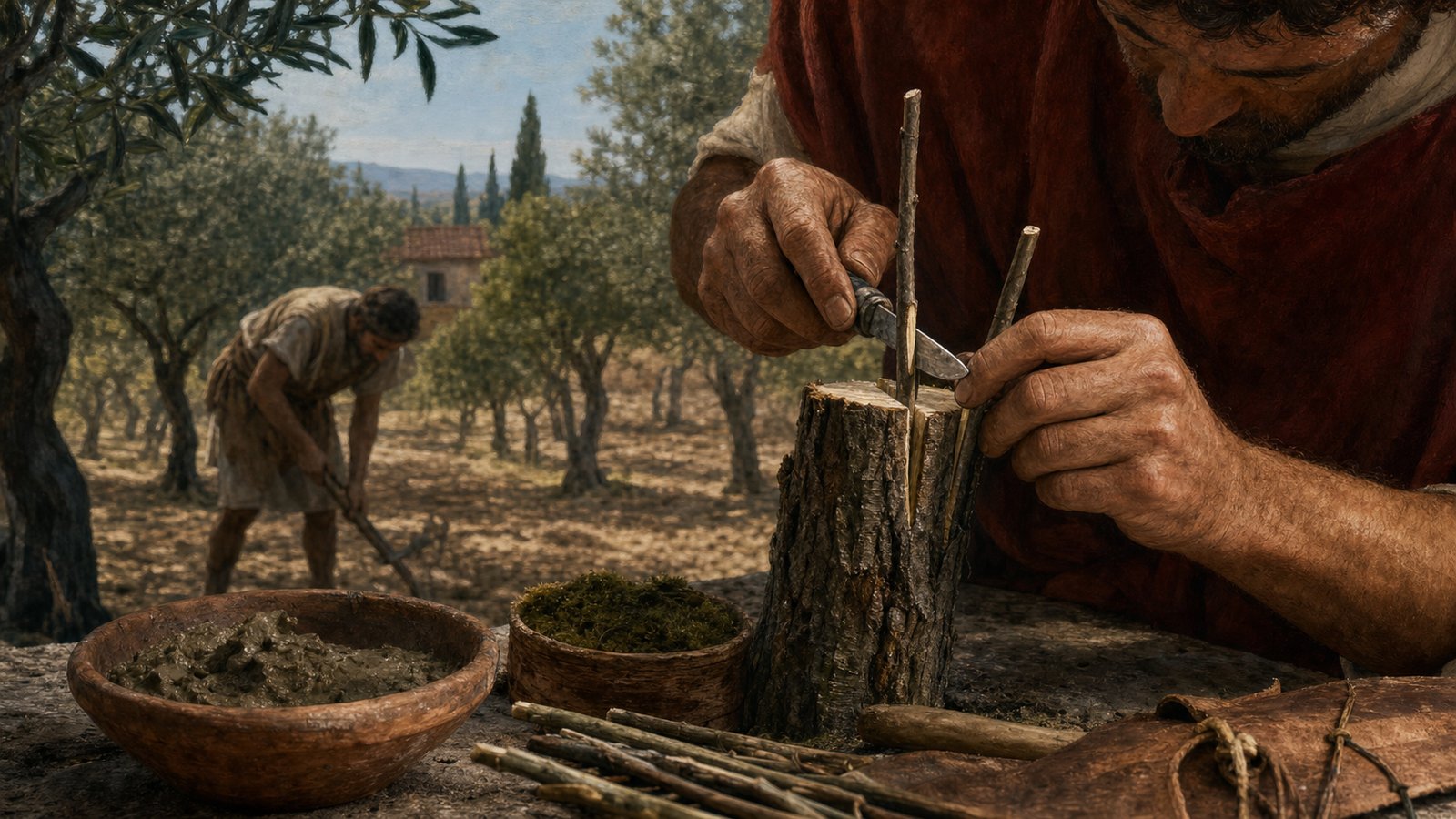
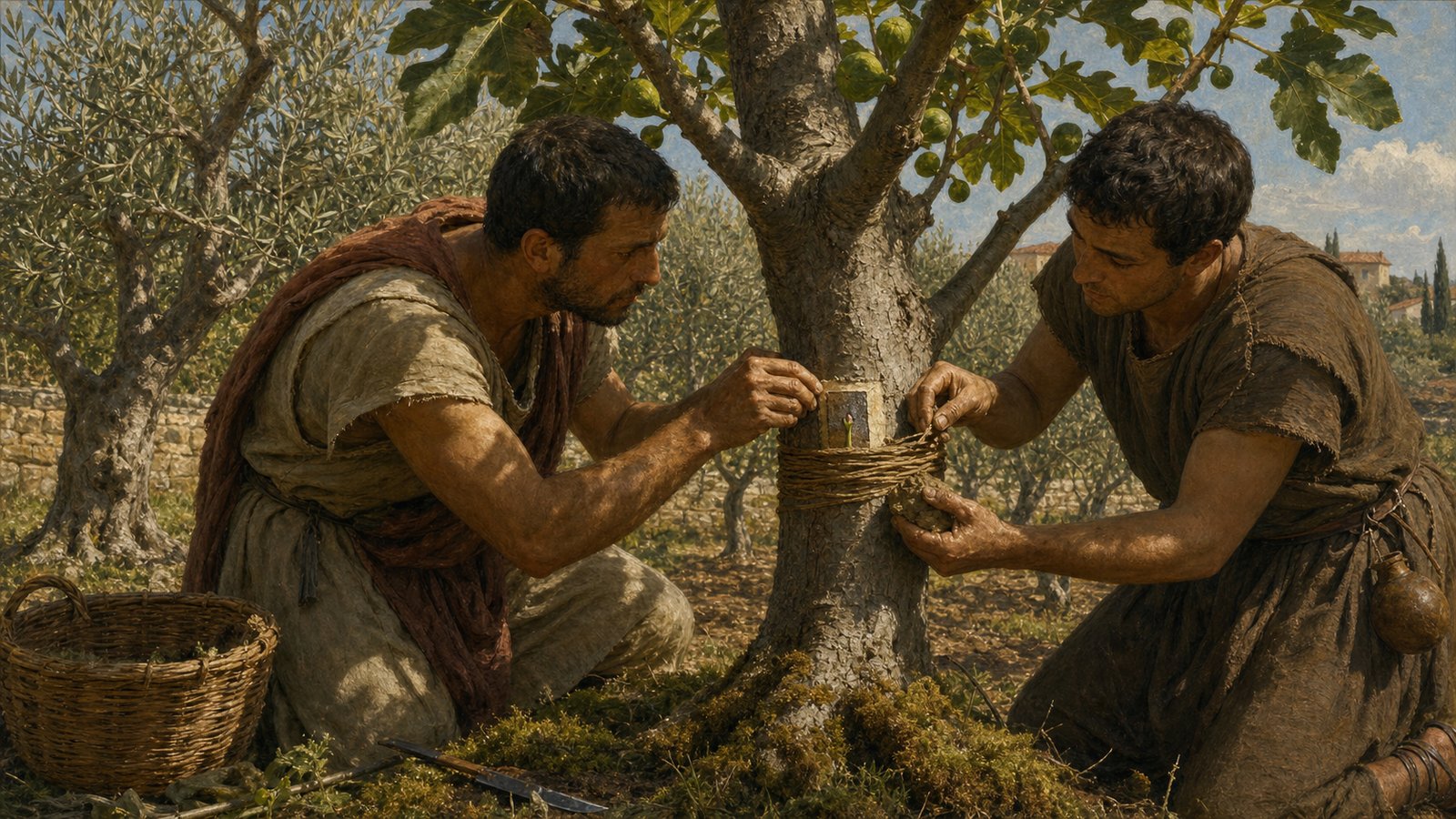
Columella’s third inherited technique moved less material. In what he calls emplastration or inoculation, a worker removed a small patch of bark carrying a healthy bud from one tree. A matching area was stripped from a vigorous branch on the receiving tree. The prepared patch was then fitted into the opening like a biological inlay.
The bud itself had to remain unharmed and uncovered by the binding. Columella directs the worker to tie around it, coat the joints and ties with mud, but leave a space so the new growth was not constricted. The instruction captures the paradox of grafting: the union required pressure and protection, while the living point at its centre required room.
He also orders shoots and upper branches of the stock cut back so that sap would not be drawn elsewhere. After twenty-one days the wrapping around the patch could be loosened. The graft was therefore not complete when the knife was put down. Follow-up pruning redirected the tree’s resources, and a timed return tested whether protection had become restriction.
Fig was especially suited to this delicate method in Columella’s account because its bark was moist, strong and full of sap. He says olive could also be treated successfully this way. The passage does not prove that every estate followed his instructions identically. It does preserve the variables an experienced Roman agronomist considered decisive: bark quality, moisture, vigor, pressure and time.
Columella Challenged the Orchard Rules He Inherited
At first Columella sounds conservative. Scion and stock should not be too dissimilar in bark; similar fruit and season made a union safer. He attributes three standard grafting methods to earlier authorities. Then he turns against their hard limit, declaring that he has a way to put any kind of scion on any kind of tree.
His example is deliberately dramatic. A small fig tree was planted within reach of an olive branch and allowed to grow for two years. The healthiest olive branch was bent down and tied to the fig. The fig stock was cut and split, while the olive shoots were pared and inserted without yet being severed from their mother tree.
The proposed union remained supported from both sides. Columella allows three years for fig and olive to coalesce; only in the fourth year, once they had joined securely, were the olive shoots to be cut from the original tree. This was not a quick cleft graft but a prolonged inarching experiment whose living bridge preserved the donor connection while the new junction formed.
Modern readers should resist treating the promised result as a controlled botanical demonstration. The important historical fact is the claim and the procedure Columella records. He presents himself not merely as a compiler but as an investigator correcting predecessors. His orchard is a place where authority could be challenged through a practical trial lasting years.
The Graft Made Orchard Knowledge Visible in a Scar
Pliny the Elder also devoted a sequence of Natural History Book 17 to layers, grafting, budding, vine grafts and scutcheons. His arrangement places grafting among multiple ways of propagating and reshaping trees. Together with Columella’s workshop-level instructions, it shows that elite Roman agricultural literature treated plant joining as a substantial technical subject, not an incidental curiosity.
The attraction was economic as well as intellectual. A grower did not need to wait for every valued fruit tree to begin again from seed. A vigorous established stock could receive selected material from a productive donor, while nursery trees could be prepared and arranged in rows. Grafting joined the long life of an orchard to deliberate choices about what it would bear next.
It also demanded a kind of touch that a written recipe could only approximate. The worker judged whether bark was sound, whether a branch was the thickness of a little finger, whether the cut was smooth, whether the tie held without crushing and whether clay excluded rain without burying the bud. Roman garden design could impose order at the scale of paths and planting beds; grafting imposed it at the narrow seam between two living surfaces.
The finished join carried the history of that intervention. A swelling, seam or change of bark marked where one growth had been made to continue through another. Columella’s recipe lets us reconstruct the scene behind the scar: the spring inspection, the selected shoot, the saw and knife, the bark aligned by hand, the clay pressed over the wound and the return weeks or years later. Roman orchard craft worked by making a cut, then organizing everything needed for the tree to survive it.