
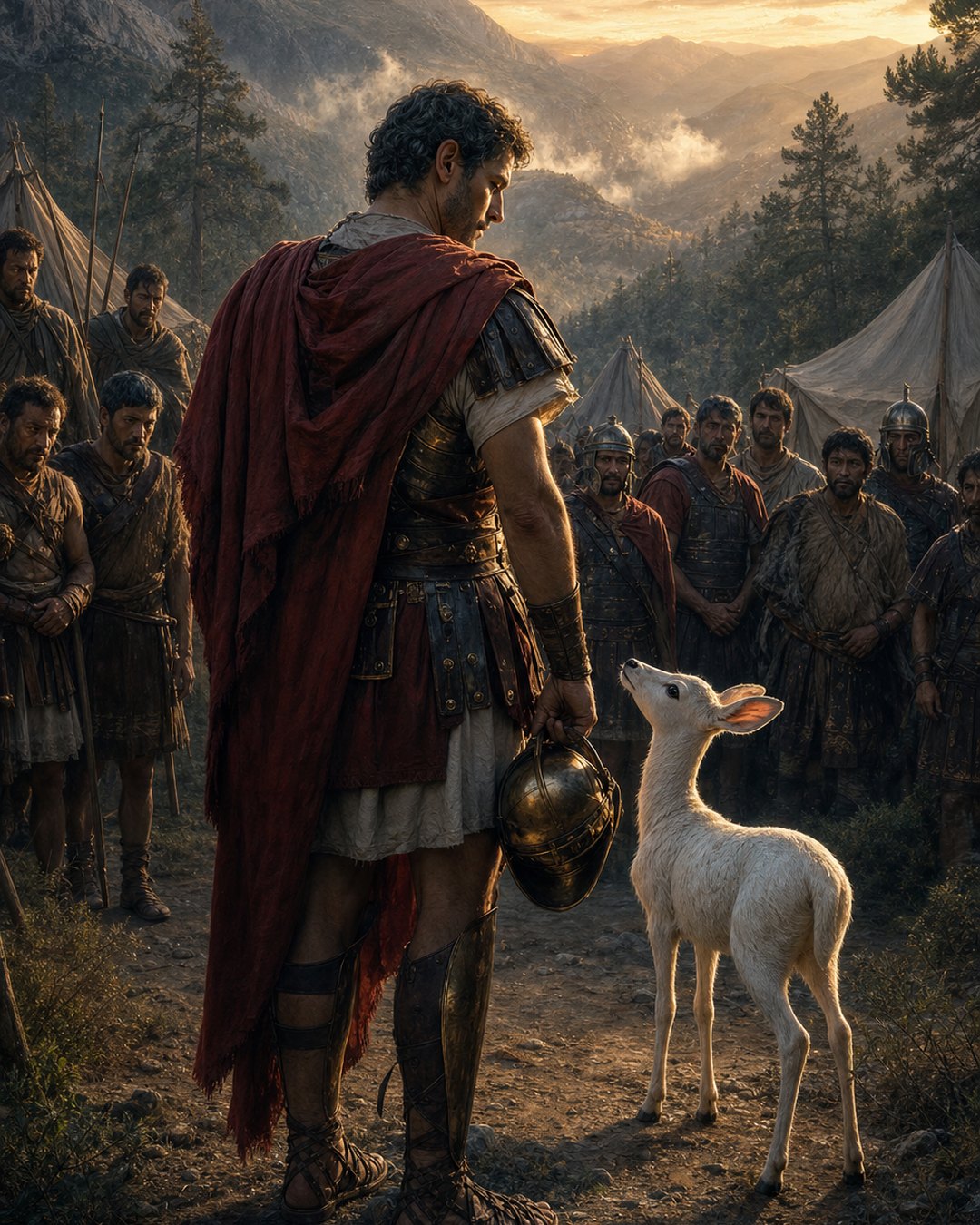
A white fawn walked through Quintus Sertorius’s camp in Hispania as if it belonged beside the commander’s chair. It answered his call, followed him through crowds and appeared at moments when news had turned favorable. Sertorius said the animal came from Diana. His soldiers could watch an ordinary military report become a divine message before their eyes.
Plutarch tells the story with enough detail to expose the mechanism. Sertorius had agents and informants. He received intelligence privately, then announced that the fawn had revealed what others could not know. The performance joined surveillance, timing and religious expectation. It gave a Roman exile commanding a mixed coalition a source of authority that did not depend on a decree from Rome.
A one-eyed exile needed a coalition
Sertorius had built his reputation through endurance and deception long before the fawn appeared. Plutarch says he swam the Rhone in armor after defeat and later entered a Celtic camp in disguise to gather intelligence for Marius. He lost an eye in the Social War and treated the wound as an honor that everyone had to see. His authority rested on the image of a commander who noticed more and endured more than other men.
Politics made that reputation dangerous. Sertorius opposed Sulla, left Italy as his faction collapsed and tried to establish himself in Hispania. He was Roman, but his survival depended on communities with good reasons to distrust Roman governors. He reduced burdens, remitted taxes and stopped forcing towns to lodge soldiers in private homes. He also armed supporters and prepared for the armies Rome would send against him.
This was neither a conventional provincial command nor a simple revolt. Sertorius needed Romans, Lusitanians and other Iberian allies to accept one strategy. The coalition could not draw legitimacy from the government that had declared him an enemy. Military competence helped, but competence is often invisible between battles. A tame white animal offered a daily sign that fortune and divine favor remained close to the commander.
Spanus brought an impossible gift
Plutarch names the giver as Spanus, a Lusitanian. A hunter had encountered a doe that had recently given birth and captured the fawn. Its body was entirely white, a rarity striking enough to turn an animal into a marvel before anyone attached a religious story to it. Spanus presented it to Sertorius.
The commander did not leave the fawn as a wild trophy. He made it gentle, accustomed it to human company and taught it to come when called. It moved through the camp without fear of noise or crowds. That training mattered. A frightened animal could ruin a revelation by bolting; a familiar one could approach on cue and make design look spontaneous.
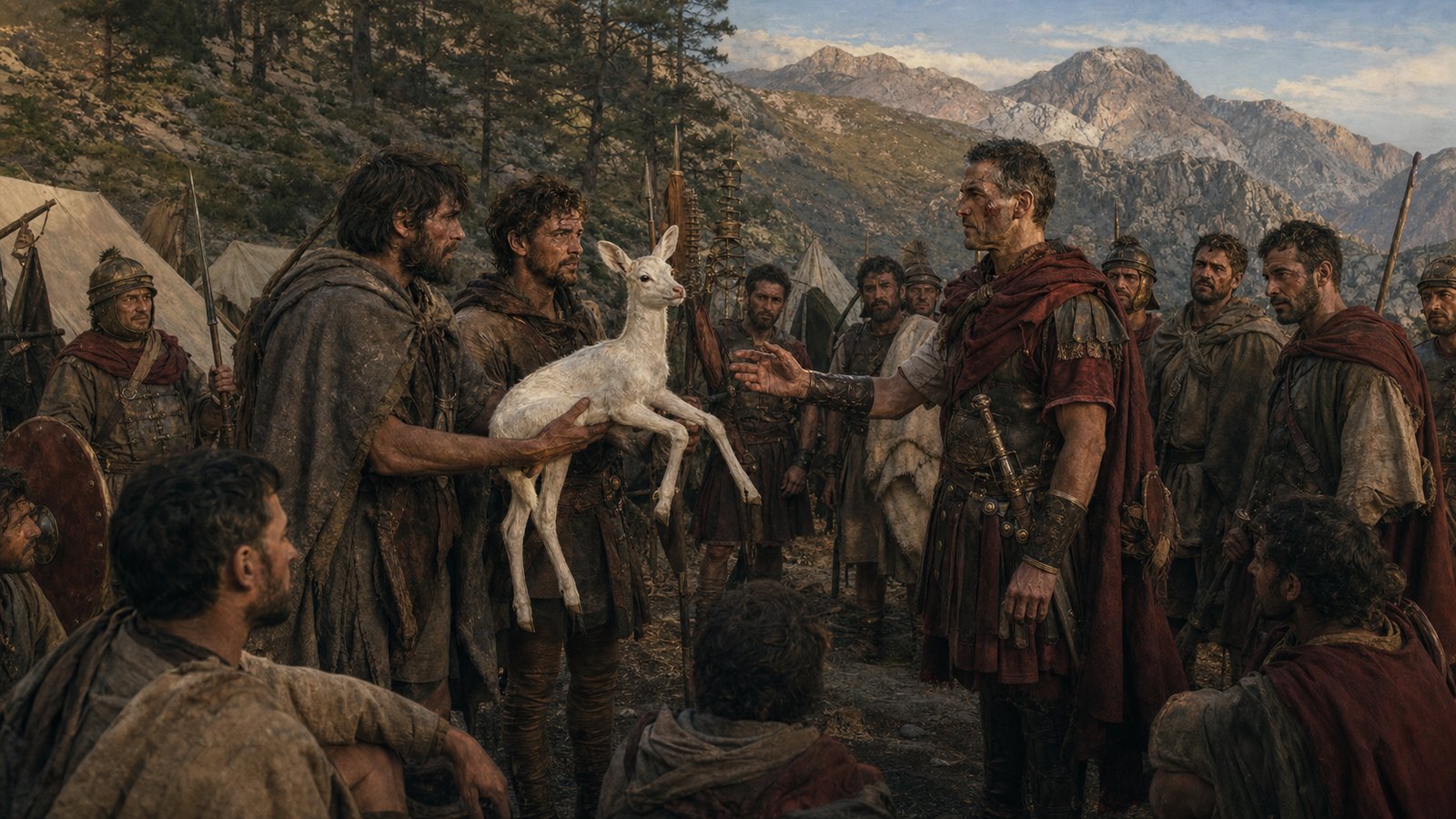
Sertorius said the fawn was Diana’s gift. The association worked on several levels. A deer belonged naturally to the goddess’s world of wild country and hunting. The animal’s white coat made it visibly exceptional. Its docility around one man suggested a relationship that ordinary soldiers could not reproduce. None of this required the camp to agree on a complicated theology. The proof seemed to walk beside him.
Agents supplied what Diana revealed
The strongest part of the story is not the claim of divine favor. It is Plutarch’s explanation of how Sertorius used information. When secret messengers reported that enemies had entered his territory or that a city had changed allegiance, he concealed the human source. He then introduced the result as something shown to him in a dream or disclosed by the fawn.
Good intelligence creates an awkward problem for a commander. Revealing its source may expose an agent. Withholding it may make an order look arbitrary. Sertorius solved both problems by giving the news a sacred intermediary. His network remained hidden, while his followers received a reason to believe that he knew what lay beyond their sight.
The method belongs beside his earlier reconnaissance in disguise. Sertorius did not wait passively for omens. He sought information, protected channels and managed how knowledge reached an audience. Rome’s military culture already valued signs, dreams and auspices, as the army’s use of omens before battle makes clear. The fawn let him bring that familiar logic into an insurgent camp without Rome’s official priests.
Plutarch says Sertorius would announce good news first. He did not burden the animal with every setback. Successful outcomes trained the audience to remember a pattern: the fawn appeared, the commander spoke, events confirmed him. Selectivity made the marvel durable. A modern label such as propaganda captures only part of it. The performance also protected sources, steadied allies and compressed a complicated report into a memorable image.
The day the miracle went missing
The system had one obvious weakness. The divine messenger was alive. During confusion caused by an enemy incursion, the fawn disappeared. Sertorius was distraught enough to offer a large reward, but he ordered the finder to keep the recovery secret. That instruction shows how carefully he guarded the public meaning of the animal. Mere return was not enough; timing had to turn it back into evidence.
When favorable news arrived from the war, Sertorius assembled his soldiers. He told them that good fortune was coming. Then attendants released the recovered fawn, decorated for the occasion, and it ran toward its familiar master. The camp erupted in joyful acclamation. Soldiers escorted Sertorius as a man favored by the gods. An anxious search had been transformed into a revelation.
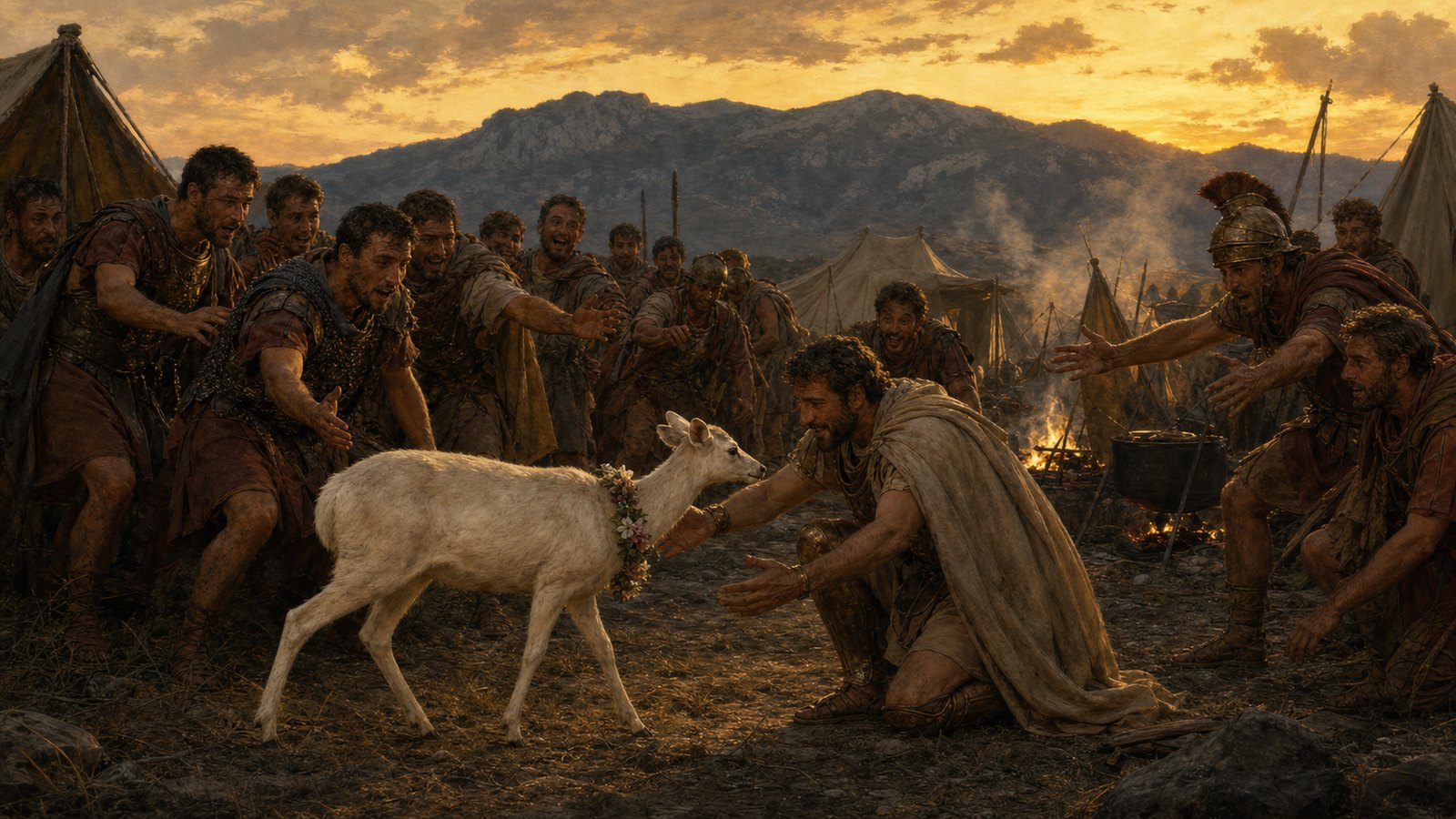
The sequence was theatrical but not empty. A commander fighting stronger Roman forces needed morale after reverses. He also needed his followers to trust information that they could not verify. The staged return gave them a shared emotional event. Relief at seeing the animal, relief at hearing good news and loyalty to Sertorius arrived together.
Belief did practical work
It is tempting to divide the camp into a cynical Sertorius and credulous followers. Plutarch’s account does not require such a clean separation. Sertorius could manipulate appearances and still respect Diana. Soldiers could recognize careful staging and still take the white fawn as favorable. Ancient political religion often worked through public action rather than private declarations of literal belief.
The animal also softened the image of a hard commander. The man who had survived civil war and directed ambushes could be approached by a small tame creature. Roman standards made units visible through metal and fabric; their power depended on shared recognition. Sertorius’s fawn performed a looser version of that work for a force assembled outside Rome’s lawful command.
His wider coalition still depended on policy. Ending abusive billeting mattered more to towns than a marvelous animal. Training, supplies and strategy mattered more in battle. Yet symbols help people understand why practical burdens belong to one cause rather than another. The fawn made Sertorius’s hidden network appear coherent. It said that his knowledge, fortune and command were parts of the same order.
The intelligence trick outlived the war
Sertorius did not defeat Rome permanently. He was assassinated by conspirators from his own side in 72 BC, and the coalition unraveled. Plutarch’s narrative nevertheless preserves him as one of antiquity’s great practitioners of stratagem. The white fawn survives because it condenses his methods into one scene.
The essential move was not inventing a miracle from nothing. It was joining three real assets: a rare and trainable animal, a functioning intelligence network, and an audience accustomed to signs of divine favor. Remove any one and the performance weakens. Without agents, the fawn reveals nothing. Without training, it cannot appear on cue. Without a coalition searching for confidence, its appearance is only charming.
That combination explains why a small animal belongs in military history. Armies move through orders, but orders depend on belief in the person who gives them and the information behind them. Sertorius made hidden reports visible without exposing their path. For a while, every quiet approach of the white fawn told his camp that their commander already knew what waited beyond the mountains.
Sources
Plutarch, Life of Sertorius 6, 11 and 20; Appian, Civil Wars 1; Internet Classics Archive; LacusCurtius.