
The Rhine did not need to be held forever to serve Julius Caesar. In 55 BC, it needed to be crossed in a way that everyone on both banks would remember. Boats could carry soldiers. Caesar rejected that solution and ordered his army to put a timber road across one of Europe’s great rivers.
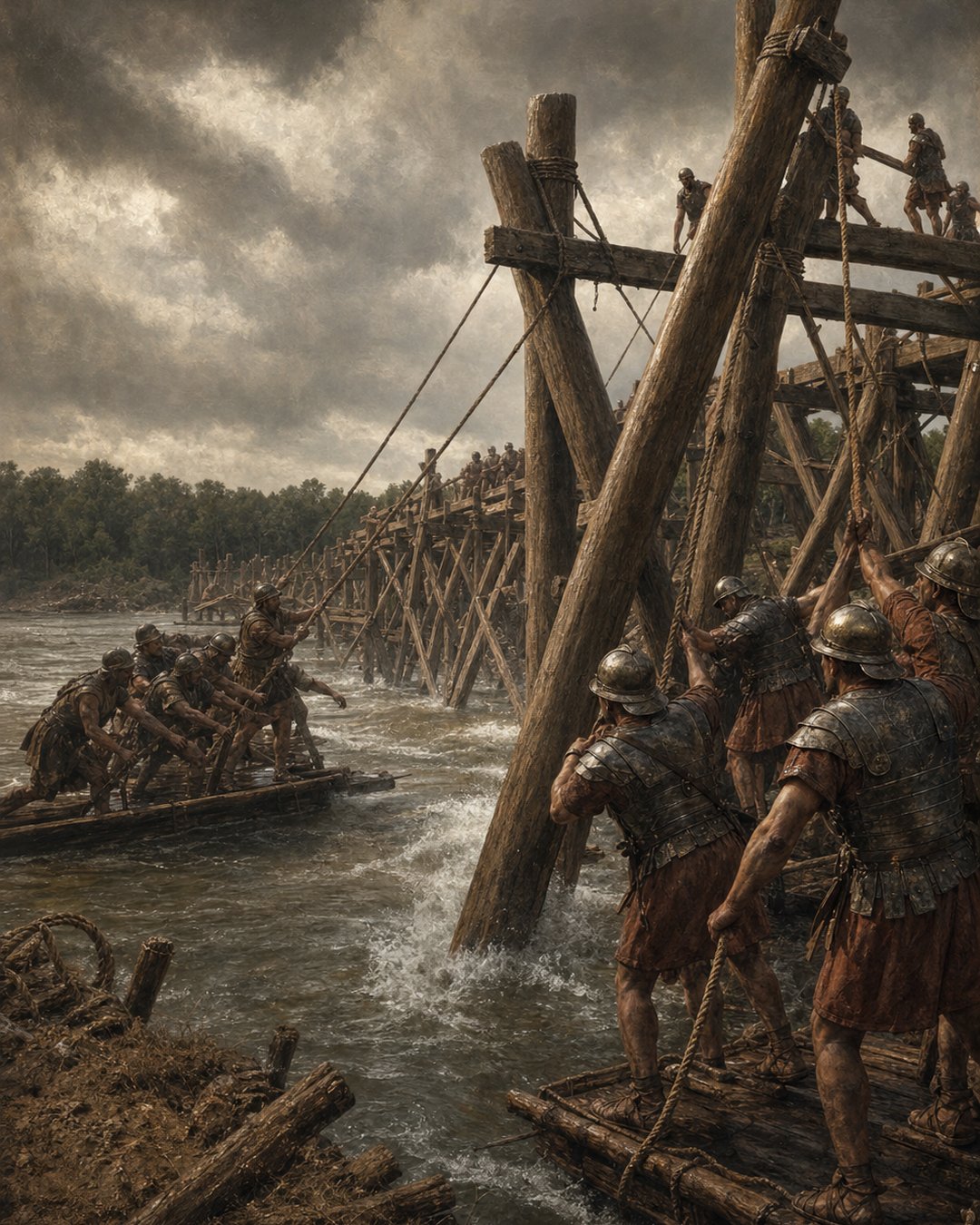
His account slows down when it reaches the structure. Heavy paired piles leaned into and against the current. Crossbeams were locked between them. Braces, lengthwise timbers, hurdles and protective stakes turned separate pieces of wood into a deck wide enough for an army. Caesar says ten days passed from the first collection of material to the finished bridge.
The crossing produced no great battle. That was part of its force. The Ubii received Roman support, the Sugambri withdrew, other communities sent envoys, and Caesar recrossed after eighteen days beyond the Rhine. He then demolished the bridge. The achievement was not possession of a permanent crossing; it was proof that a river could cease to protect Rome’s opponents whenever Roman labor decided to make it a road.
A Boat Crossing Would Have Made the Wrong Political Claim
Caesar places the decision after conflict involving German groups east of the Rhine and appeals from the Ubii, who were enemies of the Suebi and sought Roman help. He wanted to cross for several reasons: to frighten German communities, punish support given to enemies and assure the Ubii that Roman power could reach them. The river stood between all three goals and his army.
Boats offered the obvious military answer. The Ubii supplied vessels and urged him to use them. Caesar writes that such a crossing was neither safe enough nor consistent with his dignity and Rome’s. That language exposes the operation’s audience. He was not merely solving transport. He was choosing what kind of Roman arrival observers would see.
A boat bridge could still have moved troops, but it depended visibly on craft gathered from an allied people and on a familiar means of crossing. A built timber bridge transformed the army itself into the instrument. Trees, iron, ropes and organized labor would demonstrate that the legions could manufacture access rather than request it.
The same principle shaped Roman roads as instruments of control. A road was never only a surface beneath feet. It changed who could arrive, in what numbers and on whose terms. At the Rhine, Caesar compressed that logic into a temporary structure raised under the eyes of communities he wanted to influence.
Opposing Piles Made the Current Tighten the Structure
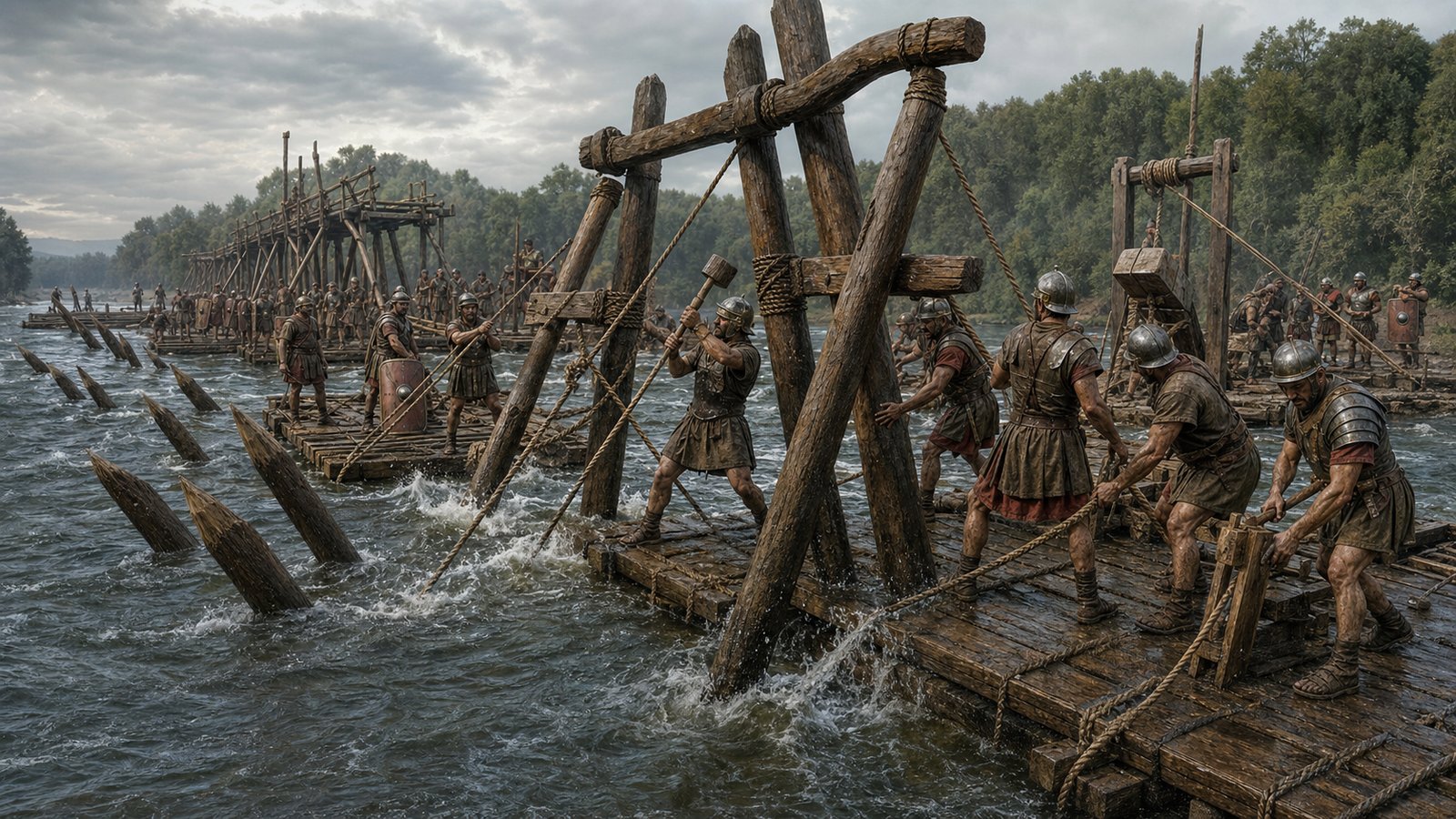
Caesar describes pairs of timbers about a foot and a half thick, joined together and driven into the riverbed at an angle. One set inclined with the direction of the water. Another pair stood downstream, separated by a broad interval and tilted the opposite way, facing the pressure of the current. The paired inclinations created a frame rather than a line of upright posts.
A crossbeam two feet wide was fitted between each opposing pair and held at both ends by braces. Caesar emphasizes the mechanical consequence: the more violently the river pressed, the more tightly the timbers were held by their opposing geometry. Whether every measurement in his concise account can be reconstructed without dispute, the design principle is clear. Force was redirected through the frame.
Lengthwise timbers linked one frame to the next. Hurdles and other material laid across them formed the roadway. Additional piles were driven obliquely downstream as buttresses, while other stakes stood upstream to intercept tree trunks or vessels launched against the bridge. The crossing had to bear marching weight and survive both water and deliberate attack.
The army’s bridge work belongs beside the repeated construction of marching camps. Legionaries were dangerous not only because they fought in formation, but because formation continued into digging, measuring, hauling and building. A river that interrupted the march became another worksite governed by coordinated tasks.
Ten Days Turned Material into a Military Schedule
Caesar claims the entire work was completed in ten days, counting from the moment material began to be collected. The statement is compact enough to sound effortless. The scene behind it was not. Timber had to be selected and cut, moved to the bank, shaped and joined; rafts or platforms had to hold workers; pile-driving equipment had to force immense posts into a moving riverbed.
The schedule mattered because delay would weaken surprise and consume supplies while hostile communities watched. Every day at the bank advertised intention without yet proving capability. Completing the deck converted a vulnerable construction camp into a route that could carry the army forward and return it safely.
No ancient account lets us count the exact workers on every task. Caesar’s ten-day claim comes from Caesar, a commander writing his own campaign narrative. It should be read as both logistical information and self-presentation. He wants readers to see disciplined speed: a difficult natural barrier reduced through planning before opponents could exploit the pause.
The result resembles the politics of permanent structures discussed in Roman bridges and governable rivers, but its time scale was inverted. Stone bridges declared endurance. Caesar’s timber bridge declared readiness. Its authority came from how rapidly it appeared and from the army waiting to move across it.
The Army Crossed to Rearrange Decisions, Not Win a Battle
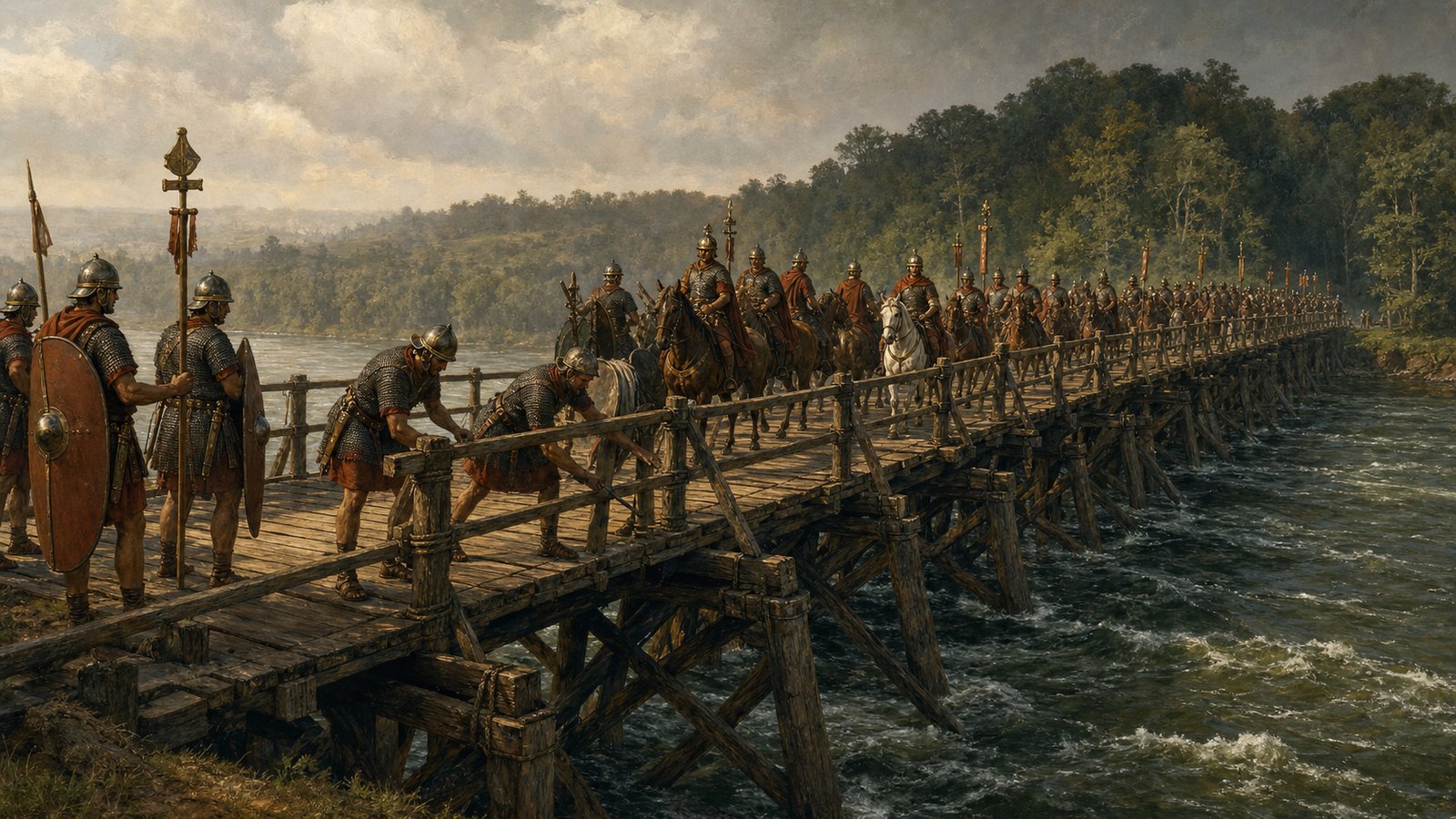
Caesar left strong guards at both ends and led the army into the territory beyond the Rhine. Envoys arrived from several communities offering hostages and obedience. He directed them to bring hostages to him and focused on the Sugambri, who had received cavalry escaping earlier fighting with Rome.
The Sugambri did not wait. Caesar reports that they removed themselves and their possessions into forests and remote places. The Suebi gathered forces deeper in their territory. The bridge therefore changed behavior without delivering the set battle that a triumphal campaign story might seem to require.
For the Ubii, the crossing made alliance material. Roman promises no longer stopped at the western bank; soldiers had physically reached their territory over a route Rome had built. For hostile groups, it removed confidence that the Rhine itself guaranteed distance. Withdrawal and negotiation were rational responses to a demonstration whose target was political calculation.
Caesar presents those effects as sufficient. He says he had frightened the Sugambri, punished them, freed the Ubii from pressure and accomplished the purposes for which he crossed. The language makes the bridge part of the argument for success. If opponents refused battle because the army could reach them, their refusal could be written as evidence that the structure had worked.
Destroying the Bridge Completed the Demonstration
After eighteen days on the eastern bank, Caesar led the army back and destroyed the bridge. A modern strategic instinct might read demolition as surrendering an expensive advantage. In the logic of this expedition, removal closed the performance. The army had entered when it chose, stayed long enough to alter decisions and withdrew without leaving an exposed timber corridor to defend.
The act also prevented the structure from becoming useful to others. A bridge carries movement in both directions. Once the legions had returned, an intact crossing could invite pursuit, demand a permanent garrison or create obligations unrelated to the immediate campaign. Destruction restored the river while preserving the memory that Rome had temporarily overruled it.
Caesar returned to the Rhine again in 53 BC and built another bridge. Repetition strengthened the threat. The technical capacity was not tied to one lucky site or one season; at least in his narrative, it was a method the army could call upon again. The absence of a permanent Roman bridge did not mean the frontier was beyond intervention.
The first crossing therefore survives as more than an engineering anecdote. Its components carried a political sequence. Angled piles resisted the water. Ten days demonstrated labor speed. The deck moved the army into allied and hostile calculations. Eighteen days showed that presence did not require annexation. Demolition turned a temporary road back into a boundary—but a boundary whose permanence Caesar had already disproved.