

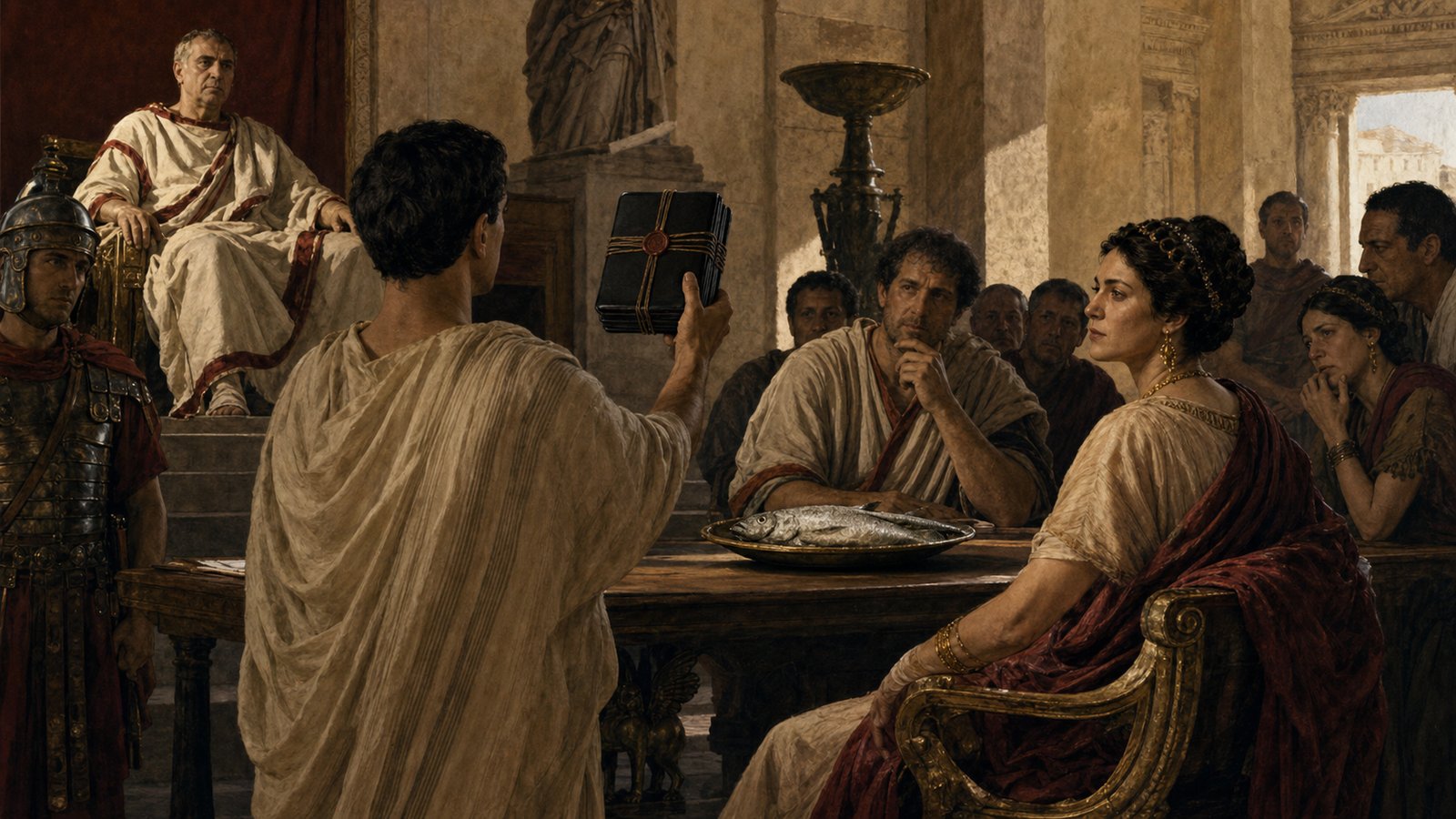
A fish lay at the center of a Roman magic case. The accusers said Apuleius had sought unusual species for secret rites. He answered as a philosopher and natural investigator: name the fish, explain the alleged spell, and show how an ordinary specimen became proof of a crime.
The hearing took place at Sabratha in Roman North Africa before the proconsul Claudius Maximus. Its background was a marriage in nearby Oea. Apuleius had married Pudentilla, a wealthy widow whose adult sons and relatives had strong opinions about her property. A family quarrel hardened into the claim that eloquence, learning and ritual expertise had allowed an outsider to control her.
Apuleius’s surviving speech, usually called the Apologia, is advocacy rather than a neutral transcript. It lets him arrange the jokes, evidence and personalities in his favor. Even through that performance, the case exposes a precise danger: when curiosity already looked suspicious, almost any object could be made to carry a sinister story.
A Recuperation in Oea Became a Marriage Crisis
Apuleius presents himself as a traveler educated at Carthage and Athens who fell ill on the road and recovered in Oea. There he renewed contact with Pontianus, a former fellow student. Pontianus’s mother Pudentilla had been widowed for years and controlled substantial property. The friendship placed a mobile intellectual inside a household whose future was already being negotiated.
According to the defense, Pontianus encouraged the marriage before turning against it under pressure from relatives. Sicinius Aemilianus emerged as a principal opponent. The conflict was not simply romantic disapproval. Marriage could redirect loyalties, residence, guardianship expectations and the eventual route of an estate. Calling Apuleius a magician gave those anxieties a criminal vocabulary.
Pudentilla was not a silent prize in Apuleius’s version. He emphasizes her literacy, decisions and correspondence because the prosecution’s theory depended on reducing her consent to enchantment. If she had chosen the marriage while understanding its terms, the darkest interpretation weakened. If she had been compelled by spells, her wealth looked captured.
The family geometry recalls the independence preserved in Sulpicia’s short elegies. In both cases, a woman’s words survive inside a tradition shaped by male editors and arguments. Pudentilla’s letters enter a legal defense, so every quotation also serves her husband’s urgent purpose.
The Charge Gathered Suspicious Objects into One Story
The allegations ranged across Apuleius’s body, studies and household behavior. His accusers mocked tooth powder and a mirror, treated his eloquence as dangerous display, questioned his interest in fish and attached ritual meaning to private acts. The list worked cumulatively. Each item made the next seem less innocent.
This was powerful rhetoric because magic rarely leaves a single agreed physical signature. A strange purchase, a nocturnal action or an unfamiliar word can acquire meaning from the story built around it. The prosecution did not need a glowing object. It needed listeners willing to see a learned stranger’s habits as coordinated concealment.
Apuleius reverses the pressure by separating the bundle. Tooth care becomes hygiene. A mirror becomes an instrument with philosophical and optical associations. Fish become specimens that require identification. Words and rituals must be tied to a specific harmful act rather than treated as a cloud of atmosphere. He keeps asking the accusation to become more exact.
That technique makes the speech unusually physical. This is not an abstract debate over whether magic exists. Bodies have teeth, markets sell fish, messengers carry letters, servants handle objects, and seals preserve documents. Every concrete thing can either anchor a claim or reveal how much interpretation the claim still needs.

Fish Forced the Accusers to Explain Their Mechanism
The fish episode is memorable because it borders on comedy without being trivial. Apuleius discusses names, shapes and natural inquiry while his opponents try to keep the specimens inside a ritual frame. He insists that an object cannot prove magic merely because a learned defendant wanted to examine it.
His answer also shows off expertise. He moves between Greek terminology, literary quotation and observations about aquatic animals. That display has two edges. It can make him look like the educated philosopher he claims to be, but it also demonstrates why neighbors might regard him as someone with uncommon knowledge and access to uncommon practices.
The defense therefore does not erase difference. Apuleius does not pretend to be an incurious provincial gentleman who never handled anything odd. He argues that intellectual inquiry supplies a better causal explanation than sorcery. Fish were obtained because natural bodies were worth studying, not because their names or organs automatically opened a hidden route to Pudentilla’s will.
The distinction matters beside Scribonius Largus’s torpedo-ray treatment. Roman writers could examine an animal’s strange effect without separating medicine, natural history and wonder as neatly as modern disciplines do. Unusual knowledge was real; the courtroom question was what action and intent followed from it.
Pudentilla’s Words Contested the Story of Enchantment
Documents allowed the defense to move from insinuation toward sequence. Apuleius invokes Pudentilla’s letters, marriage arrangements and provisions for her sons to argue that the union was deliberate. A sealed or authenticated text could not eliminate dispute, but it gave the proconsul language produced before the final courtroom performance.
One contested letter contained wording that the accusers treated as an admission that Apuleius was a magician. He answers by demanding the larger context and by attacking the way the message had been used. A clipped phrase can look like confession when family sarcasm, complaint or persuasion has been removed from view.
Inheritance remained beneath the exchange. Apuleius stresses that he did not seize Pudentilla’s estate and that her sons remained protected. These assertions are advocacy and must be read as such, yet they reveal what he thought the judge needed to hear. The marriage had to be detached from a scheme in which enchantment ended in financial capture.
The evidentiary contest resembles the correspondence behind Pliny and Trajan’s provincial trial procedure. A Roman governor did not merely encounter rules; he received allegations, questioned people, weighed status and interpreted texts. The Apologia gives that process a defendant who is determined to control every frame.
The Speech Survives, but the Courtroom Does Not Speak Evenly
Claudius Maximus presided as proconsul, and Apuleius addresses him as a cultivated judge capable of recognizing philosophy. The flattery is strategic. By constructing a shared world of education, Apuleius tries to move himself from the category of obscure ritual specialist into that of respectable intellectual. His accusers are pushed in the opposite direction, toward ignorance and malice.
No equivalent prosecution speech survives beside the Apologia. We hear Pudentilla through passages selected by her husband, opponents through his caricature and the judge through the expectations embedded in an advocate’s address. Modern readers can reconstruct accusations and social pressures, but they cannot recover every witness or interruption as if a complete court record remained.
The outcome is inferred from the speech’s survival and Apuleius’s later career: he was not destroyed by the charge. The defense likely succeeded, although the text does not preserve a clerk’s neat final verdict. Its greatest evidentiary value lies less in a dramatic acquittal scene than in the machinery of accusation it preserves.
That machinery turned biography into a crime theory. Travel suggested rootlessness. Education suggested secret expertise. Fish suggested ritual ingredients. Marriage suggested coercion. Wealth supplied a motive. Apuleius broke the chain by making each link carry its own weight instead of borrowing force from the others.
His performance was not modern scientific skepticism. He lived in a world where ritual, religion, philosophy and natural inquiry overlapped, and he was willing to advertise spiritual seriousness. The narrower achievement was forensic: he compelled ordinary objects to return to their contexts. A fish had a species, a letter had a full passage, a marriage had negotiations and a widow had a voice.
The courtroom at Sabratha survives through one brilliant, interested narrator. That imbalance demands caution, but it also preserves a rare anatomy of suspicion. Apuleius won space to explain before resemblance became guilt. His most effective defense was to show that the prosecution had mistaken a collection of suggestive things for a demonstrated act.