
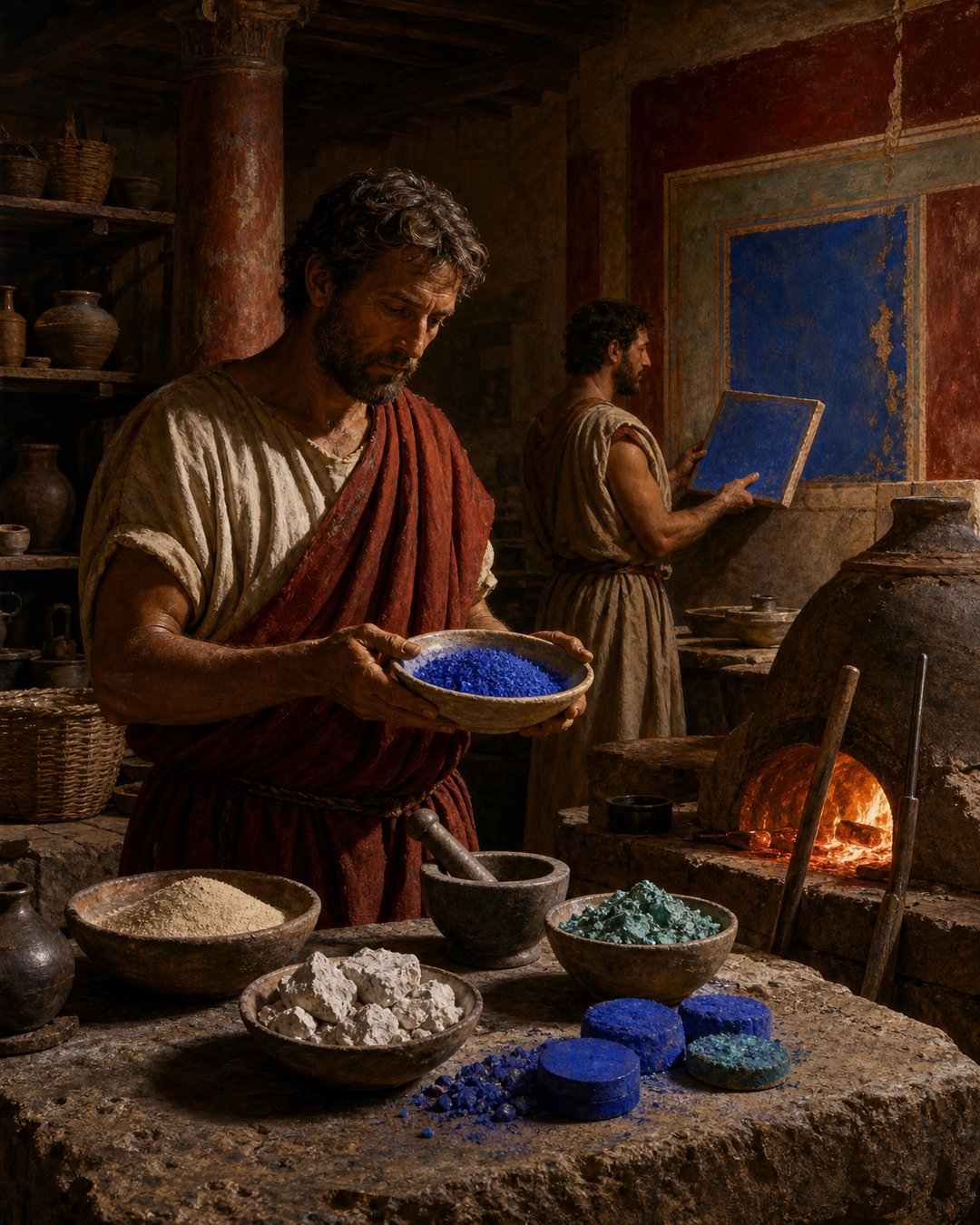
A Roman wall can lose its blue without losing the material that made it blue. To the eye, weathered plaster may look grey, brown or almost bare. Under the right illumination and camera, scattered particles answer with a strong near-infrared glow invisible to human sight.
Those particles belong to Egyptian blue, a synthetic pigment whose manufacture began long before Roman rule and spread through Mediterranean workshops. Roman builders and painters knew it as a usable blue material. Vitruvius described a version made from sand, copper and mineral additives heated together at Puteoli.
The ancient furnace and the modern detector are reading the same substance in different ways. Craftspeople wanted a controllable colour. Conservators exploit the crystal structure left behind. Between them lies a chain of mixing, firing, grinding, painting, burial, fading and rediscovery.
Blue Began as a Furnace Product, Not a Mined Stone
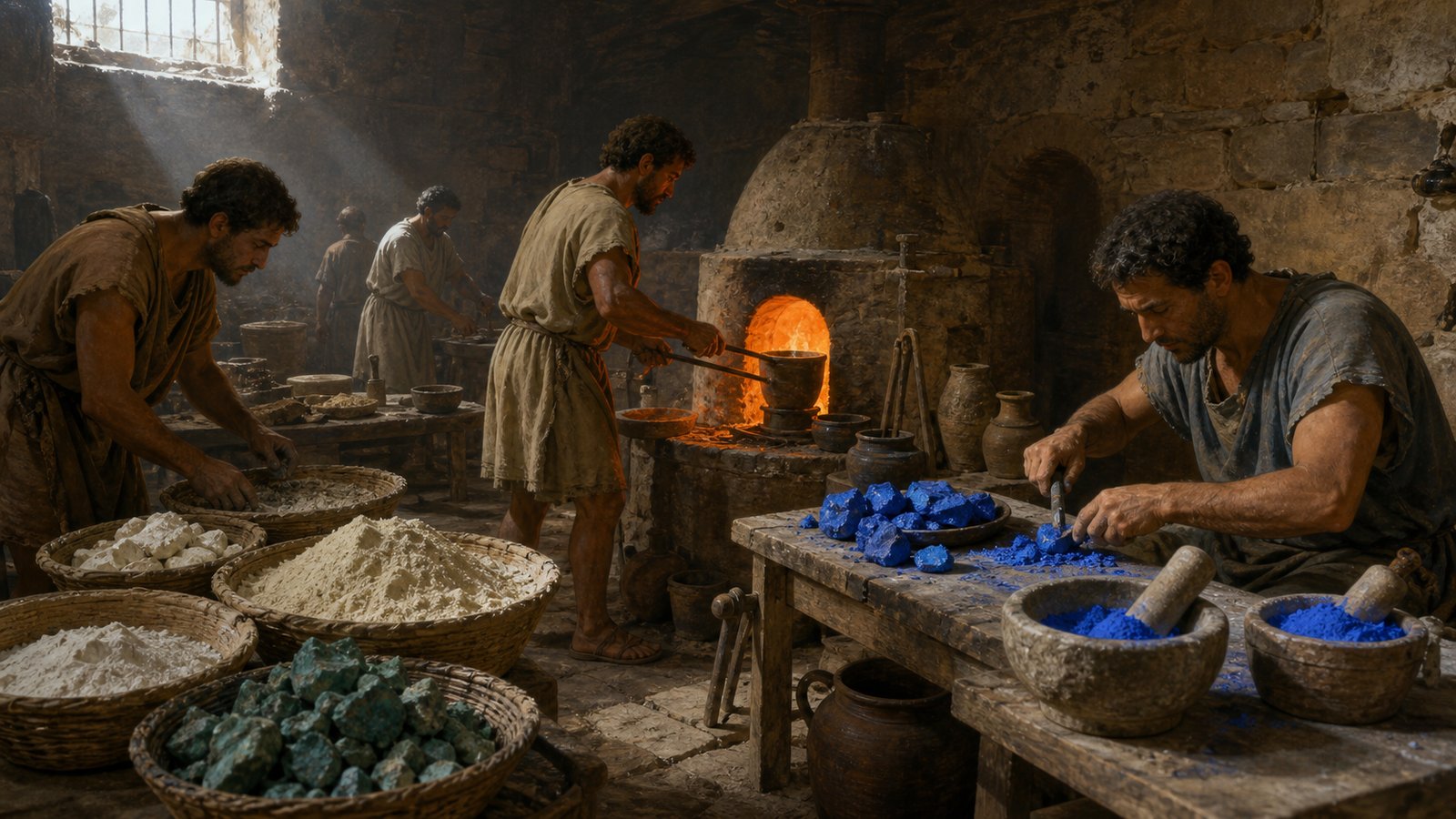
Egyptian blue was manufactured rather than simply crushed from one naturally blue rock. Its characteristic phase is the copper calcium silicate now called cuprorivaite. Producing it required silica, a calcium source, copper and an alkali flux to react under sustained heat.
That recipe made colour an exercise in controlled transformation. Pale sand and lime did not predict the finished blue by appearance. Copper-bearing material supplied the chromatic element, while firing created a new crystalline compound. The workshop had to manage proportions, temperature, atmosphere and time closely enough for the reaction to succeed.
A failed firing had several possible faces. Material could remain partly unreacted, fuse into a dark glassy mass or emerge with too little of the desired blue phase. The surviving recipes do not specify a universal visual test, but repeated manufacture would teach workers to read colour, fracture, hardness and the behavior of a cooled cake under the hammer. Quality control began before the pigment reached a painter.
The fired product could emerge as blue frit, cakes or granules. Workers then broke and ground it for use as pigment. Grain size mattered: coarse particles and finely ground powder do not scatter light in the same way, so processing could alter tone and handling even before a painter mixed a binding medium.
This manufactured route differs from Roman murex purple, where repeated biological extraction and dyeing attached colour to fibres. Egyptian blue belonged to mineral chemistry and the painter’s surface. Both demanded specialist sequences that a finished luxury colour concealed.
Vitruvius Compressed a Workshop into One Recipe
In Book 7 of On Architecture, Vitruvius describes the making of a blue pigment he calls caeruleum. He locates production at Puteoli and instructs that sand be ground with copper filings, formed into balls with moisture and fired in an earthen vessel until the ingredients unite.
His account is valuable because it gives actions rather than merely naming a commodity. Grinding increases contact, moisture allows shaping, the vessel contains the charge and heat drives reaction. Yet the short passage omits details a practicing workshop would learn through repetition: exact furnace temperature, duration, fuel management and how to judge a failed batch.
Experimental and analytical studies therefore treat the text as evidence, not a complete modern formula. Different raw materials and firing conditions can produce mixtures of phases, colours and textures. The goal was not a laboratory-pure crystal. It was a reliable pigment that could be broken, traded, ground and applied.
Puteoli also places colour inside a port economy. Copper, sand, mineral fluxes, fuel, ceramics and customers could converge there. A synthetic pigment depended on movement before it reached a wall: materials into the furnace, frit out to painters and finished rooms into the social performance of architecture.
Painters Used Blue as an Ingredient in Light and Shadow
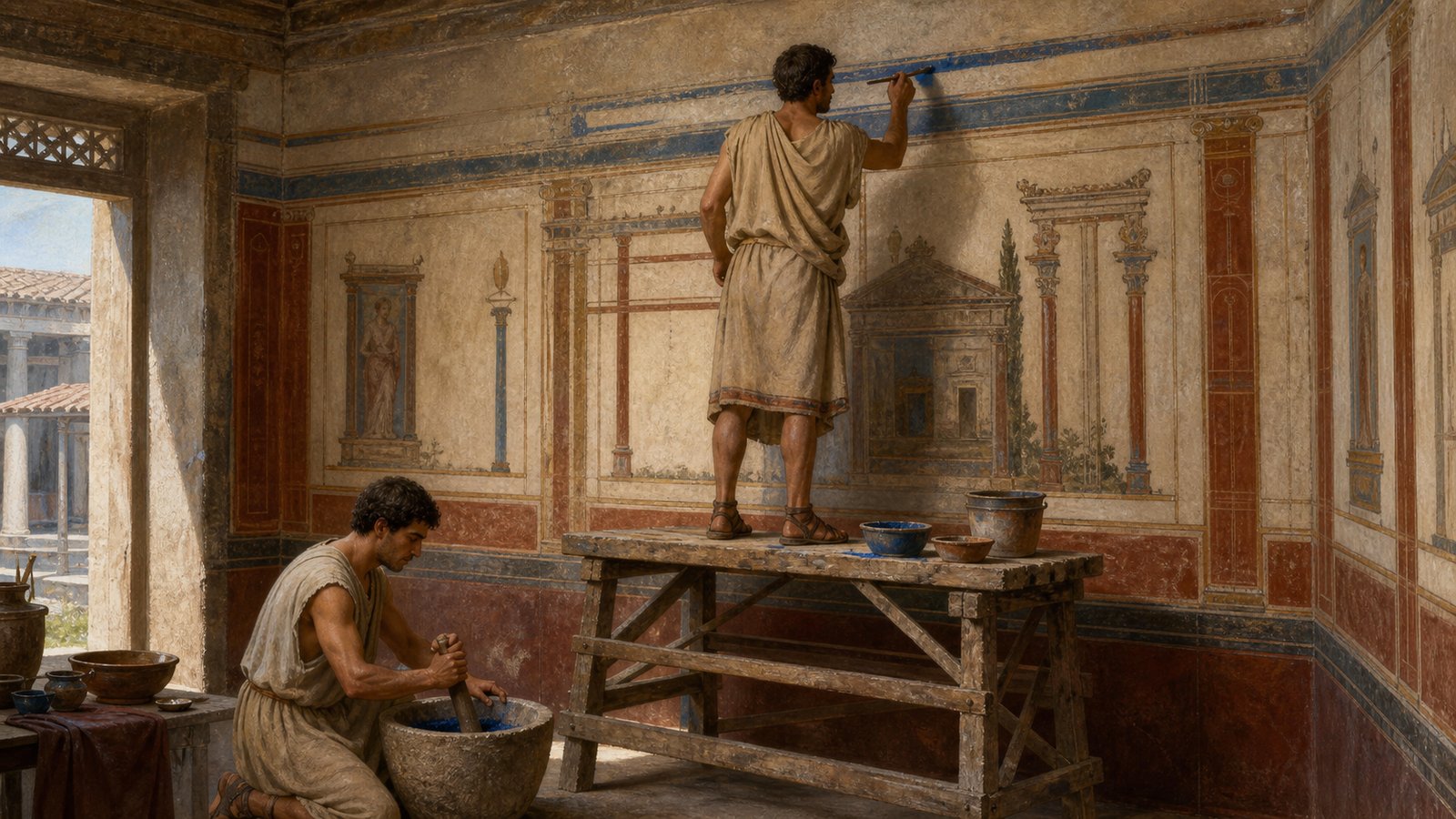
Roman painters did not need to cover every surface in saturated blue for the material to matter. Studies of Romano-Egyptian mummy portraits have found Egyptian blue used in mixtures and underlayers, including places where the visible result was not obviously blue. A small addition could cool a shadow or modify depth.
That practice makes naked-eye inspection incomplete. A faded face, garment or background may retain blue particles that once adjusted modelling without declaring themselves as a blue field. Painters managed optical relationships, not just a list of named colours.
The same layered thinking appears in Roman wall painting on prepared plaster. Surface timing, pigment behavior and finishing all affected what viewers saw. Egyptian blue could be applied in ways suited to its chemistry rather than assumed to behave identically to every earth pigment.
Expense and availability also shaped decisions. A manufactured pigment represented fuel, copper, skilled firing and grinding. Using it sparingly in mixtures could still change a composition. Detection methods are important precisely because economic value and artistic effect do not always correspond to a large visible patch.
Near-Infrared Light Makes Lost Particles Answer
Cuprorivaite absorbs energy under visible-light excitation and emits strongly in the near-infrared region. Human eyes do not see that emission, but a suitably filtered and sensitive camera can record it. The result is often a bright map against a darker surface.
The method is called visible-induced luminescence imaging. It can reveal tiny concentrations across a broad object without removing a sample from every spot. Conservators illuminate the surface, block the reflected visible light from the detector and record the longer-wavelength response associated with the pigment.
This does not mean every bright infrared pixel automatically proves a complete historical reconstruction. Imaging identifies a material response; context, microscopy and complementary analysis still matter. Contamination, restoration history and mixed layers can complicate the map. The glow locates evidence, not intention by itself.
The optical surprise has a distant cousin in the Lycurgus Cup’s changing colour. Both involve ancient material structures interacting with light in ways their makers could control without modern particle physics. Egyptian blue differs because its hidden emission has become a practical conservation tool.
A Modern Image Can Recover an Ancient Decision
Infrared luminescence has transformed survey work because it can show distribution before a conservator chooses where to sample. On a mummy portrait or wall fragment, the map may reveal blue in a garment fold, flesh shadow, border or background that ordinary photography flattens into another colour.
The information changes questions. Instead of asking only whether an artist owned blue, researchers can ask where it entered the sequence, whether it was mixed, whether different areas share a material, and how later abrasion altered the visible design. A nearly colourless particle field can preserve the route of a brush.
Production studies complete the circuit. Microscopy and chemical analysis distinguish crystalline phases and unreacted ingredients; experimental firing tests how changes in raw material or heat affect them. Imaging then follows the successful blue product across objects without requiring destructive sampling at every point.
No single Roman workshop manual survives with batch records, wages and failure notes. Vitruvius offers a compressed procedure, archaeological pigment preserves material outcomes, and modern experiments test possible conditions. Each source answers a different question. Treating them as interchangeable would make the reconstruction look more certain than it is.
The pigment’s durability is not simply that every painted blue remains vivid. Surfaces erode, binders fail, soot accumulates and particles become buried beneath alteration layers. The durable feature is the material response that can persist after appearance changes. A colour can become archaeologically quiet without becoming chemically absent.
Egyptian blue therefore carries two histories of control. Ancient artisans controlled ingredients and furnace heat well enough to create a synthetic crystalline colour. Modern conservators control illumination and filtering well enough to make those crystals signal again. The wall does not return to its first-century brightness, but it can disclose where blue once worked.