
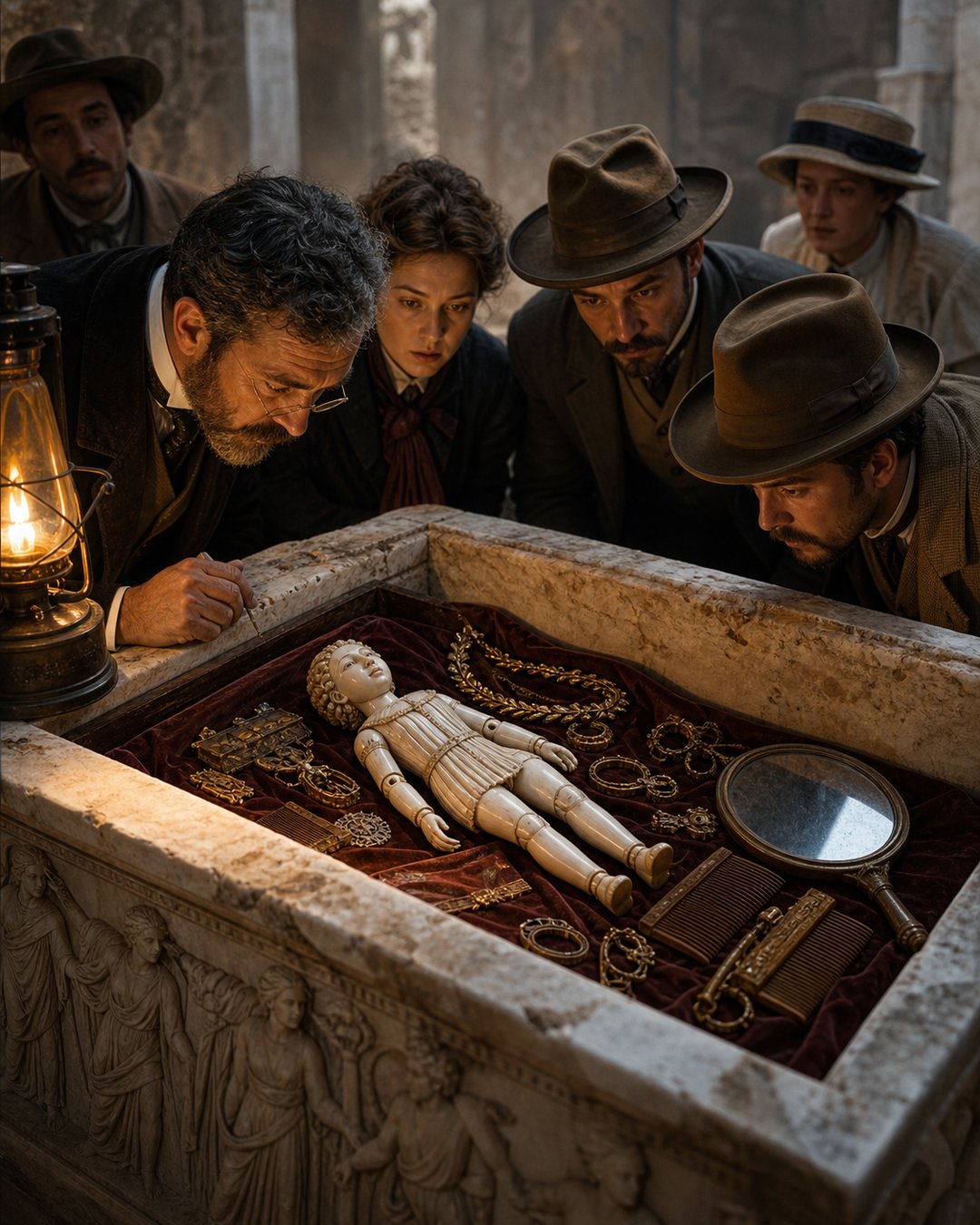
On 12 January 1889, a Roman name came back into public view with an object small enough to hold in two hands. Excavators working near the Tiber had reached a sealed marble sarcophagus. Inside lay the remains of a young woman identified by its inscription as Crepereia Tryphaena, accompanied by gold, gemstones, grooming tools, an amber distaff and a finely carved ivory doll.
The discovery was unusually powerful because the pieces had not arrived as scattered museum acquisitions. The sarcophagus, the name and the grave goods belonged to one closed burial. Another inscribed sarcophagus, for Crepereius Euhodus, had been placed beside it. Together they tied a family to a place and a moment in second-century Rome.
That completeness can tempt a modern viewer to turn every object into a certainty about Tryphaena’s last days. The better story is more disciplined. Her burial reveals wealth, craft and expectations surrounding a young Roman woman with rare clarity, while the things it cannot prove are part of its importance too.
A Building Site Opened a Sealed Roman Room
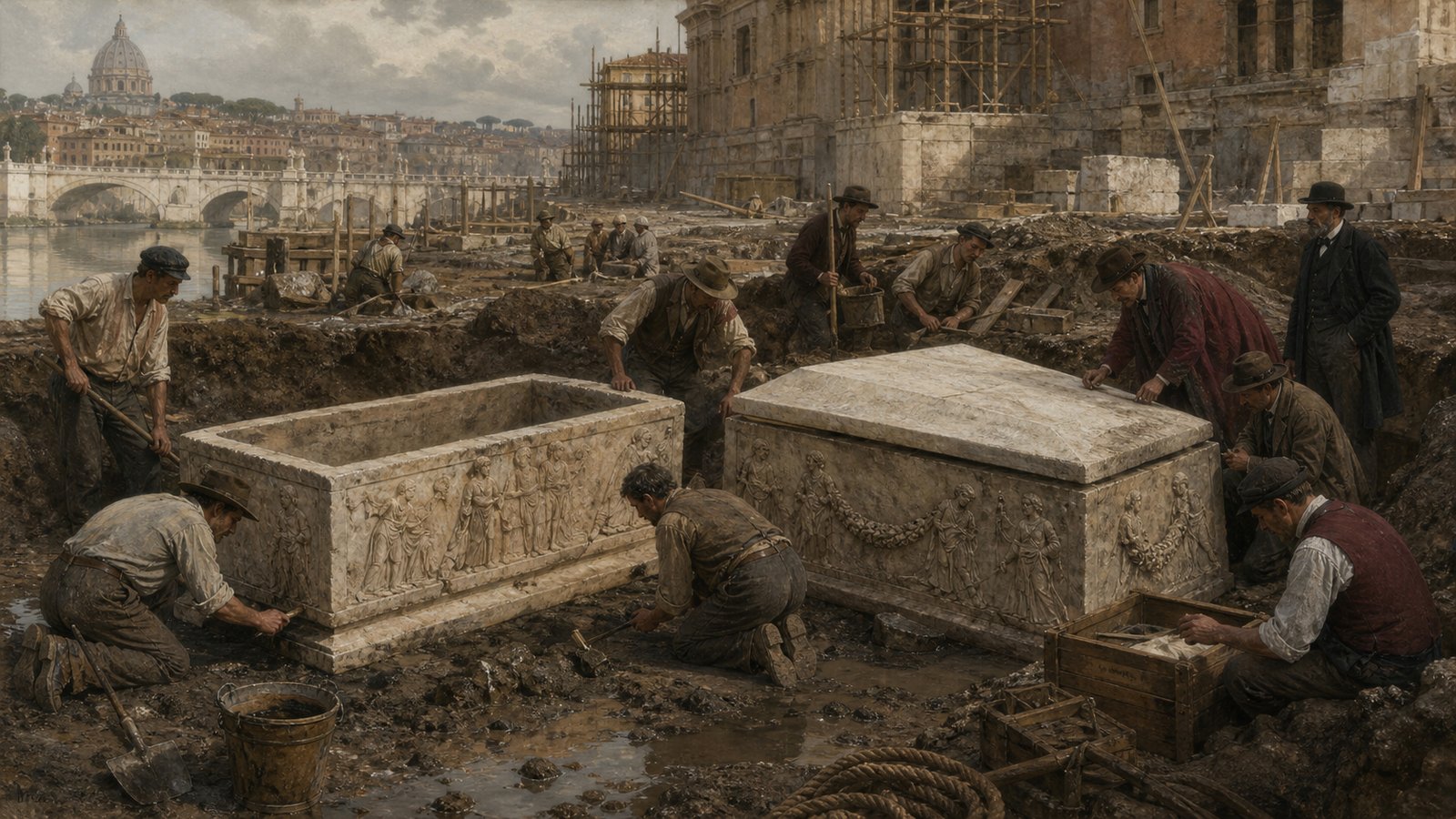
The find occurred during foundation work for Rome’s Palace of Justice in 1889. The Centrale Montemartini records that the two sarcophagi were discovered side by side and identifies their occupants from the funerary inscriptions: Crepereia Tryphaena and Crepereius Euhodus. The museum dates Tryphaena’s precious assemblage to around the middle of the second century AD.
Excavation transformed an urban construction site into a tightly documented encounter with one burial. Tryphaena’s coffin was still intact. That mattered because an unopened context preserves associations that loose objects cannot: which jewels were buried with the same person, which tools belonged to the same deposit and which doll occupied the same funerary space.
The place added another layer. The museum states that the burial ground had belonged to the imperial domain since Nero’s time. It also describes the Crepereii as wealthy freedpeople probably connected with service to the imperial household. The wording is appropriately cautious. The assemblage demonstrates prosperity; the proposed institutional connection places that prosperity within a plausible social setting without turning it into a known job description.
Tryphaena therefore reaches us differently from Regina’s inscribed tombstone in Britain. Regina’s monument compresses migration, marriage and status into words and carved imagery. Tryphaena’s name is joined to a sealed inventory. One burial speaks mainly through epigraphy; the other lets inscription and possessions test each other.
Gold and Amber Marked More Than Decoration
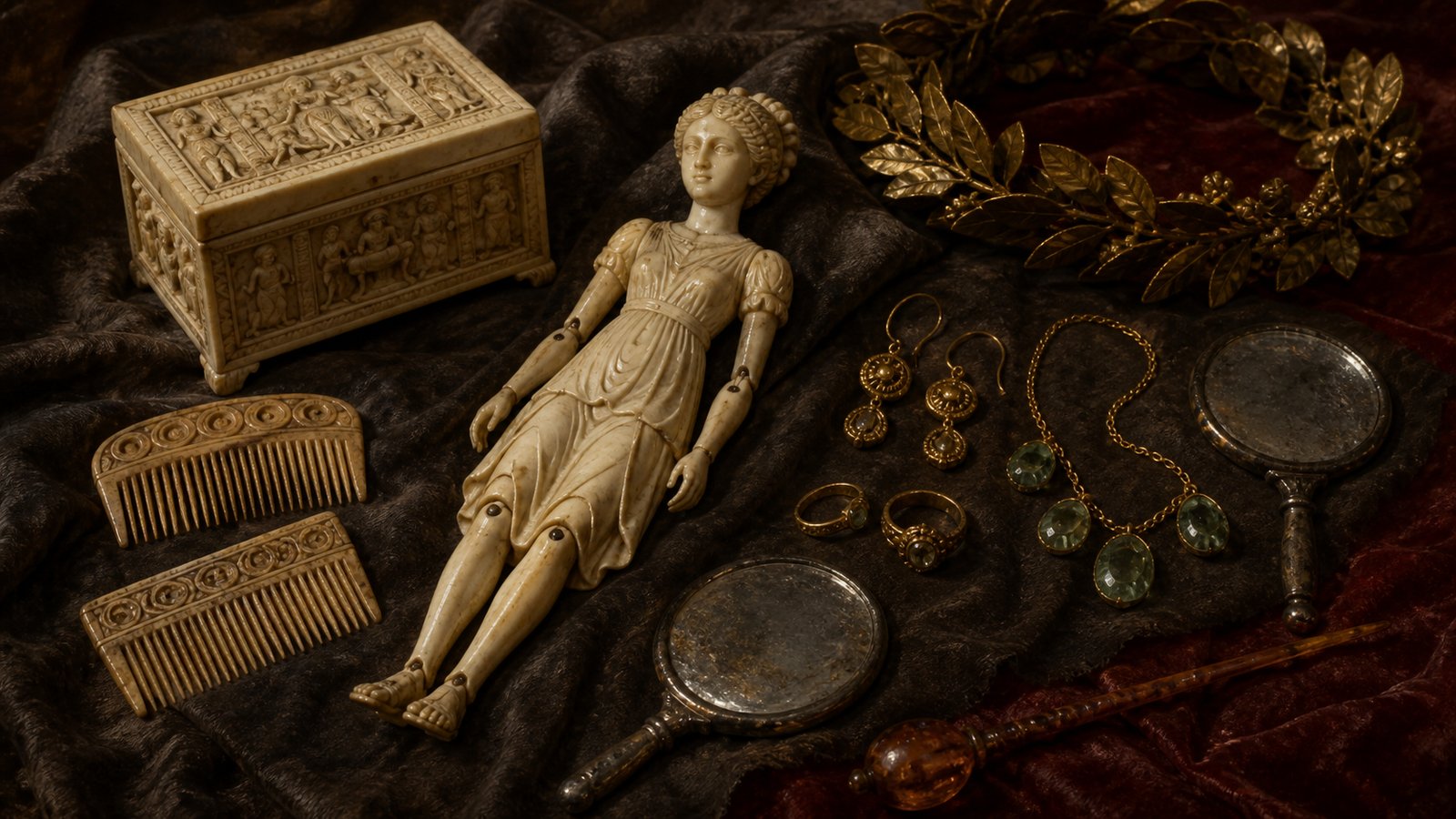
The official museum inventory lists gold jewelry and precious stones among Tryphaena’s grave goods. It identifies a gold necklace with green beryl pendants, earrings, rings, a brooch with an amethyst intaglio and a wreath of myrtle leaves. These are not generic claims about Roman luxury; they are surviving pieces assigned to this burial.
An amber distaff brought textile work into the same display. A distaff held fibres before spinning, but an amber example in a wealthy grave was also a crafted and costly object. It connected an idealized domestic activity with conspicuous material value. The burial presented competence and refinement together rather than separating work from status.
Small grooming objects narrowed the scale from public rank to the hand. The doll’s kit included tiny bone combs and small mirrors, while a casket organized miniature belongings. These pieces made care, arrangement and appearance material. Their reduced size also linked them to the doll rather than simply duplicating the adult jewelry at random.
The result resembles a biography assembled from things, but it is not a complete household census. Funerary selection is deliberate. Objects placed in a sarcophagus tell us what mourners chose to place there, not every possession Tryphaena used while alive. That distinction is as important here as it is when reading a preserved Pompeian silver table service: survival creates a coherent group, but interpretation still depends on context and selection.
The Doll Was a Machine for Human Movement
The ivory doll is the object that makes the assemblage immediately recognizable. Centrale Montemartini classifies it as a mid-second-century funerary object and records its origin in the 1889 Palace of Justice excavation. The museum’s broader account calls it very refined and emphasizes its articulated limbs.
The articulation was not a vague resemblance to a human figure. Arms and legs were made as separate parts connected at joints, allowing the body to be posed. Fine carving concentrated attention on the face, hair, hands and feet. The maker had to combine miniature sculpture with a mechanism strong enough to move without destroying the ivory around each pin.
The doll also possessed things of its own. The grave included the small casket, combs and mirrors presented as part of its kit. A ring with a key could turn storage into play or ritualized imitation. Adult practices of dress, grooming and safeguarding valuables were reduced to a scale a child or young woman could manipulate.
Yet the object should not be flattened into the modern category of a toy bought only for amusement. Its expensive material, skilled joints and funerary placement gave it several possible lives: treasured possession, model of adult femininity, display of family means and finally a chosen companion in burial. Those roles can coexist. The sealed context proves association, not a single private emotion.
A Myrtle Wreath Invites a Bridal Story—Carefully
The museum identifies a bridal wreath of myrtle among the grave goods. Jewelry, a young woman’s burial and an elaborate doll have encouraged the interpretation that Tryphaena died near the time of marriage. The group undeniably contains objects that Roman viewers could connect with feminine transition and adult household expectations.
But archaeological evidence does not preserve an eyewitness account of the intended wedding. The sarcophagus tells us that mourners buried these objects together. It does not record a ceremony date, a spoken promise or the precise reason each piece was selected. A compelling reconstruction becomes misleading when possibility is repeated as biography without qualification.
The doll sharpens the problem because dolls could stand at the boundary between childhood and adult roles. Its jewelry and grooming kit imitate mature practices, while its poseable body and miniature scale belong to a world of handling and play. The object makes transition visible without naming one exact day on which that transition was supposed to occur.
This uncertainty is productive. Instead of asking whether the doll proves a wedding-eve tragedy, we can ask what kinds of identity the burial’s designers wanted to keep together: youth, wealth, feminine cultivation, textile symbolism, family connection and an image of adulthood that had not been discarded. The answer is richer because it does not require an invented scene.
The Closed Assemblage Restored a Person, Not a Script
Tryphaena’s burial is exceptional less because any one class of object is unknown than because so many classes remain attached to one named individual. Marble inscription, sarcophagus, bodily remains, precious jewelry, amber, ivory, grooming tools and a second family burial entered the record together. That chain gives the museum display unusual explanatory power.
It also exposes the unequal ways Roman lives survive. Public officials may leave offices, laws and literary portraits. A young woman can be visible through what others buried with her. The evidence is intimate but mediated: objects were crafted by specialists, acquired by a prosperous household and arranged through a funerary decision made at death.
The 1889 discovery added another historical layer. Archaeologists, workers, journalists and visitors encountered the burial in a modern capital reshaping the Tiber district. The sealed coffin became an event in their city as well as evidence from ancient Rome. Today its permanent display at Centrale Montemartini continues that movement from private grave to public interpretation.
The responsible conclusion is neither that the objects say nothing nor that they say everything. They securely identify material, date, association and extraordinary expenditure. They strongly illuminate skilled ivory work, personal adornment and the symbols attached to a wealthy young woman. They leave motives, conversations and an exact marriage story beyond direct proof.
Crepereia Tryphaena’s name survives because stone named her. Her presence feels unusually close because the doll, casket, combs, mirrors, distaff and jewels remained beside her. The distance remains because possessions cannot speak in sentences. Archaeology’s achievement is to hold both truths at once: a life can come sharply into focus without becoming a script.