
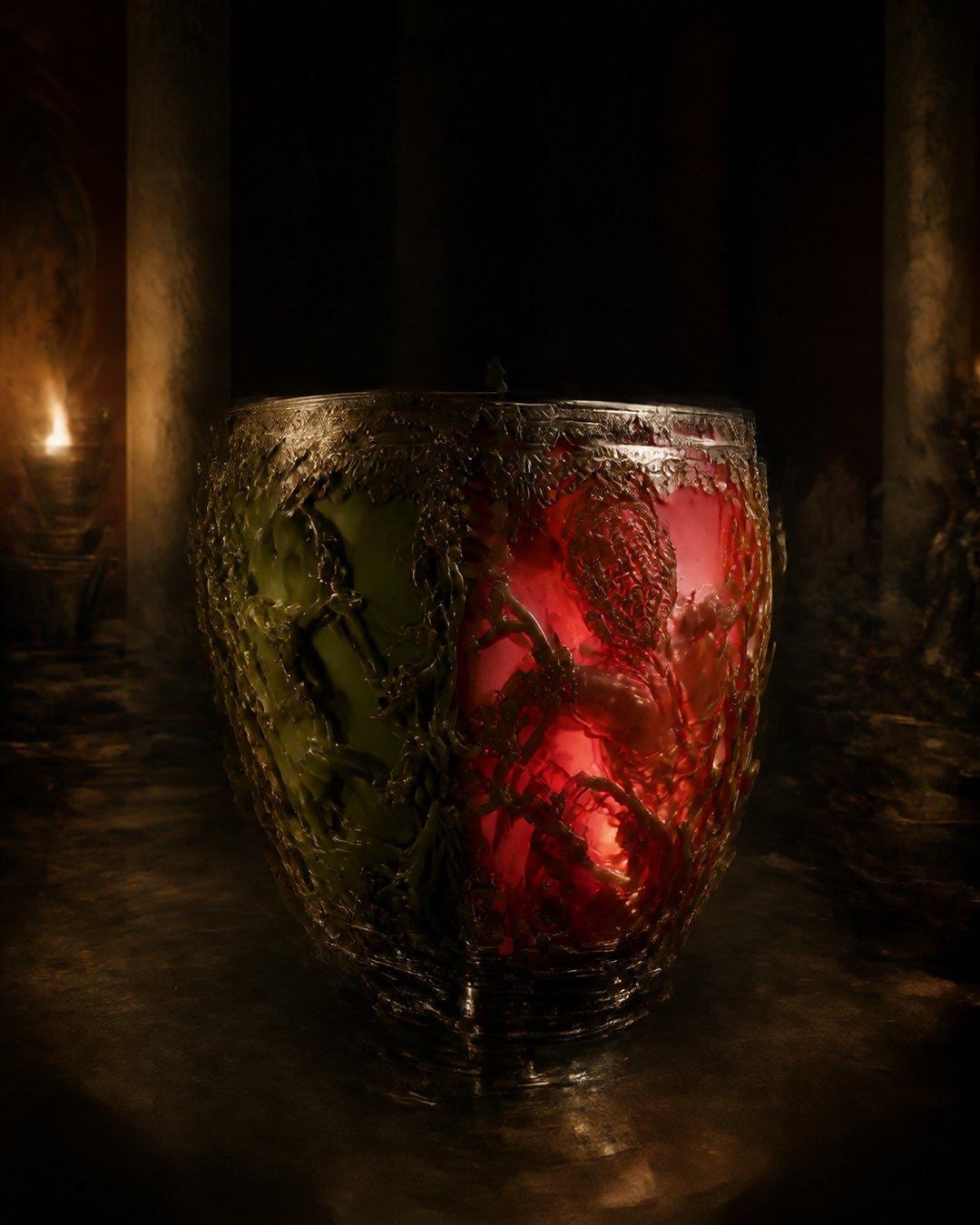
A dark green cup can become red without dye, heat or a change of vessel. Put light in front of the Lycurgus Cup and much of its glass reads as olive green. Move the light behind it and the body glows ruby. The object seems to change its material while remaining still.
The effect belongs to a fourth-century Roman cage cup now in the British Museum. Its body was not merely painted or wrapped. Cutters removed glass around a web of figures and vines until the decoration stood away from the inner vessel. The cup therefore asks two questions at once: how was its colour made, and how did it survive the carving needed to reveal the scene?
Those questions lead through a workshop rather than toward a single miracle. The colour comes from minute metal particles dispersed in the glass. The cage comes from prolonged grinding, drilling, cutting and polishing. Neither achievement needs a story about secret modern science. Together they reveal Roman specialists pushing a luxury material to an edge where one mistake could erase months of work.
The Cup Performs Differently for Two Kinds of Light
Reflected light reaches the cup from the viewer’s side and returns from its surface. Under that condition the glass appears green. Transmitted light passes through the vessel from behind before reaching the eye, and the same body appears red. The change is called dichroism because the material presents two colours under different lighting conditions.
This is not a thin surface trick. Analysis found tiny metallic particles embedded through the glass. They interact with visible light at a scale far below anything a Roman craftsperson could see directly. Their presence changes which wavelengths are scattered back and which pass through, producing the green-to-red reversal.
The surviving vessel makes the distinction unusually easy to understand because it is complete. Other Roman fragments show related behaviour, but the Lycurgus Cup lets light travel through an entire figural composition. A museum lamp can therefore turn a technical property into a visible event rather than an abstract measurement.
The effect extends the story of Roman glassblowing beyond shaping a hollow vessel. A blown blank supplied volume, but the finished cup depended on what the glass contained and on what later cutters dared to remove.
Gold and Silver Worked in Quantities Too Small to See
Modern analysis identified particles containing silver and gold. Published estimates place the metals at only a few hundred parts per million for silver and a few dozen for gold. The particles are roughly tens of nanometres across, so optical microscopes cannot resolve them; electron microscopy was needed to inspect their scale and distribution.
At that size, the particles scatter light selectively. Blue wavelengths are scattered more strongly while red light passes through, giving transmitted light its ruby appearance. Reflected light receives a different balance and the cup looks green. The physics is precise even if the ancient route to the composition remains uncertain.
Uncertainty matters. The metal concentrations are so low that scholars have questioned whether a glassmaker deliberately measured them. Silver could have carried traces of gold, or material from another workshop process could have entered a larger melt and then been diluted. The few surviving dichroic fragments do not all behave identically, which argues against effortless control.
Calling the cup “Roman nanotechnology” captures the scale but can hide the workshop problem. Roman artisans did not need a modern theory of nanoparticles to notice that a batch of glass behaved exceptionally. They needed the skill to preserve, shape and exploit a rare material whose recipe may never have been fully stable.
A Thick Blank Had to Become an Open Cage
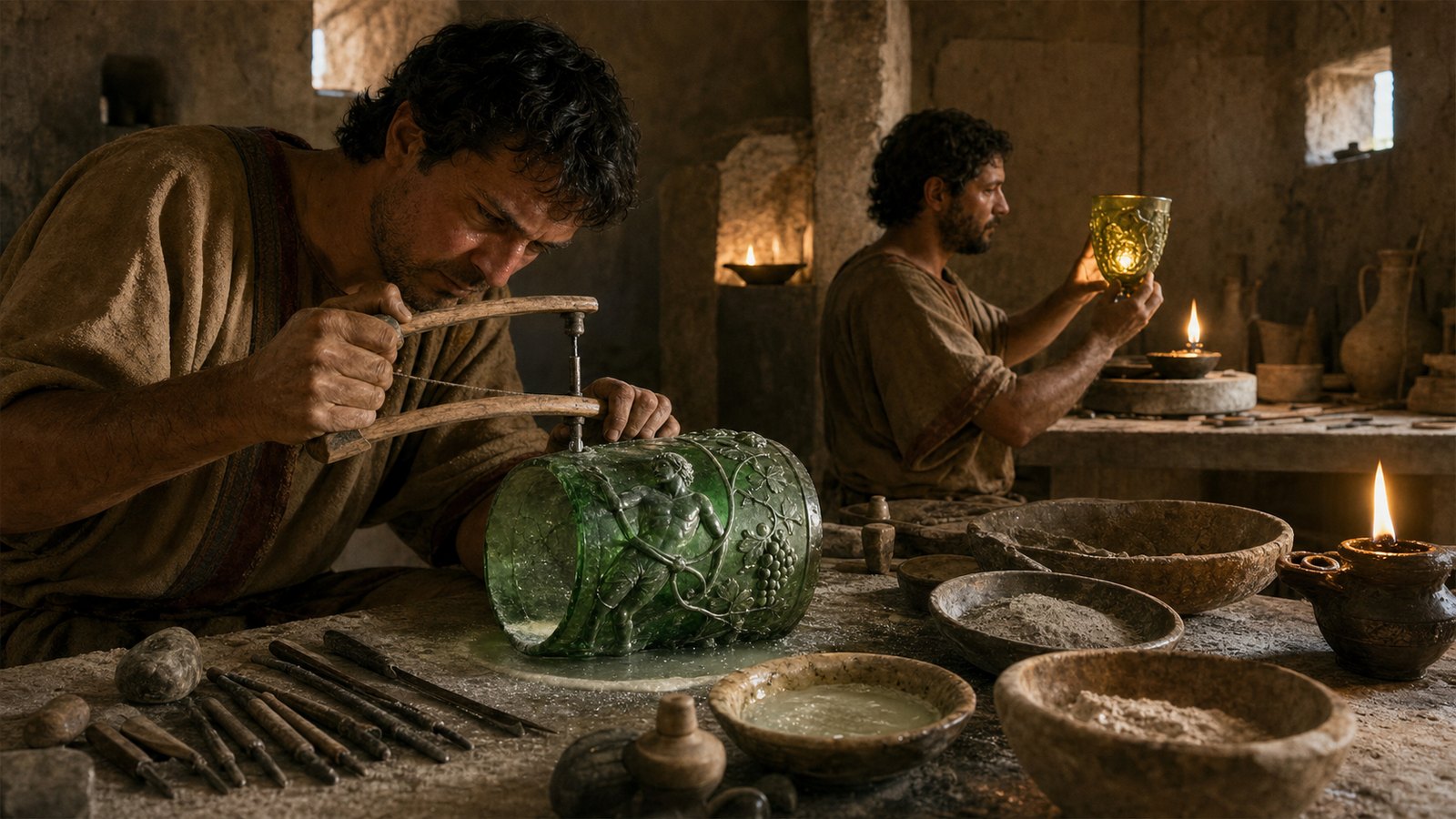
The vessel belongs to the family of diatreta, usually called cage cups. A thick blank was worked from the outside until an open network remained connected to the inner wall by small bridges. On many examples the cage is geometric. Here the surviving network carries human figures, animals and vines around the vessel.
Removing that much glass demanded controlled abrasion rather than one dramatic cut. Drills and points charged with abrasive slurry could open spaces; grinding tools could deepen channels; finer work could release limbs and vines from the background. Each stage reduced the margin for error because a snapped bridge could detach part of the scene.
The process differs sharply from lost-wax bronze casting, where a model creates a cavity to receive metal. The cage cup began as glass already present. Its relief emerged through subtraction, and the most impressive spaces are precisely the places where material no longer exists.
Behind parts of the figures, the inner wall was hollowed more deeply so that light passed through a more even thickness. This adjustment linked sculpture to optics. A bulky figure left too thick would darken differently; a carefully reduced zone allowed the mythic scene to participate in the colour change.
Lycurgus Was Caught in the Material He Tried to Master
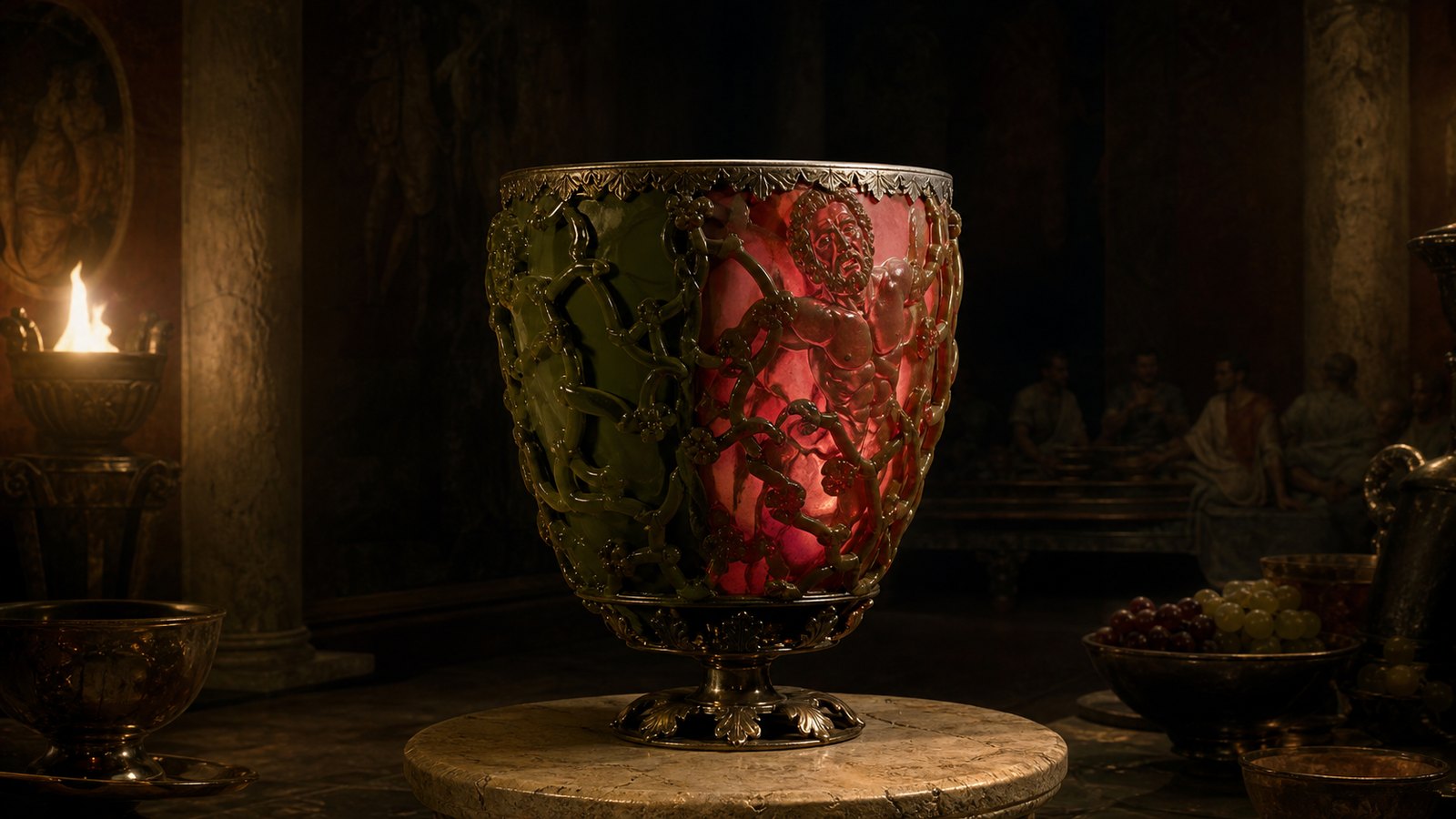
The scene shows King Lycurgus struggling against the world of Dionysus. In the myth, Lycurgus attacks Ambrosia, a follower of the wine god. She becomes a vine that entangles him. On the cup, the bound king is surrounded by figures associated with Dionysus, including the god, Pan, a satyr and a panther.
The choice turned the cage structure into narrative. Vines are not decorative borders pasted around the action; they are the mechanism of Lycurgus’s defeat. Their loops can cross the open surface, connect figures and physically trap the king while also helping the delicate network hold together.
The colours deepen that fit without proving exactly how ancient viewers interpreted them. Green can suggest the living vine, while transmitted red can evoke wine, ripening grapes or anger. Scholars have proposed such associations, but the cup carries no surviving instruction that fixes one explanation. The safe conclusion is that changing light made an already Bacchic image unusually theatrical.
The figural design is itself rare among surviving cage cups. Its narrative density required cutters to solve faces, limbs, attributes and vines in the round. A viewer turning the vessel would not encounter a repeated geometric module but a continuous crisis moving around the glass.
Its Makers May Have Worked in More Than One Workshop
The cup’s production can be separated into stages even when the exact addresses of the workshops are unknown. Raw glass was made in large furnaces, a thick vessel blank had to be formed, and specialist cutters then transformed that blank. Those skills did not have to belong to the same people or even the same region.
Egypt and the eastern Mediterranean were major glass-producing zones, while finishing could occur elsewhere in the empire. Scholars have therefore considered a chain in which unusual glass moved as a blank before reaching elite cutters. The cup’s rarity makes a specialised, expensive route more plausible than ordinary household production.
Finishing posed a final danger. The cut surfaces had to be polished until the object looked luminous rather than scratched and cloudy. Heat-assisted flame polishing has been proposed for at least part of that work, but bringing carved glass near heat risked distortion or total loss. Mechanical polishing may also have contributed.
The result preserves many decisions whose makers left no written explanation. Tool marks, thickness, bridges and colour distribution become the evidence. Archaeology reconstructs labour from the object backward, separating what can be measured from what remains a reasoned possibility.
One Survivor Carries Both Skill and Accident
The cup is dated around the late third or fourth century and measures roughly sixteen centimetres high. Its excellent preservation is extraordinary for an undercut glass vessel. It also has cracks and small losses, and the metal rim and foot seen in modern displays were added much later rather than belonging to the original Roman object.
Its documented modern history becomes clear in the nineteenth century. It entered the Rothschild collection and was sold to the British Museum in 1958. Conservation and changing displays have made the lighting effect central to the way visitors meet it today.
The object should not be reduced either to an unexplained accident or to proof that every Roman glasshouse commanded nanoscale recipes. The unusual composition may have arisen through imperfectly controlled workshop conditions. The decision to preserve the glass, form a blank and entrust it to exceptional cutters was nevertheless deliberate and costly.
When the light moves, the cup reveals several histories at once: metals dispersed beyond ancient sight, abrasive tools removing a cage from solid glass, a king caught in vines and modern analysis explaining a colour change the original makers could observe but not describe in our terms. Its achievement is not one trick. It is the alignment of material, labour and image in a single fragile survivor.