
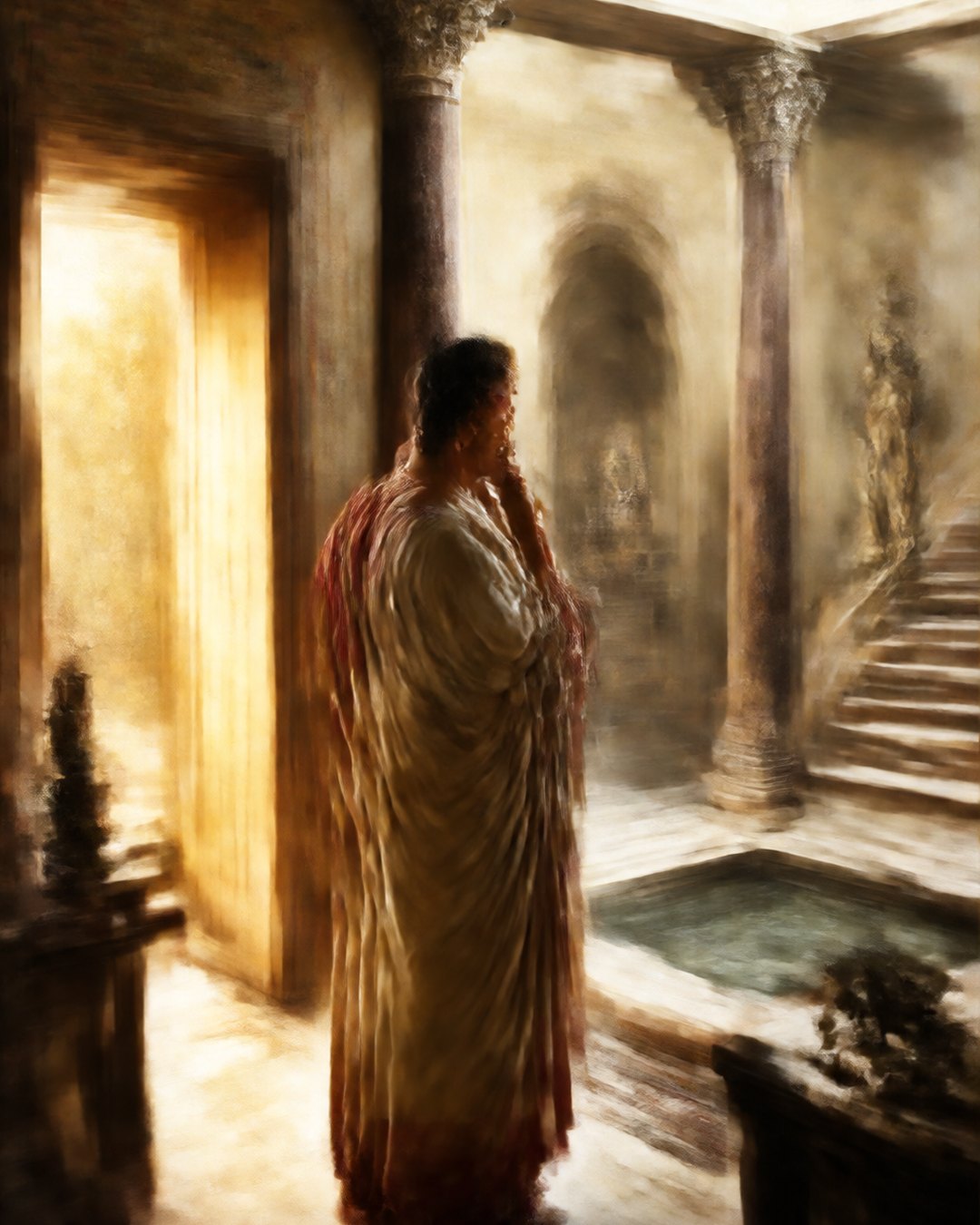
A Roman speaker could prepare for court by walking through a house without moving his feet. He began at the doorway, crossed the atrium, passed a column, paused at a couch and continued toward a staircase. At each familiar place he set a vivid mental image for one part of the speech. When the moment to speak arrived, the route supplied the order.
Quintilian describes this technique while discussing memory in the education of an orator. The earlier Rhetorica ad Herennium explains its parts with almost mechanical clarity: backgrounds provide stable locations; images represent the things to be remembered. One holds sequence. The other supplies content.
The method is often called a memory palace today, but its ancient force lies in the labor behind the metaphor. A useful route had to be distinct, spacious and thoroughly known. Images had to be unusual enough to return under pressure. The speaker trained memory by building a private architecture for public words.
Natural Memory Was Only the Starting Material
The Rhetorica ad Herennium separates natural memory from artificial memory. Natural memory belongs to the mind by birth. Artificial memory is strengthened by training and a system of rules. The distinction does not deny talent; it refuses to let talent be the final explanation for reliable recall.
That mattered to rhetoric because an orator faced long sequences, exact points and a live audience. Forgetting one paragraph did more than lose a sentence. It could break the relation between accusation and evidence, or leave a response hanging without its conclusion. Memory served argument by preserving structure.
Training also made improvement observable. A student could enlarge the number of places, sharpen weak images and rehearse the route until retrieval became faster. Failure had a location: perhaps two backgrounds looked alike, perhaps an image was too ordinary, or perhaps the speech had never been divided into manageable units.
This practical approach belongs beside the material discipline of Roman ink making. Ink made words portable on a surface. Artificial memory made an ordered version portable in the speaker. Both required preparation before language could travel.
A Background Had to Be Easier to Remember Than the Speech
In the handbook, artificial memory consists of backgrounds and images. A background is a place the mind can grasp clearly: a house, an arch, a corner or another distinct setting. It does not need to be imaginary. The strongest starting material is often architecture already known well enough to survive closed eyes.
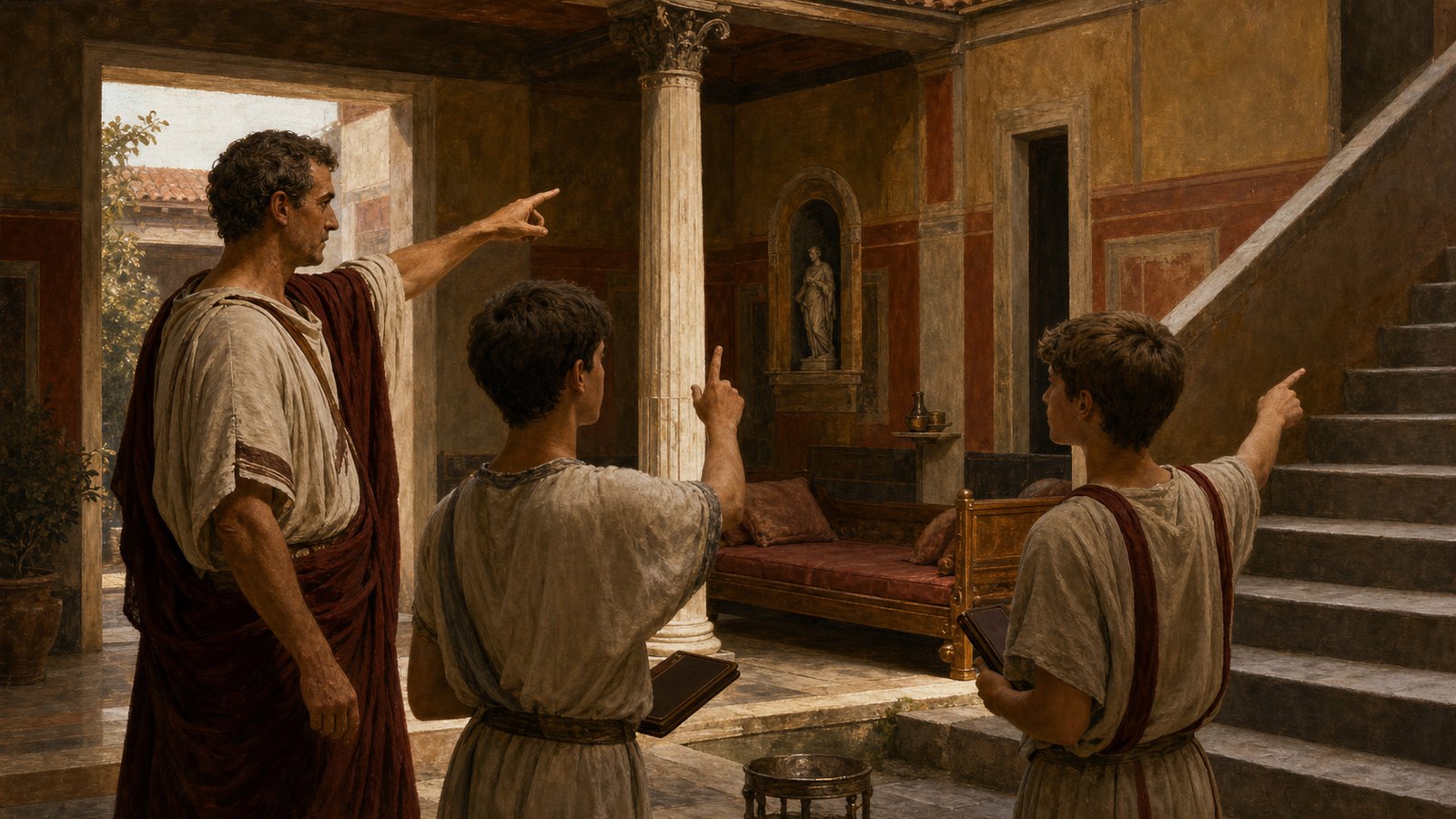
Quintilian asks the learner to fix a spacious building divided into multiple rooms. The forecourt, living spaces, bedrooms and even statues can become separate loci. The learner then assigns the first thought to the first location, the second to the next and continues in a fixed order.
Distinction prevents interference. If every corner looks the same, one thought can slide into another. The Rhetorica ad Herennium advises backgrounds that are neither crowded with passing people nor so empty and vague that they cannot be held. Moderate spacing helps each station remain an independent hook.
Architecture solves the sequence problem because a route already has before and after. A doorway comes before an atrium; a stair leads away from the lower room. The speech borrows that order. Instead of remembering an abstract list, the orator remembers where to walk next.
Strange Images Gave Abstract Points a Body
Places alone hold empty positions. Images provide what the handbook calls forms, marks or likenesses of the things to be remembered. A legal point, name or transition must be converted into something the mind can place and later recognize.
Ordinary images fade because they resemble the visual noise of daily life. The Rhetorica ad Herennium recommends striking images: exceptionally beautiful or ugly figures, comic or disgraceful scenes, unusual clothing, crowns, blood or other conspicuous details. The advice is deliberately dramatic because emotional distinctness improves retrieval.
This did not mean decorating a room at random. The image had to cue the intended thought. A person resembling a name, an object suggesting an action or a compressed scene representing an argument could give abstraction a visible body. Vividness without connection would produce a memorable distraction rather than useful recall.
The comparison between background and image is almost like writing. The handbook likens backgrounds to wax tablets and images to letters. A place is the reusable surface; the temporary image carries the current message. When one speech is finished, the same architecture can receive another set of images.
The Mind Retrieved by Moving in Order
Once the route and images were fixed, the speaker mentally revisited the locations. Quintilian describes going through the building to recover what had been deposited at each place. The ordered walk could proceed forward and, with training, backward. Sequence became navigable rather than fragile.
This is more than a chain of associations. A chain can fail when one link disappears, taking everything after it. A spatial route offers independent stations. If one image proves weak, the next doorway or alcove may still remain accessible because the architecture has its own continuity.
Retrieval had to become rapid enough for delivery. An audience cannot wait while an orator visibly searches twenty rooms. Rehearsal compresses the internal walk until the next image arrives with the next turn of the argument. The route remains elaborate during preparation but should feel immediate in performance.
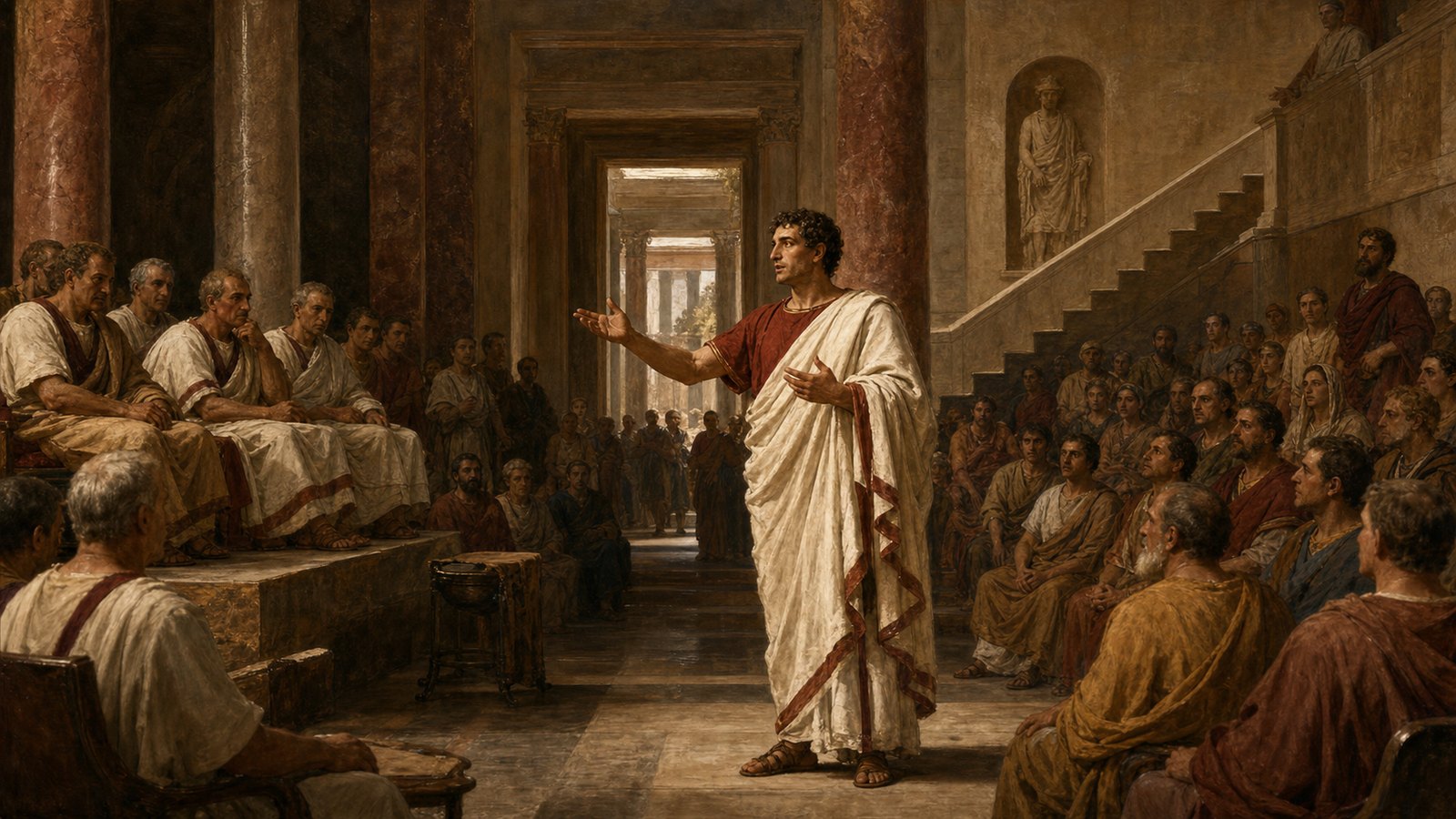
The result clarifies the scene in Cicero’s confrontation with Catiline. A forceful speech depended on more than memorable phrases. An orator also needed control over sequence while watching opponents, adjusting tone and sustaining the room’s attention.
Division Protected Memory from Its Own Weight
Quintilian does not present architectural loci as the only memory practice. He also recommends learning in parts and then joining those parts. A very long passage placed into the mind as one undifferentiated mass is difficult to inspect. Division creates units small enough to repeat accurately.
The two techniques cooperate. Sections define what must be stored; loci preserve their order. A speaker might first learn the wording or substance of one portion, then give that portion a memorable station. The route becomes an outline with enough detail attached to restore the full argument.
Attention remains essential. Quintilian warns that memory is hindered when the mind is divided. Reading, speaking, listening and arranging images all compete for mental control. Preparation therefore creates moments in which recall receives a single task before performance adds gesture, audience and interruption.
Repetition is not mindless in this system. Each pass tests whether image and location still produce the intended point. A failure can be repaired by strengthening the image, changing the location or reducing the size of the unit. Practice edits the memory structure instead of merely demanding more effort.
A Private Route Supported a Public Performance
The audience never saw the imagined house. They saw a speaker who could maintain direction without continuously consulting a written text. That freedom supported eye contact, gesture and responsiveness. Memory was not the speech’s decoration; it was the hidden infrastructure of delivery.
The method also balanced exactness and flexibility. A learner could use images to preserve wording, but loci could equally hold the substance of arguments. The orator might recover the next claim and phrase it for the moment rather than reciting mechanically. What mattered was that the route returned the right material in the right place.
No technique abolished the risk of forgetting. Similar locations, weak images, insufficient rehearsal or distraction could still break retrieval. Roman teachers responded by making those failures diagnosable. Memory became a craft with materials—place, image, order, division and repetition—rather than a gift that either arrived or did not.
An imagined house could hold an entire speech because its rooms already knew how to remain in order. Roman artificial memory borrowed that stability, populated it with impossible-to-ignore images and trained the mind to walk quickly. The public heard an argument. Behind it, the speaker moved from door to column to stair.