
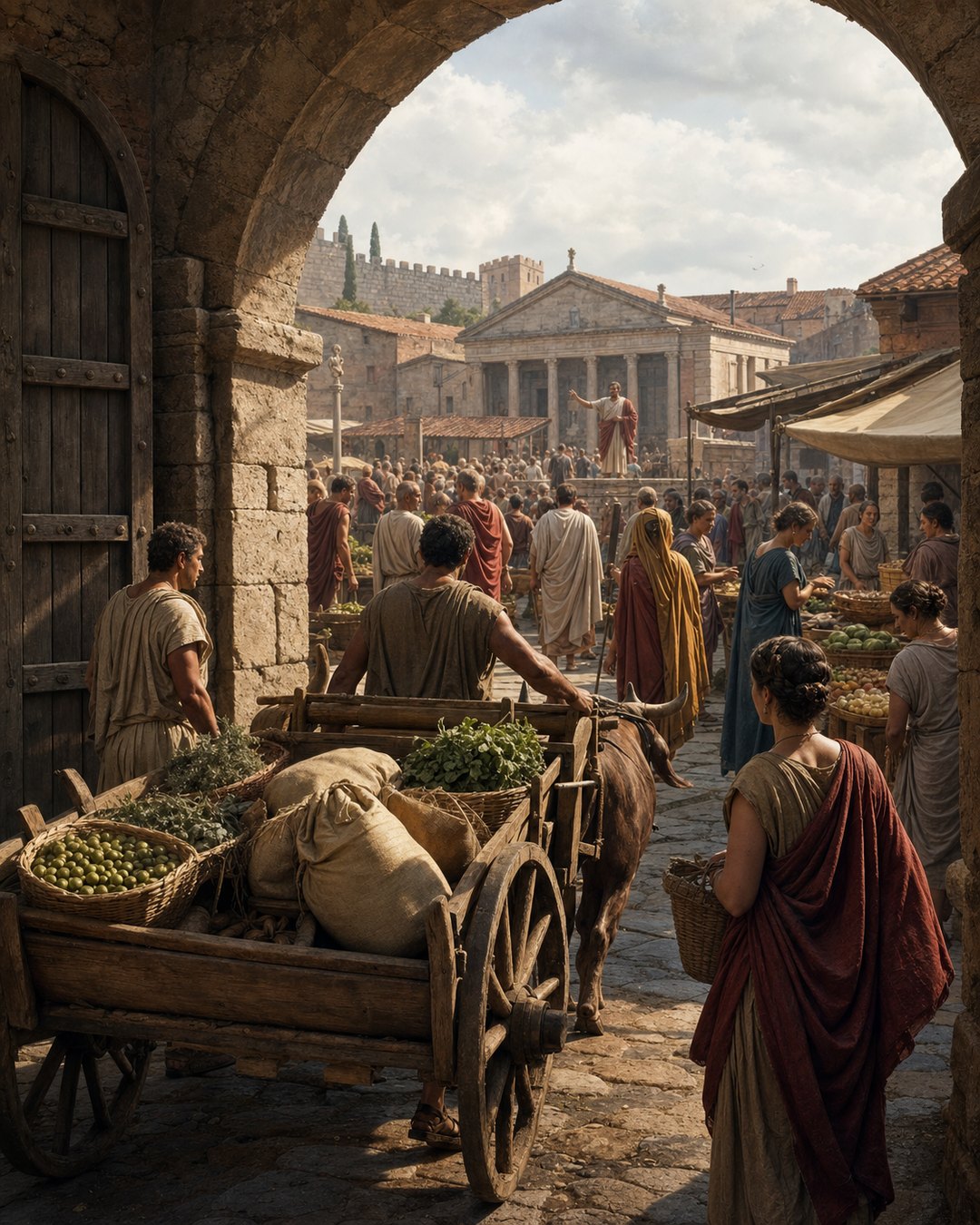
Rome’s countryside did not enter the city at random. On a recurring market day, farmers and rural buyers could plan to bring produce, settle business, hear news and return home with goods that were difficult to obtain locally. The cycle was called the nundinae, a “ninth day” by Roman inclusive counting but an eight-day interval by ours.
The market was more than a commercial opening. It concentrated people who usually worked beyond the city’s streets. That made a predictable audience for lawsuits, notices, political persuasion and rumor. A basket of vegetables and a legal appearance belonged to the same journey because the recurring day made both worth the distance.
Letters A to H Made the Cycle Visible
Roman calendars marked the market rhythm with a repeating sequence of letters, A through H. One letter identified the market day; after seven intervening days, the same point returned. The system was independent of the later seven-day week that now organizes ordinary schedules.
Inclusive counting explains the apparently awkward name. Romans counted the starting and ending day, so an interval we call eight days could be described as the ninth day. The phrase did not mean that markets drifted unpredictably. The letters made recurrence legible to anyone consulting the calendar.
This small administrative device linked different clocks. Agricultural work followed weather, season and the needs of animals or crops. Courts and magistrates followed civic classifications of days. The market letters supplied a shared short cycle. A farmer did not need urban life to become daily life; the city needed to become predictable often enough.
A Market Journey Carried More Than Produce
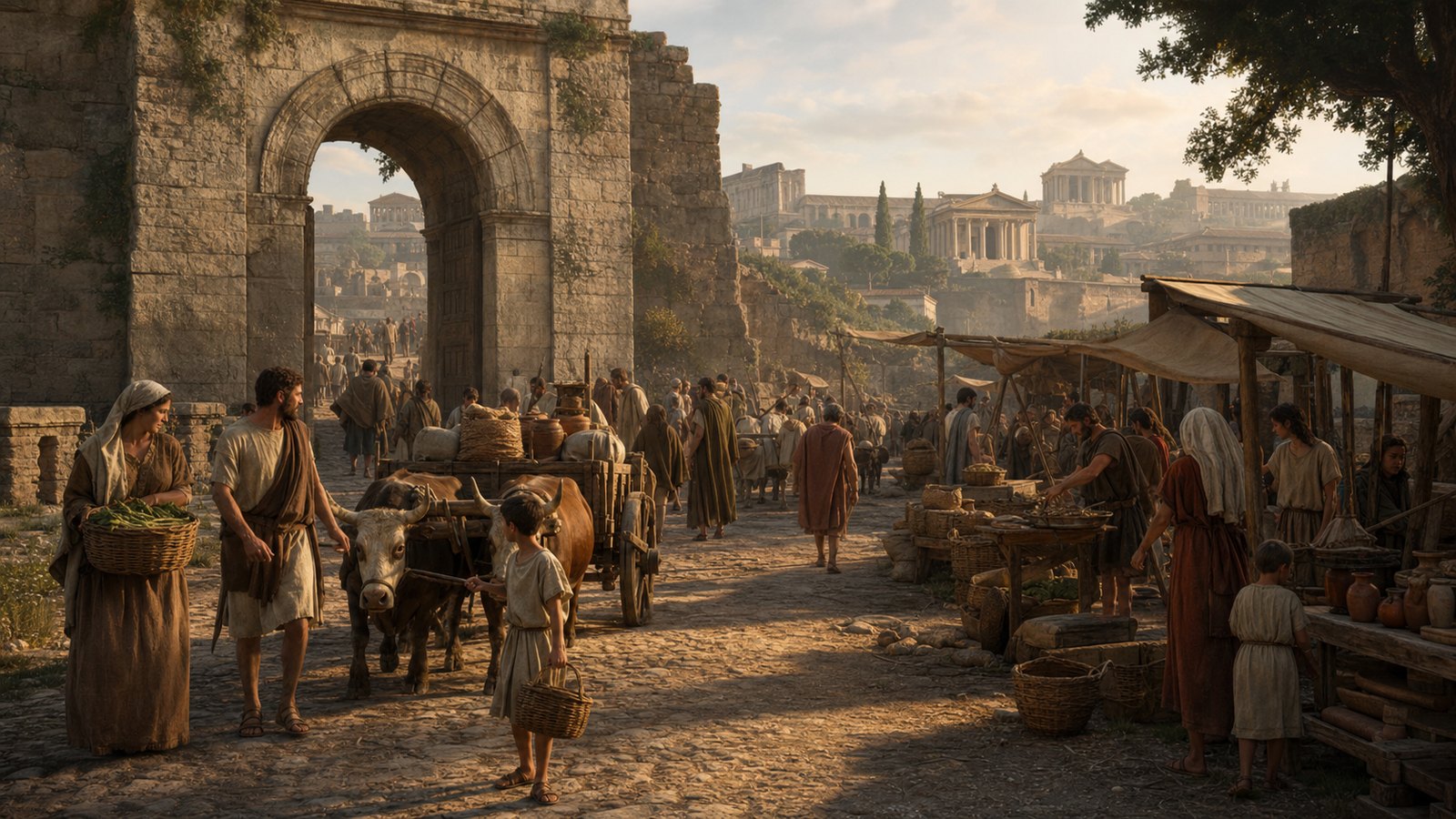
Country people came to sell what fields and households produced and to buy goods unavailable or less convenient at home. The journey required calculation. A seller needed a load worth transporting, enough time away from work and confidence that buyers would gather on arrival. Regularity reduced the risk on each side.
The returning day also created social density. People from separate farms and settlements met traders, clients, patrons and officials in the same interval. Prices became visible through comparison. News that had traveled along one road could meet news from another. The market did not erase rural distance, but it gave that distance a scheduled point of convergence.
Unlike an annual fair, the nundinae returned frequently enough to support ordinary obligations. Unlike daily retail, it was shaped around periodic arrival. That middle scale was its strength. A household could postpone some purchases for the next cycle without waiting for a festival season.
Commerce Opened a Door to Courts and News
A rural visitor could combine trade with legal business and attention to public affairs. Ancient discussions of nundinae show that the exact status of judicial and civic activity changed and required regulation. The day was a kind of holiday in one sense, but never a command that the city become still.
Later accounts connected the Lex Hortensia with making market days available for legal business. Whatever the precise legal development, the principle was practical. A person already traveling to market had a better chance to answer a summons, consult an adviser or witness a public notice than on a day devoted entirely to fieldwork.
This convergence turned time into access. Roman law could be formally open while remaining physically distant. A recurring day lowered one barrier by making several purposes share one trip. The same person might arrive as producer, buyer, litigant and citizen before returning home.
Rural Crowds Were Useful and Politically Dangerous
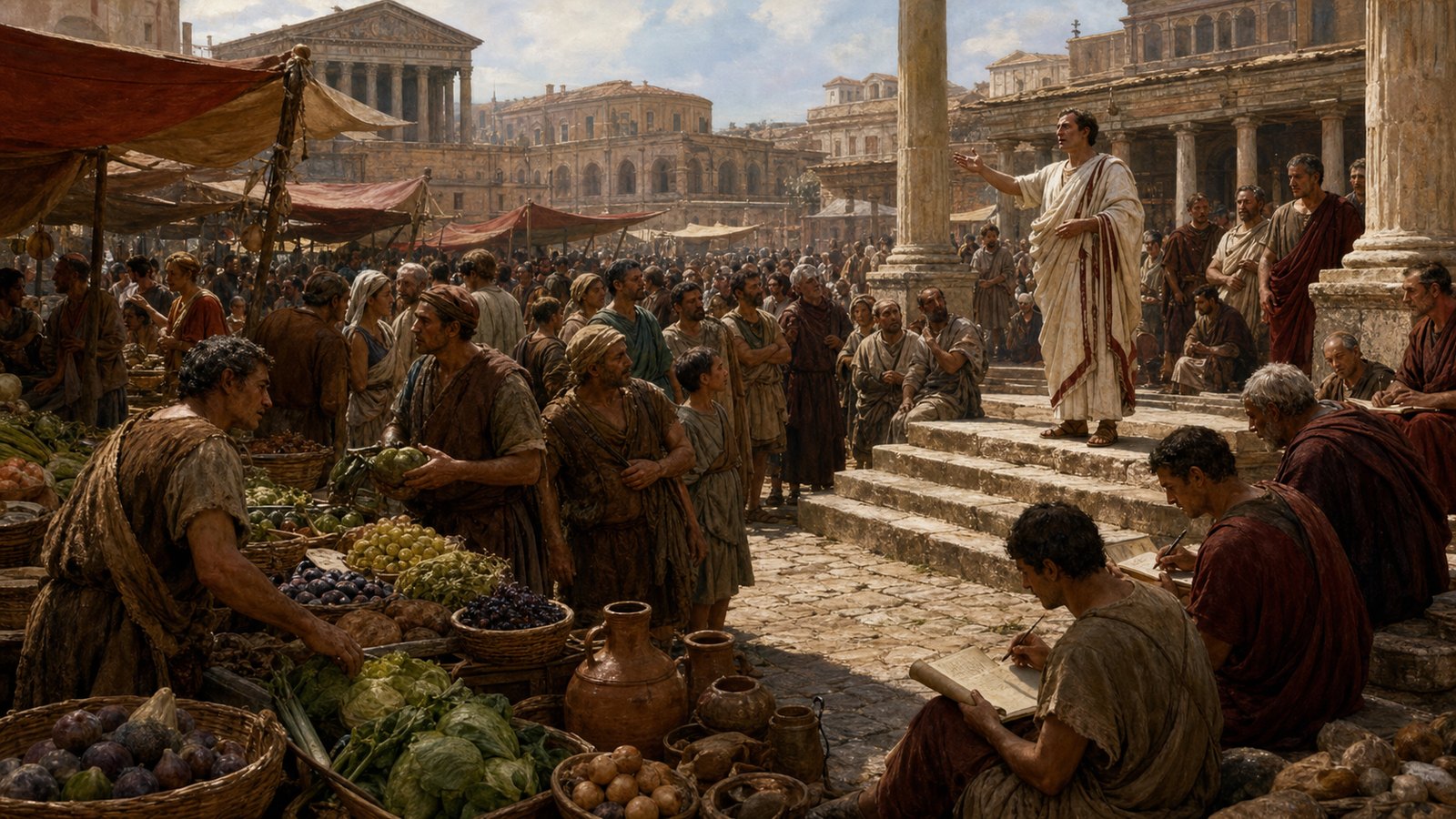
Market days placed unusual numbers of country people within reach of speeches and assemblies. That created political opportunity. Anyone seeking support could address citizens who were otherwise dispersed. It also created anxiety that commerce and voting might be manipulated together.
Roman rules repeatedly negotiated what public business could occur on nundinae. The tension was structural rather than accidental. A market worked because attendance was concentrated; politics valued the same concentration. Keeping those uses separate required more than declaring the day commercial.
The scene resembled other Roman institutions that organized an audience. When Cicero spoke against Catiline, seating and presence gave words their force. On a nundinal day, the audience assembled first for many private reasons. Politics could enter a crowd that commerce had already gathered.
The Market Cycle Joined Rome Without Making It Uniform
The nundinae did not turn every village into a suburb. Rural households still lived by local routes, seasonal labor and uneven resources. The cycle mattered because it respected that separation while providing a repeated connection. Rome became reachable in pulses.
Those pulses helped goods move, but they also helped obligations move. A debt could be discussed, a case advanced, a notice heard and a political mood tested. The countryside supplied the city, while the city returned law, information and manufactured goods. Neither side entered the exchange empty-handed.
Material traces often preserve only one part of such a system. Monte Testaccio’s broken amphorae show accumulation after long-distance trade, while a market cycle leaves fewer monumental remains. Its evidence survives in calendars, legal arguments and writers explaining why one lettered day affected so many kinds of business.
The A-to-H sequence is therefore not a minor curiosity. It is a map of recurring expectation. Farmers knew when a larger body of buyers would be present. Urban traders knew when rural produce and customers would arrive. Officials knew when citizens from beyond the city were listening.
A modern week can feel natural because work, school and commerce have been built around it for generations. The Roman eight-day market rhythm deserves the same practical imagination. It did not merely name a date. It coordinated journeys that would otherwise be too costly, uncertain or isolated.
On each return, the market remade a temporary public. Baskets were emptied, cases were heard, news changed hands and roads filled again toward the countryside. Rome’s connection to its hinterland depended not only on roads and law, but on giving people a day they could trust would return.
The cycle also distributed waiting. Perishable produce could not always pause, but many purchases, conversations and procedural tasks could be grouped around the next known market. That did not remove the cost of travel. It made the cost more productive by increasing the number of useful encounters available on arrival. Recurrence converted a difficult journey from a single-purpose gamble into a bundle of likely opportunities.
Calendar letters carried authority because people acted on them. A mark beside a date changed when carts were loaded, when a litigant left home and when a speaker expected listeners. The letter itself was simple; the coordination behind it was not. Roads, stalls and courts had to absorb the temporary increase, while households planned labor around an absence that would repeat.
Tradition credited early rulers with establishing regular markets, a way of imagining the cycle as part of Rome’s original settlement between city and countryside. The historical details are less secure than the practical memory contained in the claim. Romans understood that a community needed agreed moments of exchange. A market day was infrastructure built from time rather than stone.
That temporal infrastructure could survive changes in law because no single use defined it. Judicial access might expand or contract, assemblies might be restricted, and religious classifications might complicate business. Produce still needed buyers and rural households still needed an urban rendezvous. The nundinae endured as a negotiation among these uses, not as a perfectly fixed rule.
Sources
William Smith, Dictionary of Greek and Roman Antiquities: “Nundinae”; Macrobius, Saturnalia 1.16; Pliny the Elder, Natural History 18.