
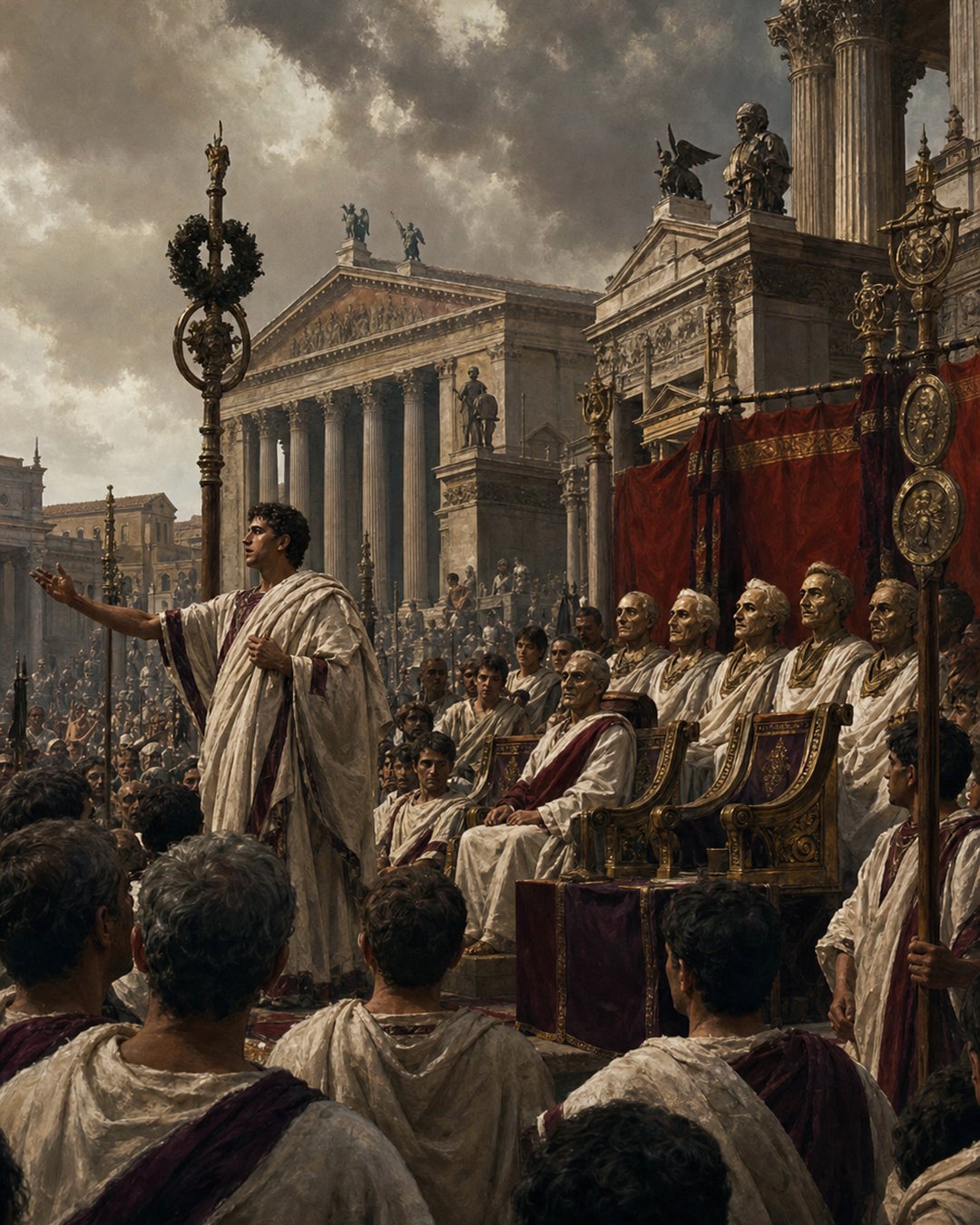
An elite Roman funeral could bring more than one dead man into the Forum. Polybius describes actors wearing wax likenesses of a family’s ancestors, dressed according to the offices those men had held. Former consuls, censors and triumphators appeared to return in procession, then sat on ivory chairs while the newest death was explained to the crowd.
The masks made genealogy physical. A family did not merely recite names carved on a monument. It assembled a temporary council of the dead in Rome’s political center. The ceremony praised the deceased, but it also demonstrated that living relatives belonged to a line trained for public command.
A Face Waited in the Most Visible Room
According to Polybius, noble households kept wax likenesses of ancestors in small wooden shrines placed in a prominent part of the house. The location mattered. Visitors entering the home encountered a map of remembered office before they reached any speech about it.
These were not ordinary portraits distributed equally among Roman families. The right to display ancestral masks belonged to the world of public distinction and aristocratic memory. A face stood for a career: magistracies, triumphs and deeds that descendants could claim as examples and obligations.
Wax made the image vulnerable and lifelike. Unlike stone, it could suggest skin and be carried on a human body, yet it required protection between appearances. The mask waited in its cabinet until another death activated the family archive. Mourning opened the doors; politics gave the faces their route.
Actors Rebuilt the Family by Height, Dress and Rank
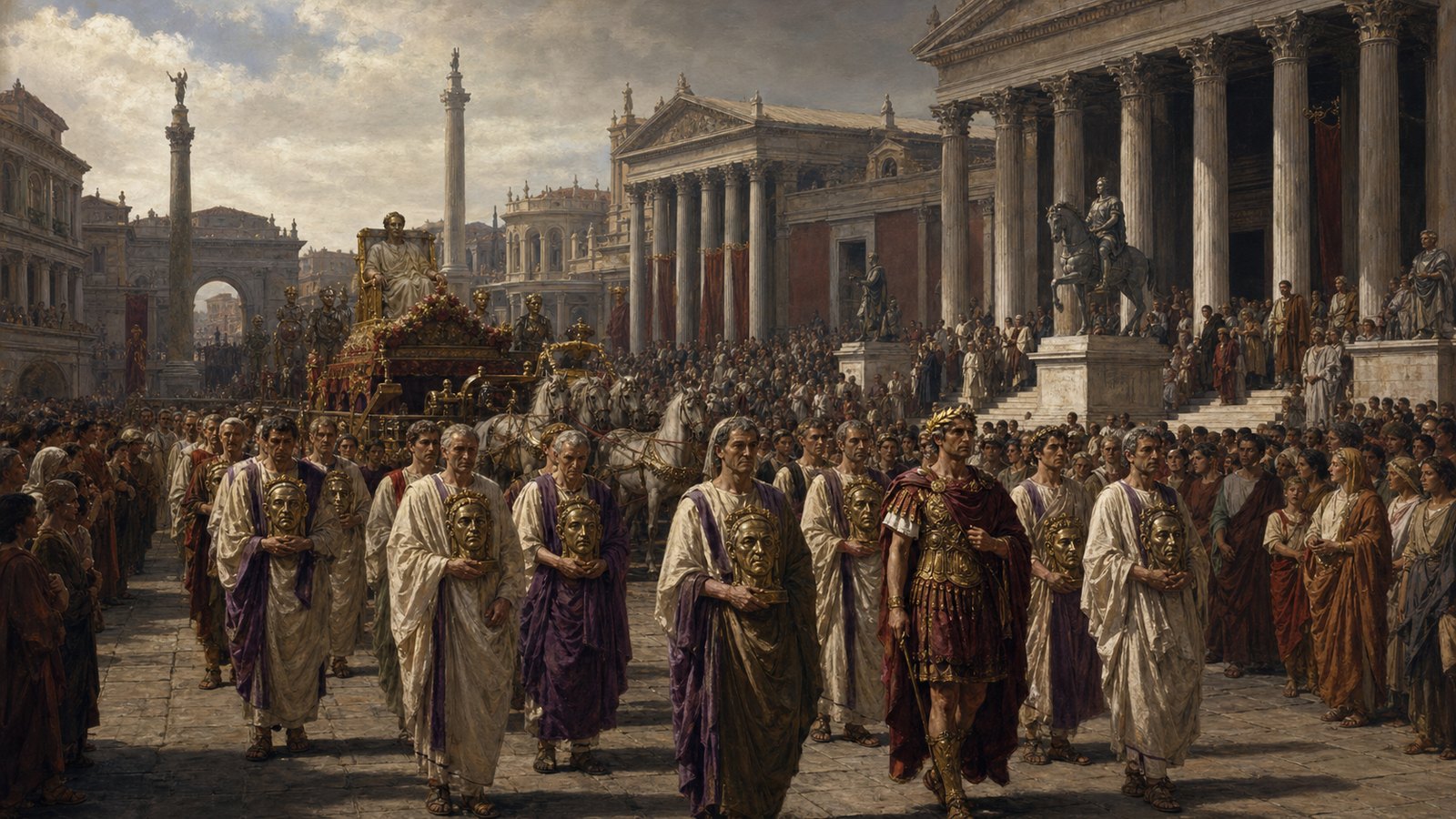
When a distinguished member of the family died, performers wore the masks in procession. Polybius says they were chosen for similarity in height and appearance to the ancestors represented. Costume then restored the visible grammar of rank. Purple borders and official insignia indicated magistracies; men remembered for triumphs appeared in triumphal dress.
The performers rode in chariots. They were not ghosts drifting anonymously behind the bier but recognizable offices arranged as people. A spectator who could not remember every name could still read the toga, the chair and the procession. Rank became costume, and costume made the family’s history legible at street level.
This did not reproduce the past neutrally. Selection created an argument. The most useful ancestors were those whose achievements strengthened the family’s present claims. Failures, obscurity and internal conflict did not need equal space. The procession was an archive edited for public movement.
The Rostra Turned Mourning into a Civic Lesson
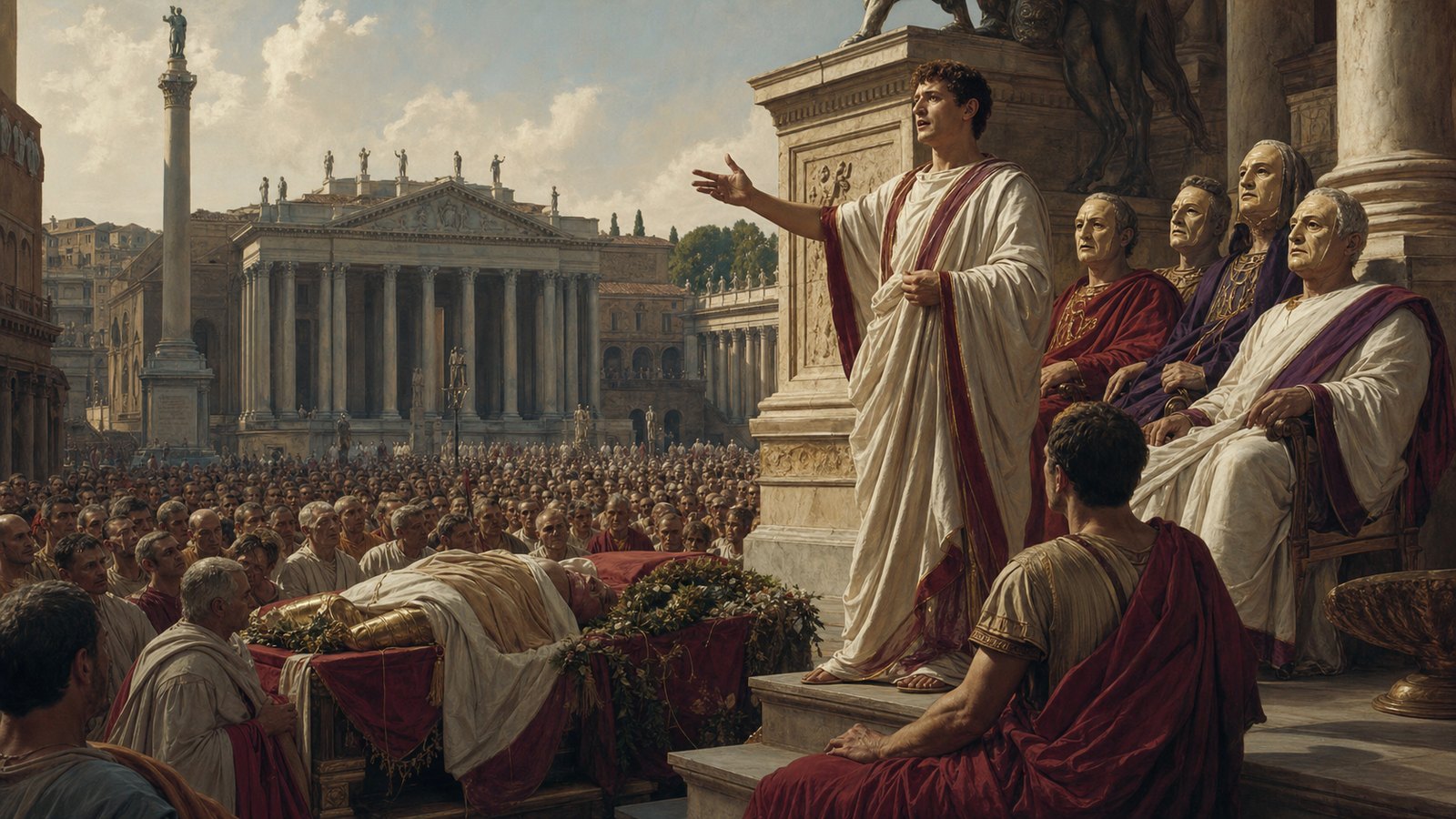
The body of the recently dead was taken to the rostra in the Forum and displayed upright when possible. An adult son or another close relative addressed the crowd. He recounted the dead man’s virtues and achievements while the masked ancestors sat nearby on ivory chairs.
After praising the deceased, the speaker moved backward through the family, describing the deeds of the other represented men. The structure joined one biography to many. A military command, election or public service no longer appeared as a solitary success; it became the newest chapter in a sequence visible on the platform.
Polybius emphasizes the emotional effect. Past achievements seemed to stand before the crowd as if the men were alive. The Forum, usually filled with lawsuits, elections and bargaining, became a theater of continuity. Death interrupted one career but allowed the family to display all its careers together.
The Audience Included Tomorrow’s Candidates
Polybius admired the ceremony because he believed it trained ambition. A young spectator saw that courage and public service could outlive the body in a form the whole city recognized. The lesson was demanding: endure hardship now and your image may return before future Romans.
For aristocratic sons, the message was even more direct. The seated masks were standards against which their own lives would be measured. They inherited privilege, but also a public comparison they could not escape. A famous name gave access while making failure more visible.
The rite therefore mixed private grief with political recruitment. The speaker was often a living heir capable of future office. By praising his father and ancestors, he demonstrated voice, composure and command of family memory before a civic audience. Funeral duty could become an introduction to public performance.
Memory Became a Form of Unequal Power
The spectacle was powerful partly because most Romans could not stage it. Many families remembered parents and grandparents, tended graves and marked anniversaries, but they did not possess a line of consular masks or the same access to the rostra. Aristocratic memory occupied public space with unusual authority.
That inequality complicates Polybius’ praise. The ceremony encouraged service, but it also presented officeholding families as the natural reservoir of future leaders. Their ancestors filled the visual field. A newcomer had to compete not only with a living rival, but with a procession of dead officeholders apparently voting by their presence.
Roman politics often transformed exceptional commands into precedents. Pompey’s Mediterranean command shows how a single vote could enlarge one man’s authority. Funeral masks worked more quietly. Repeated appearances made inherited distinction feel customary, embodied and almost constitutional.
The practice also helps explain why attacks on reputation mattered so much. To damage a name was to weaken a resource descendants expected to use. Conversely, a strong funeral could organize a disputed life into a clean sequence of offices and victories. The dead could no longer answer critics, but their family controlled the final procession.
Compare the Senate scene in which Cicero isolated Catiline through speech and seating. Roman authority was never only a written rule; bodies, places and audience reactions created political facts. At a funeral, even artificial bodies could do that work. Wax faces made lineage visible, and visibility turned memory into leverage.
The newest corpse eventually left the Forum, and the masks returned to their shrines. Yet the performance had refreshed every represented claim. Rome’s dead consuls did not literally govern again. For a few hours, however, they occupied the best seats, supplied the measure of virtue and watched a living heir speak beneath their assembled faces.
The event depended on sequence. The household opened its stored images, the procession ordered them by recognizable distinctions, the Forum provided a civic audience, and the speech converted appearance into a moral argument. Remove one element and the effect weakened. Masks without names were theater; names without bodies were genealogy; a private display lacked the rostra’s political charge. Together they produced the impression that family history had entered public session.
Costume prevented the ancestors from collapsing into an undifferentiated crowd. A triumphator’s dress recalled a specific kind of honor, while toga borders and insignia marked other offices. Those signs gave spectators a shorthand for careers too long to narrate in full. The speaker could select exemplary deeds because the clothing had already established rank. Visual classification carried part of the biography before the oration reached it.
Polybius was an outsider with unusually close access to Roman aristocratic life, and his explanation deserves to be read as interpretation rather than a camera recording. He saw education in courage where a rival family might have seen inherited dominance. The ceremony could sustain both readings. It invited young men to equal great achievements while ensuring that certain young men began surrounded by proof that greatness already belonged to their house.
For the crowd, the performance compressed centuries into a single arrangement of faces. For the family, it renewed an asset that could not be sold or transferred outside descent. For the young heir, it supplied both a stage and an audience already trained to compare him with the dead. The ceremony endured because it made those different functions appear as one act of mourning.
Sources
Polybius, Histories 6.53–54; Harriet Flower, Ancestor Masks and Aristocratic Power in Roman Culture; Pliny the Elder, Natural History 35.