
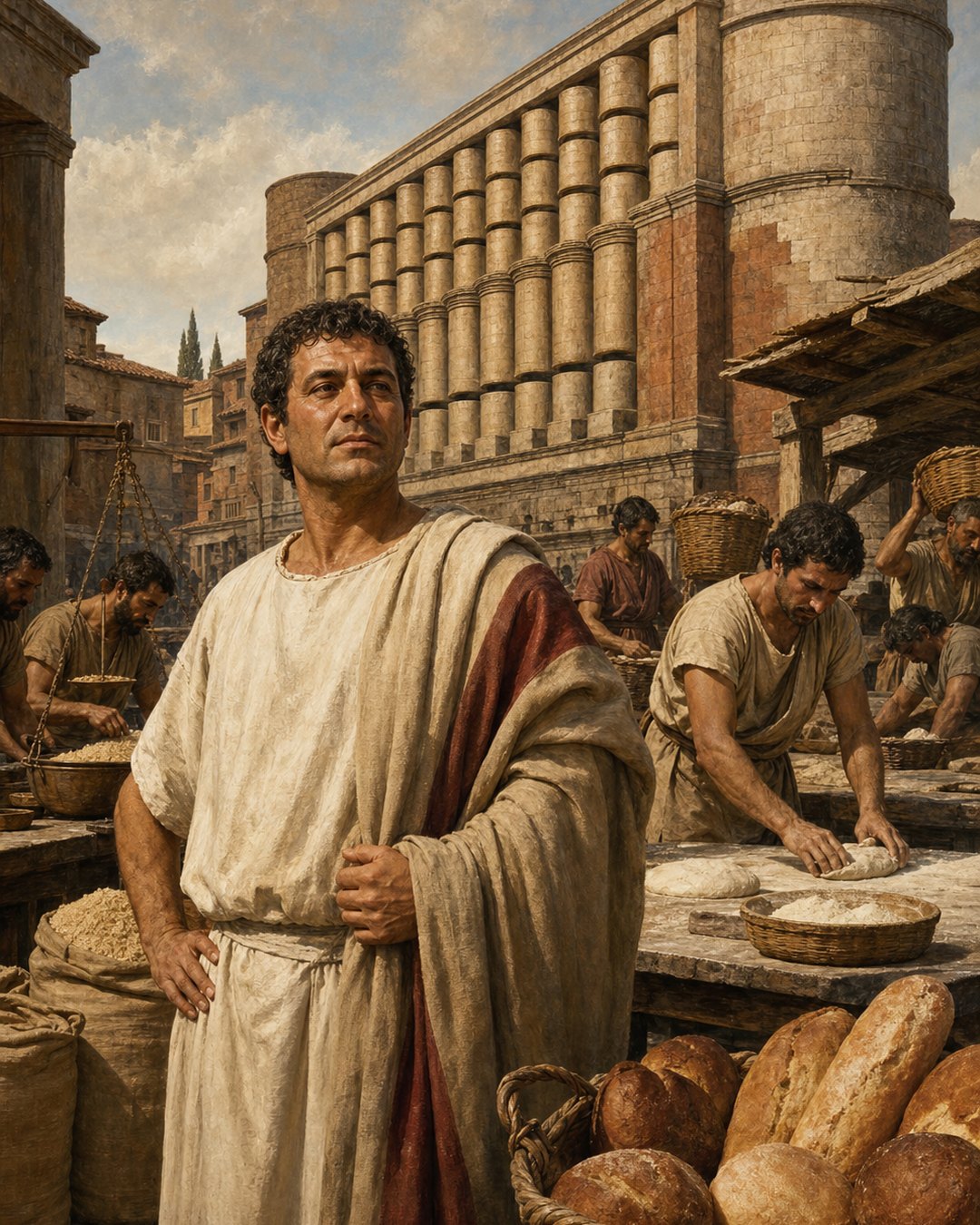
Marcus Vergilius Eurysaces did not ask Rome to remember a borrowed heroic ancestor. He put bread production on his tomb. Near the Porta Maggiore, the monument announces a baker, contractor and public servant in letters large enough for traffic to read. Above them, ranks of cylinders and a relief sequence turn commercial machinery into funeral architecture.
The result is strange because it is so specific. Elite tombs often claimed lineage, office or military honor. Eurysaces made organized work his distinction. Grain is measured, dough is kneaded, loaves are shaped, ovens are tended and baskets are carried away. The tomb does not hide the process that produced its owner’s wealth. It monumentalizes it.
A Freedman Chose a Busy Gate for His Name
The tomb dates to the late first century BCE and stood outside Rome, where burial law placed monuments along roads beyond the living city. Porta Maggiore is the modern landmark; ancient travelers encountered a dense zone of roads, water lines and graves. A tomb here competed with movement. It needed to be understood quickly by people approaching or leaving Rome.
Eurysaces supplied the answer in an inscription repeated across the structure: he was a baker, a contractor and a public servant. His name and the unconventional monument are commonly read as signs of freedman success. He could not manufacture generations of consular ancestors, but he could present the business by which he had become wealthy and useful.
“Contractor” matters. This was not a sentimental portrait of a household loaf. Rome’s population required grain to become bread at scale. Eurysaces connected his identity to organized supply, equipment and labor. His tomb claims that feeding the city could be a public achievement even when performed by someone outside the old aristocracy.
The Facade Turned Equipment into Ornament
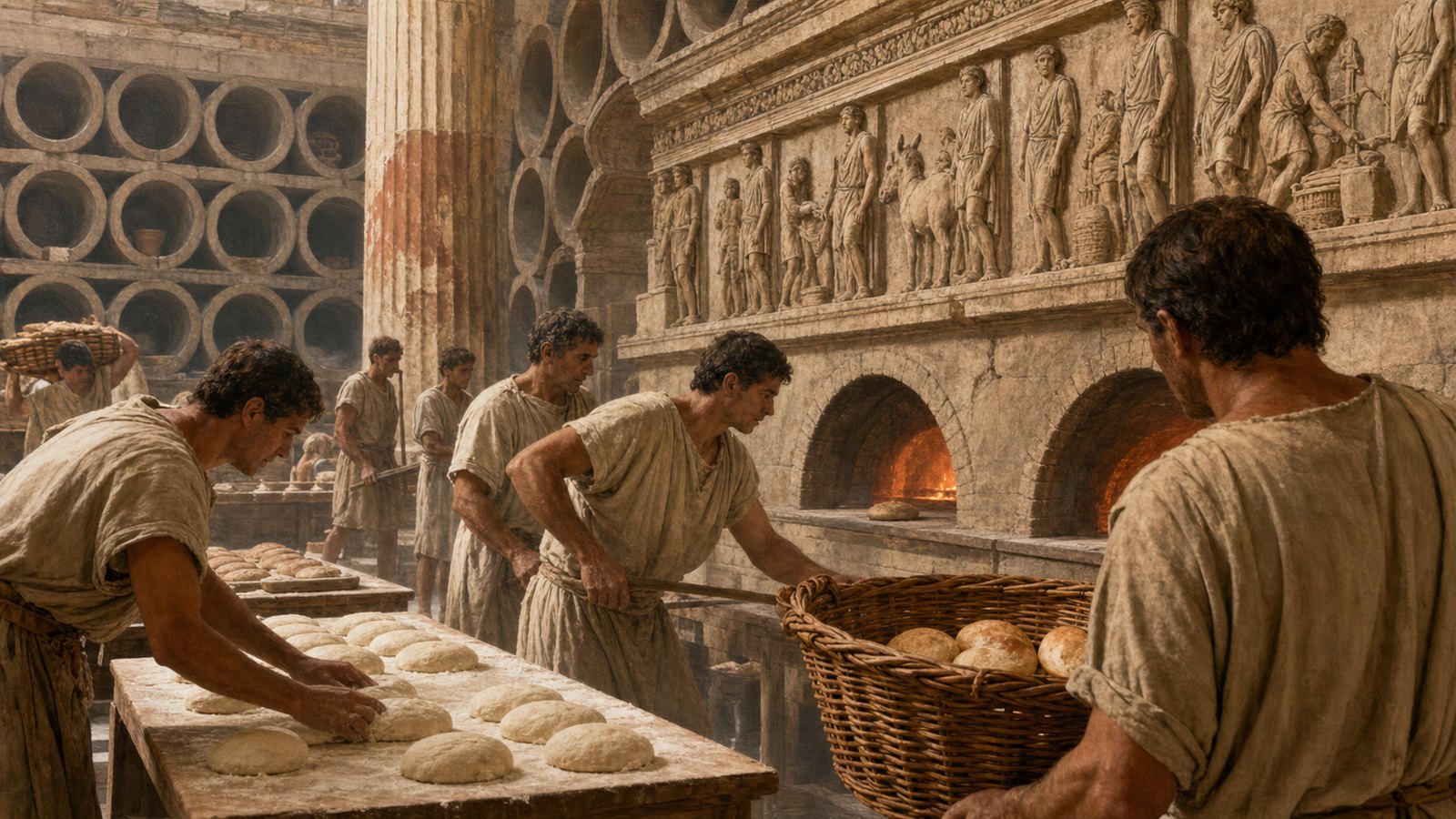
Rows of large cylindrical openings dominate the monument’s upper walls. Their exact reference is debated. Scholars have compared them with grain measures, kneading devices or other bakery equipment. The uncertainty should remain visible: the facade evokes production more confidently than it identifies one machine.
That ambiguity was probably less severe for ancient viewers. People who passed bakeries, bought loaves and saw grain handled may have recognized an industrial vocabulary now partly lost. The cylinders repeat with the force of a colonnade, but they are not classical columns. They make the tomb look assembled from the tools of its owner’s trade.
Concrete gave the core mass, while travertine created the hard pale surfaces and emphatic openings. The architecture does not merely carry an occupational symbol above a conventional grave. Work reorganizes the whole exterior. Eurysaces made a commercial process speak in the visual scale normally reserved for civic prestige.
A Frieze Preserved the Order of Making Bread
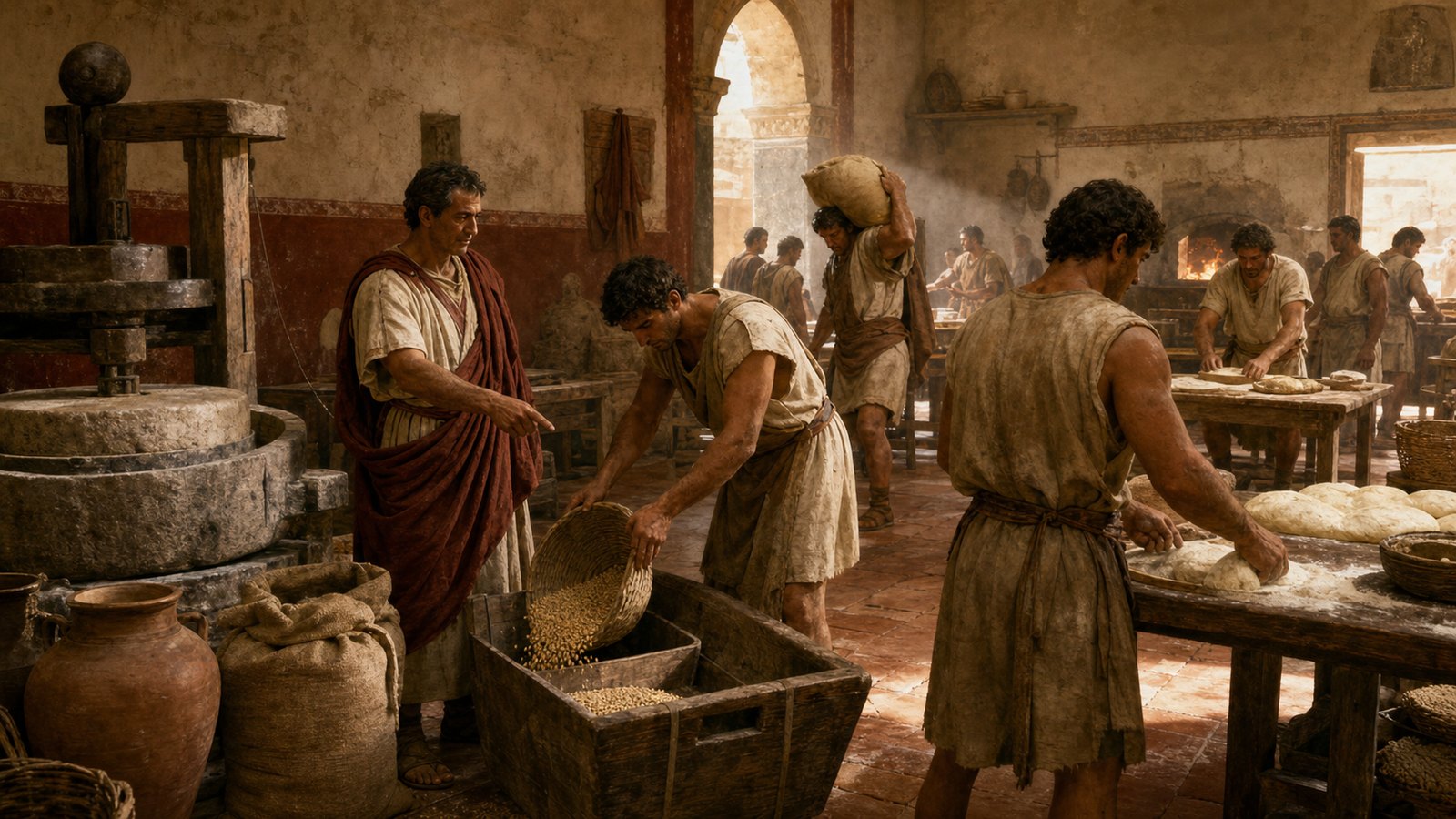
The relief frieze is even more explicit. Its scenes follow the stages of bread production: measuring grain, mixing or kneading dough mechanically, shaping loaves, baking and loading finished bread into baskets. The sequence reads almost like an operational diagram cut into stone.
Workers and supervisors appear as parts of a coordinated system. The emphasis differs from an image of one heroic craftsman. Bread depends on timing, repeated motion and handoffs. Grain must be accounted for before dough can be mixed; shaped loaves must reach the ovens; finished bread must leave in quantity. The relief turns management into a visual subject.
That makes a useful contrast with smaller tools. A file or anvil can show how a hand controlled one surface, but Eurysaces’ business required many hands and stages. Rome’s daily bread was not simply “made by bakers.” It emerged from a chain whose order mattered. The tomb makes that chain the central event of a life.
Atistia Entered the Monument Through a Breadbasket
The tomb also commemorated Eurysaces’ wife, Atistia. A surviving inscription says her remains were placed in a breadbasket. The wording is startlingly intimate and commercial at once. Even the container associated with burial was described through the household’s defining trade.
A portrait relief associated with the pair presents them together, giving faces to the names and machinery. Yet the balance is uneven. Eurysaces’ occupational declaration dominates the monument, while Atistia survives through the language chosen by her husband and through a sculptural pairing recovered from the site.
This is not enough evidence to reconstruct their marriage. It does show how thoroughly the bakery supplied the family’s public vocabulary. Trade was not confined to a shopfront; it shaped the architecture of memory, the description of burial and the image by which husband and wife met later viewers.
The Tomb Made Labor Compete with Lineage
Roman social rank did not become open merely because one prosperous baker built boldly. Freed status carried limits, and elite families possessed networks and memories that money could not instantly reproduce. Eurysaces’ monument is compelling because it confronts that imbalance rather than pretending it did not exist.
He built an alternative pedigree from process. Each measured sack and loaded basket says that wealth had a mechanism. Each cylinder converts equipment into a repeated architectural badge. The giant inscription makes occupation inseparable from name. Viewers did not need to know a legendary Vergilius ancestor; they needed to know what Eurysaces delivered.
The tomb was later absorbed into fortifications and became visible again when those structures were removed in the nineteenth century. That history changed how modern visitors see it, isolated beside traffic rather than embedded in an ancient funerary corridor. Even so, its argument remains unusually legible. Rome depended on specialized commercial labor, and one baker demanded that dependence count as honor.
Compare the discarded containers at Monte Testaccio or the workshop voices preserved in Pompeii’s graffiti. Both reveal economies through traces left behind. Eurysaces did something more deliberate: he designed the trace himself. His tomb is a boast, but an unusually transparent one. It tells us where to look for the source of the boast—in machinery, labor and bread moving through a city.
The occupational pride is also a claim about reliability. Bread production tolerates little romantic improvisation at scale. Measures, kneading, shaping, oven heat and distribution must recur every day, and a contractor’s reputation rests on making that repetition dependable. By carving a sequence rather than one symbolic loaf, Eurysaces emphasized an operating system. His workers and equipment become evidence that he could organize material, time and people.
That evidence would have spoken differently to different passersby. A customer might recognize the familiar form of a loaf or basket. A supplier might notice measured grain. Another contractor could read labor and machinery as capital. An aristocrat could dismiss the trade while still seeing a monument large enough to compete for attention. The tomb did not require every viewer to admire baking equally; it required them to connect the name Eurysaces with a visible urban necessity.
The surviving facade can tempt modern viewers to call the monument eccentric and stop there. Its oddity is more useful when treated as a precise social choice. Conventional architecture could have hidden the business beneath generic respectability. Eurysaces instead enlarged the parts of his life that old families might have considered ordinary. The wager was that scale and specificity could turn usefulness into distinction.
Its best evidence is therefore not a secret biography waiting to be decoded. It is the public relationship Eurysaces chose among name, work and memory. The inscription tells viewers who claimed the monument; the frieze tells them how bread moved; the cylinders insist that the equipment of production deserved architectural scale. Together they preserve a Roman success story written not as escape from labor, but as mastery of its sequence.
Sources
Smarthistory, “Tomb of Eurysaces the Baker”; Museo Nazionale Romano, Eurysaces reliefs; Corpus Inscriptionum Latinarum VI 1958.