
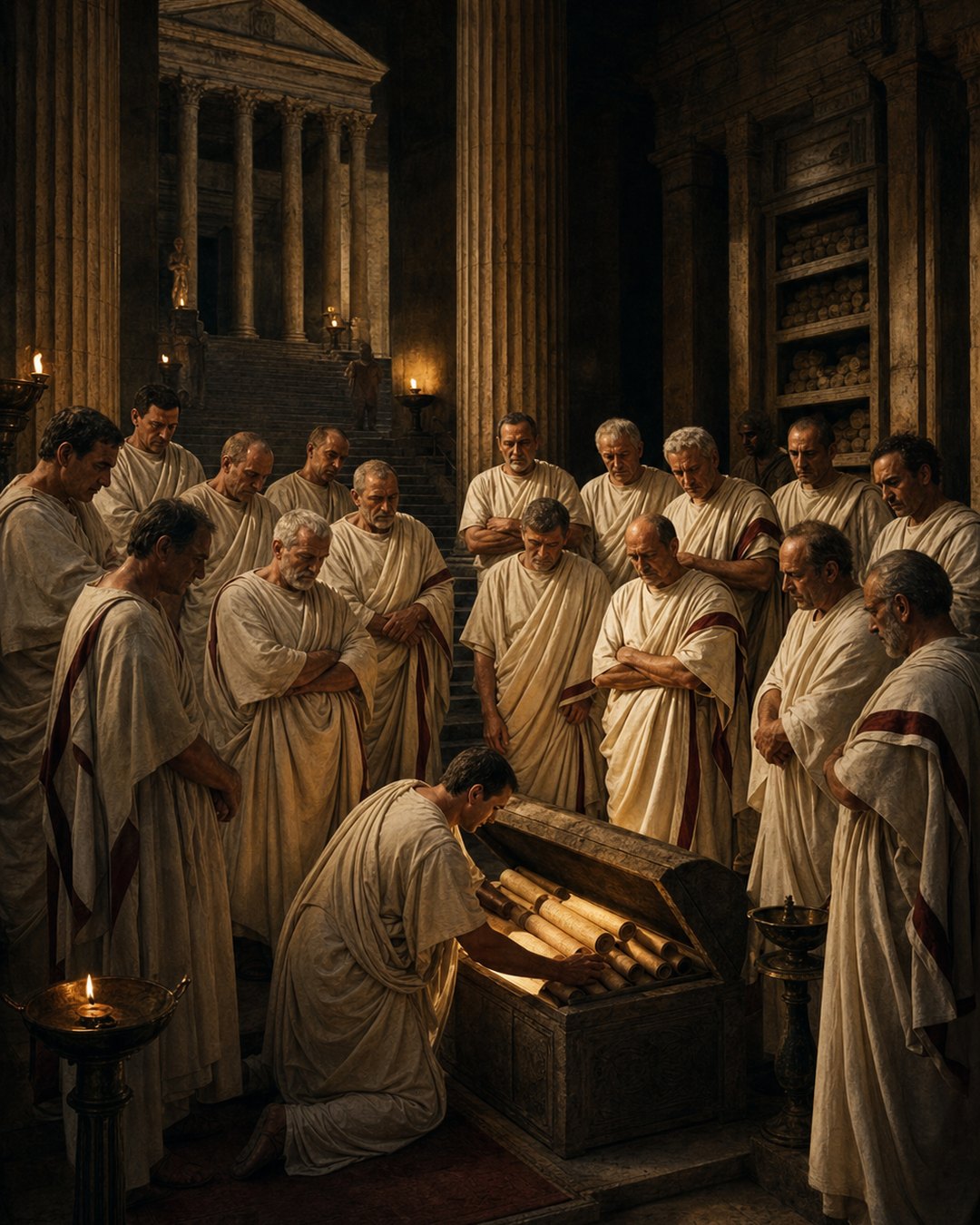
Rome did not treat prophecy as a voice that anyone could quote whenever politics became difficult. Its most famous prophetic collection was locked away, placed under named guardians and opened only after the Senate decided that ordinary answers were no longer enough. The arrangement looks paradoxical. A city that feared omens preserved dangerous verses at the center of the state, yet prevented those verses from becoming a running commentary on public life.
The Sibylline books mattered because access to them was restricted. Their keepers did not roam the Forum predicting elections. They entered the story when war, plague, failed harvests or alarming prodigies suggested that the relationship between Rome and its gods needed repair. In that narrow setting, an old text could authorize a new rite without allowing prophecy to rule every day.
Nine Books Became Three in a Royal Bargain
Roman tradition placed the beginning under King Tarquinius. A Sibyl offered him nine books at a price he considered absurd. When he refused, she burned three and returned with the remaining six at the same price. He refused again; she burned three more and offered the last three without reducing her demand. Only then did the king consult his advisers and buy what survived.
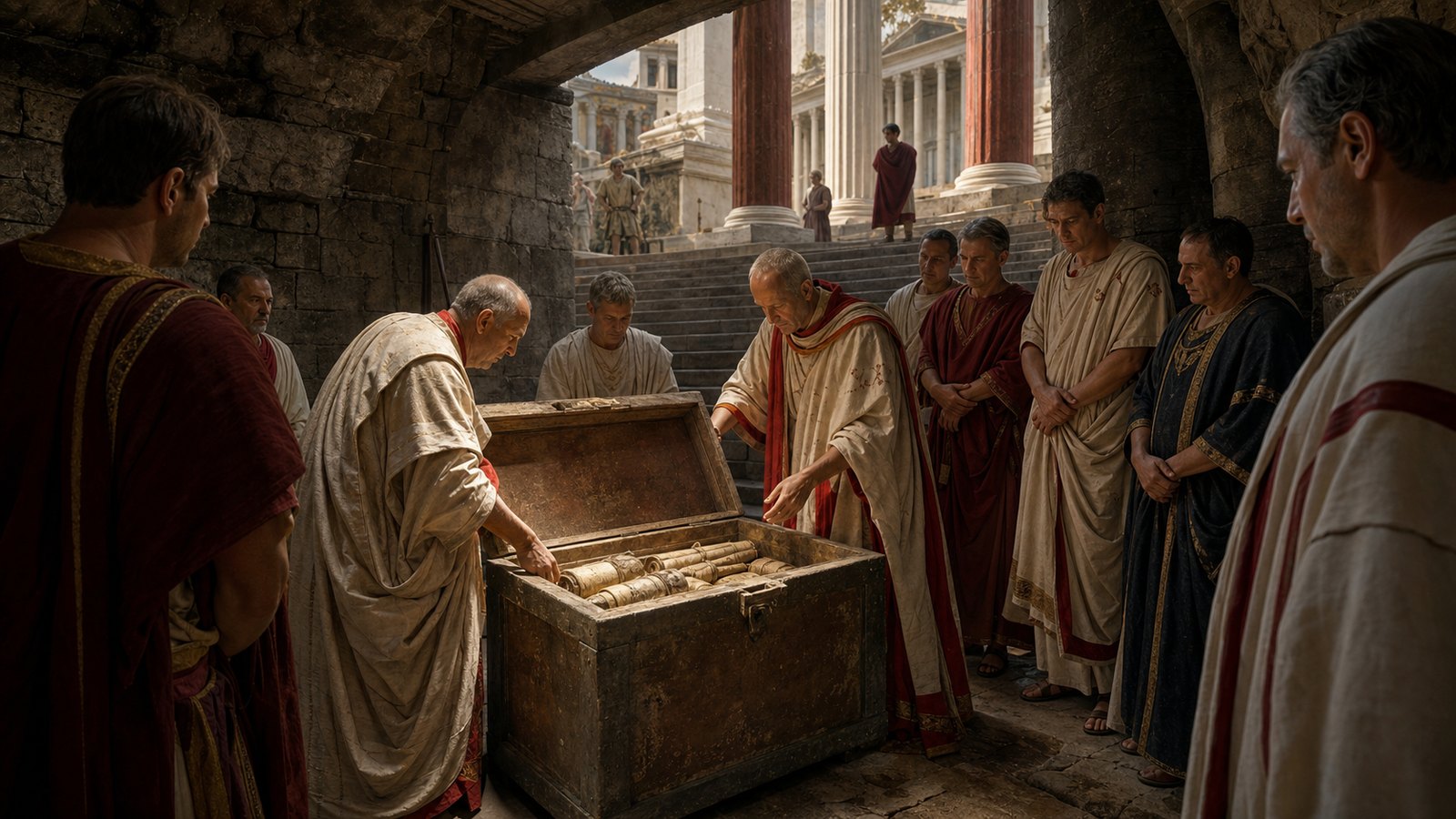
The tale is too perfectly shaped to read as an invoice. Its point is institutional: Rome acquired prophecy only after discovering that delay made knowledge scarcer and more expensive. The purchased books were said to be stored in a stone chest beneath the temple of Jupiter on the Capitoline. Their position put foreign, Greek-language prophecy beneath the protection of Rome’s highest civic god.
Two patrician officials originally guarded the collection. Their office made custody as important as interpretation. A prophecy removed from its chest without authorization was not simply religious information; it was a breach in the chain by which the state decided what counted as a legitimate divine warning.
The Senate Decided When a Crisis Needed Another Language
The books were not a calendar of fixed predictions. Consultation generally followed prodigies or public danger, and the Senate had to order it. That sequence preserved a boundary. Magistrates and senators first recognized that a crisis exceeded familiar remedies; only then did the keepers search the verses and report what ritual response they found.
This made prophecy part of government without making it sovereign. The priests supplied a religious remedy, while the Senate controlled the occasion and the public response. The exact text was normally less important than the prescribed action: games, sacrifices, a procession, or the reception of a cult that could address the particular fear.
That distinction also explains secrecy. If every citizen could attach a Sibylline line to every thunderstorm, political rivals could manufacture divine emergencies. Restricting the books reduced that competition. Rome did not eliminate uncertainty; it gave uncertainty an office, a procedure and a small group whose report could be debated.
Foreign Gods Entered Through a Roman Procedure
Sibylline consultation could lead Rome beyond its inherited ritual repertoire. Apollo and Asclepius were associated with remedies sanctioned through the collection, and the arrival of Magna Mater during the war with Hannibal became the most vivid example. As the Black Stone’s wartime reception shows, Rome could respond to catastrophe by importing a power from abroad while surrounding that arrival with senatorial orders, selected envoys and public ceremony.
This was not casual religious borrowing. The process translated something foreign into a Roman obligation. A cult entered because the authorized books had been consulted, the keepers had made a recommendation, and civic institutions had accepted the expense and choreography. Innovation could therefore appear as obedience to an older command.
The system helps explain why Roman religion could be conservative and adaptive at once. A new god did not have to be presented as a fashionable discovery. The state could say that an exceptional danger had revealed an exceptional duty. Prophecy opened the door, but public procedure determined who crossed the threshold and on what terms.
A Fire Destroyed the Text but Not the Office
In 83 BCE, fire destroyed the temple of Jupiter Capitolinus and the original collection with it. Rome’s response reveals what officials believed they had lost. They did not declare the institution finished. Envoys searched cities in Italy, Greece and Asia for verses attributed to the Sibyl, assembling a replacement body from scattered texts.
Reconstruction created a harder question: which prophecy was authentic enough to become state property? Rival verses circulated widely, and an oracle could acquire political force simply by claiming ancient authority. The recovered collection therefore required selection. Augustus later reviewed the material, rejected much of it and placed the approved books beneath the temple of Apollo on the Palatine.
The move joined preservation to imperial supervision. Augustus did not abandon Sibylline authority; he curated it. Unauthorized prophetic books were suppressed while approved verses remained under official guardianship. The same state that searched the Mediterranean for lost prophecy also burned texts that escaped its categories.
Fifteen Keepers Made Revelation Look Like Administration
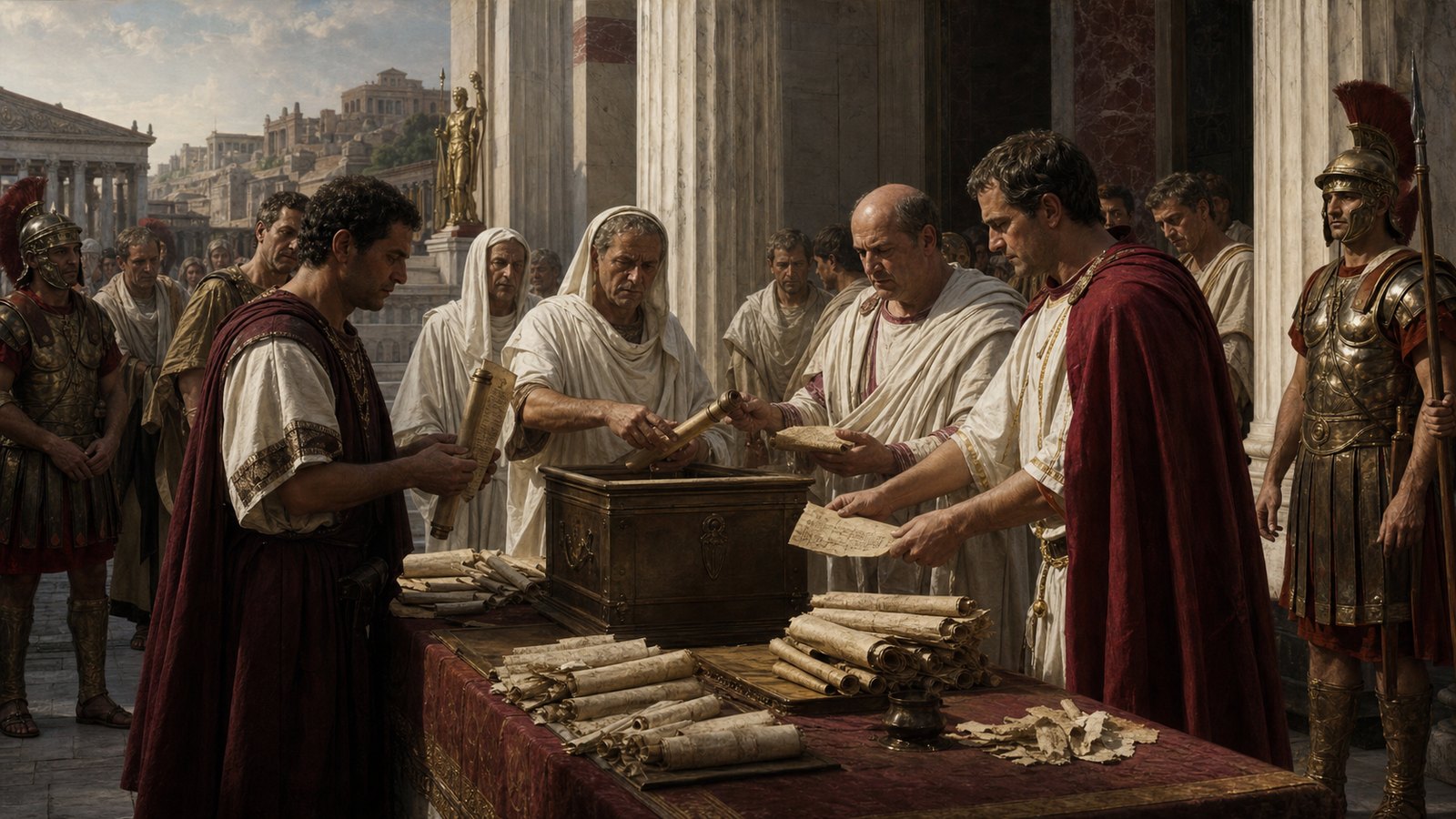
The custodial college grew from two members to ten in 367 BCE and eventually to fifteen, the quindecimviri sacris faciundis. Expansion widened the office while preserving its central principle: revelation became usable only through recognized keepers. Fifteen priests were not fifteen independent prophets. They were a college with a shared duty to guard, inspect and report.
The arrangement resembled other Roman solutions to dangerous power. Command was divided, auspices had rules, and priesthoods kept specialized knowledge. Even memory could be organized institutionally, as in the public performance of aristocratic ancestors. In each case, the city made authority visible by giving it a place, a sequence and accountable human custodians.
Late antique tradition says Stilicho finally ordered the official books burned around 405 CE. Whether viewed from their legendary purchase or their last destruction, the collection’s history is less about successful prediction than controlled consultation. Rome feared what an oracle might say, but feared uncontrolled voices more. The books remained powerful because most of the time they stayed closed.
The contrast with ordinary public persuasion is sharp. When Cicero confronted Catiline before the Senate, his words gained force by being spoken openly in a charged room. Sibylline authority worked through controlled absence. Citizens normally heard the result of consultation, not a complete reading that invited competing interpretations. The closed chest and the priestly report were part of the message: this was not one ambitious senator’s private omen.
Even the legendary number of books reinforced the danger of careless refusal. Six vanished before Tarquinius accepted the last three, and no later payment could restore the destroyed portion. Rome’s story therefore made custodianship a response to irreversible loss. Fire in 83 BCE repeated that lesson on a civic scale. The Mediterranean search that followed recovered verses, but recovery immediately required judgment, because abundance could be as destabilizing as scarcity. An official oracle had to be gathered and narrowed at the same time.
The long history of the books is therefore a history of filters: royal purchase, guarded storage, senatorial permission, priestly interpretation, post-fire collection and Augustan review. At every stage, Romans preserved the possibility that the gods might require an unfamiliar response while preventing every rumor from acquiring official force. The oracle was never simply a text. It was the text plus custody, occasion and an authorized path from warning to ritual. That chain made exceptional change appear disciplined rather than impulsive.
Sources
William Smith, Dictionary of Greek and Roman Antiquities: “Sibyllini Libri”; Livy, History of Rome; Tacitus, Annals 6.12.