
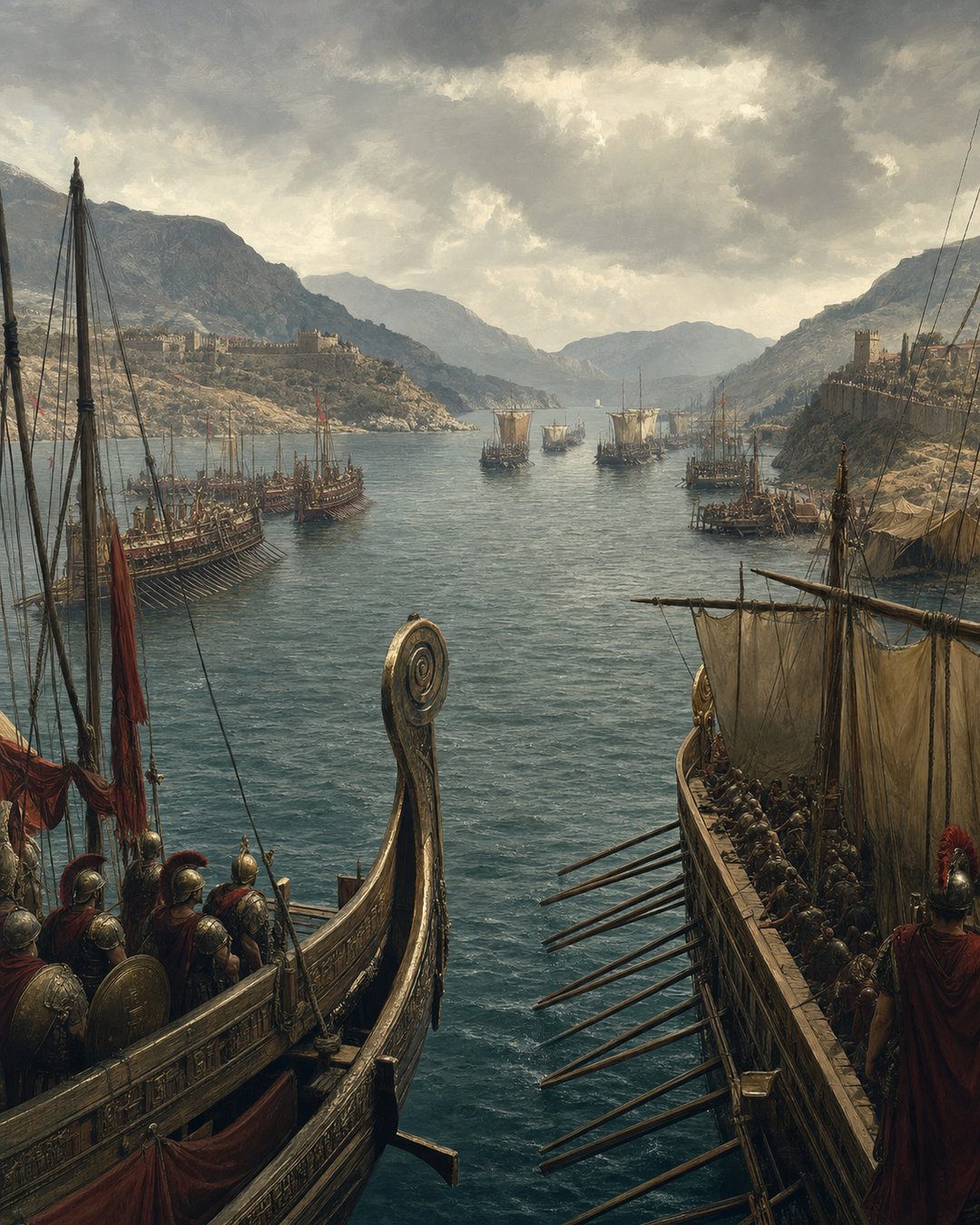
On 2 September 31 BCE, Antony and Cleopatra’s fleet faced Octavian’s forces near Actium on the western coast of Greece. The famous image is a line of heavy warships, Cleopatra’s squadron breaking through and Antony following her toward Egypt. That dramatic exit was real enough to dominate later storytelling. It was not the beginning of the defeat.
For months before the fleets collided, disease, desertion, intercepted supply routes and disagreement over strategy had narrowed Antony’s choices. Octavian’s admiral Agrippa attacked the maritime network that fed the camp. Antony still possessed a large army on land, yet he accepted battle at sea with crews so depleted that ships had already been burned because they could not all be manned. Actium was decided as much by the loss of options as by ramming, arrows or fire.
A Vast Coalition Gathered Around a Narrow Exit
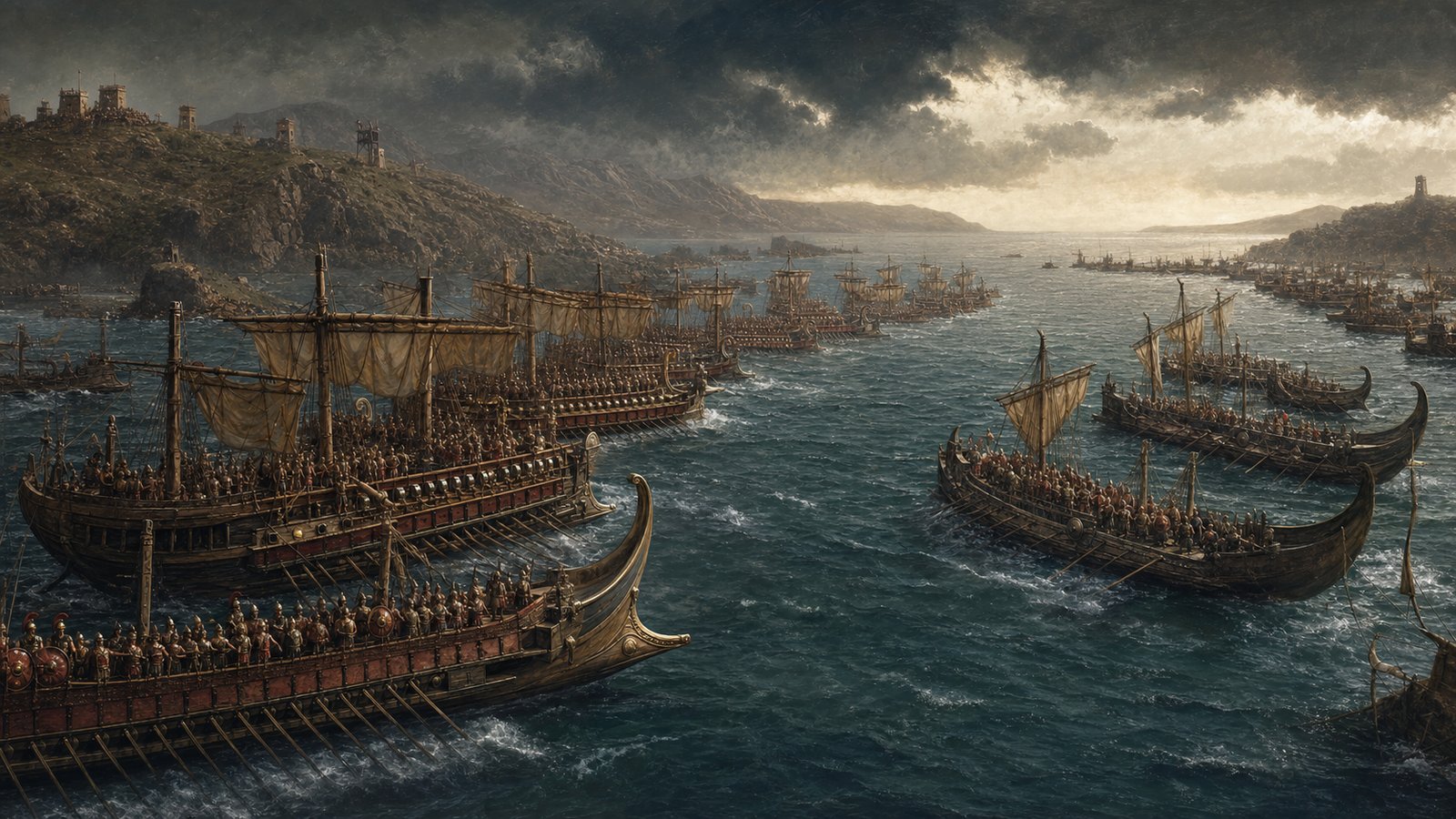
Antony assembled forces from across the eastern Mediterranean. Plutarch credits Cleopatra with two hundred ships, supplies for the army and twenty thousand talents. Allied rulers contributed troops and vessels. The concentration looked formidable, but every additional person and animal required food, water and a functioning route of delivery around a camp exposed to summer heat and marshland.
Octavian crossed from Italy and established his own position north of the Ambracian Gulf. The entrances, anchorages and nearby islands turned geography into strategy. Neither side simply sailed into an open arena. Camps protected fleets; fleets protected supply; coastal positions determined whether grain and reinforcements arrived. A commander who lost one piece of that system placed strain on all the others.
The political stakes enlarged every military problem. Antony’s alliance with Cleopatra gave Octavian a powerful propaganda target, while Antony still commanded Roman senators and legions. For context on how Cleopatra became a Roman political symbol rather than merely a romantic character, see Cleopatra as Rome’s political problem. At Actium, that propaganda struggle was attached to an actual multinational camp whose cohesion had to survive hunger and delay.
Agrippa Fought the Supply Map
Marcus Vipsanius Agrippa did not wait for one decisive fleet action. Before the main battle, he captured or threatened positions along the coast and islands connected with Antony’s communications. Ancient accounts name places such as Methone and Leucas in the widening contest. The operational effect was to make movement less secure and to force Antony to protect a network he could no longer assume was open.
Supply warfare rarely produces a single theatrical moment. Its evidence accumulates in reduced rations, sick crews, missing forage and messengers who do not return. Plutarch describes hardship and disease in Antony’s camp. Defections carried information as well as men to Octavian. Each departure told the enemy more about plans, morale and the shrinking circle around Antony.
Agrippa’s achievement was therefore not simply clever seamanship on 2 September. He helped turn Antony’s numerical mass into a burden. A large fleet without enough trained rowers could not exploit its hulls. A large land army without reliable coastal supply became harder to keep together. By pressuring the route rather than the prestige of the opposing flagship, Agrippa made time work for Octavian.
Too Many Ships Became Fuel
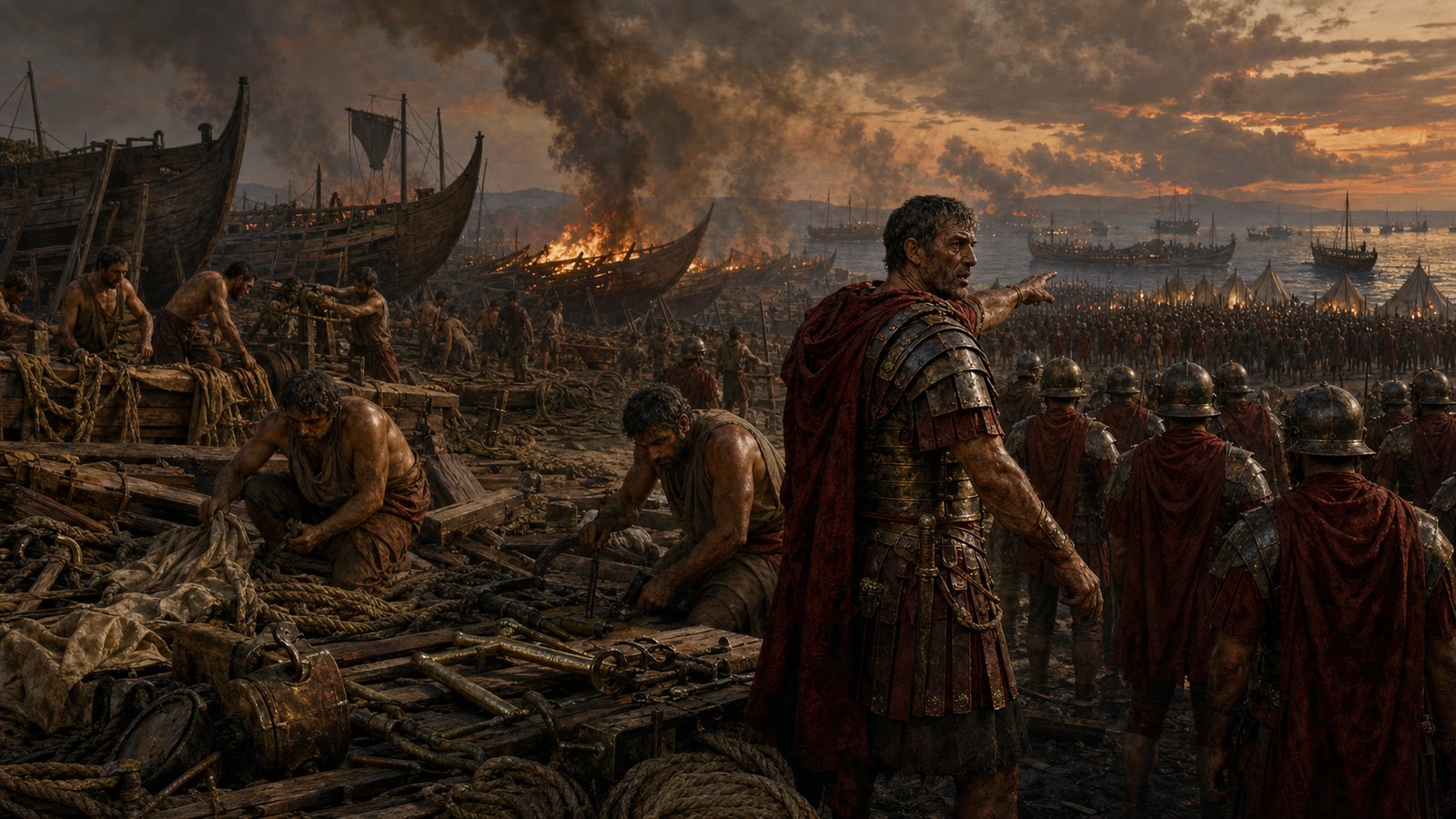
When Antony decided to fight at sea, he could not man every vessel. Plutarch says he burned all but sixty of the Egyptian ships and selected the largest and best of the remainder, placing twenty thousand heavy infantry and two thousand archers aboard. The exact totals in ancient narratives deserve caution, but the sequence is unmistakable: excess hulls were destroyed and soldiers were used to reinforce naval crews.
One veteran centurion in Plutarch’s account protested the decision, pointing to his scars and asking why Antony trusted “miserable logs” instead of the land where his soldiers knew how to fight. The speech is crafted literature, yet it captures the strategic division. Antony’s army was a source of strength, but escape by sea and the safety of the treasure made the fleet central.
Burning ships before battle did more than reduce numbers. It denied usable vessels to the enemy and concentrated limited manpower, but it also made reversal harder. Once the fleet sailed, the army ashore could not simply be transported elsewhere. Preparation had converted a debate over strategy into a physical commitment.
The Battle Line Hid an Escape Plan
Antony’s heavy ships carried towers, missile troops and reinforced prows. Octavian’s smaller vessels had advantages in maneuver and could attack from several directions. The engagement began cautiously, with both sides seeking conditions that favored their ships. Wind mattered because sails, unusually retained or loaded for parts of Antony’s force, were connected to the possibility of breaking away.
Cleopatra’s sixty ships waited behind the main line with treasure and prepared canvas. When a gap and favorable wind appeared, her squadron moved through and headed south. Antony transferred to a faster vessel and followed. Later moralizing authors transformed the decision into a man abandoning victory for a woman. Operationally, it was the execution of an escape that had been prepared before the first collision, though its timing and effect shattered the force left behind.
The departure did not mean every ship instantly stopped fighting. Plutarch says the fleet held out for hours and surrendered late in the day after severe damage and rough water. He reports three hundred ships captured and no more than five thousand dead, figures attributed partly to Octavian’s own account. What collapsed first was unified purpose: some vessels were fighting a battle whose senior leaders had already left.
Nineteen Legions Were Left Without the Story They Needed
Antony’s land army remained substantial. Plutarch emphasizes the astonishing fact that he left nineteen legions and twelve thousand cavalry without a commander’s clear presence. They did not vanish on the afternoon of the naval defeat. They waited, negotiated and gradually surrendered after commanders and allied rulers abandoned the cause.
This delay is crucial. Actium did not annihilate Antony’s military resources in one impact. It broke confidence in their political future. Soldiers could still form ranks, but they had to ask whether pay, supply and reinforcement would arrive, whether Antony would return and whether continued loyalty offered any path home. Octavian could turn a naval success into a wider victory by accepting the submission of forces that no longer believed their coalition coherent.
Rome’s civil wars repeatedly show that an army was also a political community tied to a commander’s credibility. Our examination of Augustus and the language of monarchy follows the settlement that came later. Actium supplied the necessary fact beneath that constitutional performance: Octavian had become the last leader with a viable coalition.
Victory Was Converted into a Founding Scene
Antony and Cleopatra returned to Egypt, where their remaining support eroded. In 30 BCE, Octavian invaded. Both died by suicide, and Egypt became part of the Roman imperial system. The conflict’s end gave Octavian wealth, prestige and control of the Roman world, but he still needed to describe a civil war as something more acceptable than victory over fellow citizens.
Actium offered that language. Octavian could emphasize a foreign queen, eastern luxury and deliverance from danger while minimizing the Roman character of Antony’s coalition. He founded Nicopolis near the site and associated the victory with Apollo. Commemoration transformed a campaign of attrition, sickness and defections into a clean sacred turning point.
The polished memory should not erase the mechanism. Agrippa’s attacks constrained supply; disease consumed manpower; defections leaked confidence; uncrewed ships were burned; the desire to preserve a route to Egypt shaped naval deployment; and the army ashore surrendered only after its political future disappeared. The fleets mattered, but the decisive work had begun long before they met. Actium became a symbol of one day because Octavian’s regime needed a birthday. The victory itself was built over months.
Sources
Plutarch, Life of Antony 56–71; Cassius Dio, Roman History 50–51; Encyclopaedia Britannica, “Battle of Actium”; Augustus, Res Gestae.