
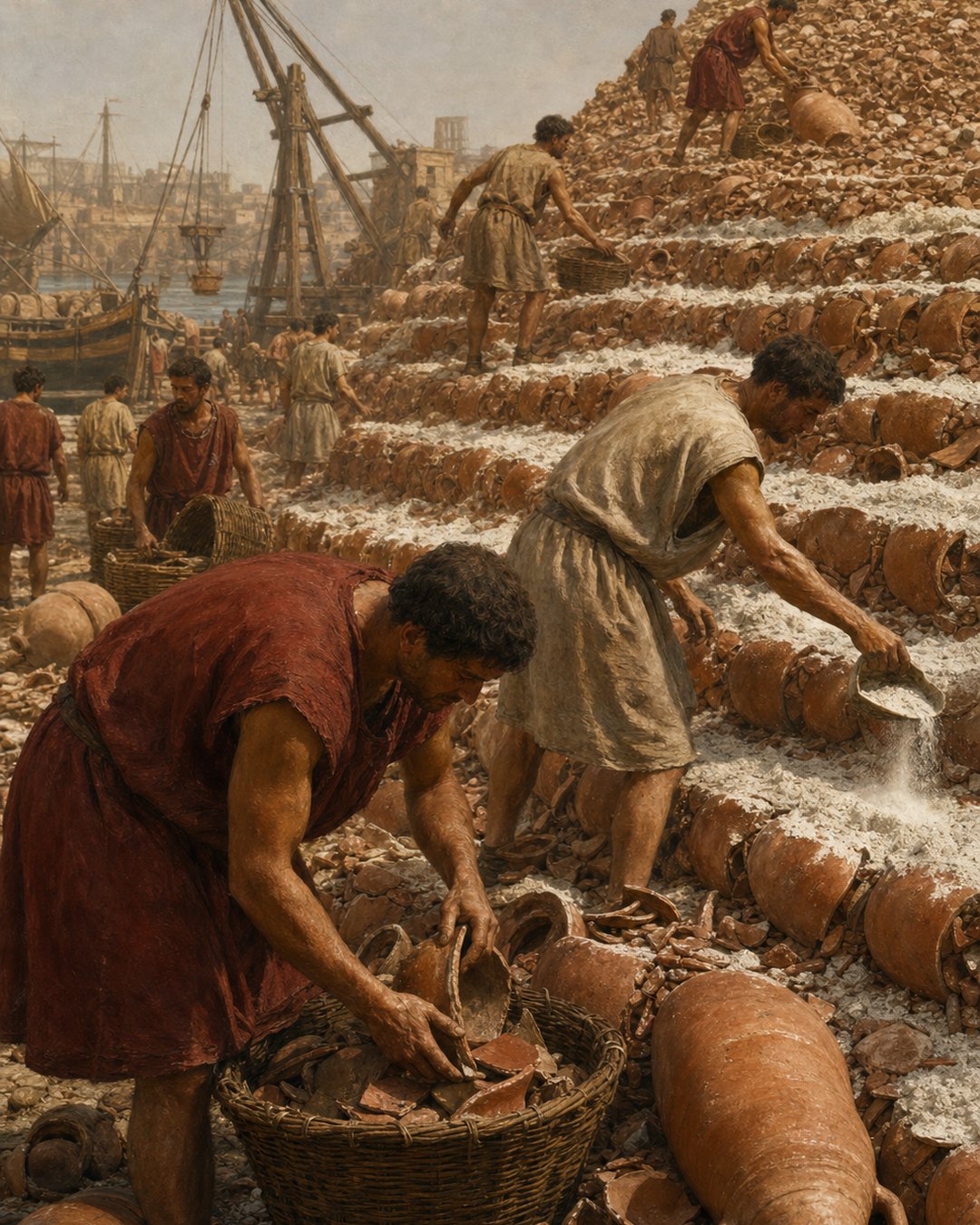
South of ancient Rome’s center stands a hill that the landscape did not make. Monte Testaccio rises from fragments of transport jars, overwhelmingly amphorae that once carried olive oil. Estimates approach eighty million containers. Their handles, rims and walls accumulated into terraces high enough to become urban topography.
The hill is often called a rubbish dump, which is true but incomplete. Casual trash does not normally create orderly layers, retaining walls and readable sequences. Amphora fragments were carried to a designated place near the Tiber’s warehouse district, broken, stacked and treated with lime. Officials and workers turned a disposal problem into managed infrastructure.
The pottery had already crossed the empire before its second life began. Much of the oil came from Baetica in southern Spain; jars also arrived from North Africa. Stamps and painted notices recorded producers, weights and controls. When the containers could no longer profitably circulate, Rome kept the marks and discarded the clay, accidentally building an archive of consumption.
Oil Reached Rome in Containers Made for One Long Journey
Olive oil was food, fuel, cleaning material and ritual substance. Supplying a capital of enormous scale required more than groves. Producers, potters, river carriers, sea captains, warehouse workers and state administrators had to connect harvest zones with consumers across hundreds of miles.
The dominant vessel at Monte Testaccio is the Dressel 20, a large, globular amphora strongly associated with olive oil from Baetica. Its thick walls and rounded body protected cargo during handling, but the form was heavy. Once emptied, sending it back across the sea made little economic sense.
Amphorae could sometimes be reused, yet oil residues turned repeated service awkward. Porous ceramic retained smell and grease, while a return journey consumed valuable ship and warehouse space. At imperial scale, a container designed for safe outward movement could become more costly to recover than to replace near the producing estates.
The story extends the wider Roman amphora system. Standardized shapes let handlers recognize probable contents and origin. At Testaccio, millions of those individual journeys reached the same terminal point, making consumption visible as mass rather than anecdote.
Paint and Stamps Followed the Jar Through Control Points
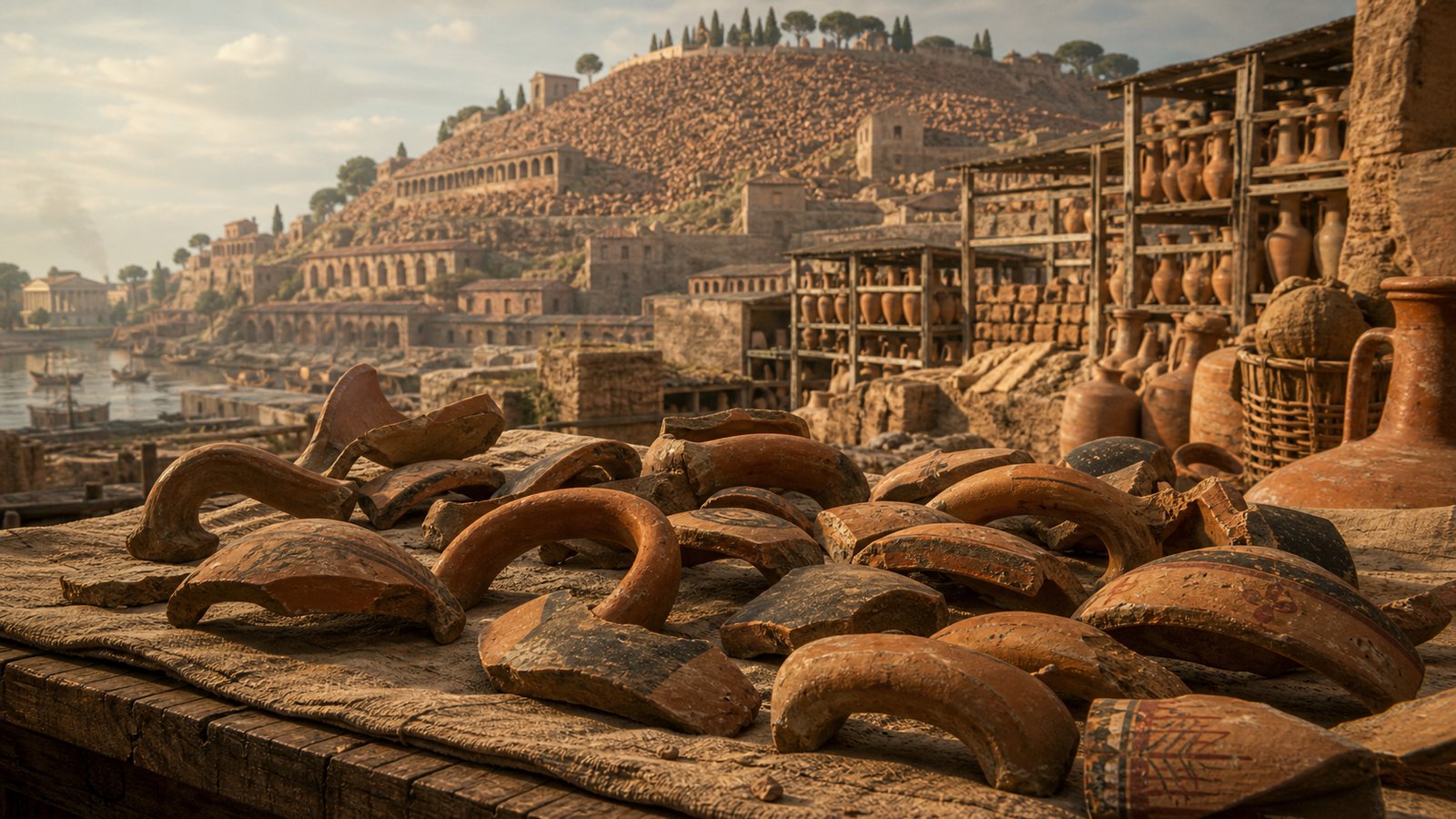
Before disposal, many amphorae carried information on clay and surface. Potters or workshops stamped handles; painted inscriptions, called tituli picti, could record weights, names and fiscal or inspection details. Not every mark means the same thing, but together they reveal multiple hands checking a shipment.
A container therefore functioned as both package and document. The vessel held oil while its exterior carried a compact chain of accountability. Names connected a perishable cargo with people or firms; numbers fixed quantities; official marks linked distant production to Roman oversight.
The paint was never intended to survive as an archaeological database. It needed to remain legible only through transport, sale and control. Disposal preserved it because fragments were concentrated rather than scattered across gardens, road fill and construction throughout the city.
Roman administration often made material carry memory, as writing tablets carried state information. Testaccio shows a commercial version. The record did not sit separately in an office. It traveled on the same curved wall that kept oil from leaking.
Workers Built Terraces Instead of Throwing Jars at Random
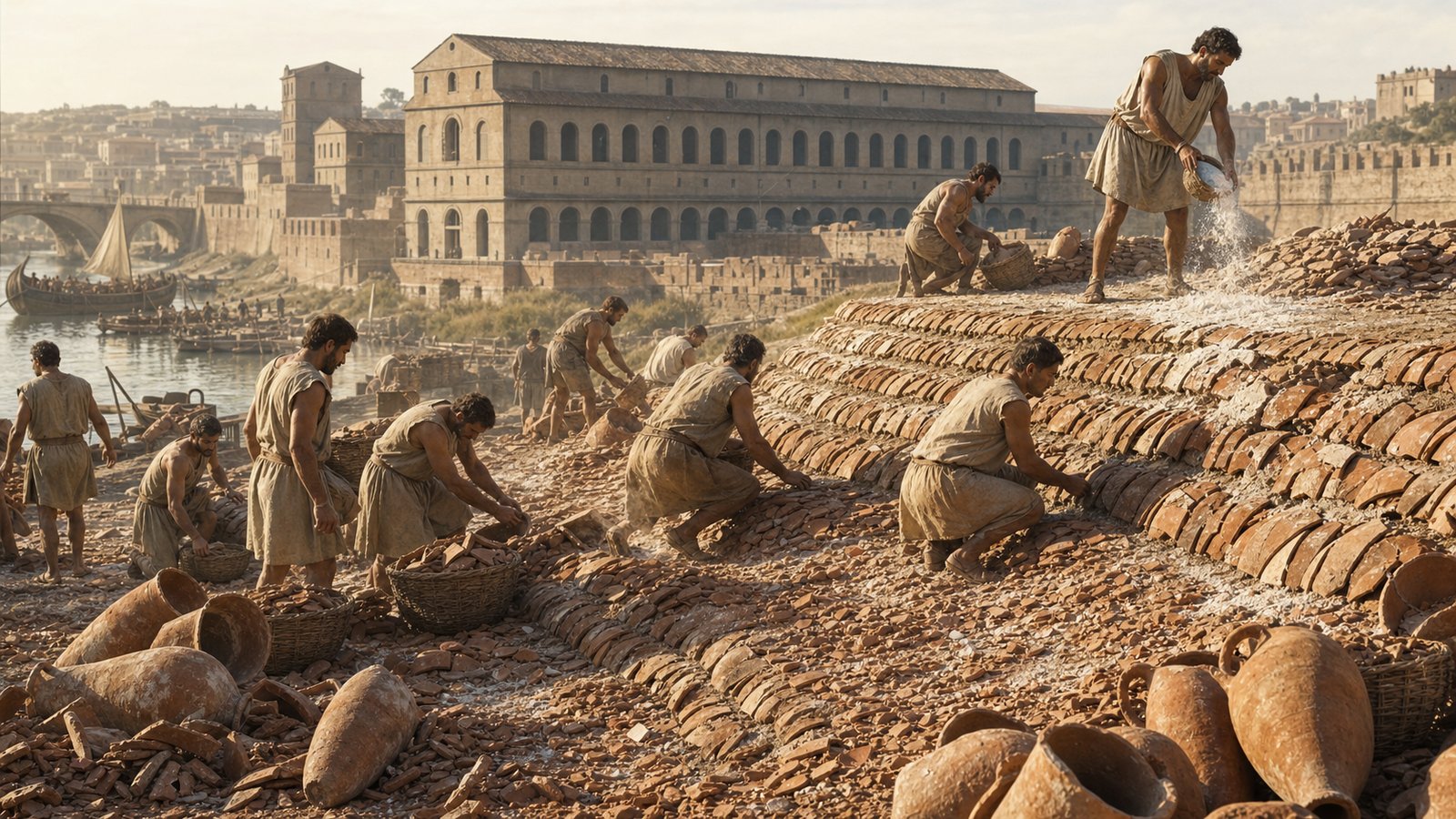
The hill’s structure demonstrates planned deposition. Workers arranged fragments into layers and used amphora pieces to create retaining edges. The resulting stepped mass has been compared to a ziggurat. Chronological sequences remain sufficiently ordered for archaeologists to associate areas with periods of dumping.
Lime was spread among deposits. It may have helped control smell and hygiene as old oil turned rancid, while also stabilizing surfaces. The physical detail matters: a gleaming food product arrived in jars, but its residue became an urban nuisance requiring another material and another workforce.
The location was practical. Testaccio stood near the Tiber port installations and the Horrea Galbae, a major warehouse complex. Empty vessels did not travel far through crowded streets before reaching their final site. Disposal was integrated with the same distribution district that had received the cargo.
Ordered dumping also protected workers from the hill they were creating. A loose mountain of curved ceramic would shift and cut. Terraces, inclined faces and retaining lines converted sharp shards into navigable ground. Administrative control can be read in the slope as clearly as in an official stamp.The labor was repetitive but skilled. A carrier had to move awkward fragments without slicing hands or feet; a layer had to receive new weight without slumping; retaining edges had to follow the growing contour. The finished hill hides those decisions because the unit was humble. Repetition on such a scale was itself an urban technology.
A Heap Measured the Appetite of an Imperial Capital
Numbers attached to Monte Testaccio are estimates because no one can count every embedded sherd. Roughly eighty million amphorae conveys the accepted scale. Even spread across about three centuries, that volume represents a sustained flow of oil and a repeated municipal response to its containers.
Baetican dominance connects Rome’s everyday needs with provincial landscapes along the Guadalquivir. Kilns produced jars near estates and river routes; oil moved downstream to Atlantic and Mediterranean shipping; the cargo entered the Tiber system and ended beside Roman warehouses. One broken handle can therefore join farm, kiln, ship and capital.
North African amphorae increased in later parts of the sequence, reflecting changes in supply. The hill does not offer a simple annual chart of imperial prosperity, because excavation samples, chronology and container capacities require interpretation. It does preserve shifts too large to recover from a single literary complaint about prices.
The warehouses near Ostia and Rome managed the city’s appetite. Monte Testaccio records what happened after management succeeded. Every deposited jar implies oil that reached the distribution system rather than disappearing in a wreck, raid or failed harvest.The implication is not that every Roman received an equal share. Distribution moved through institutions, merchants and households whose access differed. The hill measures throughput, not fairness. Its astonishing bulk should therefore be read as evidence for logistical capacity and metropolitan demand, not as proof that abundance erased poverty.
The Labels on Rubbish Became Evidence No Historian Planned
Modern excavation treats the hill as a stratified archive. Stamps can be compared with finds at production sites and across the empire. Painted inscriptions supply names and figures that literary histories rarely preserve. Ceramic typology and residue analysis test what vessels carried and when forms circulated.
Scientific analysis has identified degraded oil residues in archaeological amphorae from Monte Testaccio. Chemistry confirms what shape, inscriptions and context already suggested, while also demonstrating how ancient organic cargo can leave traces long after the liquid and consumer have vanished.
The hill acquired later uses. Cavities around its base provided cool storage for wine, and the landscape became a place for celebrations and religious performance. Authorities eventually restricted digging as archaeological value replaced the old desire to quarry useful fragments. A managed dump became protected heritage through another layer of regulation.
Monte Testaccio changes the scale at which Roman trade can be imagined. A poem may praise imported plenty, and a law may regulate supply. Here the consequences occupy a hill. Rome’s oil system ended not with an abstract market but with workers lifting greasy clay, scattering lime and adding one more controlled layer to an archive no ancient official meant to write.
Sources & Further Reading
- Avermaete Repository, Monte Testaccio
- José Remesal Rodríguez, Monte Testaccio
- Analytica Chimica Acta, Identification of Oil Residues in Roman Amphorae