
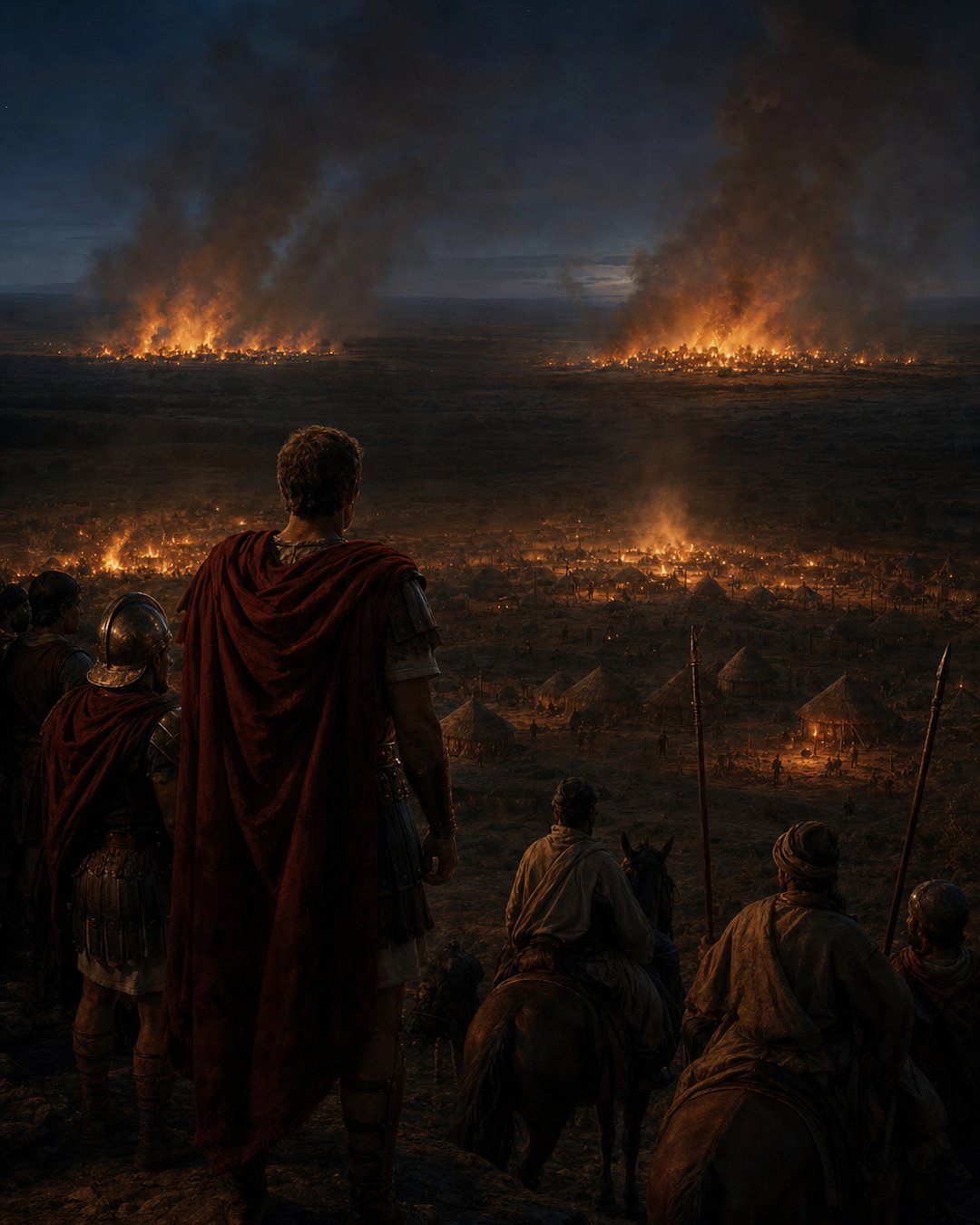
At sunset in 203 BCE, Roman troops left their camp in North Africa without the noise of a normal advance. They marched seven miles at an easy pace and deployed before midnight. Ahead of them stood two allied encampments: the Numidian king Syphax in huts of reeds and timber, and Hasdrubal Gisco with the Carthaginians. The materials that made those camps quick to build would make them quick to burn.
This was not a sudden inspiration at the edge of battle. Publius Cornelius Scipio had spent the preceding negotiations learning the ground while keeping Syphax and Hasdrubal talking. Livy’s account makes the attack a study in preparation, deception and divided command. Fire was the weapon, but information was the mechanism.
A war moved from Italy to Africa
Hannibal’s victories had made Italy the terrifying centre of the Second Punic War, yet Rome eventually attacked the system that sustained him. Scipio crossed to Africa in 204 BCE and forced Carthage to defend its own territory. The shift did not make his position simple. Carthage could call on Hasdrubal Gisco, while Syphax controlled the powerful western Numidian kingdom of the Masaesylians.
Syphax was not a permanent enemy of Rome. Livius records that he had concluded an alliance with the Romans in 213 BCE and received Roman advisers to help train his forces. The alliances of North Africa then changed. Masinissa, a rival Numidian claimant, became Scipio’s partner, while Syphax joined Carthage and married Sophonisba, Hasdrubal’s daughter. The coming night attack therefore joined a Roman-Carthaginian war to a Numidian struggle over kingship.
That political geography matters. Scipio did not possess an anonymous mass of “native cavalry.” He depended on Masinissa, a leader who understood Numidian methods, rivalries and the layout of Syphax’s camp. The alliance gave Rome intelligence as well as horsemen. It also meant that one half of the assault could be led by soldiers who knew whom they were fighting.
Negotiators doubled as surveyors
Before the attack, envoys travelled between the camps under the cover of peace discussions. Livy says Scipio included selected centurions disguised as servants among his representatives. Their task was physical and specific: inspect the entrances, the distribution of troops, the position of the huts and the materials from which the camp had been assembled.
The survey revealed an asymmetry. Hasdrubal’s Carthaginians occupied a more regular camp. Syphax’s men lodged largely in huts made from timber, branches and reeds. Some shelters stood outside a proper rampart. Dry construction, close spacing and multiple exits created a place that looked temporary because it was temporary. The Roman plan turned that looseness into a trap.
This was reconnaissance embedded inside diplomacy. The talks gave Scipio time and access; the disguised officers converted access into a map. When Scipio ended the negotiations, the enemy could interpret the pause as another turn in bargaining. Meanwhile he had enough detail to assign routes, targets and signals. Readers familiar with the discipline of Roman marching camps can see the inverse here: an encampment that could not control its own perimeter offered an attacker a chain of vulnerabilities.
Two commands, one visible signal
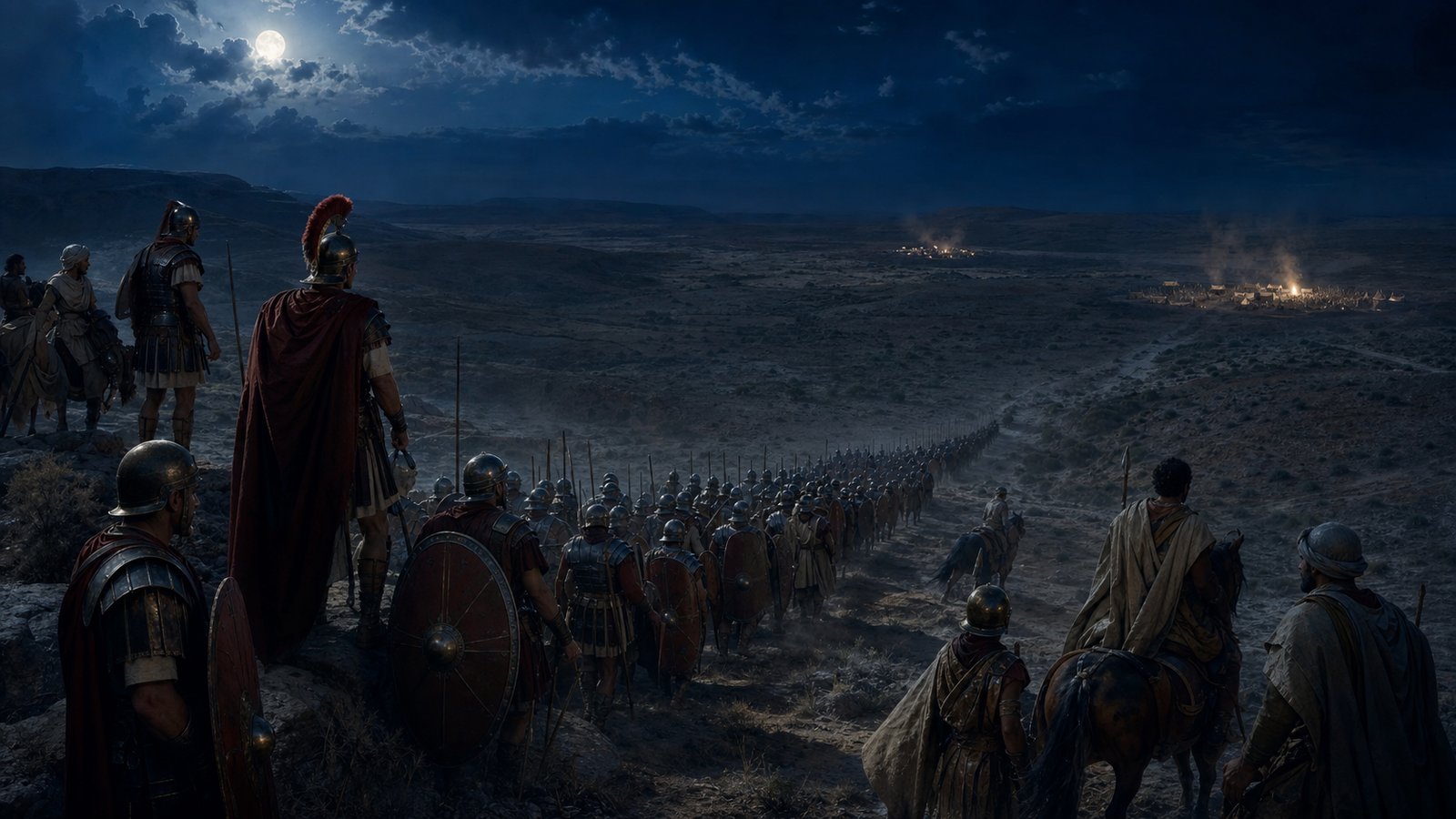
Scipio called a council of war and had the scouts report what they had learned. He also asked Masinissa for his knowledge of the enemy. The army began moving at sunset. By the first watch it had formed for action; after seven miles it reached the hostile camps around midnight.
The force then separated. Scipio assigned Gaius Laelius and Masinissa to attack Syphax and ignite the Numidian huts. Scipio took responsibility for Hasdrubal’s camp. The flame rising from Syphax’s position would be his signal. This sequencing reduced the need for messengers crossing darkness and confusion. One commander could see when the other attack had begun.
Livy also preserves a small command scene. Scipio took Laelius and Masinissa aside and urged each to compensate, through exceptional care, for the disorder inherent in a night operation. It is an unusually practical admission. Darkness could magnify surprise, but it could also break formations, conceal friendly troops and erase the certainty on which Roman drill depended.
The first mistake was to fight the fire
Flames spread from the nearest huts into the rest of Syphax’s camp. Men waking in darkness assumed that an accident had begun among combustible shelters. They rushed out without weapons to extinguish it. Masinissa had positioned armed troops at the avenues of escape, using his knowledge of the camp to turn the natural response to a fire into exposure.
The attack worked because the first seconds did not feel like an attack. A trumpet, charge or shower of missiles would have identified an enemy. Fire inside a camp suggested negligence. The defenders spent their brief chance for organized resistance looking for buckets, companions and exits. Some were trapped in burning huts; others crowded the gates and were trampled.
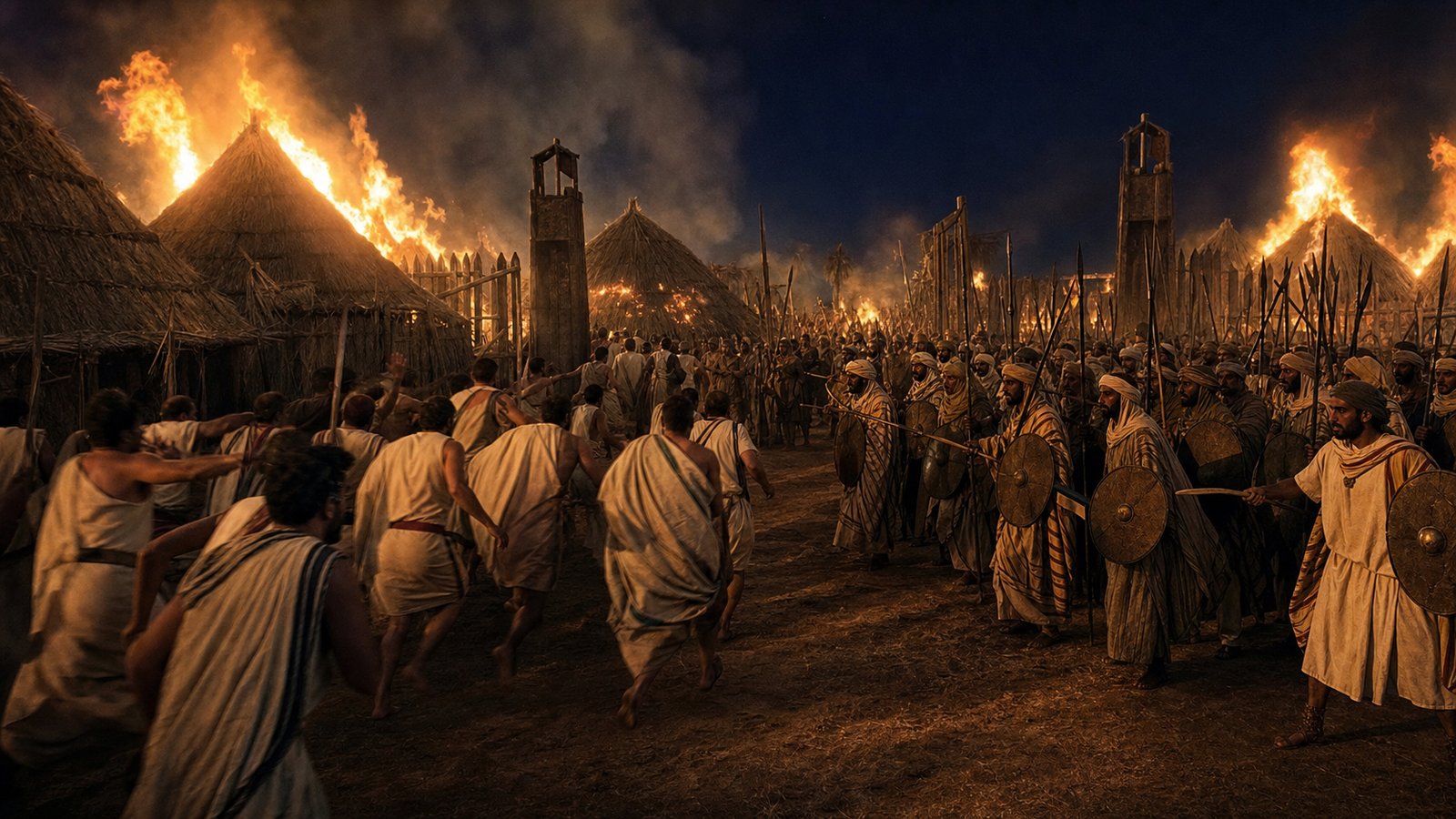
Hasdrubal’s troops saw the neighbouring blaze and made the same initial inference. They left their own camp to help, many without arms or armour. Scipio struck while that camp was open and disordered. Livy describes fire spreading there too. A single engineered misunderstanding passed from one encampment to the next.
Victory came from architecture as much as flame
It is tempting to remember the episode as a spectacular trick: Scipio burned two camps. The mechanism was narrower and more disturbing. He identified how materials, spacing, gates and habits would govern behaviour after ignition. The huts carried flame. The belief in an accident delayed recognition. The exits concentrated bodies. The alliance with Masinissa supplied local knowledge. The division of command let two attacks reinforce one another.
The operation also shows why a temporary camp was more than a sleeping place. Its arrangement determined whether soldiers could wake, arm, form and receive orders. Rome’s own camp routines were designed to make those transitions repeatable. Syphax’s position failed all four at once, not because its men lacked courage, but because the attack reached them before courage could become a formation.
There was an ethical cost inside the tactical success. Ancient accounts praise cunning, yet they also describe sleeping men burned, crushed or cut down while unarmed. Scipio’s use of negotiation for reconnaissance sits uneasily beside the violence that followed. Reading the event only as ingenuity erases what the ingenuity was built to do.
The night opened the road to Zama
Syphax and Hasdrubal escaped the destruction and raised another army, but Scipio and Masinissa defeated them again at the Great Plains. Syphax was later captured. Carthage’s deteriorating position helped force the recall of Hannibal from Italy, moving the war toward its decision at Zama in 202 BCE.
The camp fires therefore mattered beyond one night. They damaged armies, weakened an alliance and demonstrated that Scipio could impose the terms of fighting in Africa. The operation belongs beside the story of Hannibal’s deeper logistical achievement: both commanders understood that armies are systems of movement, shelter, information and expectation before they are lines on a battlefield.
At midnight, Scipio did not merely surprise sleeping opponents. He made their camp tell them the wrong story. By the time the defenders understood that the fire was an assault, the useful exits were blocked, the neighbouring army was moving without weapons, and the two halves of the Roman plan had become one disaster.
Sources
Livy, History of Rome, Book 30, chapters 3–6
Livius, “Syphax”
Polybius, Histories, Book 14