
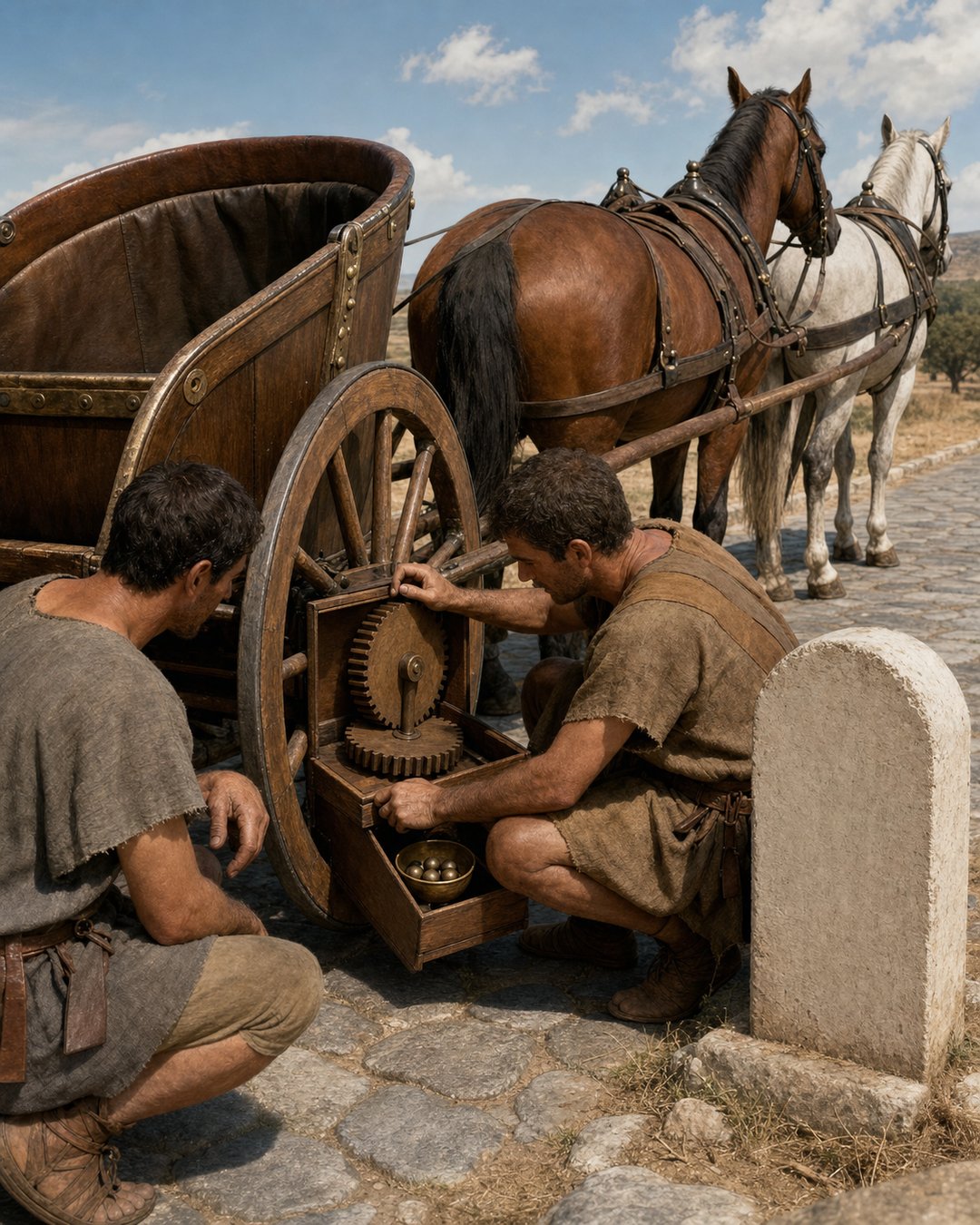
A traveller did not have to stop, look back or ask how far the chariot had gone. In Vitruvius’s design, the vehicle answered with a sound from inside its own body.
One small ball fell through a channel and struck a bronze vessel. The noise marked a mile. At day’s end, the balls collected below supplied a second record that could be counted after the journey had stopped.
Between road and sound stood three wheels, hundreds of teeth and a carefully chosen road-wheel size. Vitruvius’s machine did not measure distance directly. It translated movement repeatedly until a long stretch of travel became one discrete object in a bowl.
The description belongs to an engineering text, not a surviving user manual from an excavated chariot. Vitruvius tells us how the device should work. That is enough to reveal the ambition behind it, but not enough to claim that every road vehicle carried one or that the exact gearing always ran successfully.
The road wheel became the machine’s measuring rule
Vitruvius begins with the chariot’s ordinary contact with the ground. Its wheels should be four feet in diameter. He calculates that one complete turn would advance the vehicle twelve and one-half feet.
That dimension made the wheel more than support and traction. Once its circumference represented a known length, every rotation became a repeatable unit of travel. The road itself drove the count; the passenger did not need to estimate speed or watch a changing shadow.
A small drum wheel was fixed securely to the inside of the road-wheel hub. It carried one tooth projecting beyond its circumference. Every full turn of the vehicle wheel therefore delivered one mechanical pulse to the machinery housed in the chariot.
This first translation was simple in concept. Forward motion became rotation, and rotation became a single contact. The complexity arrived because a mile required many wheel turns. The machine needed to preserve each pulse without releasing a marker too early.
Roman roads often appear as static infrastructure. Vitruvius instead treats the moving vehicle as an instrument riding across that infrastructure. The measured line was produced where wheel and road met, one circumference at a time.
Four hundred teeth slowed the count
Inside a box on the chariot, Vitruvius placed a second drum wheel vertically on an axle. Its edge was divided into four hundred teeth. The single tooth attached to the road wheel engaged that toothed rim once during every revolution.
After one road-wheel turn, the second wheel had advanced only one tooth. After four hundred turns, it completed one revolution. This was the essential reduction: rapid repeated motion at the axle became one slow cycle inside the counting box.
The second wheel carried another single tooth projecting from its side. Above it sat a third wheel in a horizontal plane. The side tooth engaged that upper wheel once per complete revolution of the four-hundred-tooth wheel.
Vitruvius’s sequence resembles the broader fascination with controlled motion found in the report of Archytas’s wooden dove, but its purpose was different. The dove story made motion astonishing. The chariot counter made ordinary motion accountable.
The text specifies relationships rather than offering a vague wonder. One road-wheel revolution moved one tooth. Four hundred such moves turned the vertical wheel once. That revolution nudged the horizontal storage wheel. Distance survived the chain because each stage waited for the one before it.
One hole released one audible mile
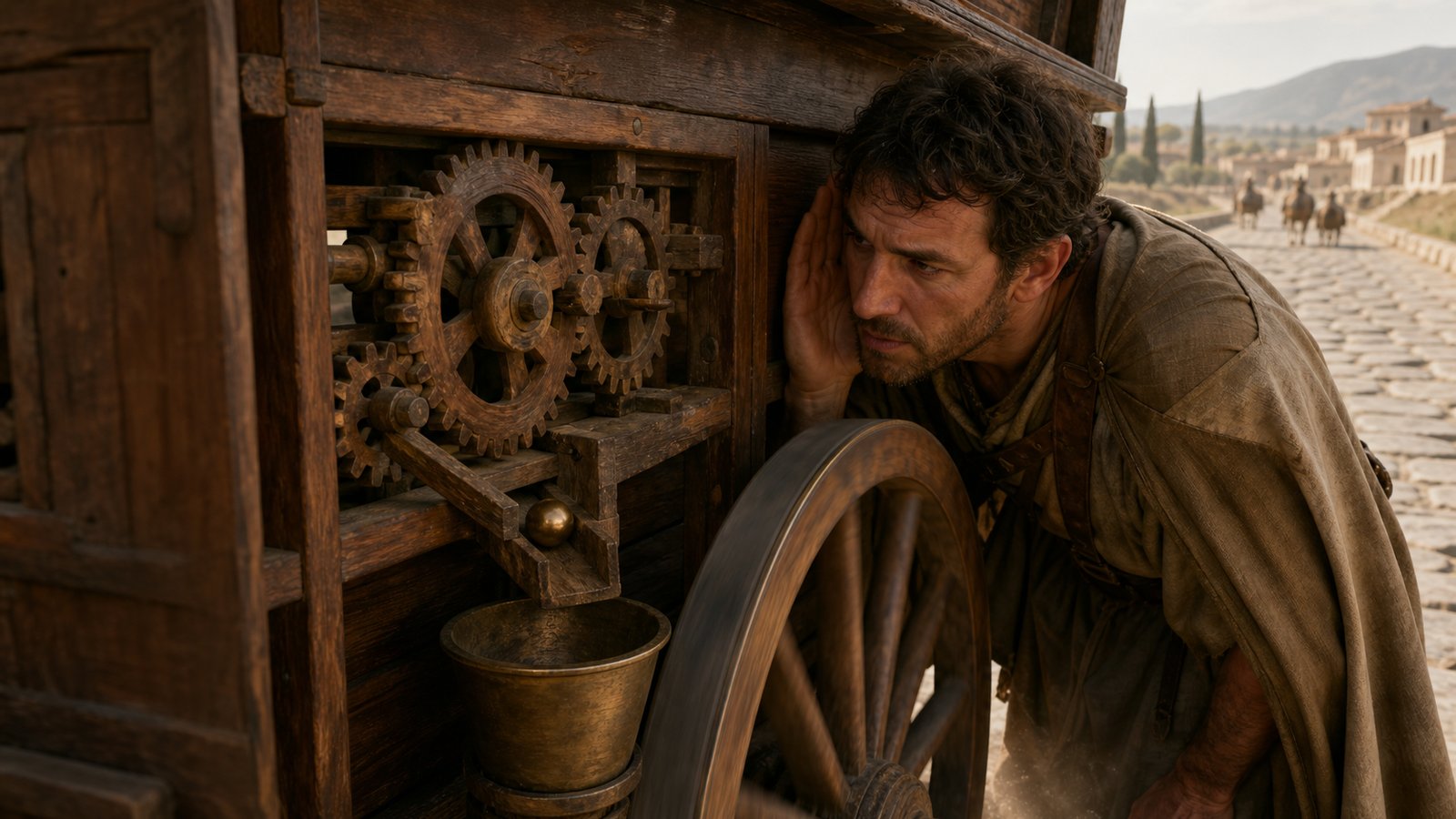
The top horizontal wheel contained holes filled with small balls. Vitruvius says their number could correspond to the miles in an ordinary day’s journey, although having more or fewer was not important to the principle.
The enclosing box had an opening and a channel. As the horizontal wheel advanced, it eventually brought one loaded hole into position. The ball dropped without obstruction into the lower part of the chariot and struck a bronze vessel.
Vitruvius equates four hundred revolutions of the road wheel with five thousand feet, or one thousand paces. The released ball was therefore not a decoration or loose tally. Its fall represented the completed mechanical sequence for that distance.
The marker had two forms. Its impact made the mile audible at the moment of passage. Its continued presence made the distance countable afterward. A traveller could hear progress during the day and then total the balls collected at the bottom.
This made memory external. Nobody had to remember hundreds of rotations or keep an uninterrupted spoken tally. The machine stored the result as objects. It converted continuous travel into separate, recoverable pieces of evidence.
The same logic moved from road to water
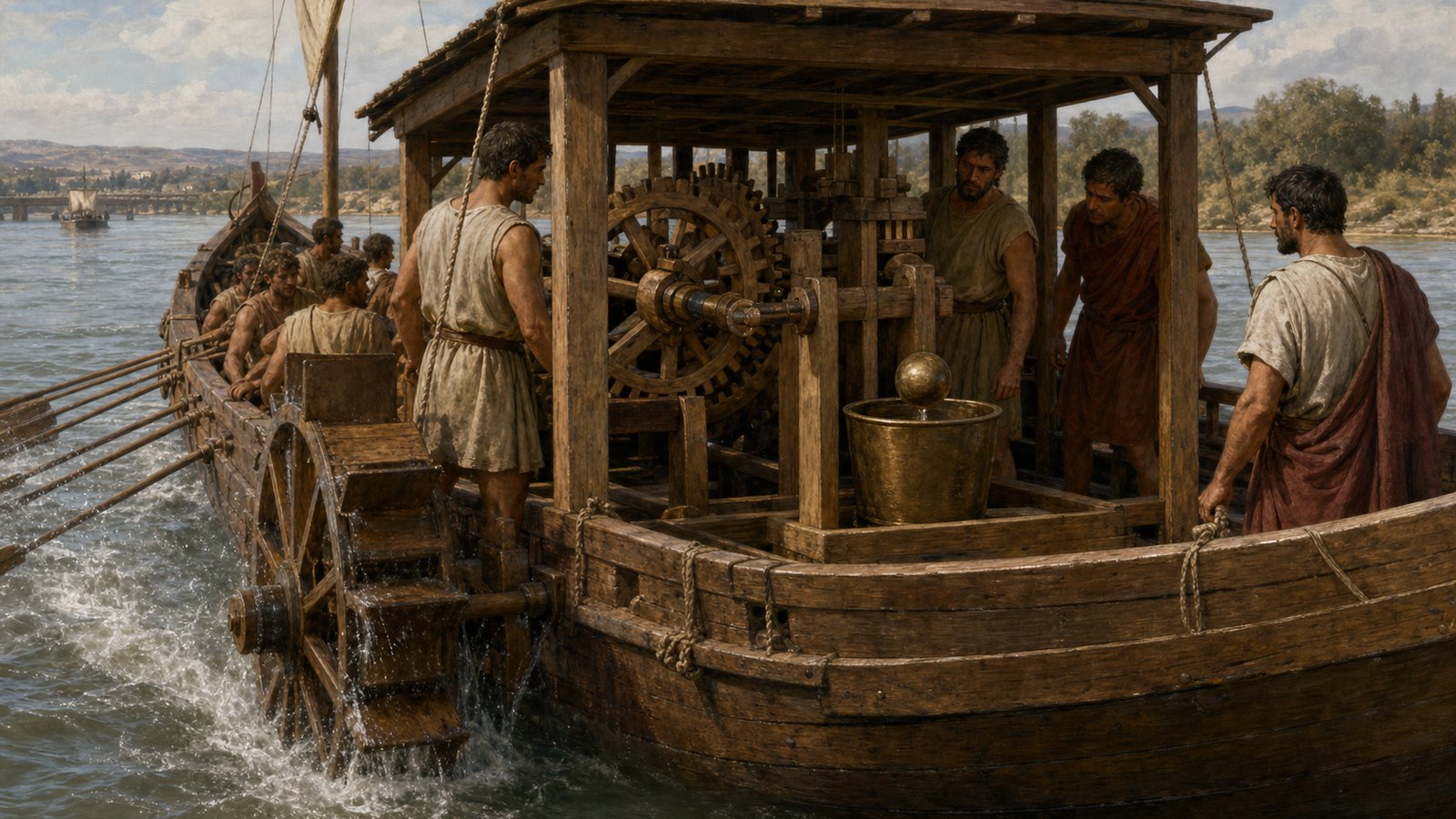
Vitruvius did not stop with a chariot. He says the same result could be achieved in navigation with only a small change to the machinery. An axle crossed the vessel and projected beyond both sides. Four-foot wheels with paddles touched the water.
As the ship moved under oars or wind, water drove those paddle wheels. Their axle turned a single-tooth drum wheel inside the vessel. A four-hundred-tooth wheel and a horizontal ball wheel repeated the reduction and release used on land.
The adaptation exposes what Vitruvius thought was portable. The source of rotation could change from road contact to water pressure, but the counting chain remained. Motion entered through an axle, was slowed through toothed wheels and ended as a ball ringing in bronze.
That combination of measured movement and audible notice recalls Roman water clocks that made passing time observable. Both devices turned a continuous process into intervals people could register. One divided time with water; the other divided travel with wheel turns.
Vitruvius closes by saying the mechanism would offer utility and amusement in peace and safety. The pairing is revealing. A machine could be practically useful and still delight because hidden motion produced a clear result.
A distance became something the vehicle could remember
The odometer description is easiest to misunderstand when treated as a modern dashboard instrument placed too early in history. Vitruvius’s own account is stranger and more physical. It depends on wood and bronze, projecting teeth, a perforated wheel, gravity, sound and a pile of balls.
Its achievement was conceptual as much as mechanical. A mile had no colour or shape moving beside the chariot. The machine gave it both an event and an object. The ring announced that a threshold had been crossed; the ball remained as the threshold’s material trace.
The design also required calibration before travel. Wheel diameter, circumference, tooth count and the accepted relation between feet and paces had to agree. If one stage drifted, the final bowl would still look precise while recording the wrong distance.
That vulnerability should temper confidence without erasing the engineering thought. Vitruvius presents a complete causal chain from ground contact to daily total. Later doubts about the practicality of particular gear contacts do not change what his text attempted to describe.
The chariot counter imagined a vehicle capable of observing its own journey. The traveller supplied no continuous arithmetic. Rotation accumulated invisibly until the mechanism released one ball, and then another. By evening, the road had been translated into a handful of bronze markers.
What began as dust under a four-foot wheel ended as sound and number. Vitruvius’s mile was not merely passed. It was processed, announced and stored.
Sources
Vitruvius, De Architectura 10.9