
The most useful detail in the story of Archytas’s flying dove is not that it flew. It is that it could not take off again.
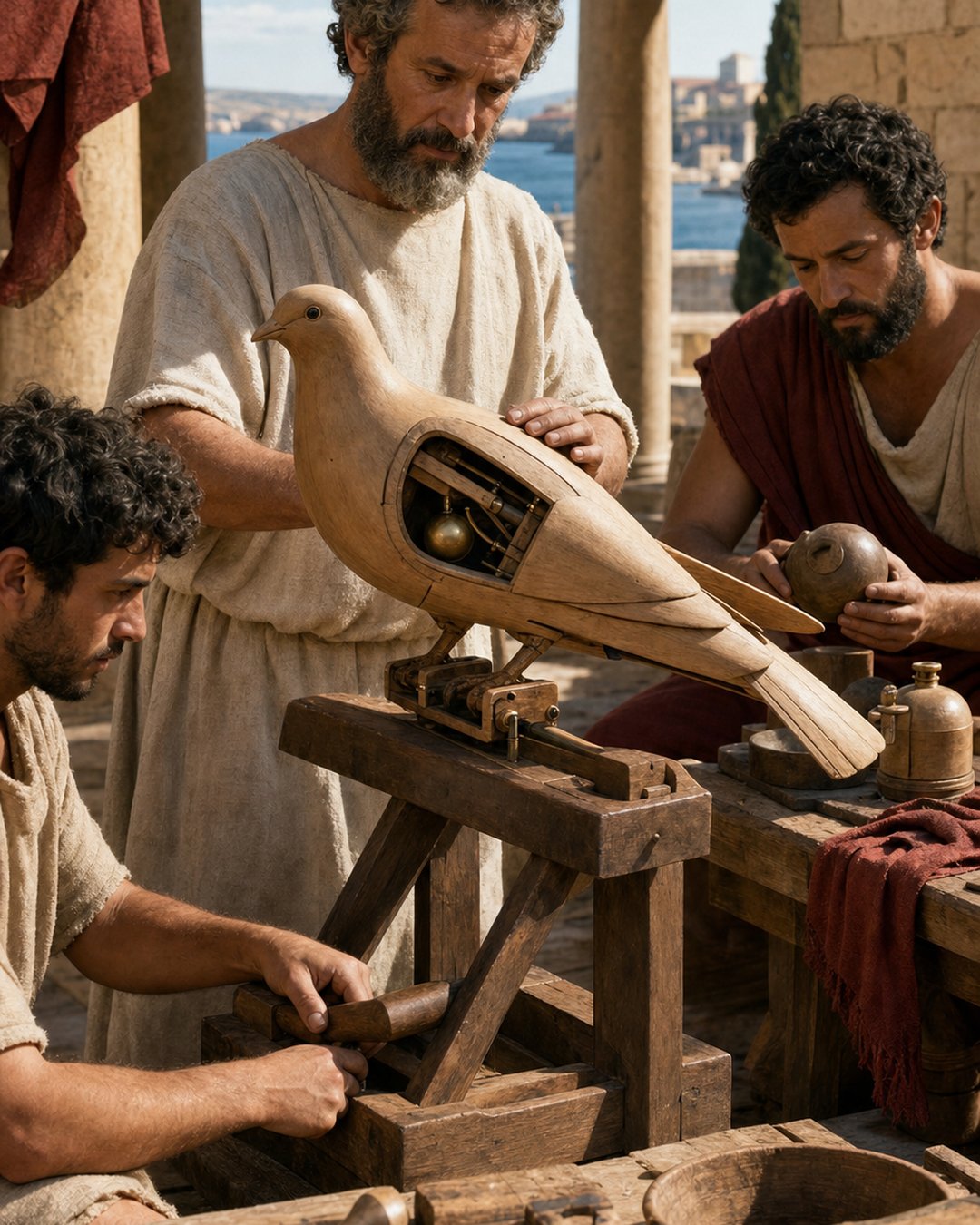
Aulus Gellius reports a wooden model made by Archytas of Tarentum. Balanced by weights and moved by a hidden current of enclosed air, the dove crossed the boundary between crafted object and moving body. Then it landed, and the performance was over.
Gellius placed this report beside stories he considered plainly false, yet he did not grant it unlimited credibility. He called it marvellous without making it magical. By naming balance, weights and air, he gave the wonder a mechanical vocabulary. By preserving the failed relaunch, he also preserved its edge.
The result is not an ancient blueprint for an aeroplane. It is a compact account of a prepared machine that released motion once. The dove matters because its success and failure belonged to the same mechanism.
Gellius sorted a mechanism from a shelf of marvels
The chapter begins in suspicious company. Gellius reviews extraordinary claims attached to Democritus, including recipes and powers he regards as inventions protected by a famous name. He explicitly calls several stories reported by Pliny marvellous and false.
This opening changes the tone of what follows. Gellius was not collecting every wonder with equal enthusiasm. He had already demonstrated that reputation could become a shelter for fiction, especially when later writers wanted an impressive authority for impossible knowledge.
Archytas’s dove enters only after that warning. Gellius says it should appear no less marvellous, but “not wholly absurd.” The qualification is narrow and deliberate. He does not certify every part through personal observation. He explains why the report deserved a different hearing from stories that supplied no workable physical cause.
Authority still mattered. Many eminent Greeks were said to have transmitted the account, and Favorinus had stated it positively. Gellius describes Favorinus as a diligent investigator of old records. That gives the report a chain of testimony, not experimental replication.
The distinction is essential. A source can preserve what respected earlier writers believed without allowing modern readers to reconstruct the device. Gellius offers a reported event, two principles and a limit. Anything more precise must be labelled inference rather than smuggled into the wooden body.
This critical arrangement makes the dove unusually valuable. Its place in the chapter records an ancient reader deciding that a wonder with named causes was different from a wonder that merely borrowed Democritus’s prestige.
Weights made the wooden body behave as one object
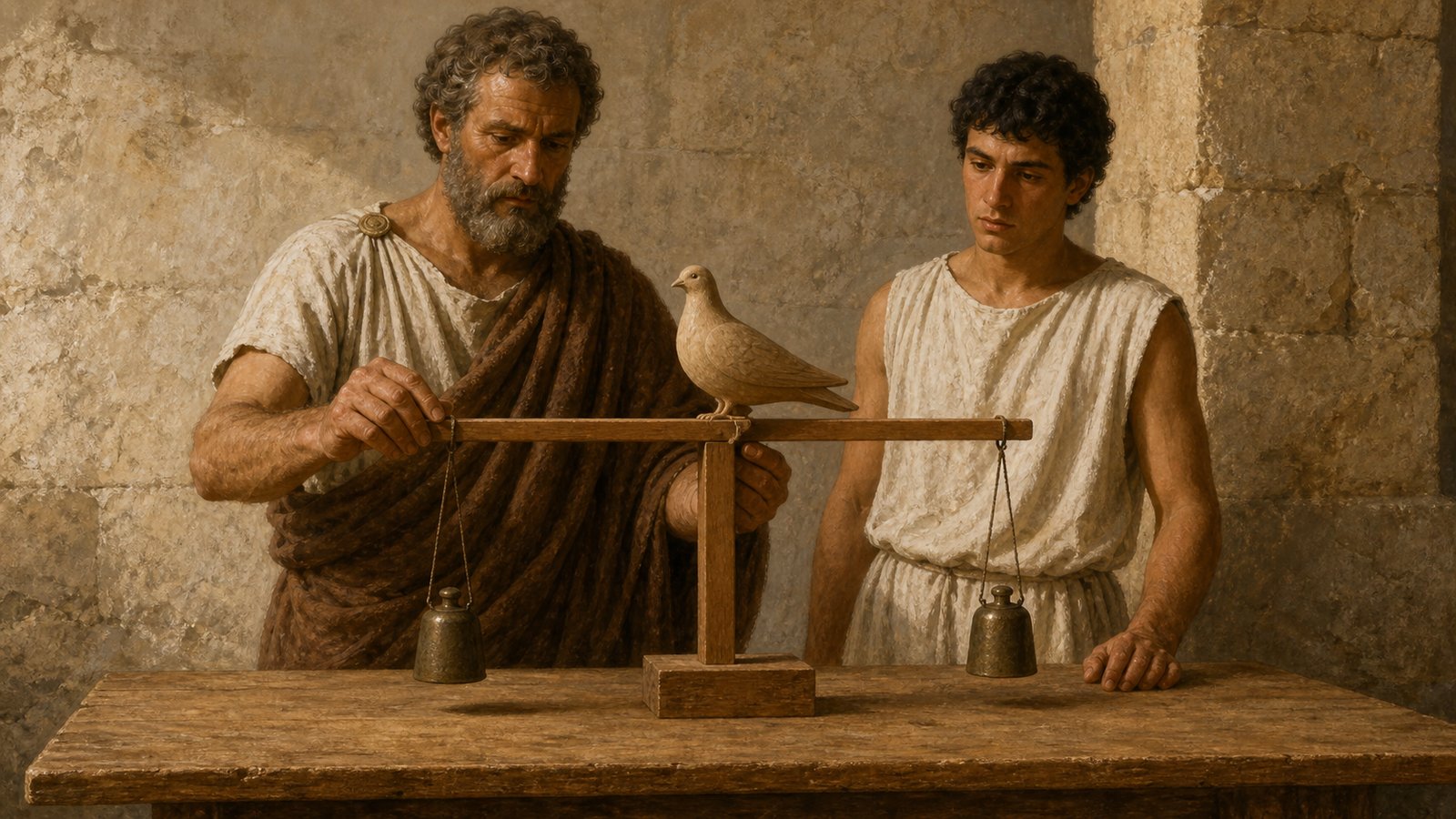
Gellius’s first physical clue is balance. The model was “nicely balanced” with weights. A wooden bird does not move like a living one by default. Its centre of mass depends on how the head, body, wings, internal cavity and added metal are distributed.
Small changes could decide whether a launched object pitched forward, stalled, rolled or maintained a useful attitude. Counterweights would not create motion by themselves, but they could make the motion supplied elsewhere act through a stable arrangement.
That is familiar workshop logic. The article on Roman dividers and repeated measurement shows accuracy becoming portable through a tool. Archytas’s reported weights made a relationship portable through a body: mass had to be placed so that separate wooden parts behaved as one moving form.
The source does not tell us the weight material, attachment points, wing profile or exact scale. It does not say that the bird flapped. Images of intricate gears, clockwork or a modern airframe would therefore claim more than the text supports.
What it does support is a sequence of preparation. Someone shaped the dove, tested its balance and adjusted mass before release. The flight began on the bench long before the model entered the air.
Balance also explains why landing could be final. A device arranged for one launch might strike the ground, lose its attitude or exhaust the condition that made release possible. The same precision that allowed the first motion did not automatically include recovery.
A hidden current supplied motion without revealing a motor
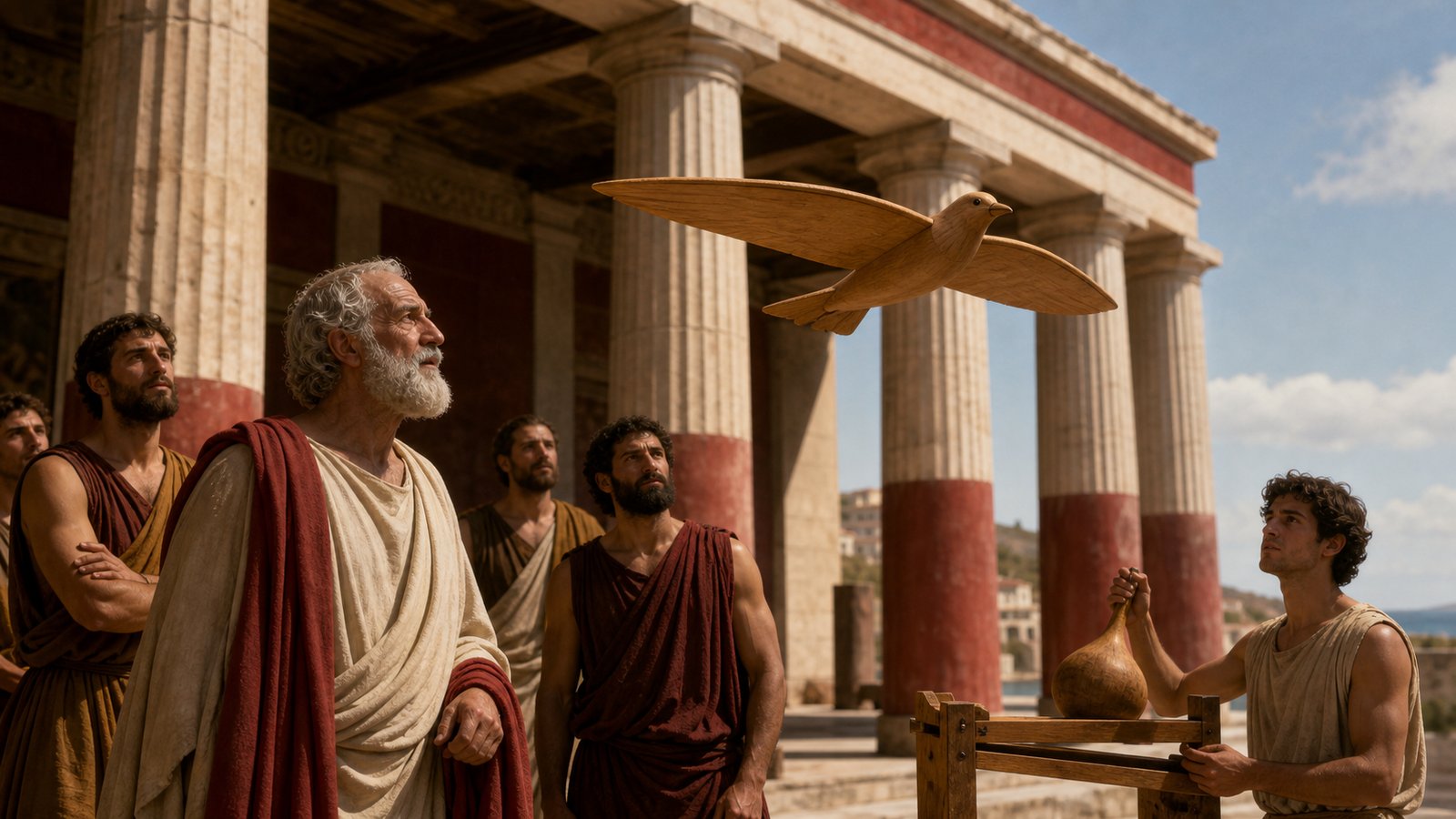
The second clue is air “enclosed and hidden within” the dove. Gellius does not describe a pump, reservoir, valve or external line. His phrase identifies a current as the mover while withholding the architecture that produced it.
That absence should restrain reconstructions. Compressed air, steam and external launching arrangements have all attracted speculation around ancient mechanical stories. The surviving passage does not select a complete design. It tells us only that Favorinus or Gellius understood concealed air as part of the explanation.
Ancient machines could make invisible forces legible through controlled parts. The water screw converted rotation into a rising flow; the dove reportedly converted a hidden current into a brief visible journey. In each case the mechanism matters more than the surface resemblance to nature.
The wooden bird did not need to be mistaken for a living dove. Its form made the feat intelligible. A vessel shaped like a bird moved through the region associated with birds, and the audience could compare crafted motion with flight immediately.
Air was a useful dramatic agent because it could act without being seen. Observers saw the body move but not the current inside it. That concealment did not necessarily mean deception. Enclosure was part of making pressure or flow do directed work rather than dissipate around an open vessel.
Yet the source never says how long the flight lasted, how high it rose or whether it glided after an initial impulse. “It flew” is the surviving scale of the claim. Turning that phrase into sustained powered flight would erase the careful economy of the testimony.
Landing exposed the difference between release and autonomy
Favorinus’s quoted sentence supplies the decisive failure: whenever the dove landed, it did not rise again. The quotation then breaks off, leaving its final explanation incomplete. The damaged ending makes confident engineering diagrams especially risky.
Still, the negative result reveals the system boundary. A machine can perform motion after being prepared by people without carrying the means to restore its starting condition. The dove may have spent pressure, lost a launch position or depended on an arrangement available only before release.
That distinction separates stored action from autonomy. The device had enough organization to move after the maker let go. It apparently lacked a cycle that could gather energy, rebalance, aim and launch again from the place where it came to rest.
The inability to relaunch is therefore not an embarrassing footnote to remove from the marvel. It is the detail that makes the report mechanically interesting. Repeatability would have demanded another layer of control beyond a single successful release.
Gellius’s phrasing also protects the story from endless inflation. A flying wooden dove can quickly become a machine with navigation, flapping wings or long endurance in later retellings. “It did not rise again” pulls the account back toward a bounded demonstration.
Archytas’s achievement, as transmitted, was to coordinate material, weight and air well enough for one passage. The landing showed what had not been solved. Success occupied the interval between launch and rest.
The broken explanation is a reason to read more carefully
No surviving reader can stand beside Favorinus and ask what followed his unfinished “for until this…” Gellius’s text leaves the explanation open exactly where curiosity becomes strongest.
That gap encourages two opposite mistakes. One is dismissal: because the design is incomplete, the entire report must be worthless. The other is completion by fantasy: because a mechanism is imaginable, a preferred reconstruction must be what Archytas built.
A better reading keeps each layer separate. Ancient testimony says a wooden dove flew. Gellius reports balance by weights and motion from hidden enclosed air. Favorinus says landing ended its ability to rise. The specific apparatus remains unknown.
This discipline does not drain the story of wonder. It relocates wonder from anachronistic flight technology to the ancient habit of mechanical thought. A crafted body could be tuned, charged and released. Observers could ask what invisible agency moved it and notice where the performance stopped.
The account also catches Gellius doing source criticism in miniature. He rejects spectacular tales attached to one philosopher, pauses over another and explains why it is not entirely absurd. His standard was not modern laboratory proof, but neither was it pure credulity.
Archytas’s dove survives as a machine made vivid by its boundary. Hidden air gave it motion; weights made that motion manageable; landing made the preparation visible in retrospect. Once the stored conditions were gone, wood remained wood, waiting for human hands to begin again.
Sources
Aulus Gellius, Attic Nights 10.12