
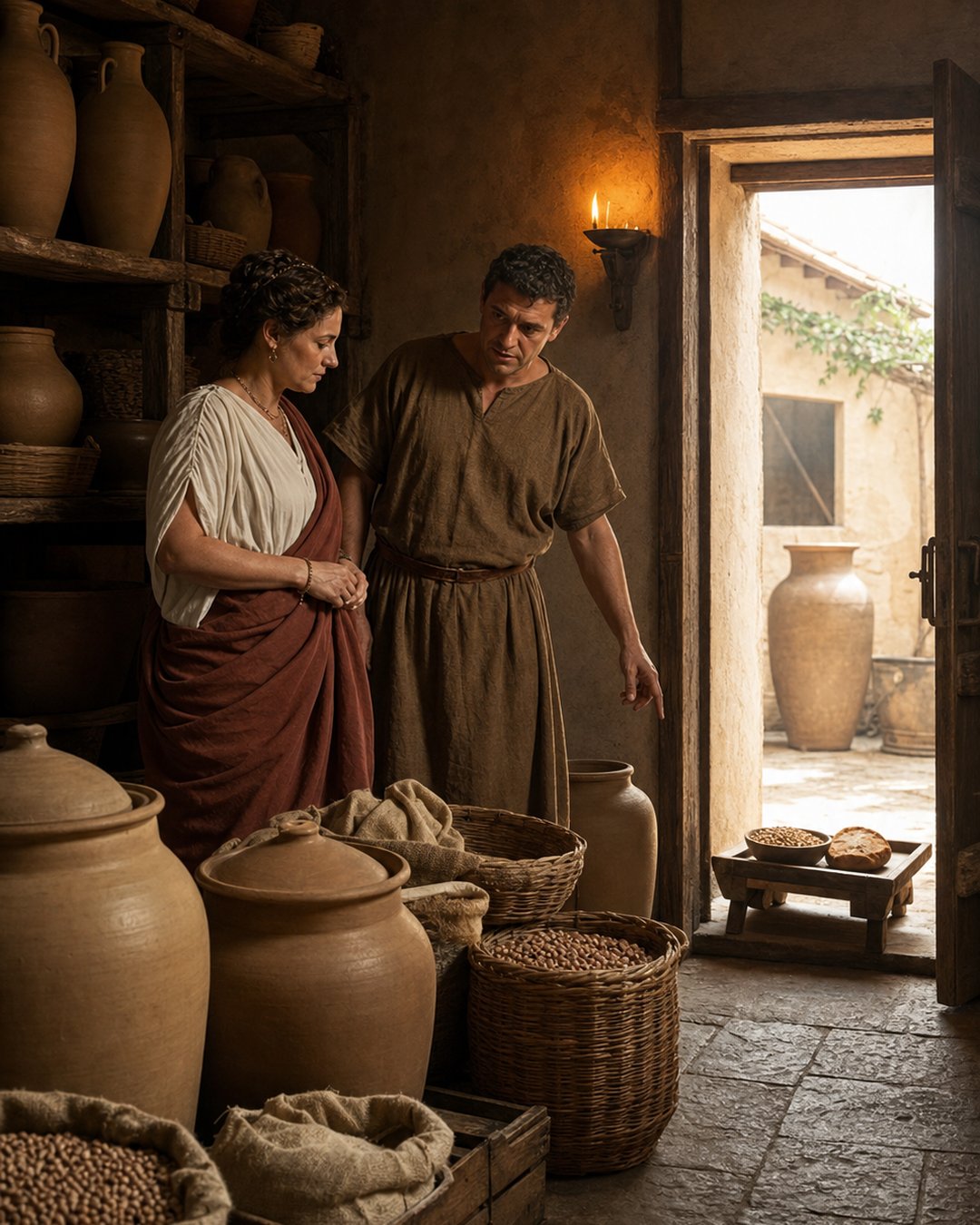
A Roman pantry could not be defined simply by opening a door and naming what stood inside.
Aulus Gellius records a conversation in the entrance hall of the imperial palace on the Palatine. An overconfident grammarian was discussing the gender and declension of penus, a Latin word for household stores. The philosopher Favorinus interrupted with a more practical question: what did the word actually include?
The first answer sounded obvious. Wine, wheat, oil, lentils and beans belonged in the category. Favorinus then added millet, panic-grass, acorns and barley. A list could keep growing without revealing the rule that united its items.
Roman jurists had already tried to draw that rule. Their answers turned a pantry from a physical room into a boundary made from duration, purpose and use. Food for today’s dinner could fall outside it. The same kind of food stored for months could enter. Goods held for sale might stand beside household reserves yet belong to a different legal category.
A grammarian named examples while Favorinus demanded a rule
Gellius stages the exchange among people waiting to greet Caesar. Men of many ranks had gathered in the palace entrance, and a circle of scholars formed around Favorinus. The unnamed grammarian treated small points of language with theatrical seriousness, raising his eyebrows and speaking as if grammatical endings carried oracular weight.
His command of forms was not necessarily false. He knew that earlier writers had used penus with different genders and endings. He could produce literary examples. Favorinus’s objection was that this display left the object itself undefined.
When asked what penus meant, the grammarian supplied familiar provisions. Wine, grain, oil and pulses gave listeners recognizable contents but no limit. Favorinus’s follow-up about millet, acorns and barley exposed the weakness. If resemblance alone admitted each new food, the speaker still could not say where the category stopped.
Favorinus asked for genus and species: a broad class followed by the distinction that marked the relevant members. He illustrated the problem with the word “man.” Pointing to two individual men would identify examples, not define humanity. A useful definition had to explain why one thing belonged and another did not.
The scene matters because its argument is not decorative wordplay. Household stores could appear in wills, disputes and juristic writing. Naming them imprecisely could change what a legal phrase covered. Favorinus therefore moved from the grammarian’s performance toward rules that had consequences beyond the schoolroom.
Scaevola separated tomorrow’s reserve from today’s meal
Gellius reports a definition attributed to the jurist Quintus Scaevola. Penus consisted of things prepared for eating or drinking by the father and mother of the family, their children and the household members embraced by the definition. The people served by the stores mattered as much as the edible objects.
Scaevola then introduced time. Articles prepared from day to day for luncheon or dinner were not penus. Supplies collected and laid away for use over a long period were. A bowl of lentils destined for the next meal and a jar of lentils held against future need could therefore occupy opposite sides of the line.
This is not a modern inventory system projected backward. Gellius does not give shelf labels, accounts or standard container sizes. What survives is the principle: immediate consumption differed from durable provisioning even when the substance was identical.
The explanation connected the term with the innermost part of the house, where stores were kept rather than left ready at hand. Yet location alone was not decisive. The contrast between ready access and deep storage helped describe duration. Goods moved inward because they were being reserved, not because every object behind one wall automatically acquired the same status.
Large dolia could turn wine into stored household or commercial wealth. Scaevola’s definition addresses a different layer of the problem. The container reveals capacity; the legal category asks whose future use that capacity was meant to secure.
Incense, wax and mule feed stretched the pantry beyond food
Later authorities did not leave Scaevola’s boundary untouched. Gellius adds views that tested whether supplies supporting household consumption belonged alongside the food and drink themselves.
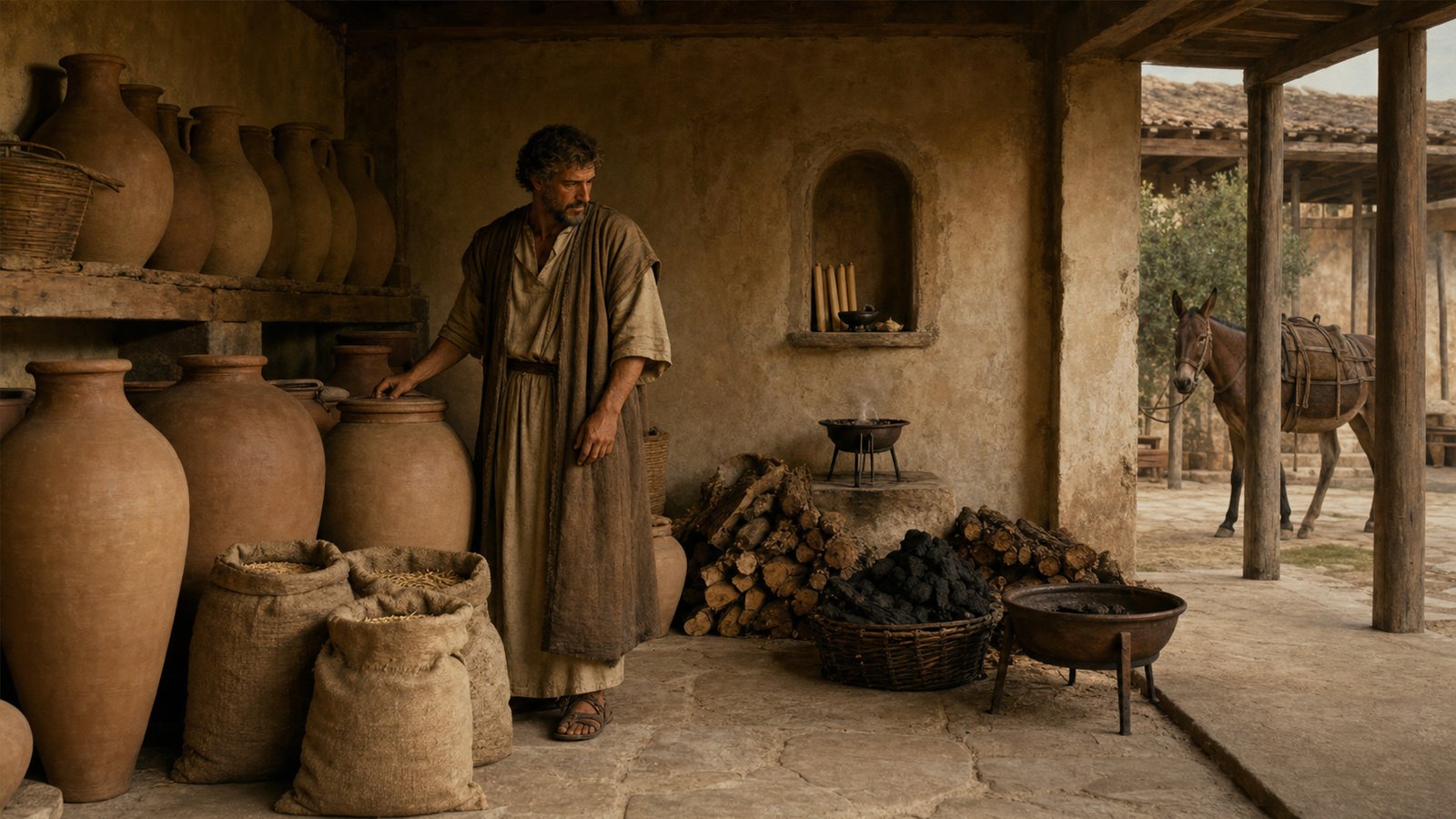
Servius Sulpicius reported that Aelius Catus included incense and wax tapers because they were provided for practically the same purpose. These were not meals. They supported household activity and observance around the stores, widening the category from calories toward the equipment of maintained domestic life.
The connection with Roman household worship and the Lares helps explain why incense and tapers were not trivial additions. Domestic provision joined material maintenance to repeated ritual action. A reserve could sustain what a household did as well as what its members ate.
Masurius Sabinus extended the discussion to provisions prepared for beasts of burden used by the householder. Feed for a mule did not nourish a family member directly, but the animal could move people, fuel or food. Supporting the household’s working capacity made fodder a plausible part of its reserve.
Some authorities also admitted wood, faggots and charcoal used to make the provisions ready. Uncooked grain and cold ingredients were potential meals; fuel converted them into usable food. The proposed category thus reached one step backward along the process of consumption.
These additions show jurists reasoning by function. Incense, light, fodder and fuel looked unlike wine or wheat, yet each could be attached to the purpose for which durable household stocks existed. The debate was not about whether all useful objects belonged. It was about how closely an auxiliary supply had to serve provisioning.
One storeroom could contain two legally different inventories
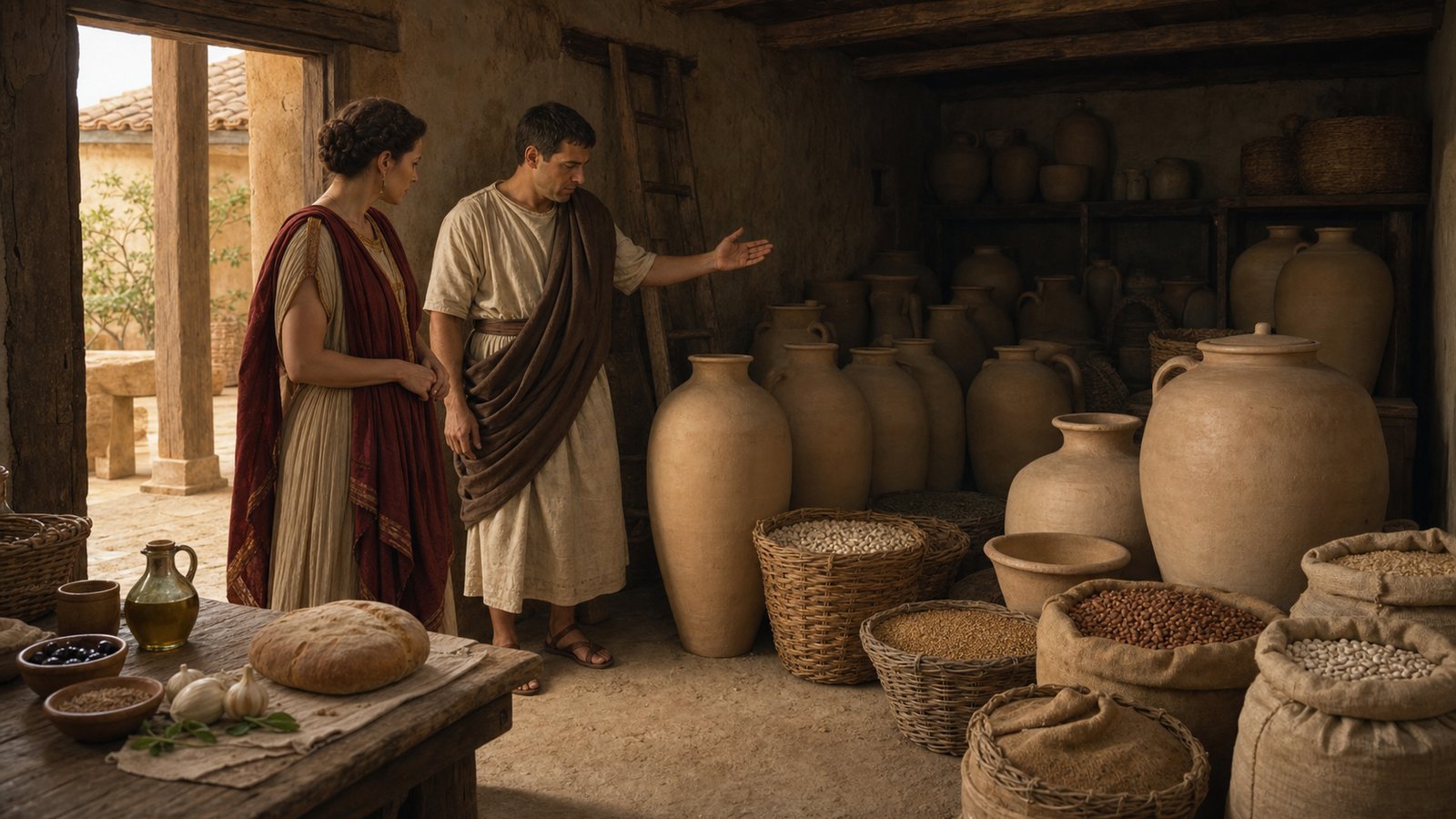
Sabinus supplied a particularly sharp test when goods for household use and goods for trade were kept in the same place. Physical proximity could not decide their identity. A merchant-householder might stack similar jars together while intending some for family consumption and others for sale.
Gellius says Sabinus counted as penus only the amount sufficient for one year’s needs. The annual measure did not turn every provision into household stores. It separated a bounded reserve from commercial excess within the same stock.
A year is concrete enough to administer but broad enough to cover seasonal uncertainty. Harvests, transport and preservation all made future supply uneven. The source does not explain how jurists calculated the needs of households of different sizes, so a universal ration should not be invented. What it does preserve is a horizon against which intention could be judged.
The rule also prevents a location-based shortcut. If ten amphorae served the household and forty were held for customers, all fifty might occupy one room. Only the portion tied to annual household need entered the category. Use divided the stack without moving a single vessel.
That distinction illuminates the domestic economy without pretending home and market were separate worlds. They could share storage, labour and containers. Juristic language had to separate them conceptually because walls did not.
Correct naming made ordinary storage legible to law
Favorinus told the grammarian that Roman citizens should be ashamed to call a thing by the wrong name, just as they would object to calling a person by someone else’s name. Gellius admired the philosopher for drawing better questions out of ordinary conversation rather than dragging impressive material into it without cause.
The discussion succeeds because a small word opens several rooms at once. It reaches the dining table, deep storage, a domestic shrine, the fuel pile, the stable and the merchant’s inventory. Each space contributes supplies, but no single room defines the category.
Scaevola’s distinction between daily meals and long-term stores provides the first boundary. The later jurists test its edges. Incense and tapers ask whether ritual support belongs. Fodder asks whether working animals count. Wood and charcoal ask whether preparation fuel follows the food. Trade stock asks whether intended sale defeats physical storage.
None of those questions requires imagining Romans as modern logisticians. They show something more specific: legal language following objects through different purposes. A jar was not classified by material alone. Timing, intended user and expected destination mattered.
The pantry’s deepest lesson is therefore about verbs rather than nouns. Supplies were prepared, collected, stored, consumed or sold. Those actions decided which name fit. One year of household need could sit beside merchandise, and the law drew an invisible line through the pile.
Favorinus began by refusing to be impressed by declensions detached from meaning. The jurists rewarded his question with a category precise enough to separate supper from security and household reserve from trade. Rome’s pantry was not merely where food waited. It was where future use gave ordinary things a legal identity.
Sources
Aulus Gellius, Attic Nights 4.1