
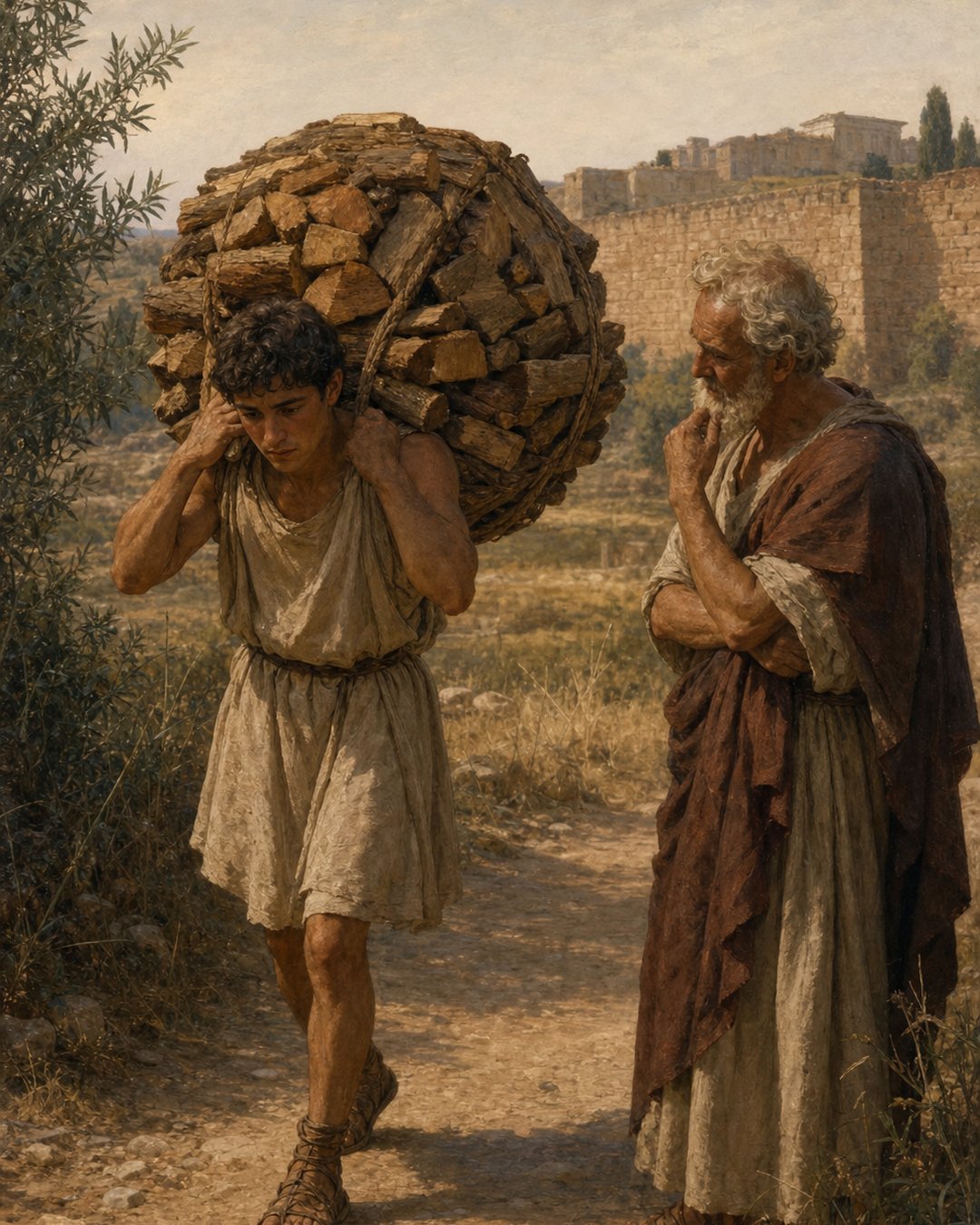
Before Protagoras entered philosophy, a bundle of firewood made someone stop him on the road.
Aulus Gellius says the young man earned his living as a hired porter. He was carrying many blocks of wood from the countryside into Abdera, bound with a short rope. The load was awkward, yet he walked easily and quickly.
Democritus noticed that contradiction. He did not begin by asking the porter for an opinion about nature or language. He examined how the wood had been arranged, asked who had tied it and required Protagoras to undo the work and make it again.
The repeated bundle became an entrance examination without a schoolroom. Practical judgement was visible in weight, rope and movement. Patronage followed only after Protagoras proved that the arrangement was his own and could be reproduced.
An awkward load made efficiency visible from a distance
Gellius identifies Protagoras’s work without romantic disguise. He was a hired labourer who often carried heavy burdens on his back, one of the people Greeks and Romans named as porters. His income depended on moving other people’s material.
The particular burden was a large collection of wooden blocks brought from the nearby countryside into his native Abdera. Such pieces resist neat packing. They differ in thickness, branch angle and weight, and they can roll or press unpredictably as the carrier walks.
One short rope held the load. That limitation made arrangement more important. Extra cord could have wrapped disorder repeatedly; a short binding required the pieces themselves to support the structure. Friction, crossing surfaces and balanced mass had to do work that rope length could not.
Democritus first saw the result in Protagoras’s gait. The young man moved easily and rapidly under something difficult to hold together. Efficiency was not presented as a claim by the worker. It appeared as a mismatch between the burden’s awkward shape and the carrier’s controlled progress.
The archive’s article on rope-makers and shared tension follows fibres becoming reliable cordage. Gellius’s scene begins after rope exists. The crucial problem is how little of it, placed intelligently, can persuade many irregular pieces to travel as one load.
Democritus therefore approached a working man because the object advertised judgement. The road supplied evidence before either person spoke.
Democritus turned observation into a repeatable test
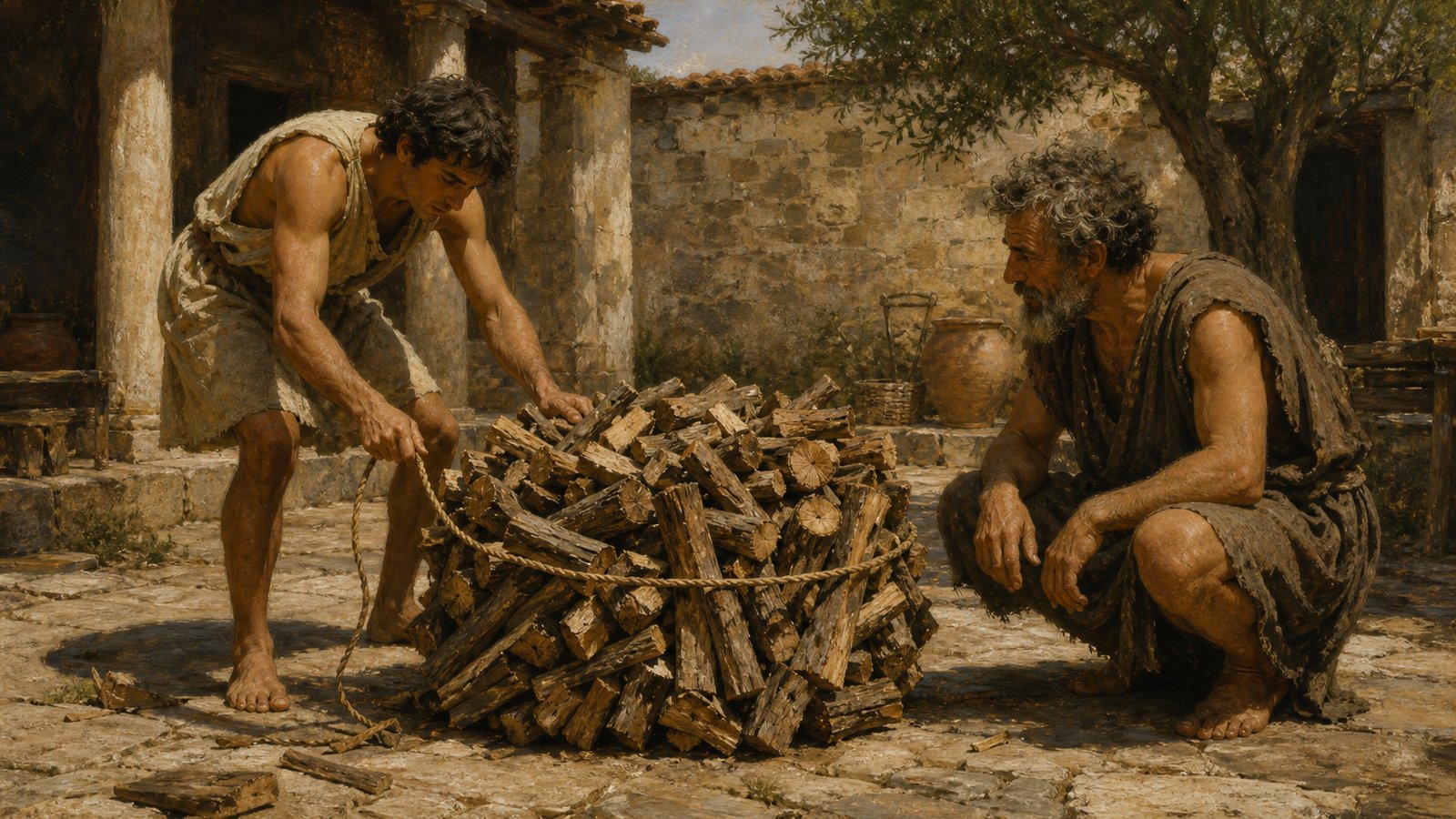
Admiration alone would not prove who designed the bundle. Someone else might have arranged it, or a lucky first attempt might have survived longer than expected. Democritus asked Protagoras to stop and rest, then inspected the structure closely.
Gellius describes the heap as almost circular and balanced with nearly geometrical accuracy. The phrase does not mean Protagoras had written a proof or calculated modern force diagrams. It gives intellectual form to what Democritus saw: uneven material had been organized around a stable whole.
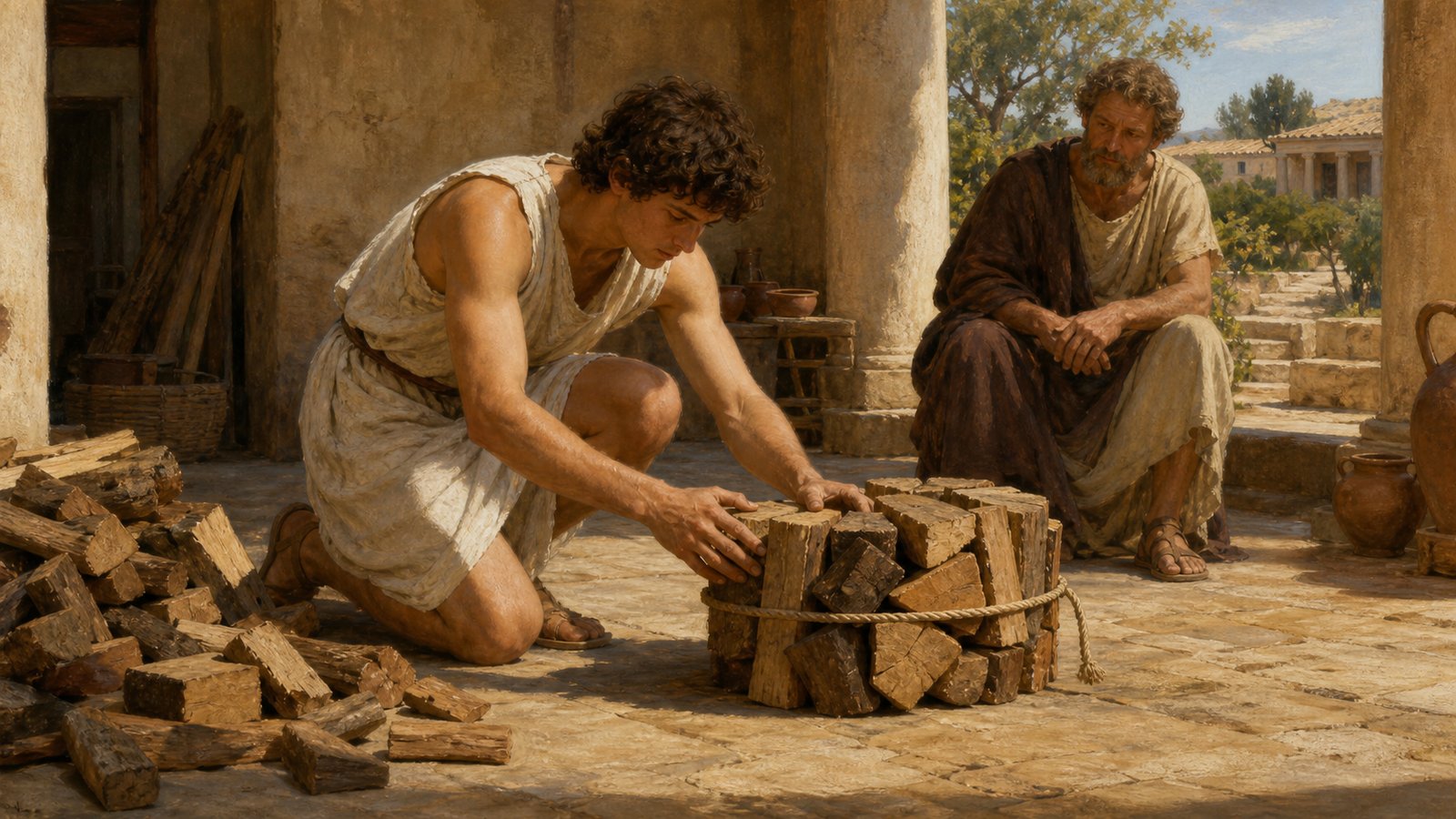
When asked who made it, Protagoras answered that he had. Democritus then required the decisive action. He told the porter to untie the load and arrange it again in the same way.
Reconstruction separated possession from understanding. A man might carry a bundle tied by another person. He could not easily reproduce its compact balance unless he grasped which pieces locked, where the rope should bite and how the total weight should sit against the body.
This is why the short scene has the shape of an experiment. The first bundle produced a surprising observation. The investigator isolated authorship through a question, removed the result and asked for repetition. Protagoras rebuilt it.
Gellius does not report a stopwatch, dimensions or a comparison group. “Almost geometrical” is Democritus’s impressed reading of craft, not a measurement record. But repeatability gives the story more structure than a simple tale of genius recognized at a glance.
The bundle joined hand knowledge to intellectual promise
Democritus concluded that the uneducated porter possessed keen intelligence and cleverness. His praise focused on a talent for doing things well. The route into study began not with inherited polish but with competence under material constraints.
That judgement challenges an easy division between thought and labour. Protagoras had already solved a problem involving shape, sequence, pressure and balance. The solution lived in his hands and shoulders, but it could be observed, undone and repeated.
The article on basketmaking and the first structural rod shows a similar principle in another material: the order of placement determines whether later pieces can share a load. Protagoras’s wood bundle had no permanent woven wall, yet its pieces also depended on an intelligent sequence.
Manual knowledge includes predictions. A porter learns which branch will snag, which block will rotate, where rope will slip and how a load changes when lifted from ground to back. Such knowledge may be expressed through adjustment rather than vocabulary, but it still distinguishes better and worse arrangements.
Democritus did not merely see strong muscles. Strength alone could carry an inefficient burden for some distance. What attracted him was economy: many awkward pieces, little rope and unusually easy movement.
The tale therefore makes practical work legible as evidence of teachability. Protagoras was not already represented as a philosopher hidden in poor clothes. He was represented as someone whose existing skill suggested capacity for further disciplined thought.
Recognition mattered because it unlocked time and money
After the test, Democritus told the young man that his ability could find greater and better employment. Gellius says he took Protagoras away, kept him in his house, supplied money and taught him philosophy.
Those provisions are not incidental. Intellectual potential does not erase the need to eat. A porter who earns a living by the load cannot simply exchange labour for study unless someone replaces the income and provides time, shelter or instruction.
Patronage converted recognition into a changed daily schedule. Democritus’s house became the material bridge between the road and philosophical education. Without that support, praise might have left Protagoras carrying the next bundle exactly as before.
The power imbalance should remain visible. Democritus chose, tested and financed; Protagoras was the object of inspection before becoming a pupil. Gellius presents the intervention approvingly, but the porter’s own account of the encounter does not survive here.
The story also looks backward from fame. Gellius’s readers knew Protagoras as the celebrated figure whose name stood on Plato’s dialogue. That ending makes the firewood seem prophetic. Yet on the road the outcome was not guaranteed. The bundle became decisive because a particular observer recognized a kind of order he valued.
Social mobility in the anecdote was therefore neither automatic nor purely individual. Skill produced evidence; Democritus interpreted it; resources made a new path possible. All three stages were required.
Later fame changed the meaning of the porter’s rope
Gellius closes with a judgement of the adult Protagoras. He calls him the cleverest of sophists rather than a true philosopher and mentions the enormous annual fee he demanded from pupils. The praise of youthful ability becomes entangled with an older argument about paid teaching.
That ending creates an economic reversal. The young Protagoras once sold bodily labour by carrying burdens. The famous teacher later sold advanced instruction at a price Gellius considered remarkable. Money remained in the story, but the skill being purchased had changed.
Modern readers need not accept Gellius’s hostility toward sophists to see why he arranged the biography this way. Origins can be used both to celebrate ascent and to frame later ambition. The humble bundle proves talent while making the later fee appear even more dramatic.
The account is also a traditional origin story introduced with “they say.” It should not be treated as a documented employment record. Its details reveal what made recognition persuasive to Gellius: skilled arrangement, observation by a wise patron, successful repetition and support for education.
Those details preserve labour instead of treating it as empty background. The wood had to be cut, moved, balanced and delivered. Protagoras’s future did not announce itself through an abstract slogan. It appeared in the way his work reduced strain.
One short rope thus connected two economies of knowledge. On the road, judgement made a physical load manageable. In Democritus’s house, money and teaching made intellectual labour possible. The knot did not contain philosophy, but it revealed a mind capable of arranging difficult things so they could hold together.
Sources
Aulus Gellius, Attic Nights 5.3