
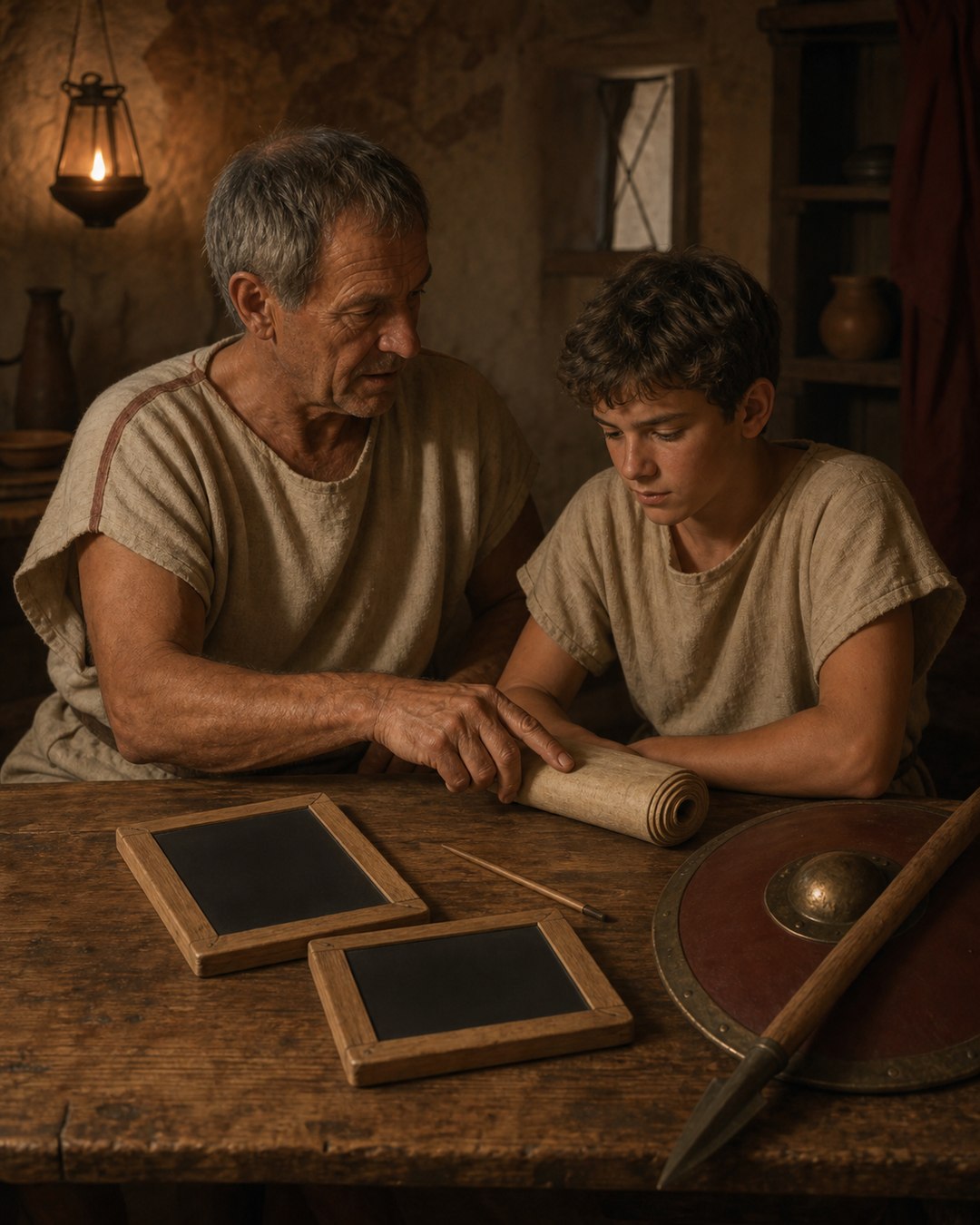
Cato the Elder had an accomplished schoolteacher in his household. He still chose to teach his son himself.
The decision required more than hearing a reading lesson. Cato became instructor in letters, law and athletics. He taught riding, boxing, weapons, heat, cold and swimming through the Tiber’s current. Then he copied out a history of Rome by hand in large characters so one boy could use it at home.
The large writing is the memorable object, but the curriculum around it supplies the meaning. Cato was not separating mind from body or family affection from political education. He was trying to supervise every route by which authority entered his son.
Plutarch presents the effort with admiration and unease. A father gives extraordinary attention, yet his reason for excluding an enslaved teacher exposes the hierarchy on which the household depended.
The household already contained a professional teacher
The teacher was Chilo, an accomplished enslaved man who instructed many boys. His presence means Cato was not responding to a lack of expertise. A trained educator was already available inside the house.
Cato’s objection concerned authority and indebtedness. He said he did not want his son scolded by an enslaved man or to have his ears tweaked when he learned slowly. More deeply, he refused to let the boy owe an enslaved person for something as valuable as education.
The argument reveals a contradiction. Chilo’s skill could be used for other children, and his labour increased the household’s educational capacity. Yet Cato imagined gratitude to that teacher as an inversion of status when his own son was involved.
Roman elite education often relied on people whose learning exceeded their legal freedom. Greek-speaking tutors, readers, secretaries and pedagogues could transmit literature and technique while remaining enslaved or dependent. Knowledge crossed the hierarchy even when elite ideology resisted acknowledging the debt.
The broader account of Roman schoolrooms training voices for public careers shows education moving toward grammar and rhetoric beyond the household. Cato’s arrangement pulls in the opposite direction: the father keeps the foundational curriculum close enough to embody it himself.
Reading, law and exercise formed one programme
Plutarch lists Cato’s roles without treating them as separate professions. He was the boy’s reading teacher, tutor in law and athletic trainer. Letters prepared the son to receive inherited knowledge; law prepared him for civic judgement; exercise prepared him to endure command and combat.
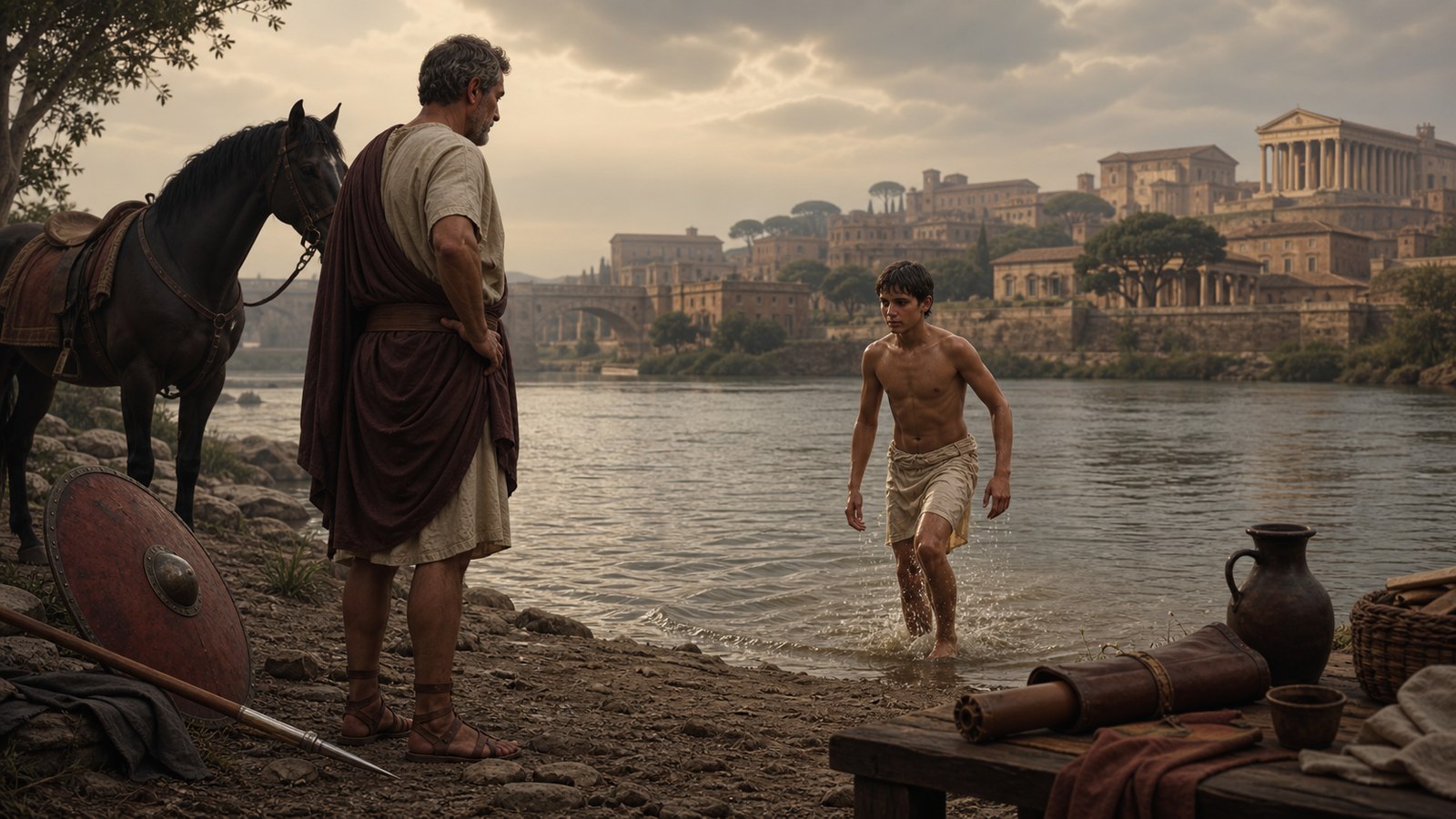
The physical range is striking. Cato taught the javelin, fighting in armour and horsemanship. He added boxing and the ability to withstand heat and cold. Swimming meant entering the Tiber and working through eddies and waves rather than practising in still ornamental water.
This was education as controlled difficulty. The boy learned techniques, but he also learned that a Roman man should remain effective when the environment resisted him. A cold river, heavy equipment or a horse supplied tests that a written lesson could not.
Law belonged beside those exercises because both demanded discipline under pressure. The future public man needed to remember rules, speak and judge, while also demonstrating bodily command. Cato’s curriculum makes the elite household a preparation ground for offices, campaigns and reputation.
Plutarch later notes that the son’s body was delicate. Cato therefore relaxed some of his own extreme austerity. That qualification matters. The programme was rigorous, but it was adjusted to the actual pupil rather than enforced as a perfect copy of the father.
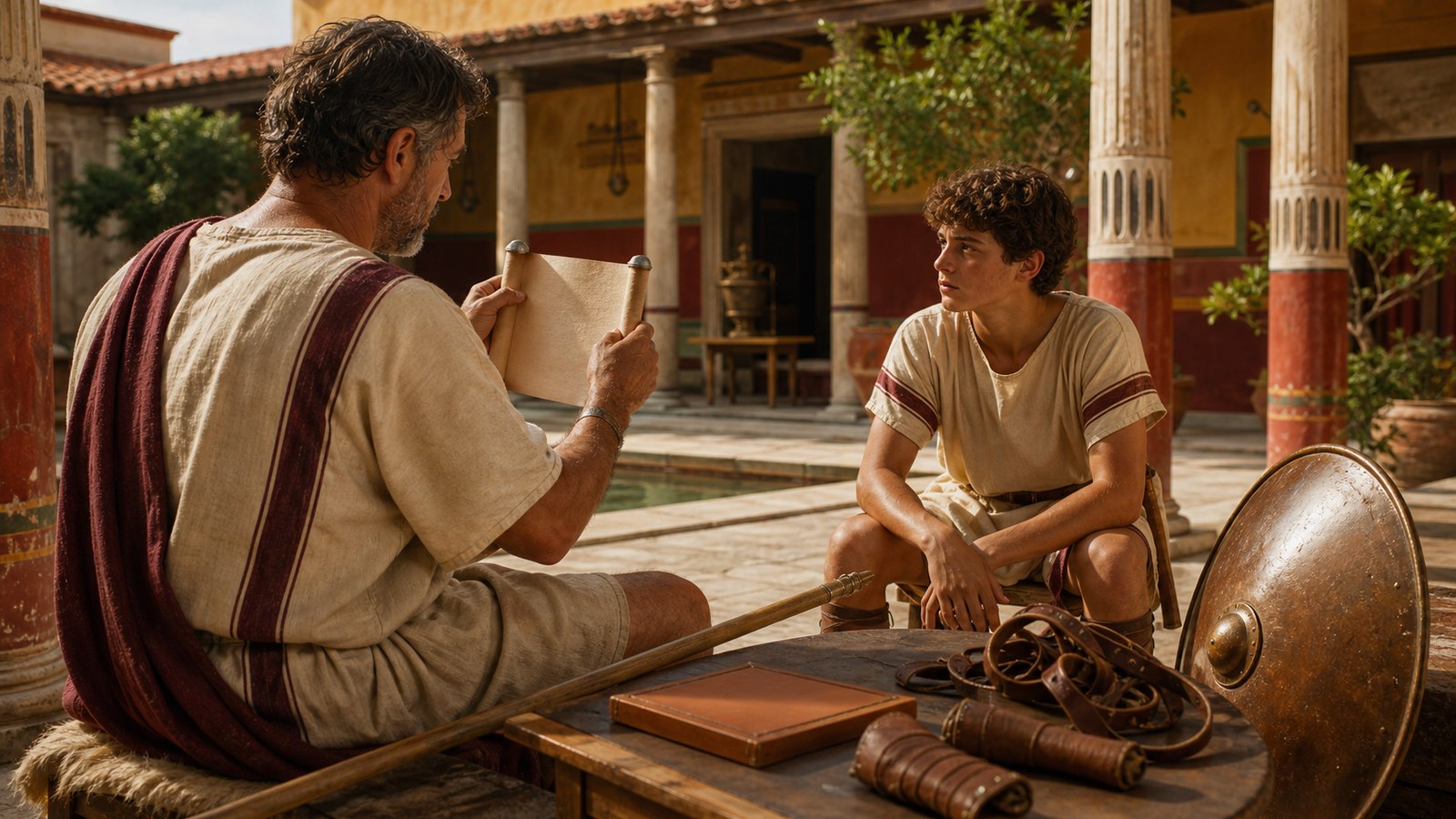
Large characters turned Roman history into a home object
Cato said he wrote his History of Rome with his own hand and in large characters. The source does not preserve the teaching copy or tell us its exact format. It does give a purpose: his son could use it at home to become familiar with the country’s ancient traditions.
Large writing made the text easier to encounter at an early stage of literacy. It also increased the physical labour and material space required from the copyist. Every line announced that this was not a casual note handed to a secretary.
The father’s hand joined content to authority. Rome’s past reached the child through a version selected, written and presented by Cato. The history was both a reading aid and a statement about who should interpret national tradition.
That differs from the rapid signs used to catch Cato’s public speech. Shorthand compressed a performance so words could be retained after they were spoken. The large-letter history expanded writing for deliberate instruction. One technique served speed and public record; the other served visibility and repetition at home.
No surviving line allows us to reconstruct every story in the copy. Calling it propaganda in a modern institutional sense would overstate the evidence. It was unmistakably selective, however, because every history chooses beginnings, heroes, conflicts and lessons. Cato made those choices part of fatherhood.
Attention to the child coexisted with household domination
Plutarch surrounds the lessons with details of parental presence. Unless public business intervened, Cato attended when his wife bathed and swaddled the infant. The mother nursed the boy herself.
She also nursed infants of enslaved household members, Plutarch says, so they would develop brotherly affection toward her son. The image sounds intimate, but the intended relationship remains centred on the freeborn child. Affection was cultivated across a legal division that the household preserved.
The same structure appears in the education episode. Cato gives time, labour and care to his son while Chilo’s expertise remains available without freedom. Paternal devotion did not challenge slavery. It helped define which child could claim the master’s own teaching.
This tension prevents the large-letter book from becoming a simple scene of timeless parenting. The lesson was made possible by an estate in which other people performed work, taught other boys and occupied controlled places. Intimacy at the centre depended on hierarchy around it.
Plutarch can admire Cato’s attention while preserving enough detail for readers to see its boundaries. The father’s refusal to let his son owe Chilo gives us the clearest clue: education created obligations, and Cato cared intensely about which obligations an elite boy was allowed to feel.
The pupil eventually carried the curriculum into battle
Plutarch completes the educational portrait with the son’s later military service under Paulus Aemilius against King Perseus. During battle, the young man lost his sword, either knocked away or slipping from a wet grip.
He gathered companions, returned into the fighting and recovered it among piled equipment and bodies. Paulus admired the effort, and Plutarch says Cato praised his son extravagantly in a surviving letter.
The scene is not proof that every lesson worked exactly as planned. It is the biographer’s payoff. The delicate boy trained in armour, endurance and paternal tradition becomes a soldier whose response to loss protects honour in front of comrades and commander.
Education also led into family alliance. The son married Tertia, daughter of Paulus and sister of the younger Scipio. Plutarch credits the match to the young man’s own merit as well as his father’s standing.
Cato’s large-letter history therefore belonged to a long project. It taught reading, but it also placed one child inside a story of Roman conduct that law, bodily training, campaign service and marriage would continue.
The handmade copy is compelling because it is both generous and controlling. Cato gave his son something no purchased object could reproduce: his time, hand and chosen account of Rome. He also ensured that the boy’s foundational debt ran upward to his father, not sideways to the skilled enslaved teacher already in the room.
Sources
- Plutarch passage at LacusCurtius
- Plutarch in the Project Gutenberg translation
Plutarch, Life of Cato the Elder 20.2–8.