
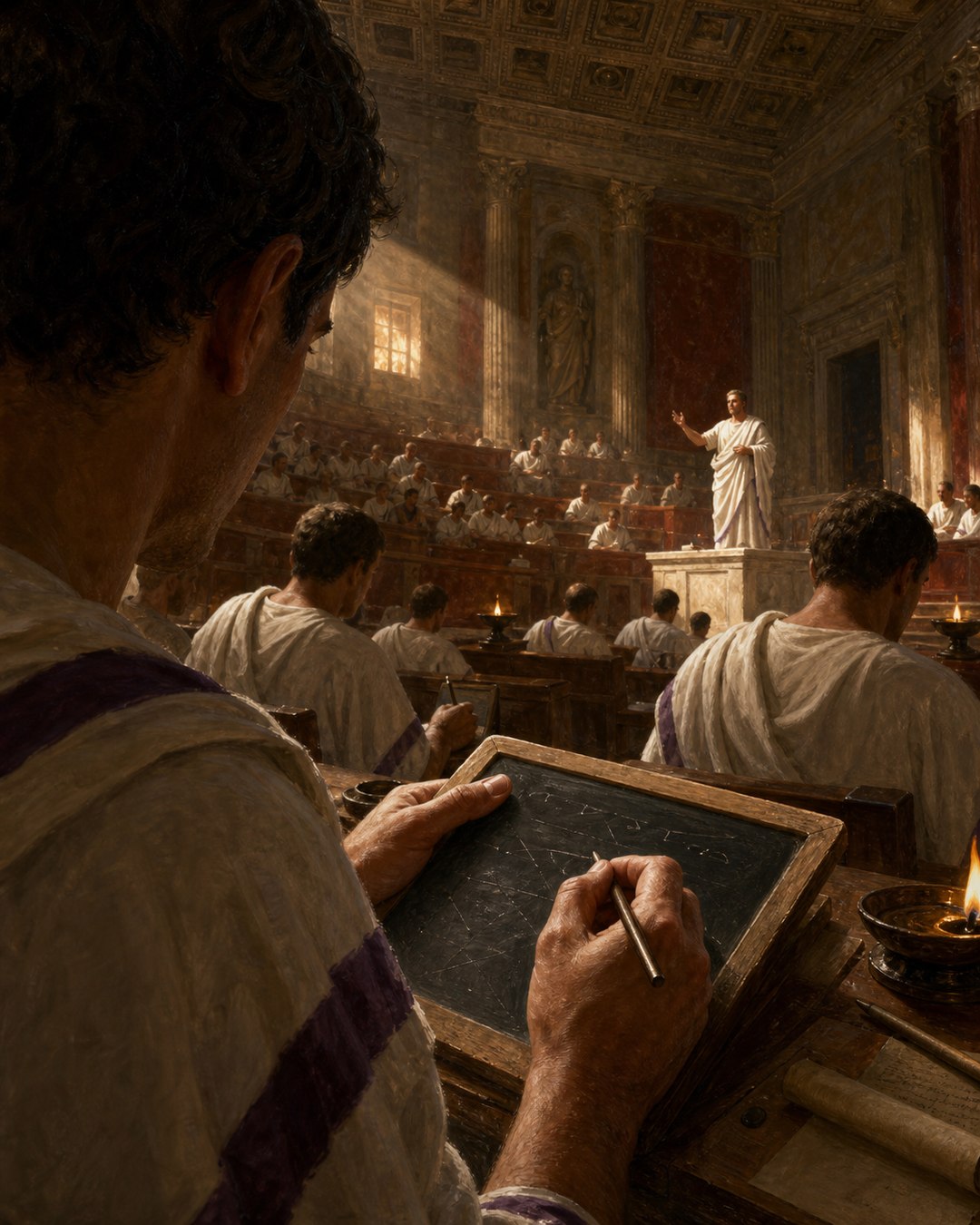
In 63 BCE, Cato the Younger rose in the Roman senate during the crisis surrounding Catiline. His words moved faster than an ordinary copyist could write them. Yet one version of the speech survived, and Plutarch explains why: Cicero had stationed skilled writers around the chamber who could compress many words into a few short strokes.
The scene is the earliest famous demonstration of Latin shorthand. The system became known as Tironian notes after Marcus Tullius Tiro, Cicero’s secretary, former enslaved worker and later freedman. Tradition often makes him the inventor. The surviving evidence asks for a more interesting answer than a single moment of genius.
Shorthand worked as an organized human system. Signs had to be devised, learned, written at speed, combined across several recorders and expanded into readable text. Political memory therefore depended on hands that elite speeches usually leave offstage.
Cicero Put Fast Writers Around the Chamber
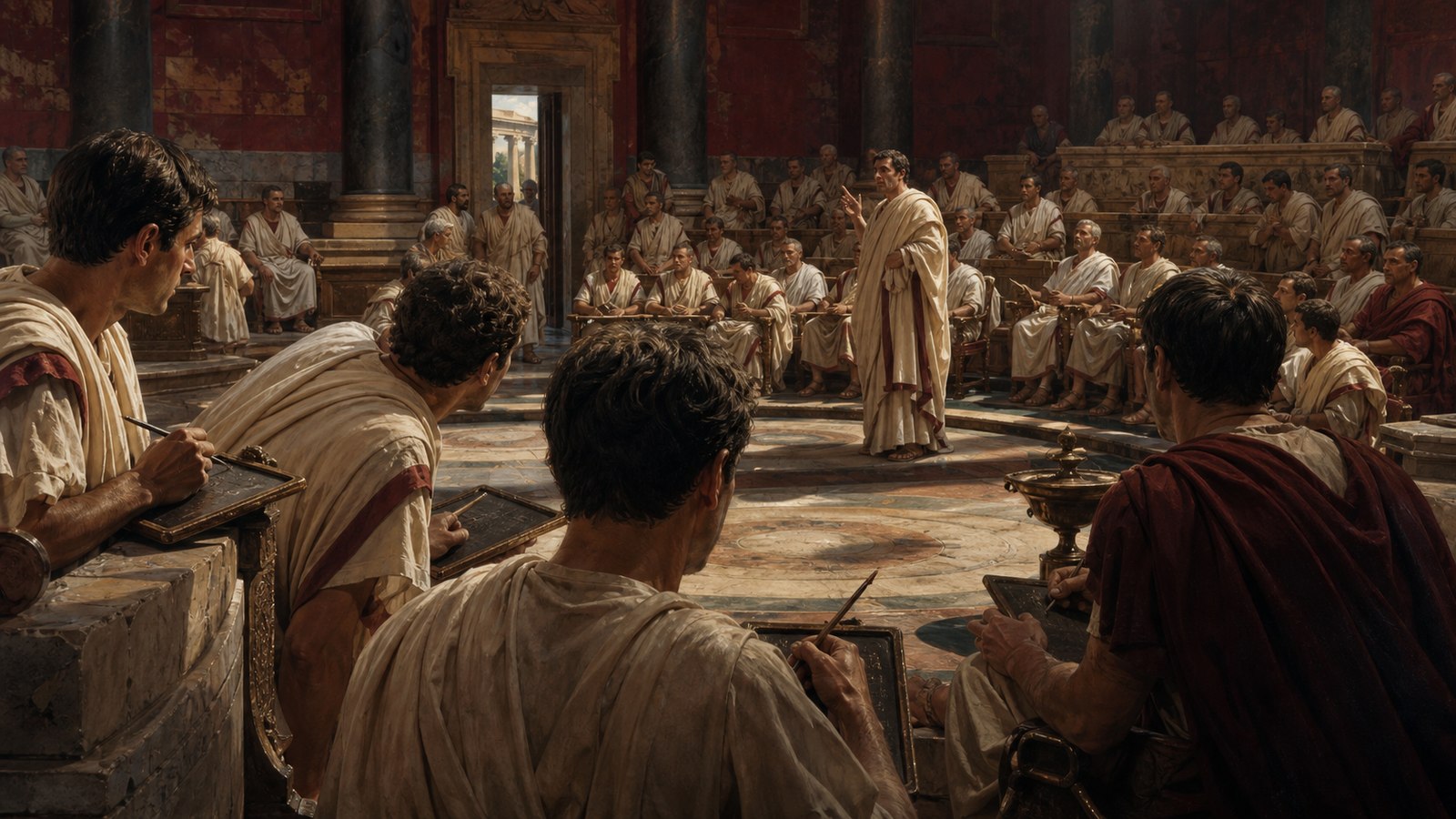
Plutarch’s Life of Cato the Younger describes a deliberate arrangement. Cicero, then consul, placed several expert and rapid writers in different parts of the senate house. They had been taught to make figures that represented many words in a small number of strokes. Plutarch calls the result the first example of the Roman shorthand writer’s art.
The date and setting gave the technique unusual stakes. The senate was debating the fate of the Catilinarian conspirators, and Cato argued forcefully for execution. Plutarch says this was the only one of Cato’s speeches to survive. Whether every line reached later readers unchanged is another question, but the explanation ties preservation to a specific recording method.
Distributing writers around the room solved more than one problem. A single scribe could miss phrases, lose the speaker in noise or fall behind. Several trained listeners could capture overlapping portions and later reconcile them. Shorthand was therefore both a graphic code and a workflow.
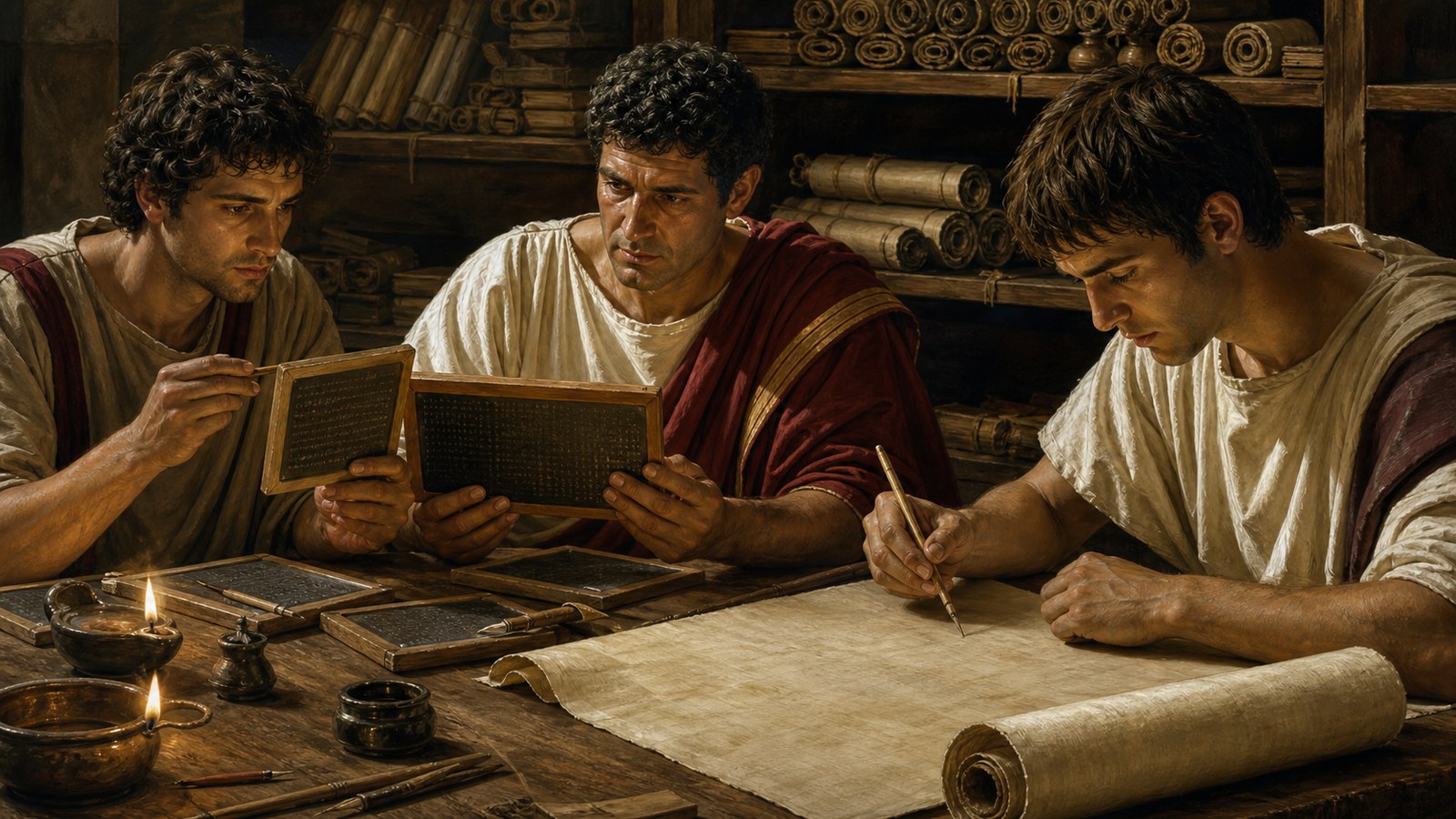
The marks were only an intermediate product. Someone still had to compare sequences, resolve doubtful abbreviations, restore ordinary grammar and prepare a copy that readers outside the trained circle could understand. Every surviving speech conceals this passage from sound to compressed sign and from compressed sign back to continuous prose.
The process adds a hidden layer to the material politics of Roman voting. Tablets and bridges organized citizens’ choices; stenographic signs organized what later audiences could remember of elite debate. Neither medium was neutral, because design shaped what could be recorded and recovered.
Tiro Stood Where Servitude Met Authorship
Marcus Tullius Tiro first lived in Cicero’s household as an enslaved man and later became his freedman. Cicero’s correspondence mentions him frequently and reveals duties far wider than rapid dictation. Tiro handled manuscripts, copyists, accounts, property business and the practical movement of written work.
After manumission he took Cicero’s praenomen and nomen, Marcus Tullius. His exact birth year is disputed, and Jerome’s later claim that he died in his hundredth year does not sit comfortably with all the evidence in Cicero’s letters. Caution about the dates is useful because Tiro’s biography accumulated legend along with documentation.
His relationship to Cicero also outlasted daily secretarial service. Ancient testimony credits Tiro with collecting and publishing his former patron’s letters and speeches after Cicero’s death, and with writing works of his own on Latin language and other subjects. The archive associated with Cicero was not self-preserving; it was edited by labour and judgment.
Tiro’s trajectory complicates easy labels such as “assistant.” Enslavement placed his skill under another man’s ownership. Freedom did not erase that origin, but it let him appear as an author, editor and property holder. The same culture that prized Cicero’s voice depended on a worker whose technical intelligence made that voice durable.
Four Thousand Signs Were Not an Alphabet
Tironian notes did not simply replace each Latin letter with a shorter one. The system used compact marks for whole words, common elements, syllables and grammatical endings. Marks could be joined into ligatures, allowing a compound sign to occupy less space than the expression it represented.
Later accounts describe an early stock of about four thousand signs, expanded by other users to roughly five thousand. Medieval teaching and compilation pushed collections much higher, sometimes toward thirteen thousand forms. Those totals vary because signs changed shape, combined with one another and could be counted in different ways.
A large repertoire made training essential. Speed came from instant recognition, not from pausing to invent a private squiggle for every phrase. Writers needed shared conventions so that notes could be read back, compared and expanded. A code that only its maker understood would fail at the second half of the task.
The signs belonged to a broader Roman world of writing surfaces described in the archive’s study of papyrus pages. Papyrus, ink and layout carried the finished text. Shorthand intervened earlier, at the unstable point where a voice became marks before those marks became a book roll or archival copy.
The Inventor Story Is Less Secure Than the Senate Scene
Tiro is often credited with inventing the notes that bear his name, but no copy of an original manual by him survives. The strongest early narrative, Plutarch’s, speaks of Cicero’s trained writers in the plural rather than isolating Tiro as the sole inventor standing in the chamber.
Other ancient authors supplied competing genealogies. Isidore of Seville attributed earlier marks to Ennius and described later additions by several named figures. Dio Cassius associated shorthand teaching with Maecenas and the freedman Aquila. These traditions do not make Tiro irrelevant; they warn that systems usually grow through communities of practice.
The most defensible formulation is therefore traditional credit with explicit limits. Tiro’s name became attached to Latin shorthand, his work made him an entirely plausible organizer and developer, and Cicero’s circle demonstrably used rapid signs. But the exact division of invention among Tiro, Cicero and other trained writers cannot be reconstructed from surviving contemporary documents.
This uncertainty improves the history. A lone inventor tale directs attention to one clever mind. A system history asks who trained the writers, standardized marks, distributed bodies around a room, collated their records and converted compressed strokes into prose that readers could circulate.
Medieval Scribes Kept One Roman Mark Alive
Tironian notation continued far beyond the late Republic. Medieval monasteries copied tables of signs and used selected notes in manuscripts. The repertoire expanded and shifted, showing that the system was not a fossil preserved unchanged from Cicero’s lifetime.
One sign has an especially visible afterlife: the Tironian et, meaning “and.” Shaped differently from an ordinary ampersand, it remained common in Irish scribal and print traditions and can still be encountered today. A compressed Roman conjunction outlived the political emergency that made shorthand famous.
The survival of et also shows why sign histories are uneven. A compact mark for an extremely common conjunction remained useful even when most of the larger technical vocabulary was no longer taught. Systems can disappear without every component vanishing; one practical piece may enter a new writing habit and cease to feel like shorthand at all.
That survival should not tempt us to imagine a direct, unbroken transcript of Cato in every medieval mark. What endured was a toolkit repeatedly taught and adapted. Each copying community selected useful signs, altered forms and placed them in new linguistic settings.
Plutarch’s senate scene ultimately reveals how fragile public speech was. Cato’s voice vanished as sound almost immediately. What remained depended on prepared listeners, a shared notation and later editorial choices. The short strokes mattered because people built a chain around them. Tiro’s enduring importance lies within that chain: not as a mascot for speed, but as evidence that Roman authorship rested on trained hands, social dependence and technical systems of memory.