
The marble columns of the temple of Diana at Ephesus presented a transport problem before they became an architectural one. Vitruvius says Chersiphron feared that an ordinary carriage, burdened with one of the immense shafts, would drive its wheels into the soft road between quarry and building site. Adding a stronger wagon did not remove the fundamental danger: the stone’s weight still reached the ground through a few loaded wheels.
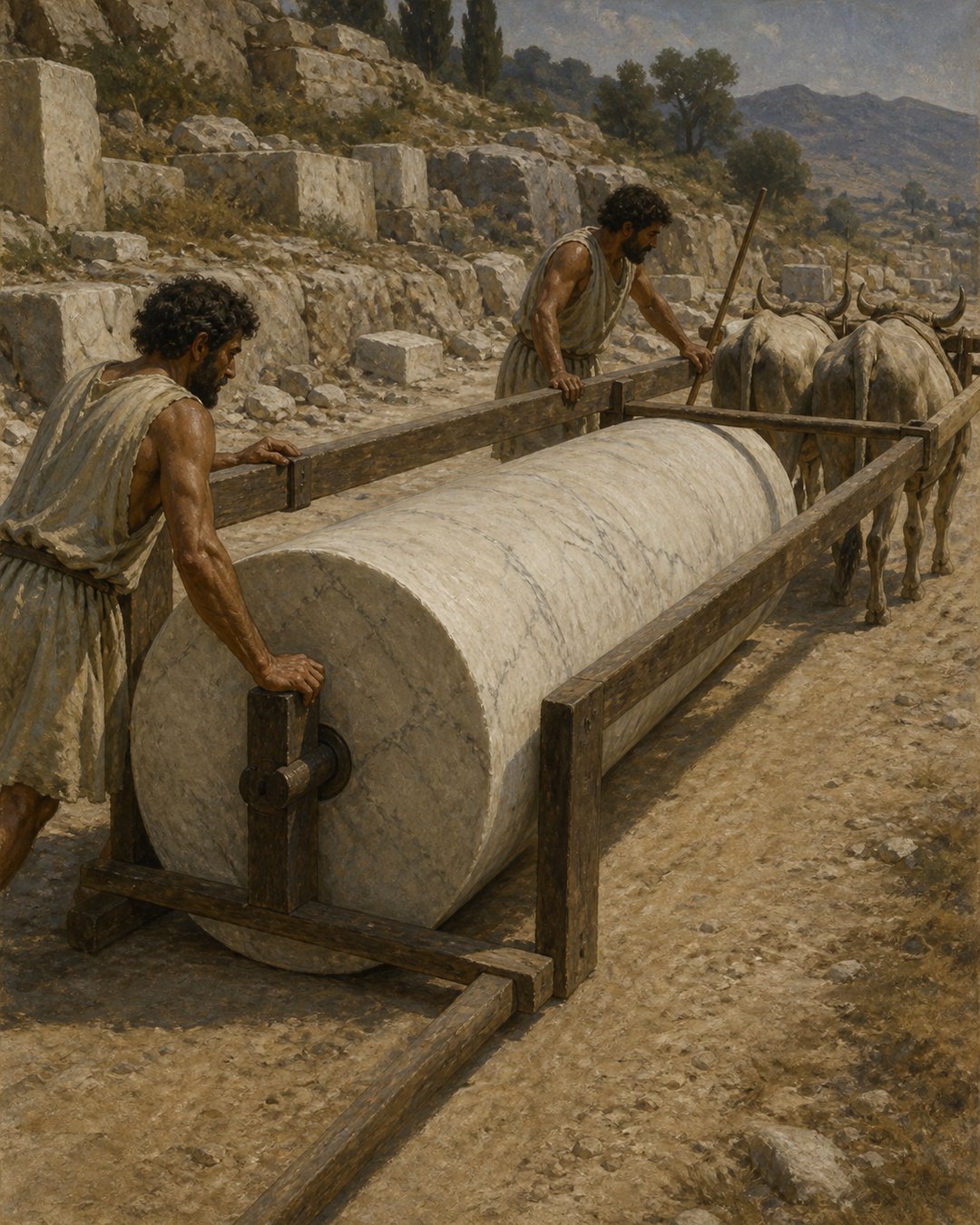
Chersiphron changed the machine’s boundaries. He fitted iron pivots into the two ends of a column, secured them with lead, and placed them in gudgeons carried by a long timber frame. Oxen pulled the frame while the marble shaft itself rotated. The column no longer sat motionless on a vehicle. Its cylindrical body became the rolling element inside one.
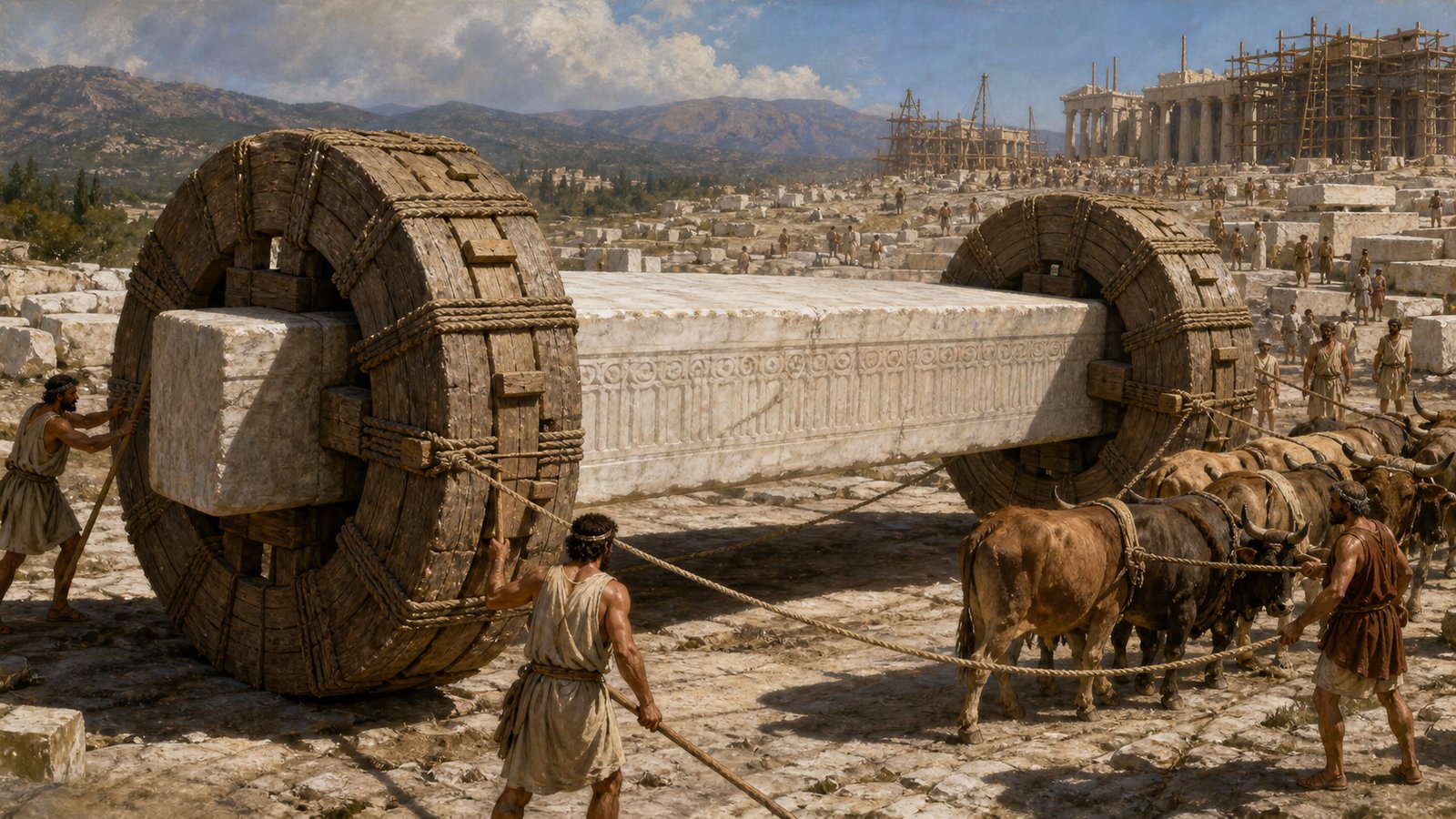
His son Metagenes later adapted the same idea for rectangular entablature blocks by fastening enormous wheels around their ends. Vitruvius preserved both designs together with their strict condition: the route was only about eight thousand feet and crossed a level plain. This was not a universal answer to heavy transport. It was a machine shaped around one stone, one road, and one temple.
Soft Ground Made the Ordinary Wagon the Wrong Tool
Loaded carts concentrate force. However broad the platform, the weight ultimately passes through wheels into a narrow contact with the road. On firm paving that may be manageable. On soft ground, sinking increases resistance and can twist an axle, trap the vehicle, or threaten a valuable load with an uneven fall.
Vitruvius does not say that the Ephesians first destroyed carts in experiments. He gives Chersiphron’s judgement: trusting the shafts to carriages was not prudent because their weight might sink the wheels. The architect treated prevention as part of building the temple. Quarrying a finished column was not success if transport shattered or stranded it.
The challenge joined craft to route knowledge. A marble shaft was long, heavy, and already shaped. Ropes slung around it could bruise edges or shift. A tall load raised the centre of gravity. More draught animals increased pull but also demanded room and coordination. Chersiphron needed to move the stone without stacking it high above an ordinary chassis.
Roman and Greek builders routinely adjusted process to material. quarry workers used holes and wedges to define movable stone before brute force could help. Here the same principle continued beyond extraction: geometry determined what kind of transport the marble could safely become.
Iron, Lead and Timber Turned the Column into a Roller
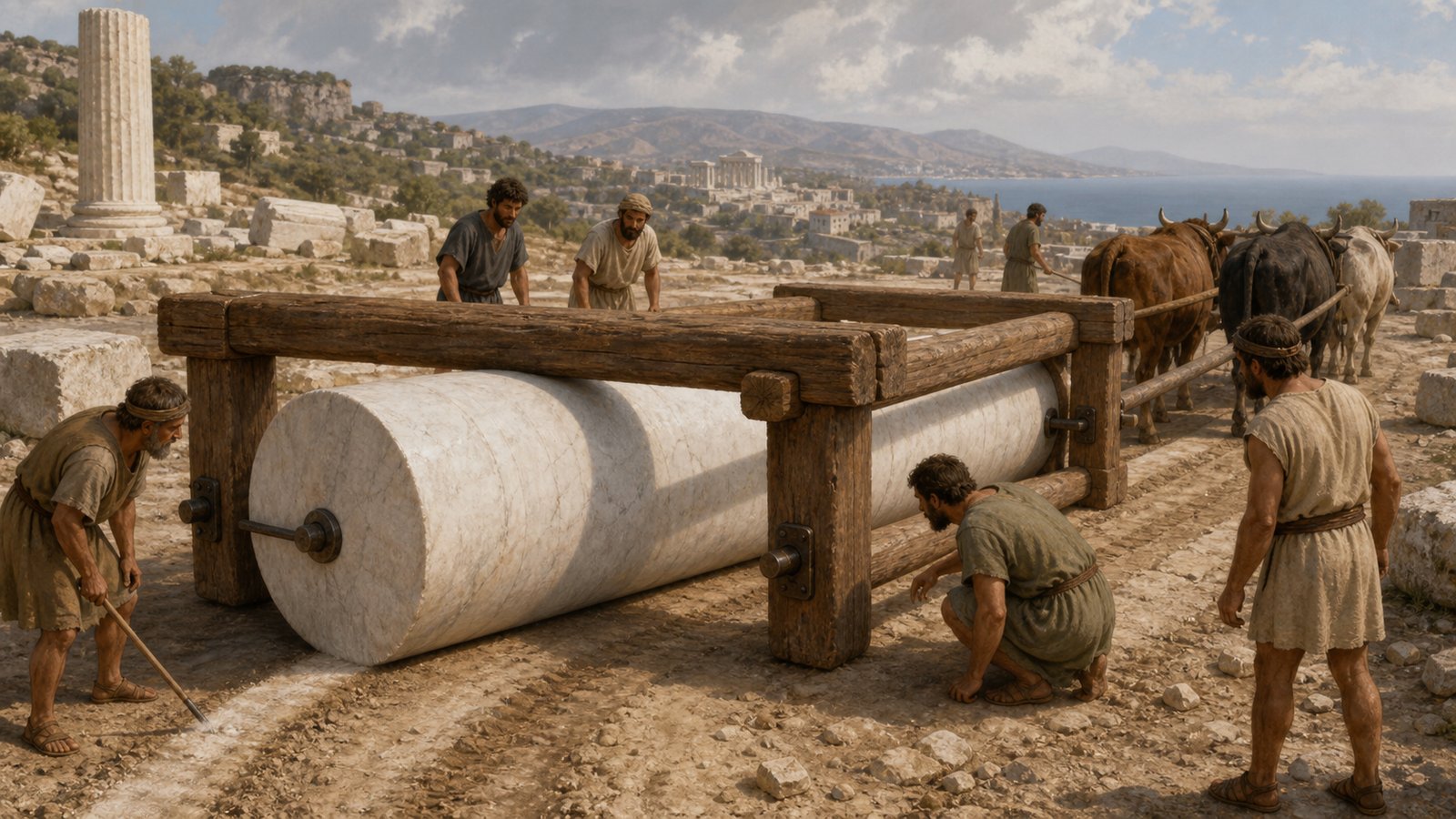
Chersiphron built a rectangular frame from four timbers. Two long members matched the length of the column, and two transverse pieces held them together. At each end of the marble shaft, workers inserted an iron pivot. Vitruvius says the iron was dovetailed into the stone and run with lead, making the connection part of the precious shaft rather than a loose clamp around it.
Those pivots rested in gudgeons fixed to the frame. The frame also carried oaken draught shafts for the ox team. As the animals advanced, the pivots revolved in their supports and the column rolled. The timber maintained alignment and supplied the hitch; the marble supplied the large cylindrical surface that met the ground.
The system redistributed the ordinary vehicle. There was no separate platform carrying a dead load and no small wagon wheel bearing the whole shaft beneath it. The column rotated around the axis defined by its inserted pivots. Its diameter became the effective wheel diameter, while the long frame controlled direction and kept the draught force connected to the centre line.
The detail about lead matters. Iron alone driven into marble could create damaging point pressure or loosen under repeated motion. Vitruvius’s wording places lead in the fitted connection, where a softer metal could fill space around the dovetailed pivot. The ancient account does not provide a modern stress calculation, but it clearly describes a composite joint rather than a casual pin hammered into stone.
Rotation also recalls other ancient machines in which a bearing converts dragging into controlled movement. bronze bearing assemblies from the Nemi ships show a different scale and purpose, yet both mechanisms depend on guiding motion at the interface instead of asking raw pull to overcome uncontrolled friction everywhere.
Metagenes Made a Rectangular Block Behave Like an Axle
Columns offered an obvious advantage: their round shafts could roll. The temple’s entablature blocks did not. Metagenes, Chersiphron’s son, preserved the central idea by changing which part of the assembly provided the circular surface. He constructed wheels about twelve feet in diameter and fixed the ends of each stone block into them.
The rectangular marble now occupied the position of an axle between two giant wheels. Pivots and gudgeons followed the principle used for the columns. When oxen drew the machine, the wheels turned around the block’s line and carried it forward. Vitruvius compares the arrangement to a heavy rolling stone used for smoothing walks in exercise grounds.
This adaptation reveals what the builders considered essential. Chersiphron’s exact shape was not sacred. The useful rule was to integrate the load with the rotating system and avoid placing it on a conventional wagon. When the stone could itself roll, it did. When it could not, wheels were built around its ends so it became the structural link between them.
Twelve-foot wheels were not modest pieces of equipment. Their diameter lifted the assembly and required strong timber construction, accurate alignment, and open space. Yet larger wheels changed how obstacles met the load. A rut or irregularity that stopped a small wheel confronted a shallower approach relative to the giant circle, provided the structure stayed upright and on line.
The entablature machine also avoided repeated lifting between quarry cart and site. Each transfer of a monumental block introduced rigging risk. By fitting the stone into its transport assembly and pulling it to the work, the builders reduced the number of moments in which the load hung from ropes or balanced above a separate platform.
The Level Eight-Thousand-Foot Route Was Part of the Machine
Vitruvius immediately limits the achievement. The method would not suit a considerable distance. The quarry stood no more than eight thousand feet from the temple, and the interval was a plain without a decline. Distance and gradient belonged to the design as surely as pivots and timber did.
On a level route, oxen had to overcome rolling resistance and irregular ground. A descent would add an accelerating mass that the team might not restrain. An ascent would demand greater sustained pull and load the joints differently. Turns would force the long frame or broad wheel pair away from the easy straight line described by the mechanism.
Vitruvius reinforces that warning with a later failure. Paeonius needed to move a stone base twelve feet long, eight feet wide, and six feet high. He built wheels about fifteen feet in diameter around it and wrapped rope around bars joining their circumferences. The concept could roll, but the machine continually swerved and required correction. The contractor exhausted his money before completing the obligation.
That later machine shows why motion is not the same as control. A huge assembly may respond to oxen and rope yet still consume labour in steering, resetting, and protecting the route. Every correction costs time. Misalignment can increase friction, damage edges, or bring one wheel into softer ground than the other. The road is an active part of the mechanism because its surface decides whether both sides advance together.
Chersiphron and Metagenes succeeded by designing within unusually favourable boundaries. The stone was near the temple. The ground was level. The column’s form offered a rolling surface, and the entablature could be enclosed between wheels. Their ingenuity lay not in pretending weight had disappeared, but in choosing where rotation occurred and matching the machine to a finite corridor.
The temple’s standing marble could later hide the logistics that delivered it. Vitruvius restores the moving scene: oxen leaning into oaken shafts, iron pivots turning in gudgeons, lead holding against marble, timber frames keeping a line, and workers watching soft ground. Monumental architecture began well before erection. For these stones, the road from quarry to sanctuary was one of the most carefully designed parts of the building process.
Sources
Vitruvius, On Architecture, Book 10, chapter 2, sections 11–14.