
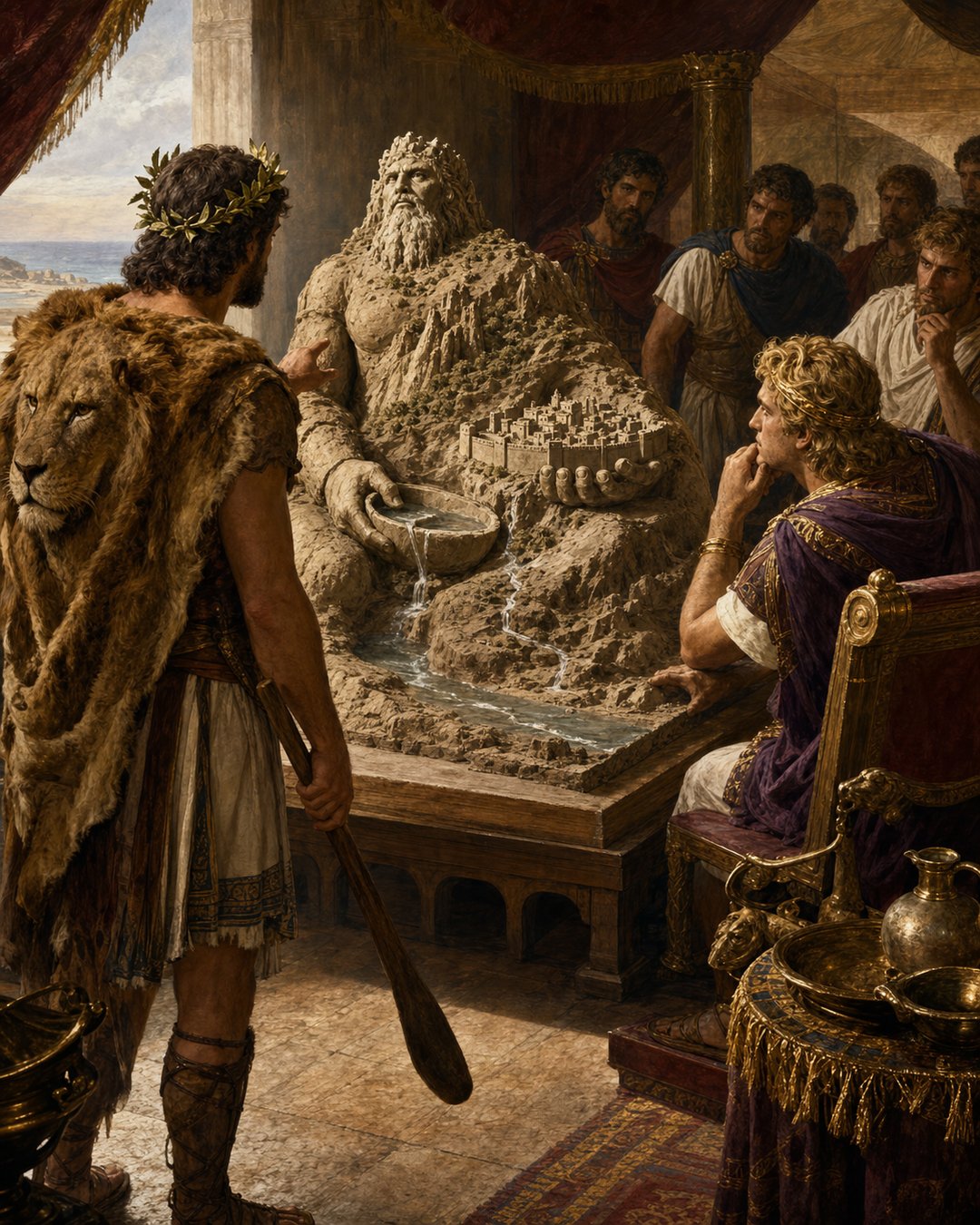
Dinocrates did not wait quietly for a royal appointment. According to Vitruvius, the Macedonian architect reached Alexander’s army with letters to powerful men, watched those introductions stall, and decided to turn his own body into the invitation. He stripped off his ordinary clothing, covered himself with oil, placed a poplar wreath on his head, slung a lion skin across one shoulder, took a heavy club, and walked into the tribunal while the king was dispensing justice.
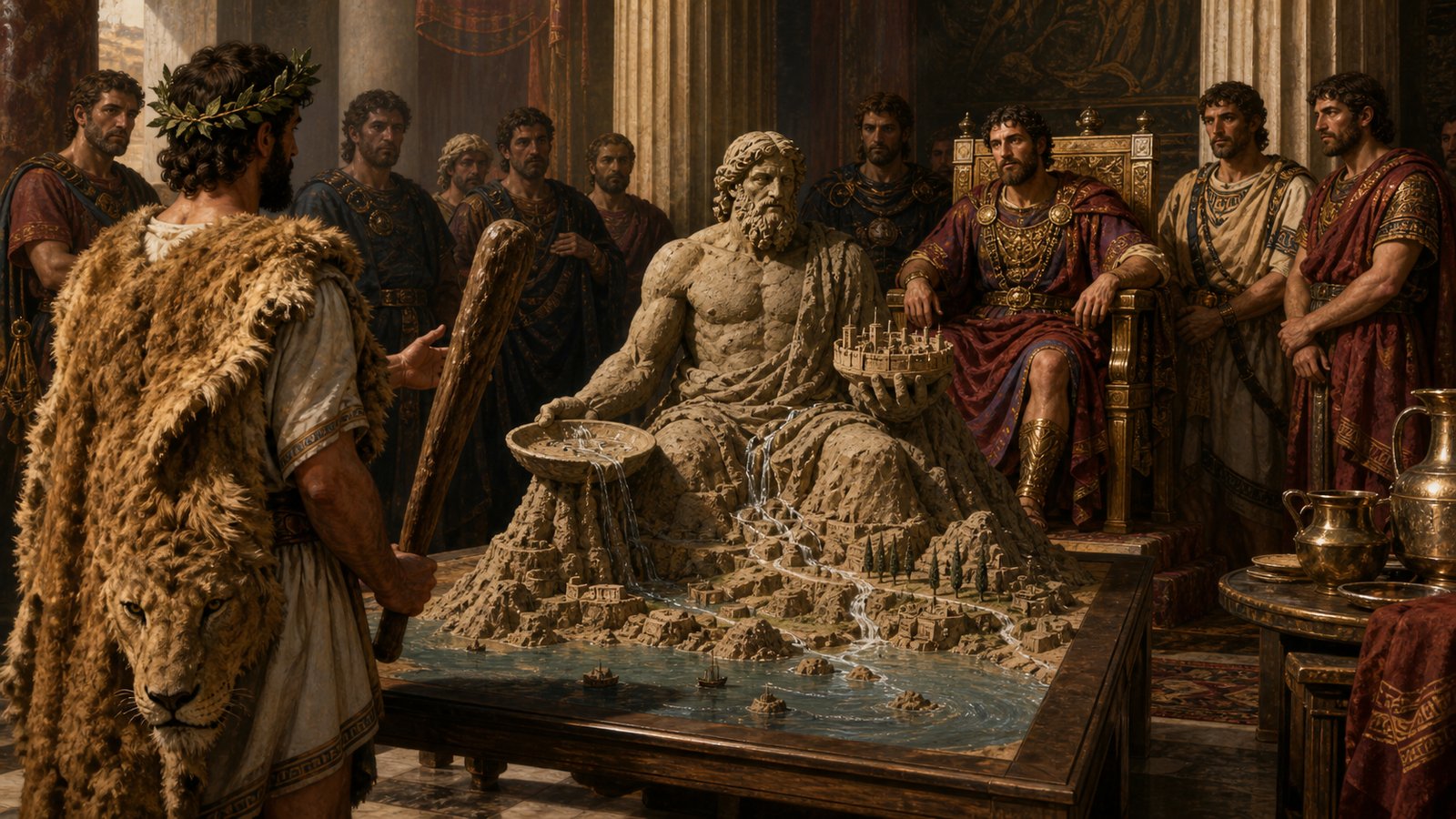
The performance worked. The crowd stared, Alexander noticed the disturbance, and the architect finally received his question: who was he? Dinocrates answered with a proposal scaled to royal ambition. Mount Athos would become a colossal human figure. In one hand it would hold a city; in the other, a great cup gathering the mountain’s streams and releasing them into the sea.
Alexander admired the outline, but his first test was not about sculpture. He asked whether the land around the proposed city could feed it. When he learned that supplies would have to come entirely by sea, the spectacle lost its political foundation. Vitruvius uses the exchange to separate a project that can be drawn from a city that can endure.
A Costume Forced Open the Royal Door
Dinocrates first tried the respectable route. Letters from countrymen and relations connected him with leading men near the king. They received him kindly and promised to find the right moment, but the moment never arrived. Access was itself a design problem: his plan could not be judged until he crossed the human machinery around Alexander.
His solution borrowed the visual equipment of Heracles. Oil made his uncovered body conspicuous. The poplar wreath, lion skin, and club converted a tall architect into a moving emblem of strength. Vitruvius emphasizes that Dinocrates was handsome and dignified, details that explain why the stunt appeared impressive rather than merely disruptive.
The timing sharpened it. Alexander was hearing cases when the unusual figure entered the tribunal. The crowd’s attention became leverage. Instead of waiting for an official to present him, Dinocrates caused enough public curiosity that the king ordered space cleared and asked for an explanation. Architecture reached power through theatre before a line of the scheme had been inspected.
This was more than vanity in Vitruvius’s telling. The author contrasts Dinocrates’s physical advantages with his own old age, wrinkled face, and sickness. Addressing his Roman emperor, Vitruvius says he must seek commendation through knowledge rather than appearance. The anecdote therefore opens a technical book with an uncomfortable truth: patrons may first notice the designer before they understand the design.
The Mountain Was Asked to Perform as a Body
The proposal made geography into royal portraiture without placing Alexander’s named likeness on a conventional statue. Mount Athos itself would take human form, large enough to hold an inhabited city in its left hand. The right hand would carry a basin into which streams from across the mountain gathered before falling to the sea.
Every element amplified scale. A normal statue stands inside a city; this city would occupy part of a statue. A fountain normally receives piped water; this cup would reorganize a mountain’s drainage. The inhabitants would live inside a landscape composed as an image. Dinocrates offered Alexander not one building but a horizon made memorable by settlement, water, and stone.
Vitruvius says Alexander was delighted. That response matters because the king did not reject the idea as impossible or ridiculous. He recognized the grandeur and later stated that the scheme could be executed. The failure emerged only after admiration, when he changed the frame from monument to inhabited system.
Roman readers knew how power could be written into landscape. Yet a boundary, road, or street grid also had to manage movement. Vitruvius’s warning about winds in city streets similarly begins with forces a plan must redirect rather than surfaces it merely displays. Dinocrates had given streams a theatrical route, but he had not answered what would move food into thousands of mouths.
One Question About Soil Repriced the Spectacle
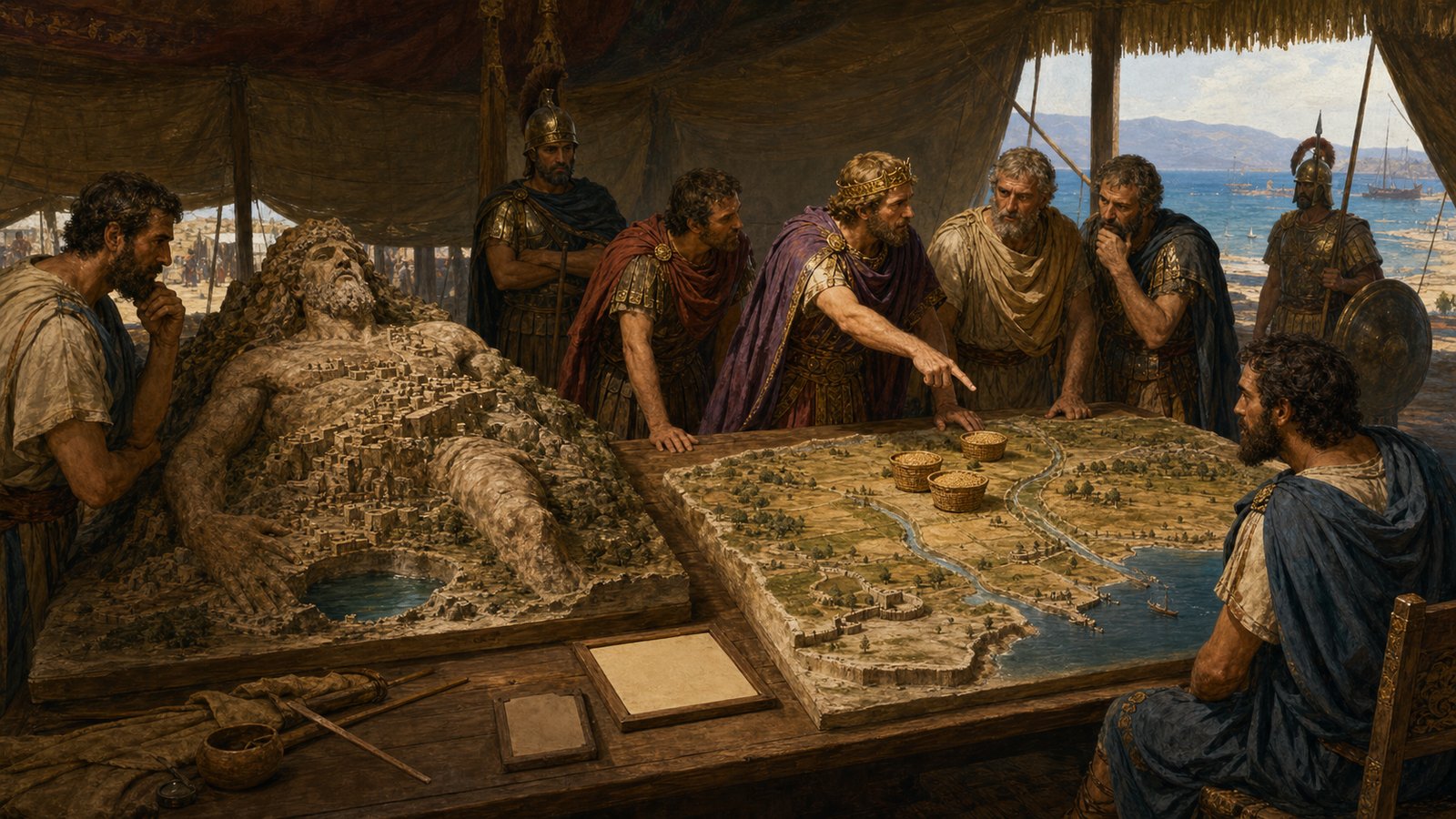
Alexander asked whether the neighbouring soil could yield enough produce for such a community. The question immediately reached beyond construction. A city requires grain through poor weather, disrupted voyages, population growth, and war. Stone might last for generations while each household’s food reserve vanished within weeks or months.
The answer was fatal: the settlement’s supplies would come by sea. Maritime transport could carry large quantities, but complete dependence created a narrow point of failure. Storms could delay ships. Enemies could contest approaches. A harbour crowded by urgent imports could not replace fields that produced food in several directions around the walls.
Alexander explained the relationship with a bodily comparison. As an infant depends on its mother’s milk to grow, he said, a city depends on the fertility around it. Local production fed riches and population as well as survival. It also mattered to defence, because a settlement that could not sustain itself offered an attacker a way to pressure it without overcoming every wall.
This reasoning turned the mountain body against itself. Dinocrates had imagined Athos as a giant capable of holding an urban population, but Alexander found that the figure could not feed what it carried. The right hand controlled water as spectacle while the city in the left lacked secure nourishment. The visual body was immense; the metabolic system was missing.
The rejection also clarifies why founding rites and practical routes belonged together in ancient urban thought. a founder’s plough could mark a city boundary and its gates, but the line only mattered if people, animals, harvests, and defenders could pass through it. Athos offered an unforgettable edge with a dangerously thin supply network.
Alexandria Preserved the Ambition and Changed the Ground
Alexander did not dismiss Dinocrates. He called the Mount Athos design admirable but politically unsound, then asked the architect to remain with him. That distinction saved both the designer and the useful part of the ambition. A failed site test did not prove that Dinocrates lacked ingenuity; it proved that ingenuity needed a different geography.
The architect followed the king into Egypt. There Vitruvius lists almost the inverse of Athos’s weaknesses. The chosen place was naturally strong. It occupied a centre of commerce. Its land produced abundant grain, and the Nile provided transport. Defence, food, exchange, and movement converged before the monumental city took shape.
Alexandria did not abandon spectacle. Its scale and royal name still served Alexander’s reputation. What changed was the support beneath that ambition. Grain did not depend solely on a sea crossing to an isolated mountain. River transport connected fertile country with an urban and commercial node. The setting could sustain population rather than merely astonish visitors.
Vitruvius’s anecdote therefore does not offer a simple contest between practical king and foolish artist. Dinocrates understood how form could command attention, and that talent won him a place near Alexander. Alexander supplied a second discipline: the patron tested whether the proposed image could become a durable polity. Together those judgements moved the architect from an unrealized mountain figure to a city embedded in productive land and transport.
The sharpest moment is still the first question after delight. Alexander did not begin by asking how many labourers would carve Athos or how streams could be channelled into a cup. He asked what the citizens would eat. In that order, Vitruvius located the difference between a colossal object and an urban future.
Sources
Vitruvius, On Architecture, Book 2, introduction 1–4.