
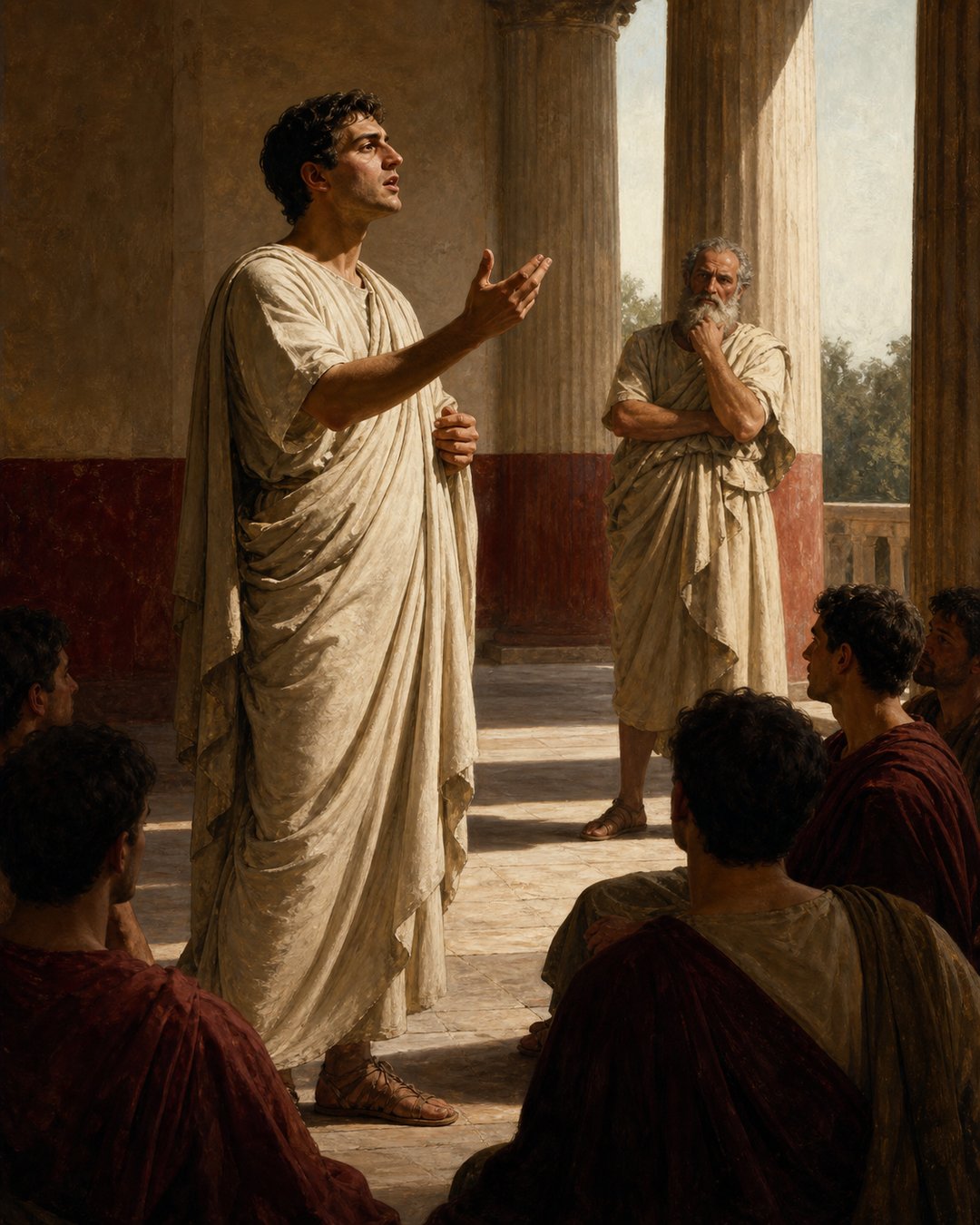
Cicero’s young voice was powerful enough to make listeners worry about the body producing it. Plutarch describes him as spare and lean, troubled by a weak stomach and able to take only a little light food late in the day. His voice was full and strong, yet harsh and unmodulated. Passion drove it upward into a high register that sounded difficult to sustain.
This was not the portrait of a man without talent. Cicero had just defended Sextus Roscius, won, and gained admiration by accepting a case others feared. The problem was that intellectual speed and courage did not automatically create durable delivery. A Roman advocate needed to be heard across a court, control the emotional temperature of a speech, and return the next day able to do it again.
Plutarch makes Cicero’s journey to Greece part refuge, part health measure, and part reconstruction. Exercise strengthened his body. Study gave his voice modulation. Declamation exposed habits that ordinary conversation could hide. Teachers in Athens, Asia, and Rhodes treated public speech as something made through correction rather than released in one natural burst.
A Famous Victory Revealed an Unfinished Instrument
The Roscius defence placed Cicero in danger as well as public view. Plutarch connects the prosecution with the power surrounding Sulla and says advocates avoided the case through fear. Cicero took it, won, and became admired. He then left for Greece while spreading the explanation that his health required attention; Plutarch presents the concern as genuine even while noting Cicero’s fear of Sulla.
His physical details matter because Roman oratory was bodily labour. The advocate stood, projected, paced argument, changed tone, and sustained attention without amplification. A full voice could become a liability if harshness forced every important sentence into the same upper range. Listeners might hear strain before they heard control.
Plutarch does not give a clinical diagnosis for the stomach weakness or explain every exercise Cicero used. He does describe the visible problem and the result. The young man had difficulty eating, carried little weight, and spent vocal force aggressively. Later his body acquired vigour and his voice became modulated and pleasant, adjusted to the body supporting it.
The transformation complicates the idea that Roman public voices simply emerged from elite confidence. Roman schooling prepared voices before public careers through reading, imitation, memory, and performance. Cicero’s later training shows that even a successful advocate could discover that education had not finished the instrument.
Athens Offered More Than a Place to Hide
At Athens, Cicero heard Antiochus of Ascalon and admired the fluency and grace of his diction even while disagreeing with parts of his philosophy. This combination reveals what the journey could provide. Cicero did not need to accept every doctrine to study how thought arrived through a speaker’s arrangement and sound.
Plutarch says Cicero considered a life of philosophy in Athens if public affairs were closed to him. The possibility made training more than a temporary technical repair. He was deciding whether the forum would remain his arena at all. Sulla’s death, letters from friends in Rome, and Antiochus’s encouragement moved him back toward political work.
By then exercise had strengthened him and modulation had softened the voice’s effect. Yet improvement did not send him directly home. Cicero treated his rhetorical style as an instrument requiring further preparation. He cultivated declamation and sought teachers whose criticism could test different dimensions of performance.
In Asia he studied with Xenocles of Adramyttium, Dionysius of Magnesia, and Menippus the Carian. The named sequence resists the image of one miraculous lesson. Different ears could notice rhythm, arrangement, pronunciation, force, or excess. Travel widened the circle of correction before Roman audiences fixed his public habits more deeply.
Greek Removed the Shelter of Native Fluency
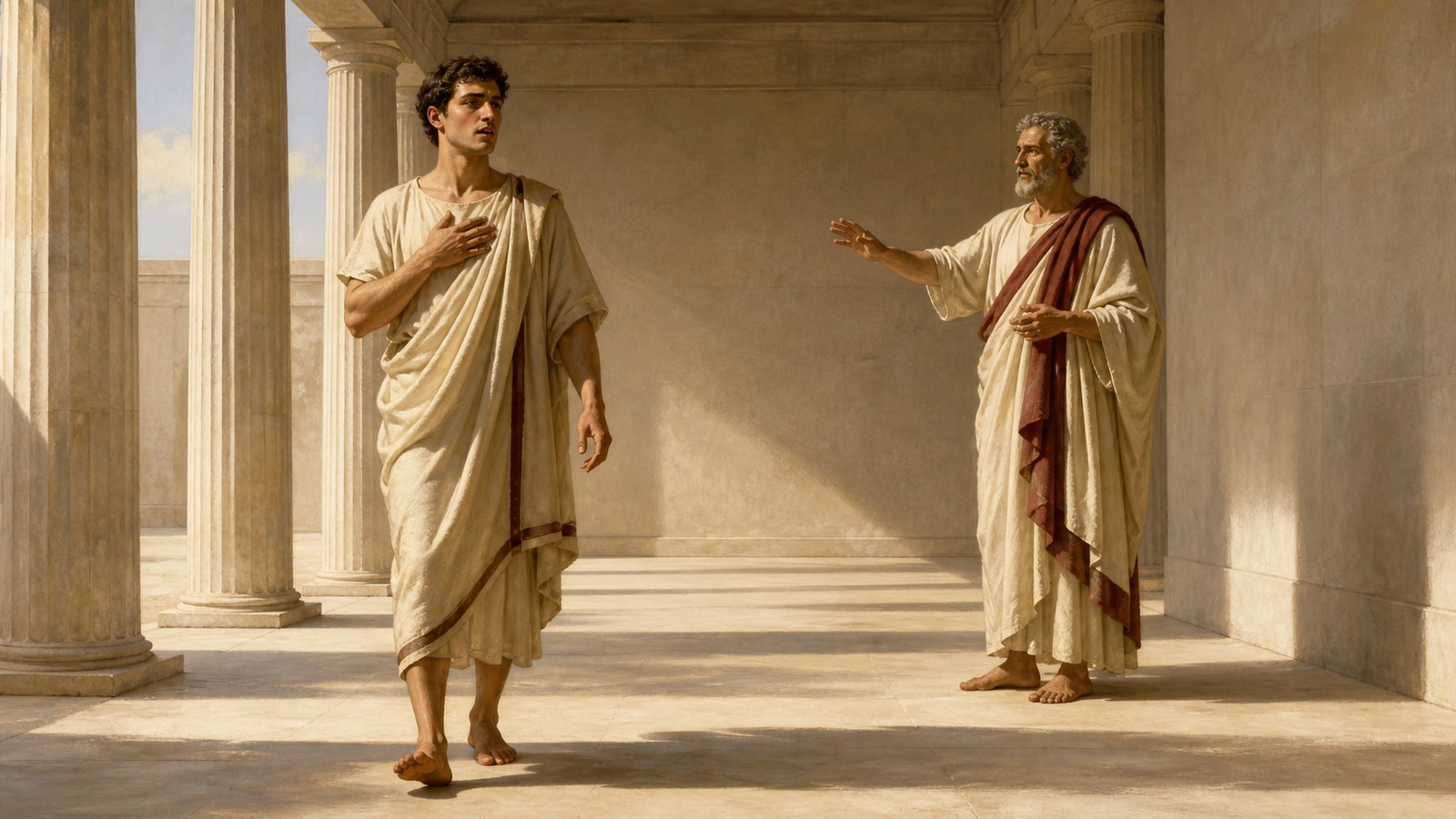
At Rhodes, Cicero studied oratory with Apollonius, son of Milon, and philosophy with Poseidonius. Apollonius did not understand Latin, so he asked the Roman visitor to declaim in Greek. Cicero agreed because he believed his faults could be corrected more effectively that way.
The language change was a demanding test. In Latin, verbal speed and familiarity could carry a speaker past a weak transition or an uncontrolled cadence. Greek required Cicero to manage argument through a learned language before a teacher qualified to hear its details. Fluency still mattered, but it could no longer hide entirely inside Roman status or a Latin audience’s excitement.
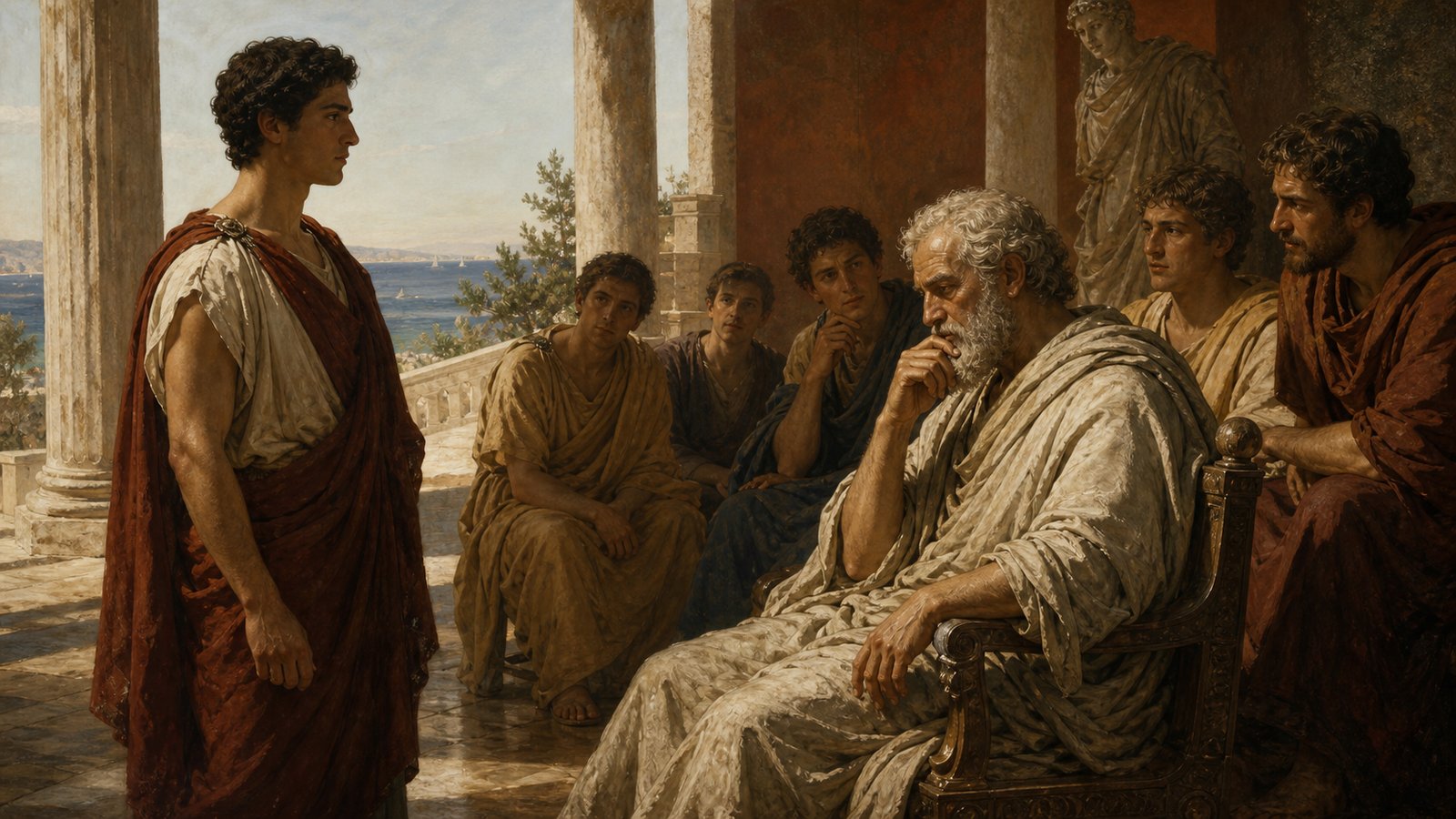
Plutarch stages the aftermath carefully. Other listeners were astonished and competed in praise. Apollonius remained unmoved while Cicero spoke, then sat in thought for a long time after he finished. Cicero became distressed by the silence. The teacher eventually praised him and lamented that Greek culture and eloquence would now belong to Rome through him.
The compliment is memorable, but the silence before it is more useful for understanding training. Cicero had travelled for judgement, not applause alone. A teacher who paused denied him the immediate confirmation surrounding a successful young advocate. The performance had to exist for a moment as an object under consideration.
That relationship between teacher and ambitious Roman appears elsewhere in the tradition. a rhetoric teacher who corrected senators’ dress treated the school as a space where public rank did not cancel discipline. At Rhodes, Cicero likewise submitted Roman promise to an external standard and waited for the verdict.
Actors Supplied the Technique Politics Could Not
Plutarch adds that Cicero remained weak in delivery and studied Roscius the comedian and Aesop the tragedian. The detail puts theatre beside philosophy and rhetoric in the construction of a political voice. An actor knew how a pause changed attention, how gesture carried across distance, and how intensity could be shaped without spending every reserve at once.
Imitation did not mean turning a legal argument into a play. Forum and stage had different rules, audiences, and stakes. Cicero could still examine how trained performers joined breath, posture, timing, facial direction, and pitch. His original problem was not lack of force; it was force without enough modulation. Theatre offered examples of power distributed across a performance.
Plutarch later credits Cicero’s delivery with contributing greatly to persuasion. That outcome makes the early harsh voice important. The mature effect was not merely the sound Cicero happened to possess. It had passed through illness, exercise, philosophical listening, repeated declamation, travel, multilingual testing, professional teachers, and observation of actors.
The account should not be read as a modern vocal-training manual. Plutarch does not preserve breathing drills, daily durations, or medical instructions, and his biography shapes the journey into a story of formation. What survives is the sequence of problems and responses: a vulnerable body, an overdriven register, exercise, modulation, criticism, imitation, and return.
Cicero’s public career would still expose limits. Training could not remove fear, fatigue, political danger, or every failed performance. It could make the voice less dependent on one explosive quality. A speaker who knew only intensity had nowhere to go when a case required patience, irony, restraint, or a controlled rise toward accusation.
The harsh young voice already contained strength. Greece did not replace it with something smaller. Teachers and performers helped Cicero divide that strength into choices. By the time he returned toward Roman public life, his body and delivery had become better matched, and the forum could hear not only force but command over force.
Sources
Plutarch, Life of Cicero, sections 3–5.