
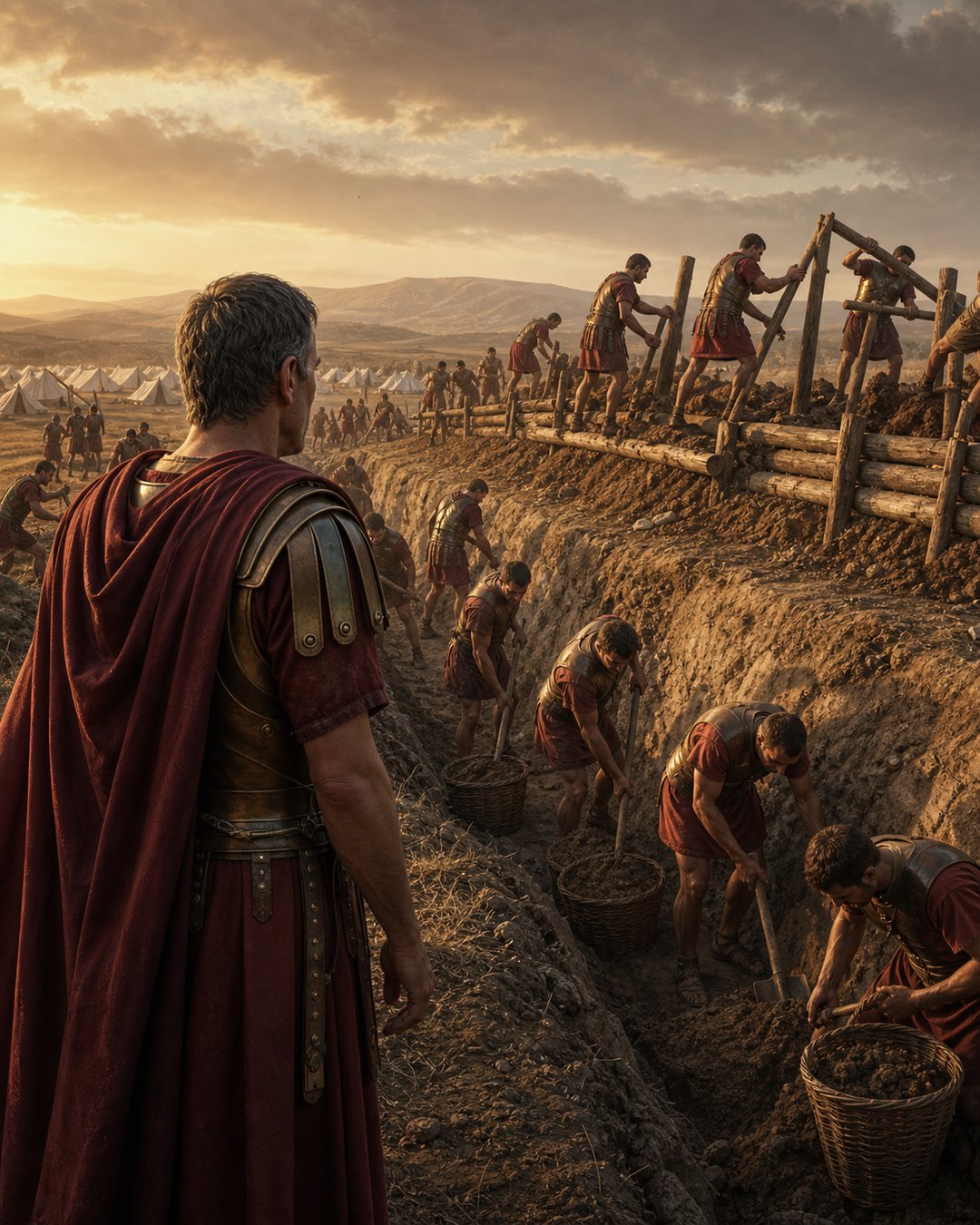
Scipio Aemilianus arrived in Spain to command an army he did not yet trust. Rome had elected him consul for a second time in 134 BCE because the war around Numantia had dragged on through defeats, reversals, and damaged morale. Appian says Scipio understood the order of his problem: he could not overcome the enemy until he had first brought his own men under discipline.
He did not begin with a dramatic assault. He removed traders, prostitutes, soothsayers, and diviners from the camp. Surplus wagons were sold. Pack animals were restricted. A soldier’s cooking equipment came down to a spit, a brass kettle, and one cup; beds disappeared, and Scipio slept on straw before asking others to do the same.
Then the landscape became a training ground. The army marched across the plains, built a fortified camp, demolished it, dug trenches, filled them, raised walls, and knocked them down. Appian describes this as daily work. Scipio watched from morning until night and timed what the different teams completed. The camp was not only shelter at the end of movement. Repeated construction became a test of whether thousands of people, animals, tools, and loads could act as one field force.
The First Reform Happened in the Baggage Train
An army carries its habits in its baggage. Appian’s list makes Scipio’s diagnosis unusually concrete. Wagons and unnecessary contents went up for sale. Only designated pack animals remained. Cooking required a spit, kettle, and cup rather than a private collection of comforts. Food was plain boiled or roasted meat. Men could not bring beds into a campaign whose commander lay on straw.
These changes were not a claim that every object beyond the list was morally corrupt. They altered movement. Each wagon occupied road space, required animals, slowed difficult crossings, and needed drivers and forage. A dense tail of private equipment could stretch a column while the fighting troops at its head encountered terrain or danger. What looked like comfort inside camp became delay once the army had to leave it.
Scipio also forbade soldiers to ride on mules during the march. Appian gives him a cutting question about what could be expected in war from a man unable to walk. He mocked those who depended on servants for bathing and anointing, comparing them with mules that lacked hands. The jokes enforced a physical boundary between a campaign and the domestic status some soldiers tried to preserve inside it.
Frontinus remembers the same reform through frequent marches, several days of rations, cold, rain, stream crossings, and the destruction of utensils useful only for indulgence. Equipment was judged by whether it survived movement and served a necessary task. Roman marching footwear mattered for the opposite reason: leather, nails, and repairable construction helped bodies keep moving when the road itself imposed the test.
Every Finished Camp Was Ordered to Disappear
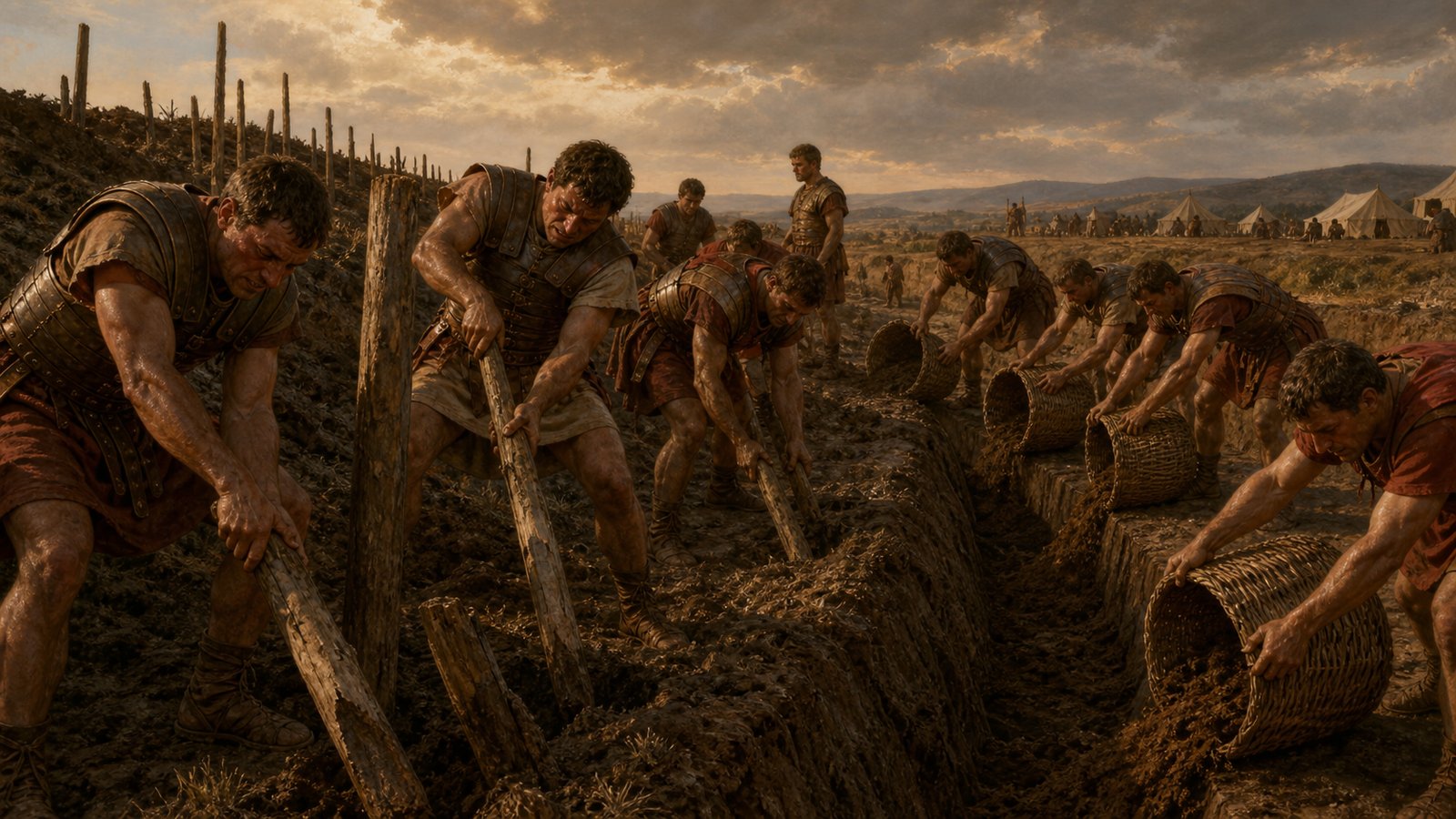
Appian’s training sequence denied the soldiers the satisfaction of treating completion as rest. They fortified one camp after another, then demolished what they had built. They dug deep trenches and filled them again. They raised high walls and overthrew them. The purpose was not to leave a chain of useful forts across friendly ground. It was to repeat the work until the army’s response became observable and dependable.
A trench demanded aligned labour. Some men opened hard ground while others carried loosened earth away from the cut. A rampart required the spoil to arrive where it could become a coherent barrier. Tents had to occupy an ordered interior without blocking movement. Tools, loads, and teams all had to reach the right place before darkness or attack made confusion dangerous.
Demolition mattered because it prevented one successful performance from being mistaken for readiness. A wall that remained standing could conceal who had learned the sequence and who had merely followed neighbours once. By knocking it down and marching onward, Scipio created another trial on different ground. Soil, slope, fatigue, and distance changed, but the requirement for coordinated work did not.
The exercise sharpened a mechanism already central to Roman campaigning. the reusable logic of a Roman marching camp turned a temporary stop into defensible order. At Numantia, Scipio used that logic before direct battle as a diagnostic. If the army could not make its own perimeter predictably after a march, its commander had little reason to trust it under pressure near an enemy city.
A Marching Square Exposed Every Weak Link
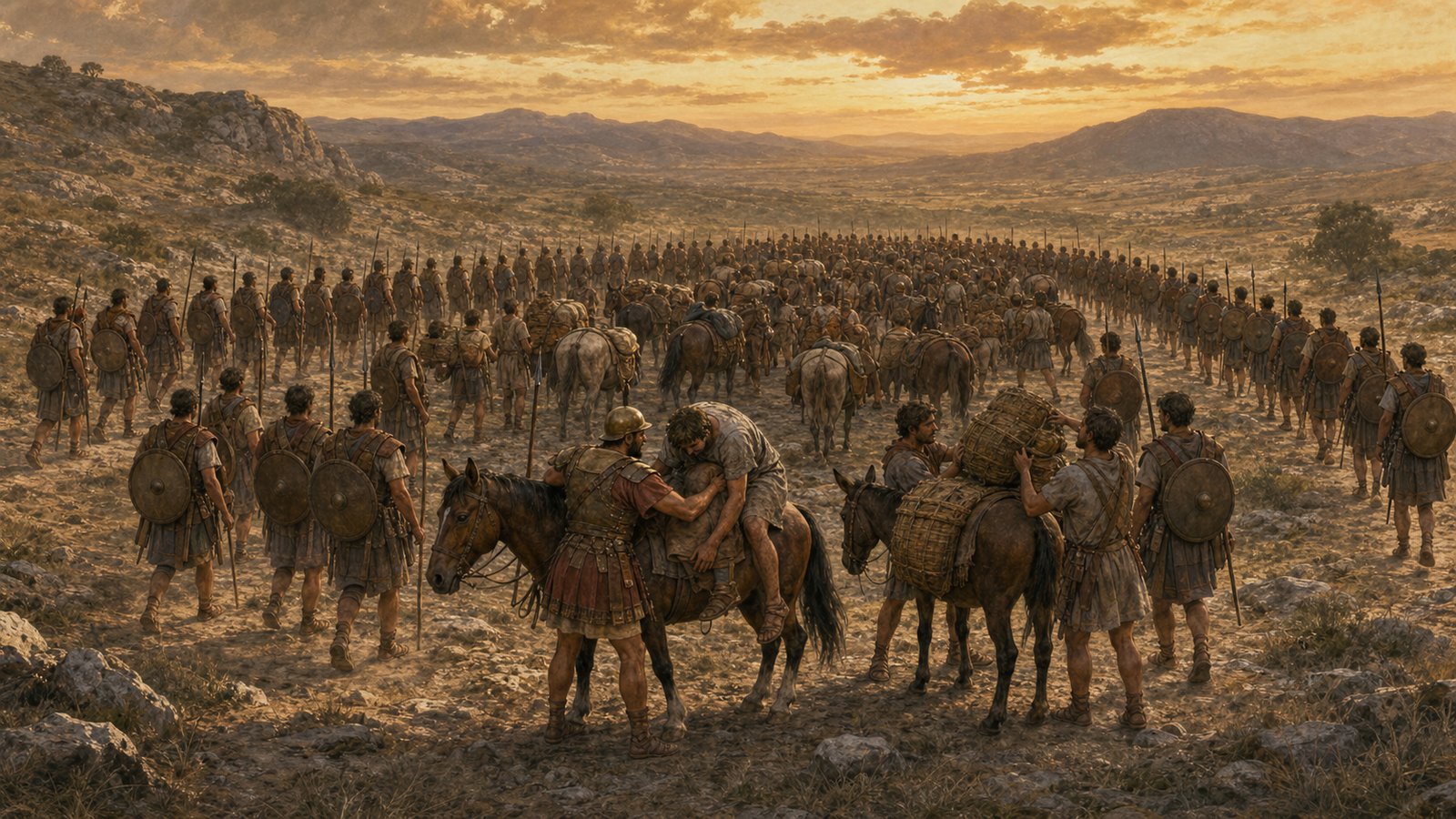
Work in camp was connected to order on the road. Appian says Scipio moved the army in squares and did not allow men to change their assigned places. He circulated around the formation, often visiting the rear. Fixed positions made straggling visible. A soldier who drifted away could no longer disappear into an irregular procession and rejoin without exposing the gap.
The arrangement did not mean the column ignored weakness. Scipio made horsemen dismount and give their places to sick men. When mules carried too much, infantrymen took part of the load. Discipline here was not blind attachment to the original distribution. The formation stayed coherent because the commander redistributed strain without allowing individuals to choose their own place or pace.
That distinction joined severity to logistics. An overloaded animal could fail and block movement; an exhausted sick soldier could fall behind; a rider protected from every inconvenience could leave the hardest burden to someone else. Scipio’s inspections forced these problems into the open while they could still be reassigned. He was measuring not only obedience but the capacity of the formation to absorb unequal bodies and loads.
Cold, rain, and streams extended the test beyond level ground. Frontinus says the troops became accustomed to carrying several days of food and fording water. Wet clothing, cold hands, uncertain footing, and heavy rations changed the speed of every task that followed. A camp built after such a crossing told Scipio more than one erected by rested men beside an established road.
The Clock Turned Labour into Command Evidence
At the end of a march, the day’s vanguard did not simply stop. Appian says those men deployed around the chosen camp site. Horsemen scouted the surrounding country. Other groups dug the trench, built the rampart, or pitched the tents. Scipio assigned a time for completion and kept an accurate account.
The clock transformed effort into information. A commander could hear that men had worked hard, but a finished trench at a known time offered firmer evidence. Repetition allowed comparison from one day to the next. Delay might reveal poor tool distribution, a weak team, a confused assignment, an overburdened column, or exhaustion accumulating behind the front ranks.
Timing also connected separate jobs. A rampart team could not use earth that trench diggers had not yet produced. Tents could not be laid out intelligently if the defensive line remained uncertain. Scouts had to create warning time while the camp was most exposed, and the perimeter guard had to cover workers whose hands were occupied. One missed stage changed the risk borne by every other stage.
Scipio’s presence from morning to night made the measurements part of command rather than an exercise delegated out of sight. Appian depicts him moving through the line, inspecting the rear, adjusting burdens, and observing camp work. He reduced his own comfort and access to favours at the same time. The system would have been less persuasive if its author slept softly while ordering straw or travelled easily while mocking men who rode.
Only when he judged the army alert, obedient, and able to endure labour did Scipio move near Numantia. The sequence is the point. Camp discipline did not decorate a victory achieved elsewhere; it came before he accepted battle risk. Rome had sent a celebrated commander, but Appian’s Scipio first behaved like an auditor of marching feet, mule loads, cooking vessels, trenches, walls, tents, and hours.
The repeated camp turned preparation into something that could fail safely. A slow wall on a training plain produced another day of work. The same confusion beside Numantia could leave a column scattered or a perimeter unfinished in reach of the enemy. Building and demolishing allowed Scipio to discover weaknesses before the Numantines discovered them for him.
His army did not need one perfect camp. It needed the ability to make the next camp after cold, rain, distance, hunger, and changed ground. By ordering each completed fortification to disappear, Scipio tested whether the real structure lived in the earthworks or in the trained sequence that could produce them again.
Sources
Appian, The Spanish Wars, sections 84–86.
Frontinus, Stratagems, Book 4, chapter 1, section 1.