
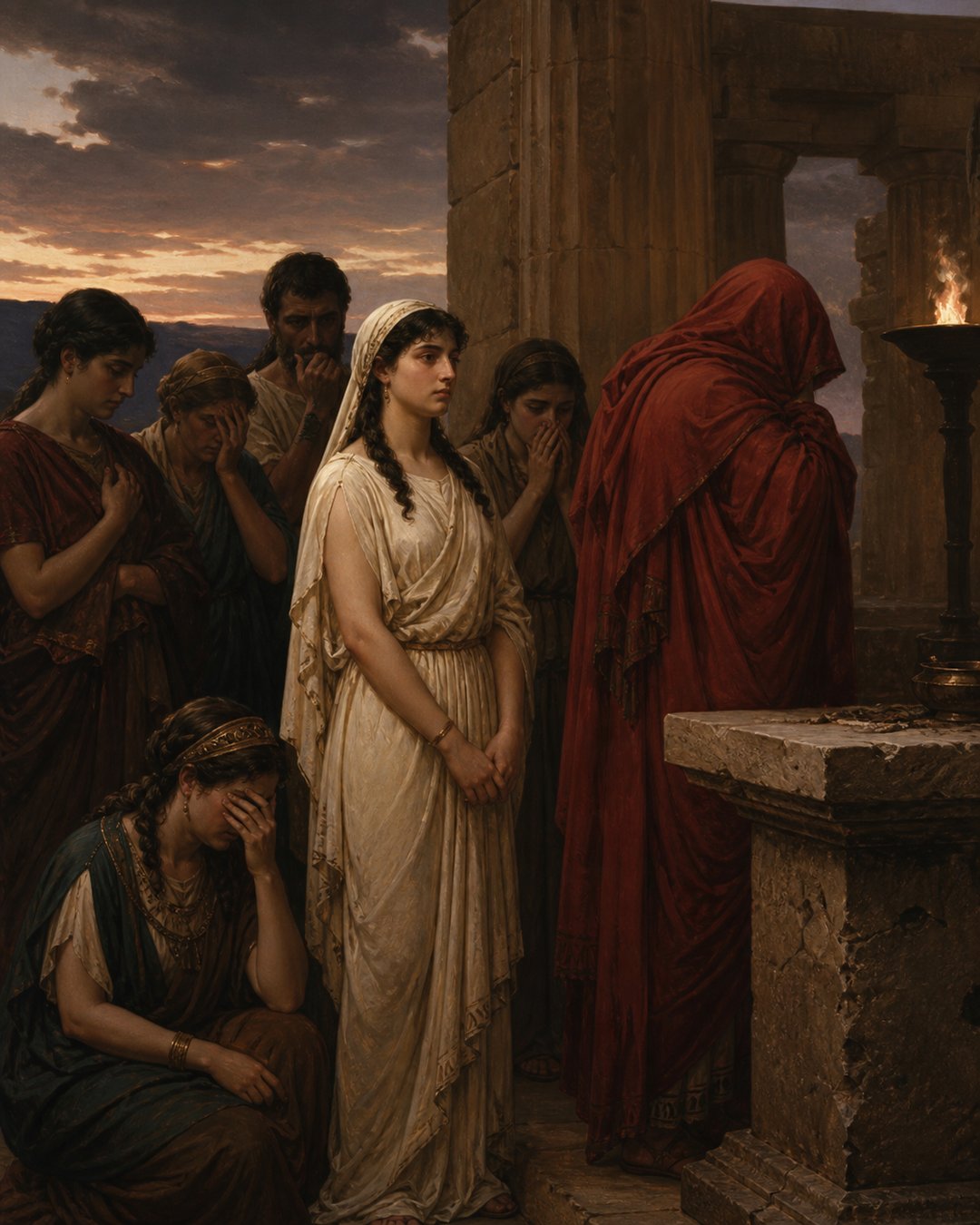
One face in Timanthes’s lost painting refused the viewer’s gaze. Iphigenia stood at an altar awaiting death. Around her, relatives and witnesses showed grief in different degrees. Her father did not. A fold of cloth concealed him at the moment when the picture should have revealed its deepest sorrow.
Pliny the Elder preserved this arrangement centuries after the painted panel had entered the history of Greek art. His brief account does not give its dimensions, colours, ownership, or later location. Instead, he remembers an expressive problem and the painter’s answer. Timanthes had already used the visible signs of mourning on the other figures. To paint the father as simply one more anguished face would flatten the emotional order he had built.
The veil solved that problem by changing the viewer’s task. The other mourners could be read from brows, mouths, eyes, and posture. Agamemnon had to be completed in imagination. Timanthes made absence perform as the climax of a carefully graded scene.
The Altar Fixed Every Figure Inside the Same Disaster
Pliny identifies the subject through Iphigenia at the altar, waiting for what he calls her doom. The myth supplied an audience with the terrible situation before it inspected a single gesture. Agamemnon’s fleet required a sacrifice; the victim was his daughter; the people assembled around her knew what the ritual demanded. Timanthes could therefore compose reactions rather than narrate every preceding event.
The altar gave the panel a hard centre. This was not grief remembered afterward in a private room. The threatened death remained present, organized as ceremony, with the victim exposed before family and witnesses. Each mourner occupied the same moment but carried a different relationship to it.
That structure matters because Pliny describes sorrow comparatively. He says grief appeared on all the faces and notes the uncle in particular. The figures were not a repeated chorus of identical grimaces. They formed a sequence in which one expression prepared the eye for the next.
Roman readers knew art through stories like this as well as through surviving objects. The contest of three painted lines made control of the brush into a test legible even without the original panel. Timanthes’s Iphigenia survived by a different verbal mechanism: a viewer could reconstruct the logic of the faces even after the paint itself disappeared.
The myth also prevented the veil from becoming empty ambiguity. A covered stranger might be asleep, ashamed, praying, or merely turned away. A covered Agamemnon beside Iphigenia’s altar could be understood through his impossible position as father and commander. Context loaded the cloth with emotion.
Visible Sorrow Had to Rise Without Becoming Repetition
A painter can intensify grief through tears, tightened mouths, lifted hands, collapsing knees, averted eyes, or bodies leaning toward the victim. Yet each sign loses force when copied mechanically across a group. Timanthes’s problem was not the inability to paint one sad person. It was how to arrange many sorrowing people while keeping the father’s pain unequal.
Pliny’s phrase about exhausting the characteristic features of sorrow reveals the compositional pressure. The painter had spent his available vocabulary as he moved through the witnesses. That does not mean ancient artists possessed a fixed checklist of expressions. It means the account imagines a scale whose visible summit had already been reached.
The uncle’s face, singled out by Pliny, marked a high point before the final figure. Timanthes could have exaggerated the father beyond it: more tears, a more twisted mouth, a more violent gesture. Such escalation risked turning grief into distortion. It could also make the father appear merely louder rather than more deeply affected.
The solution was to leave the scale of visible expressions entirely. Agamemnon’s grief would not be one degree above the uncle’s. It belonged to another category because it could not be inspected. The cloth preserved difference without requiring a grotesque face.
This restraint distinguishes the panel from art anecdotes built around spectacular deception. A false fire alarm supposedly exposed which sculptures Praxiteles valued most; the trick forced a hidden preference into action. Timanthes worked in the opposite direction. He concealed the decisive expression and trusted viewers to recognize why it remained inaccessible.
A Fold of Cloth Recruited the Viewer as Collaborator
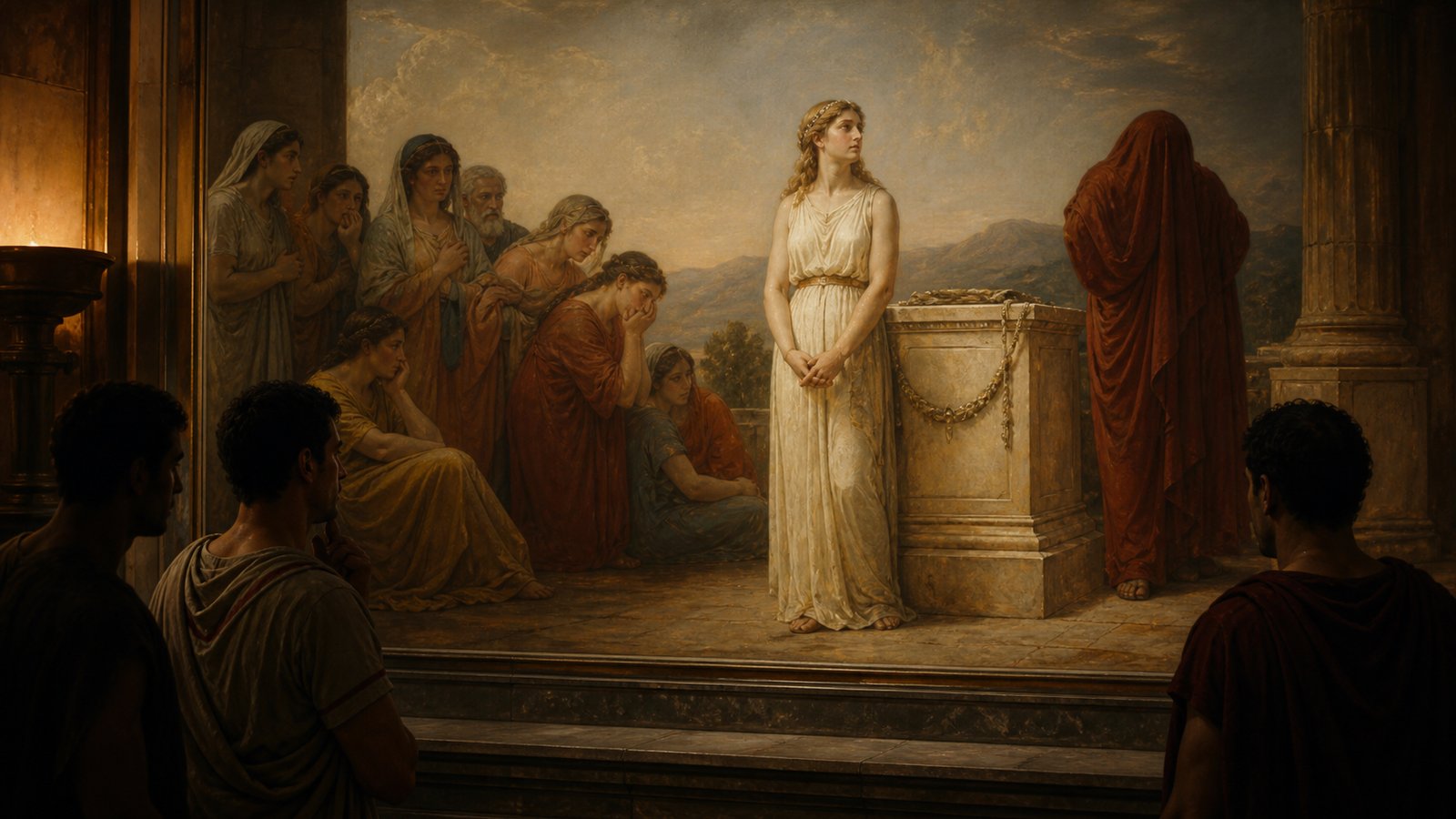
The veil did not remove Agamemnon from the composition. It made his body, orientation, and covered head more important. Even without a face, the figure could turn away from the altar, bow beneath the fabric, or hold the garment in a gesture of refusal. Pliny gives none of those exact details, so a responsible reconstruction cannot pretend to know them. What survives is the principle of concealment.
That principle transferred work from artist to audience. Viewers had already studied the visible mourners and learned the emotional range of the scene. When they reached the covered father, they supplied an expression greater than any fixed set of painted features. Each imagined face could become as severe as that viewer believed paternal grief required.
Concealment also stopped the audience from judging Agamemnon too easily. A painted face can be assessed: Does he weep enough? Does he look guilty, obedient, broken, or cold? The veil suspends that verdict. It leaves him inside the ritual but denies the comfort of a readable response.
The fabric therefore functioned as more than costume. It was an active boundary between public spectacle and private feeling. Everyone around the altar could see the father’s withdrawal, yet no one could possess the expression underneath. The panel turned an exposed sacrifice into a study of what could not be exposed.
Pliny’s praise depends on this participation. He does not say only that the drapery was painted skilfully. He praises the choice to use drapery at exactly the point where ordinary facial expression would fail the hierarchy. Invention lay in deciding what not to show.
Pliny Valued the Thought Beyond the Brushwork
Timanthes appears in Pliny’s catalogue among painters known through rivalries, celebrated works, and memorable devices. The Roman author calls him highly gifted and says orators loudly commended the Iphigenia. That afterlife matters. The painting became useful not only to artists but to speakers thinking about how expression reaches its limit.
Pliny reinforces his judgment with another lost work, a small panel of a sleeping Cyclops. To communicate the giant’s scale, Timanthes placed satyrs beside him measuring his thumb with a thyrsus. Once again, a relation did what direct representation could not. A small panel could not physically contain a giant, but a familiar object used as a measure allowed the mind to enlarge him.
The Cyclops and Agamemnon operate through opposite kinds of indirection. Tiny measuring figures make an unseen body feel enormous. A veil makes an unseen face feel overwhelmed. In both cases, the decisive content is not fully deposited on the painted surface. The spectator draws the conclusion.
This is why Pliny says something more was always implied by Timanthes’s brush than it expressed. He praises the execution as excellent, then places inventiveness above it. Technique served a design that understood where depiction became weaker than inference.
The Iphigenia panel is lost, and later versions cannot certify its original appearance. Yet the compositional argument remains unusually precise. Sorrow rises through a group; the visible vocabulary reaches its ceiling; the father disappears behind cloth; imagination supplies the unbearable remainder.
Timanthes did not abandon the most important face. He made its refusal to appear the picture’s final act. The veil carried no painted tears, but it held every expression the artist had chosen not to reduce to one answer.
Sources
Pliny the Elder, Natural History, 35.36.