
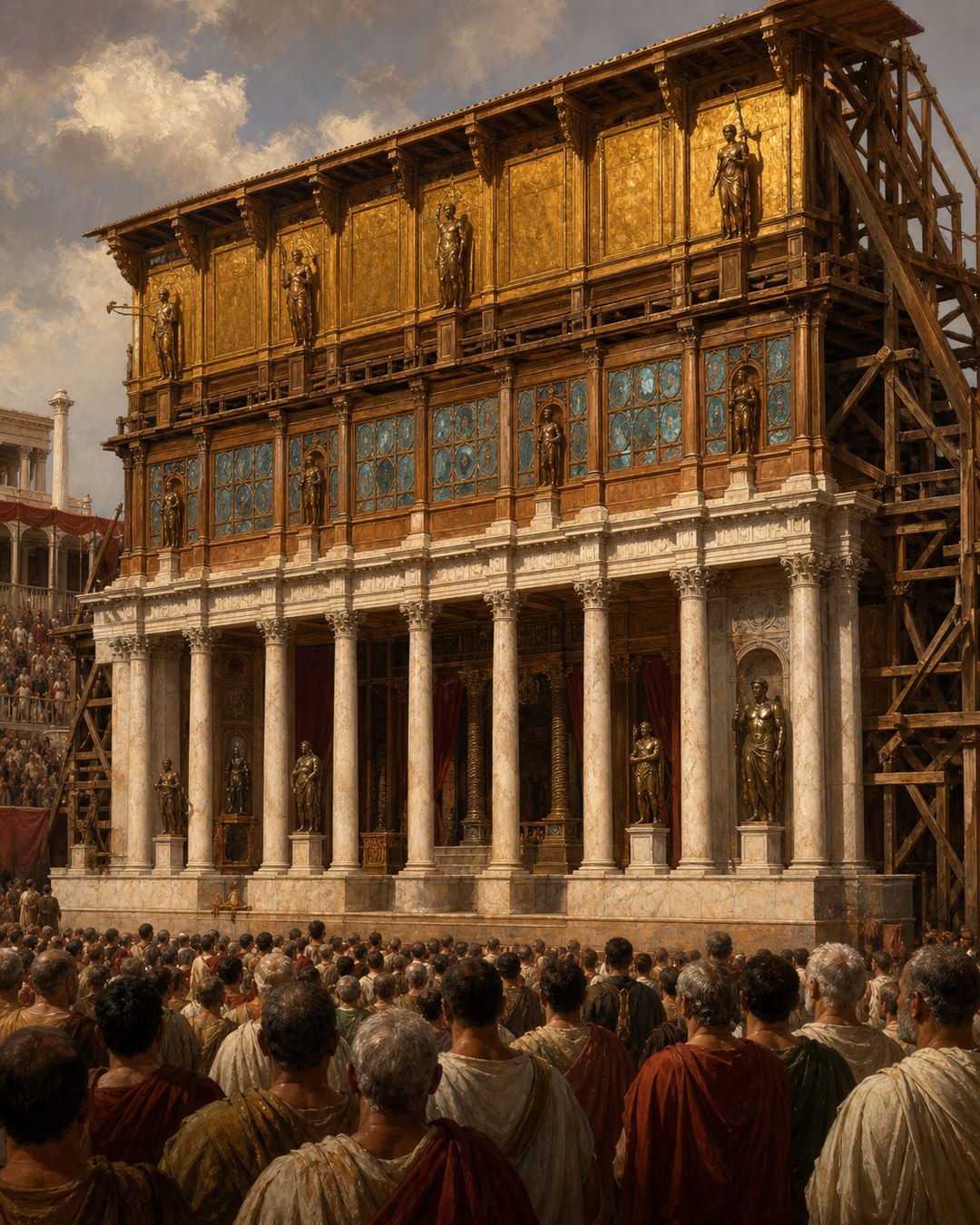
For a few festival days, Rome looked up at a building that seemed determined to exhaust comparison. Its lower stage façade was marble. Above it came glass. Gilded timber occupied the highest level. Pliny counted 360 columns and 3,000 bronze statues, then gave the audience an astonishing reported capacity of 80,000.
The sponsor was Marcus Aemilius Scaurus, serving as aedile in the late Republic. The office placed public games, streets, markets, and urban display within a politician’s path to higher rank. Scaurus answered that opportunity with a theatre whose extravagance mattered precisely because it was temporary.
Pliny’s numbers should be read as claims in a moralizing ancient account, not as measurements recovered from foundations. Yet his description preserves a sharp political mechanism. Valuable materials were assembled for public wonder, ranked vertically where a crowd could read them, then broken apart. Some of the movable wealth passed from festival architecture into Scaurus’s private villa. The building vanished; the memory of what he could command did not.
One Aedileship Turned Expense into a Public Argument
Scaurus did not need a permanent monument to make a permanent claim. Pliny introduces the theatre while condemning luxury and political excess. He calls Scaurus a private citizen, then treats his aedileship as a blow against public morals. The language is hostile, but the hostility reveals what the display was understood to do.
An aedile’s games placed generosity before a mass audience. Spectators received performances and visual abundance. The sponsor received recognition, obligation, and a story about his capacity. The exchange did not require a written campaign promise. It unfolded through access: for a short time, material usually associated with temples, palaces, and elite houses became the scenery of a civic festival.
That setting helps explain why duration mattered. A permanent theatre could justify costly stone through repeated use. A temporary structure denied itself that defence. Every column and surface announced that Scaurus could mobilize resources for an occasion brief enough to be remembered as a burst.
Pliny sharpens the contrast by recalling that Romans had once criticized a distinguished citizen for putting six columns of Hymettian marble into a house. Scaurus’s theatre multiplied columns to 360. The comparison is less an architectural survey than a scale of changed expectations: what had provoked censure in a doorway had expanded into the face of public entertainment.
Other Roman building stories show money disappearing into projects meant to endure. Nicaea’s theatre consumed ten million sesterces while cracks and unstable ground threatened the unfinished work. Scaurus’s project inverted that problem. Its short life was planned from the beginning, so impermanence itself became part of the spectacle.
Three Storeys Made Materials Perform in Rank
Pliny’s most memorable detail is the sequence: marble below, glass in the middle, gilded wood above. These were not interchangeable decorations scattered across one façade. Each material occupied a storey, turning the building into a vertical catalogue of expense.
The marble base supplied visual weight. Pliny says the lowest columns stood 38 feet high. At ground level, stone presented the language of durable monumental architecture even though the surrounding work was destined for dismantling. It made the temporary stage look rooted.
Glass changed the register above. Pliny calls this use of glass a luxury unheard of afterward. He does not provide a construction drawing, and “of glass” need not mean a modern transparent curtain wall. The safe conclusion is narrower: glass was conspicuous enough across the second level to define that storey in his description.
Gilded timber completed the rise. Wood suited temporary construction because it could be framed, joined, moved, and removed. Gilding denied it a merely practical appearance. The upper level combined the material logic of a short-lived structure with a surface that caught light like precious metal.
The ordering created contrast as the eye climbed: solid pale stone, reflective glass, warm gold. An audience did not need to know the supply routes or workshop accounts to understand escalation. Material difference made wealth legible at a distance.
Roman spectacles routinely turned engineering into visible social order. The Colosseum’s velarium made ropes, masts, sailors, and controlled shade part of the audience’s experience. At Scaurus’s theatre, the tiered façade made procurement and finish perform before the play had begun.
Columns and Statues Converted Quantity into Scenery
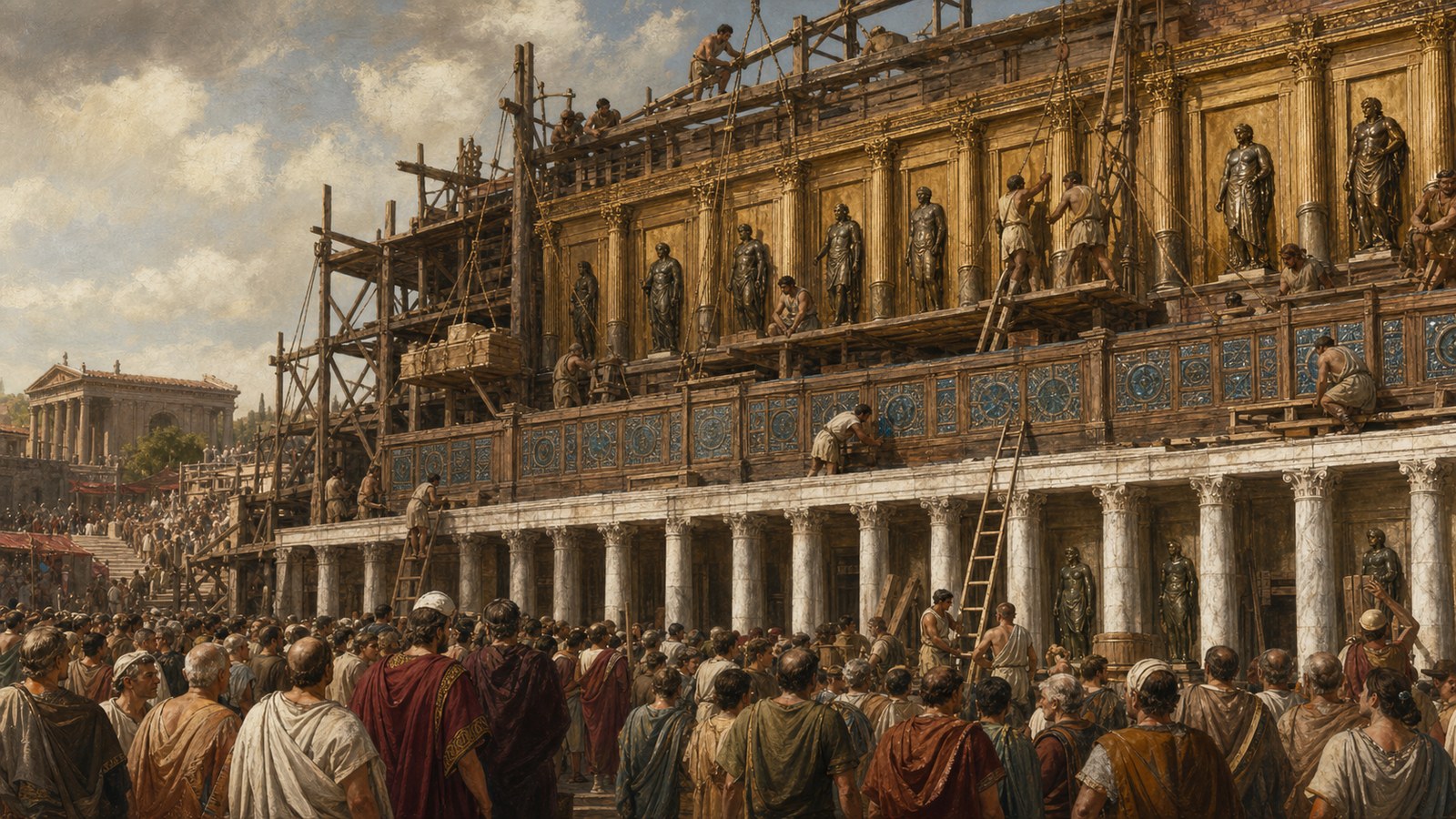
Pliny does not stop at materials. He supplies a barrage of quantities: 360 columns, the lower ones 38 feet tall, and 3,000 bronze statues between them. Their cumulative effect is deliberate. One costly object might be admired as art. Thousands became an environment.
The statues are especially revealing because he describes them by number rather than by subject. He does not tell us which gods, heroes, rulers, or decorative figures appeared. In his argument, identity gives way to multiplication. Bronze has become stage density.
That absence limits reconstruction. An image of every named figure would invent what the source withholds. What can be pictured is rhythm: repeated columns, bronze forms occupying intervals, changing surfaces across three levels, and a crowd facing an architecture too dense to take in at once.
Pliny also claims room for 80,000 spectators and contrasts it with 40,000 seats in Pompey’s later permanent theatre. Ancient crowd figures often magnify scale, and the temporary building has left no plan with which to test this one. The comparison still tells us how Pliny wanted readers to feel the theatre’s disproportion. A short-lived work by an officeholder supposedly exceeded a later landmark built for a much larger city.
The theatre therefore operated through counted excess. Columns repeated past the point where one column’s workmanship could dominate attention. Statues accumulated past the point of individual viewing. Spectators themselves became another number in the account, proof that private command had created a temporary public world.
The Stage Survived as Movable Private Luxury
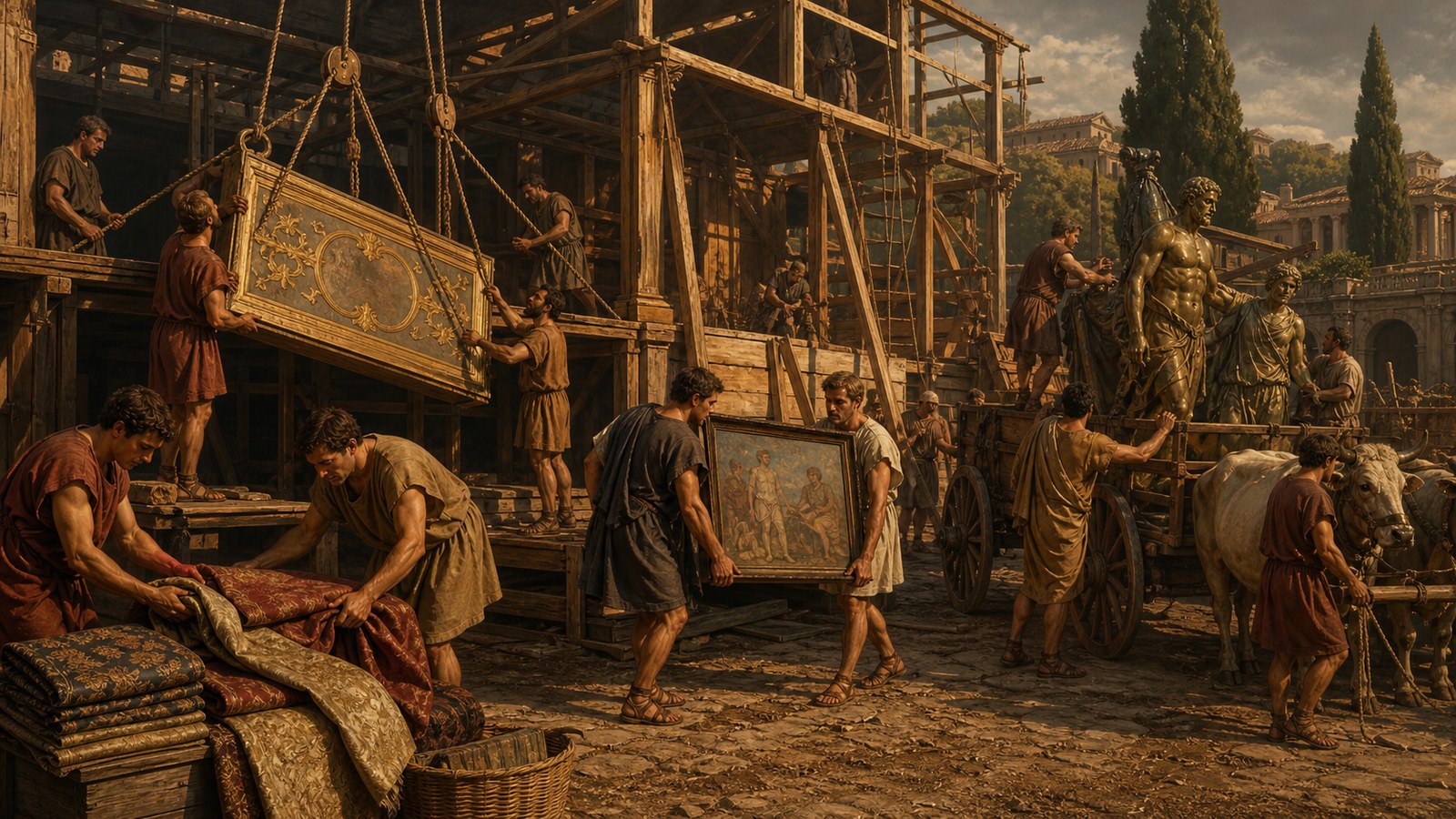
A temporary theatre did not mean every component was disposable. Pliny lists Attalic textiles, paintings, and other stage properties among the fittings. These were movable assets. Once the performances ended, they could leave the civic setting without losing their value.
He says Scaurus transferred items to his villa at Tusculum, retaining what served his daily luxury. That movement completes the political circuit. Materials entered public view under the sponsor’s name, gathered attention during the games, and then returned to private possession carrying the aura of the event.
The distinction between structure and furnishing matters. Timber framing could be dismantled; textiles could be folded; paintings could be carried; bronze sculpture could be removed and placed elsewhere. The festival assembled them into one total image, but their separate lives continued afterward.
Pliny reports that servants later burned the villa in revenge and assigns the loss a staggering value of 300 million sesterces. That total belongs to his rhetoric of excess and cannot be treated like a surviving inventory. It nevertheless closes the story with another transformation. Objects gathered from many places, displayed for days, and absorbed into domestic luxury finally disappeared in a private fire.
The theatre’s afterlife was thus not a ruin. There were no marble seating tiers slowly weathering into an archaeological landmark in Pliny’s account. Its traces were reputational, literary, and portable. Scaurus could stop paying for public access while continuing to inhabit selected pieces of the display.
Pliny Preserved the Monument by Attacking It
Pliny wanted Scaurus’s theatre to indict luxury. His indignation controls the scale, the comparisons, and the sequence of facts. He blames powerful family connections, speaks of damage to public morals, and frames the building as folly. A modern reader should not strip that purpose away.
Nor should moralizing make the account useless. The criticism preserves the logic that made the theatre memorable: office, short duration, stacked materials, repeated objects, mass spectatorship, and the return of fittings to a villa. Those features form a coherent mechanism even when individual numbers remain impossible to verify.
The building did not claim greatness through survival. It claimed greatness through concentration. Marble, glass, gilded timber, bronze, paintings, and rich cloth were made simultaneous for an audience, then released back into other uses. The expensive act was not owning each component separately. It was commanding them all at one moment.
That is also why the vanished theatre stayed in Roman writing. A durable monument asks later generations to keep looking at it. Scaurus’s theatre required witnesses to remember what was no longer there. Pliny, while condemning it, became one of those witnesses.
The few days were not a defect in the political design. They were the point. Scaurus made scarcity of time amplify abundance of material: Rome had to see the spectacle now, while the marble, glass, gilding, bronze, cloth, paintings, and crowds still occupied one temporary frame.
Sources
Pliny the Elder, Natural History, 36.24.