
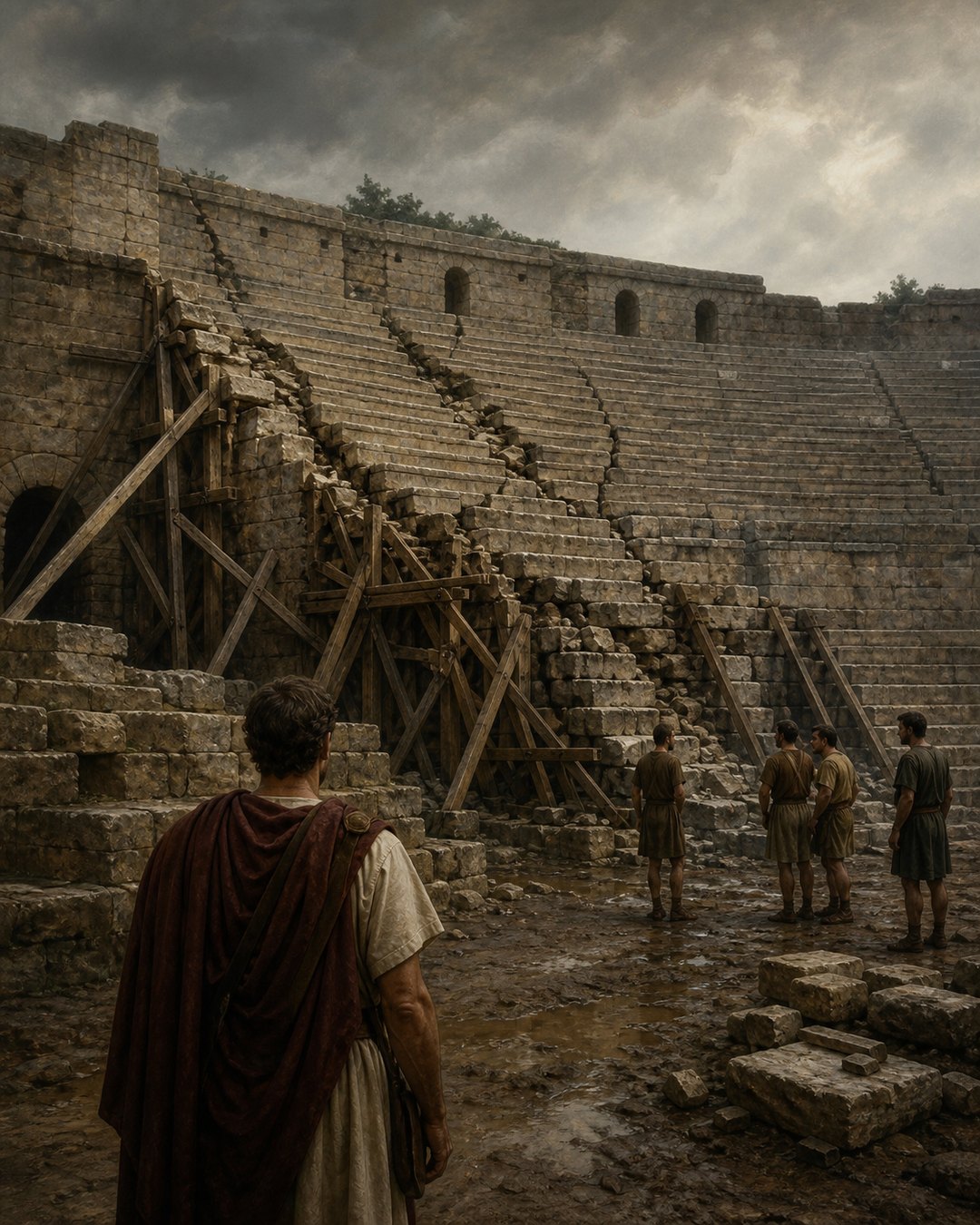
More than ten million sesterces had gone into Nicaea’s new theatre, and the accounts were not even complete. Most of the structure stood unfinished. Parts had sunk. Large cracks opened through the masonry, and timber props crowded around a monument that was supposed to display civic confidence.
Pliny the Younger could not tell Trajan whether the ground was too soft and damp or the stone too brittle. He could see the result: an expensive public building whose supports might cost more than the strength they supplied. The next decision ranged from finishing the theatre to abandoning it or pulling it down.
The failure spread beyond broken stone. Private donors had promised galleries and porticos, but their work depended on the public core being completed first. Elsewhere in the same cities, a gymnasium rose wider than the one fire had destroyed, and a vast bath was being excavated below a mountain. Pliny’s letter is an audit of the moment when prestige, prior spending, and technical uncertainty all pressed government to continue.
Ten Million Sesterces Bought an Unfinished Question
Pliny was serving in Bithynia and Pontus with a mandate to inspect troubled local administration. At Nicaea he encountered a theatre already too advanced to dismiss as a preliminary plan. The greater part had been built, yet spectators could not use the promised complex because the structure remained incomplete.
The reported cost exceeded ten million sesterces. Pliny carefully adds that the accounts had not been made out, preserving the uncertainty instead of presenting an audited total. Even the known number was therefore a warning rather than a final reckoning.
Physical evidence made delay dangerous. The building had sunk and showed what Pliny calls great gaping crevices. One possible cause lay beneath it: soft, wet ground that could not carry the mass evenly. Another lay in the material itself: stone liable to crumble and fail.
Those explanations demanded different remedies. Weak ground implicated the site and foundations. Brittle stone implicated selection and construction. Without knowing which problem dominated, adding more masonry could deepen the failure rather than complete the monument.
Nicaea’s theatre differed from Nicomedia’s two abandoned aqueduct schemes, where earlier routes and reusable blocks could be inventoried for another attempt. A cracked theatre could not be separated easily into failed and sound sections. Every promised addition would load a structure whose behavior was already in doubt.
Props Held Up Stone but Not Confidence
Temporary supports often make time for diagnosis or repair. Pliny saw props and buttresses around the theatre, but he doubted their value. They appeared more costly than strengthening. Money could keep flowing into visible emergency measures without resolving why the building had moved.
That observation turns shoring into a financial clue. A useful prop transfers load and stabilizes a threatened section. An ineffective forest of timber only announces that the project cannot trust its own masonry. Maintenance begins before construction has ended.
Pliny therefore framed three options for the emperor: finish, abandon, or demolish. Each accepted a different loss. Completion risked sending more money onto weak ground. Abandonment left an unusable ruin after enormous expense. Demolition admitted that salvaging the project might be less rational than removing it.
There was no neutral choice. Even waiting required supports and exposed unfinished stone to weather. Yet previous expense could not prove that future expense would succeed. Pliny explicitly worried that anxiety to save money already disbursed would cause the remaining funds to be spent with equally poor results.
The letter captures a problem that survives every building culture: the amount already invested exerts political force, even though it cannot repair a crack. Pliny did not use modern financial language, but he isolated the logic. Earlier spending explained urgency; it did not establish structural safety.
Private Promises Waited on the Public Core
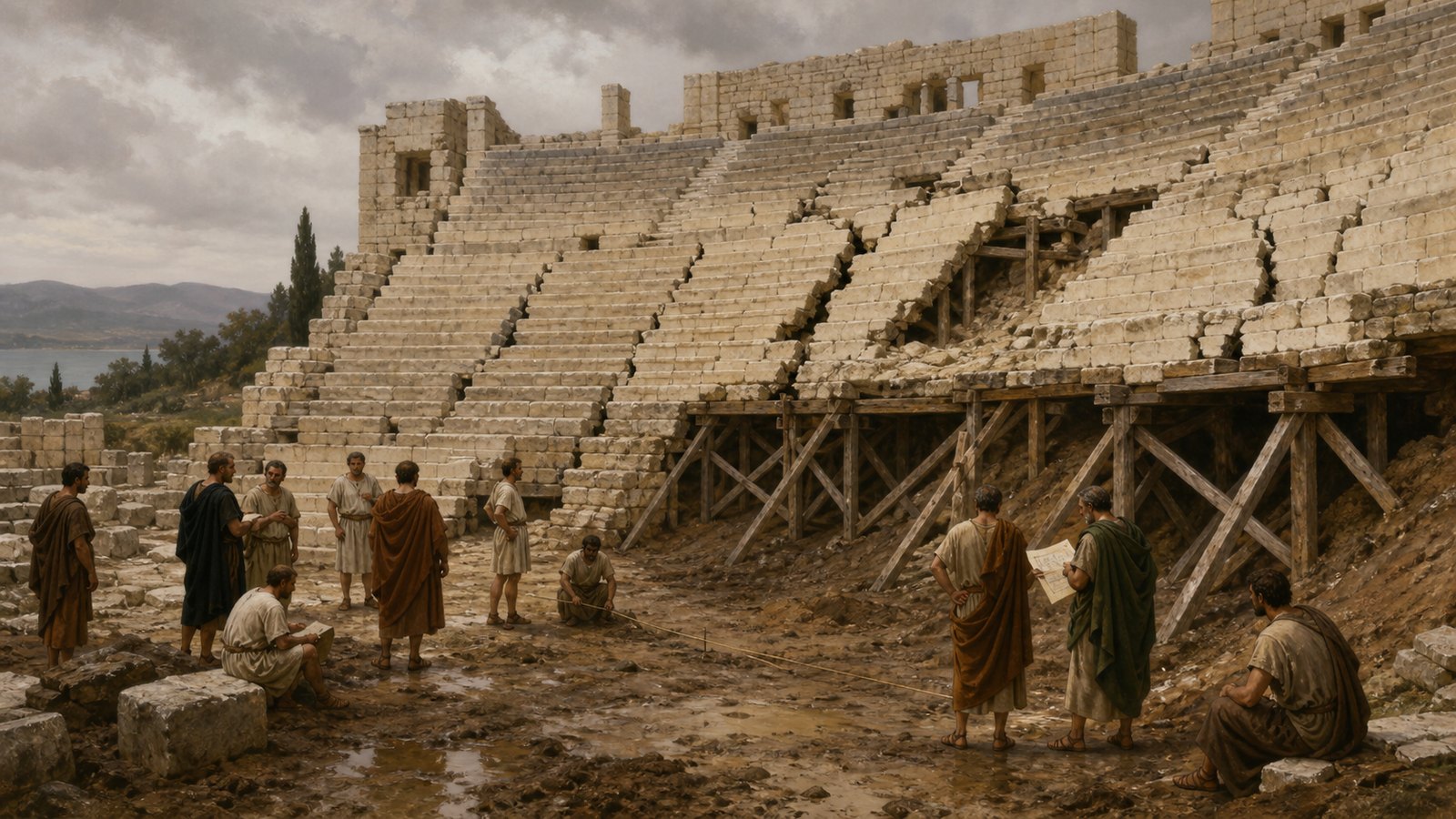
The theatre’s financing was layered. Public work had to create the essential structure. Private individuals promised visible additions, including galleries and porticos above the pit. Such benefactions could attach family prestige to a civic monument without requiring one donor to finance the whole.
Those promises could not float independently. The galleries needed support beneath them. Porticos needed a stable plan and finished load paths. When the core stopped, the privately funded perimeter stopped as well.
Trajan recognized that dependency. He told Pliny not to press donors to begin their promised sections before the theatre existed. Their pledges had been made because there would be a theatre. The administration could not reverse the sequence and use private additions to pretend the failed public foundation was complete.
This makes the cracks institutional as well as physical. A local council could authorize expenditure. Builders could raise seating and walls. Benefactors could promise the parts audiences would see. But a weakness early in the chain suspended every later commitment.
The material problem resembles the depreciation concern in Roman estimates for the annual loss of value in brick walls, but the timing was harsher. Nicaea did not face the ordinary aging of a useful building. Its monument demanded emergency judgment before opening.
A Gymnasium and Bath Repeated the Appetite for Scale
Pliny widened his report because the theatre did not look like an isolated accident. Nicaea was rebuilding a public gymnasium destroyed by fire. The replacement was planned on a more extensive scale than the old building, and considerable money had already been spent.
He found the result disjointed and poorly put together. An architect claimed that walls twenty-two feet thick still could not carry their loads because their centers lacked cement and the work had not been reinforced with brick. Thickness alone did not guarantee coherence.
The accusation came from a rival of the person who began the work. Pliny includes that fact because expertise arrived entangled with competition. A technical claim could be serious while its speaker also possessed a reason to discredit the earlier architect. The governor needed assessment, not merely a confident diagnosis.
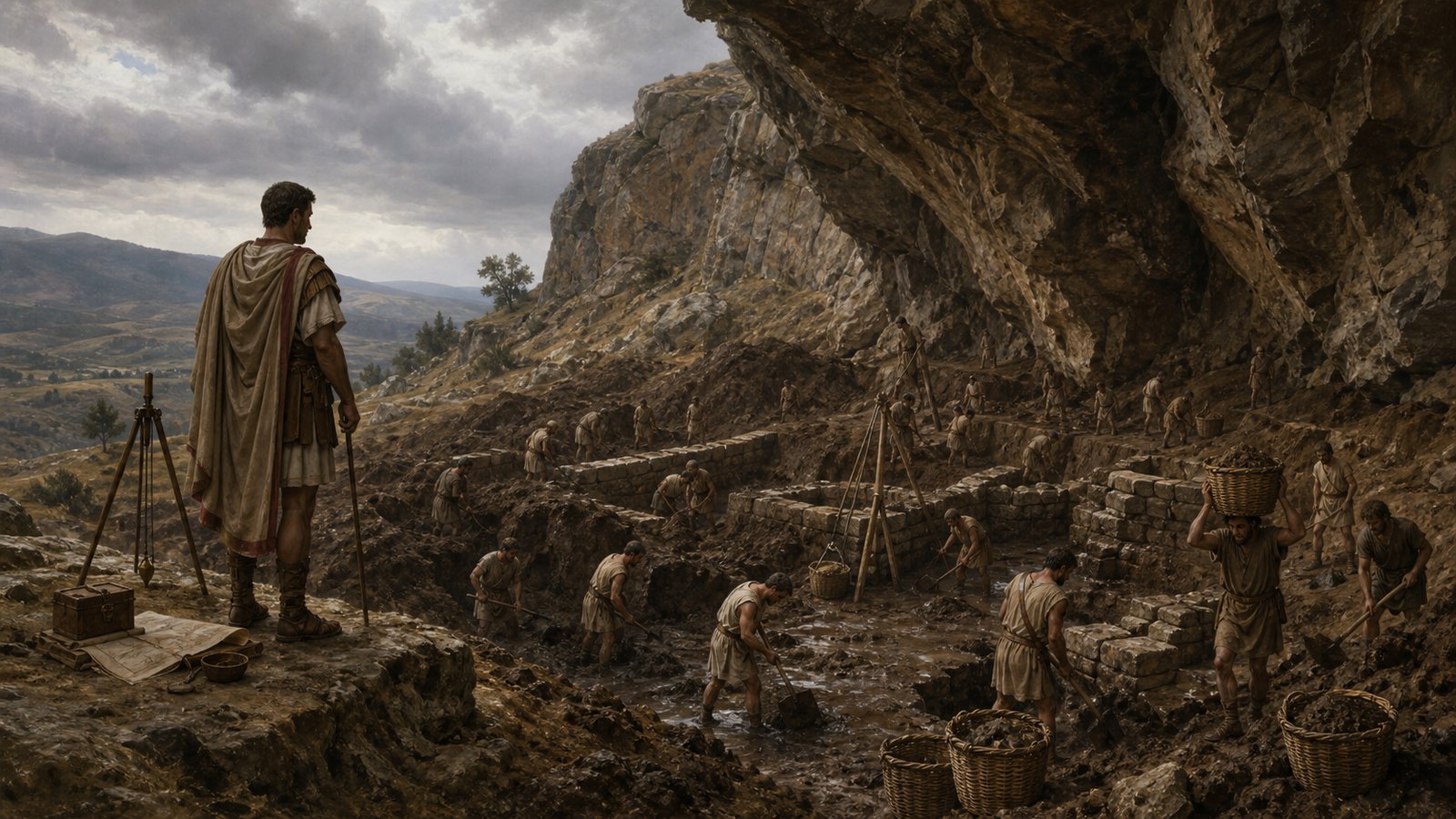
At Claudiopolis, builders were excavating an immense public bath in a low-lying place under a mountain. Pliny’s phrasing suggests that digging dominated progress. The site itself appeared to multiply the work before walls and pools could rise.
The funding carried an imperial connection. Senators added to the local council through Trajan’s favor paid entrance money that supported the bath. A badly chosen site could therefore waste both local resources and the political value of the emperor’s appointments.
Three projects reveal the same pressure in different forms. The theatre had already consumed a fortune. The gymnasium grew larger after destruction. The bath pursued immensity on difficult ground. Monumental scale had become a decision made before structural and financial discipline caught up.
Trajan Sent the Decision Back to the Province
Pliny asked Trajan to send an architect. He wanted someone to determine whether the works should be finished as begun, repaired where necessary, or moved to different sites. A specialist from the center might also have given the eventual choice an imperial shield.
Trajan declined that part of the request. He told Pliny that the governor was best placed to judge the Nicaea theatre and needed only to report the plan adopted. The gymnasium should be reduced to what the city could afford. Claudiopolis also required local advice about its unsuitable bath site.
The emperor’s answer was practical and pointed. Every province, he said, had people experienced in architecture. Sending someone from Rome would not save time when many of Rome’s own architects came from Greece. Distance from the capital did not mean absence of skill.
Responsibility therefore stayed where observation was possible. Pliny could inspect cracks, accounts, ground, stone, and rival claims. Local architects could test the works. Trajan would authorize the administrative frame without pretending that an imperial reply could diagnose masonry he had not seen.
The exchange does not preserve the final fate of every wall. It preserves something more revealing about decision. Rome’s monumental cities could bind public money, private prestige, expert rivalry, and imperial favor into one project. When the stone failed, those relationships had to be separated before construction could continue safely.
Nicaea’s ten million sesterces had purchased mass but not certainty. The next useful expenditure was not another portico or another prop. It was a defensible judgment about whether the theatre beneath them deserved to stand.
Sources
Pliny the Younger, Letters, 10.39–40.