
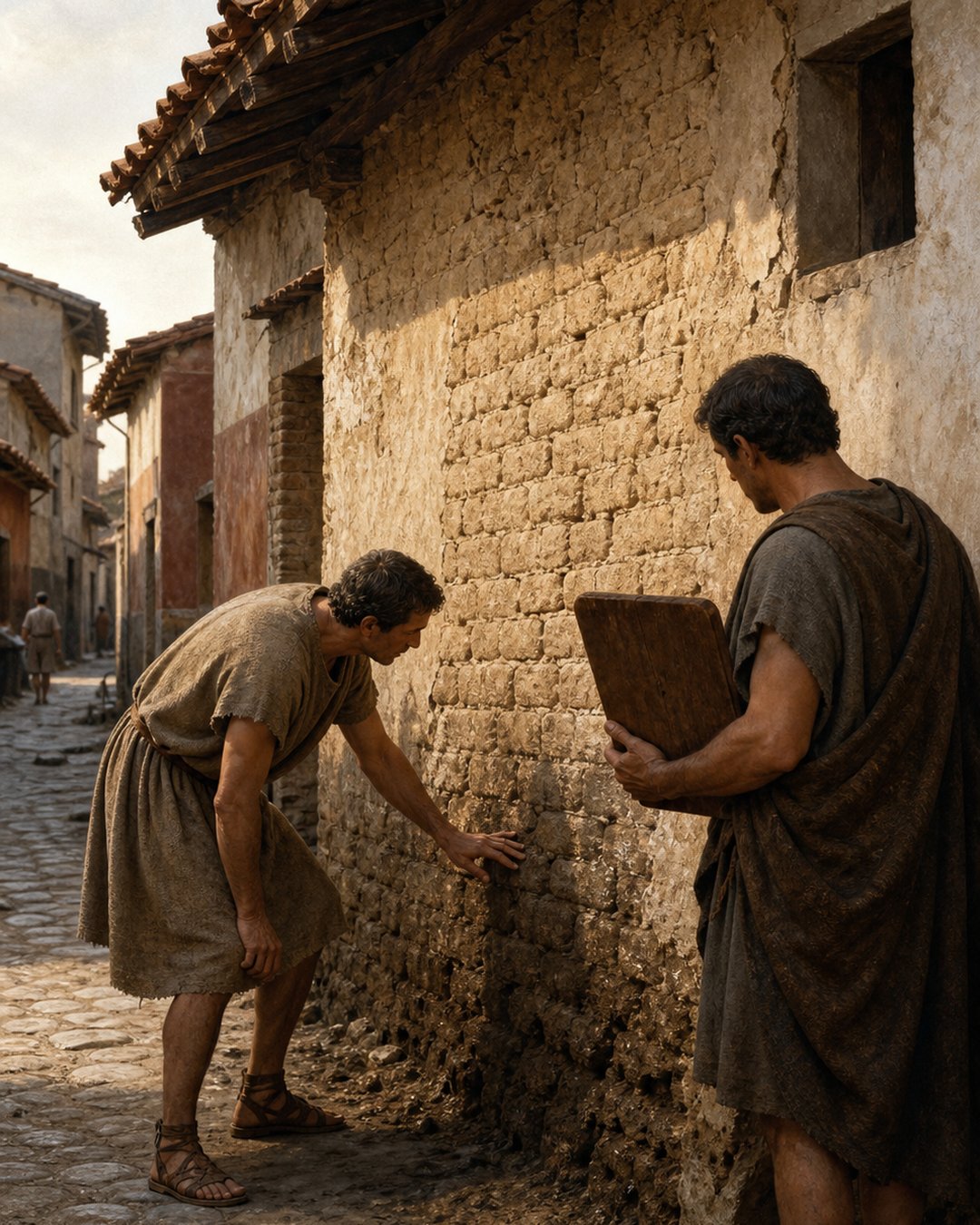
A Roman house wall could lose value even while it remained standing. Vitruvius describes assessors who examined shared walls when property was valued. For brickwork, they did not simply ask what construction had cost. They deducted one eightieth of that cost for each year the wall had existed. Once it was more than eighty years old, they left it out of the valuation.
The formula looks severe beside Vitruvius’s own praise for old brick structures. He points to walls at Arezzo and to a brick wall at Utica that had carried a roof for many years. Properly made and kept dry, sun-dried brick could endure. Yet an inspector could not see every season of damp, every weak joint, or the care taken before the bricks entered the wall.
The annual deduction converted that uncertainty into arithmetic. It also exposed an urban problem. Roman builders wanted thin walls because land inside a city was precious, but thin earthen masonry had limits. Roofs, bonding, party-wall design, and legal dimensions determined whether saved floor space became useful or dangerous.
Rain Reached the Wall Before Age Did
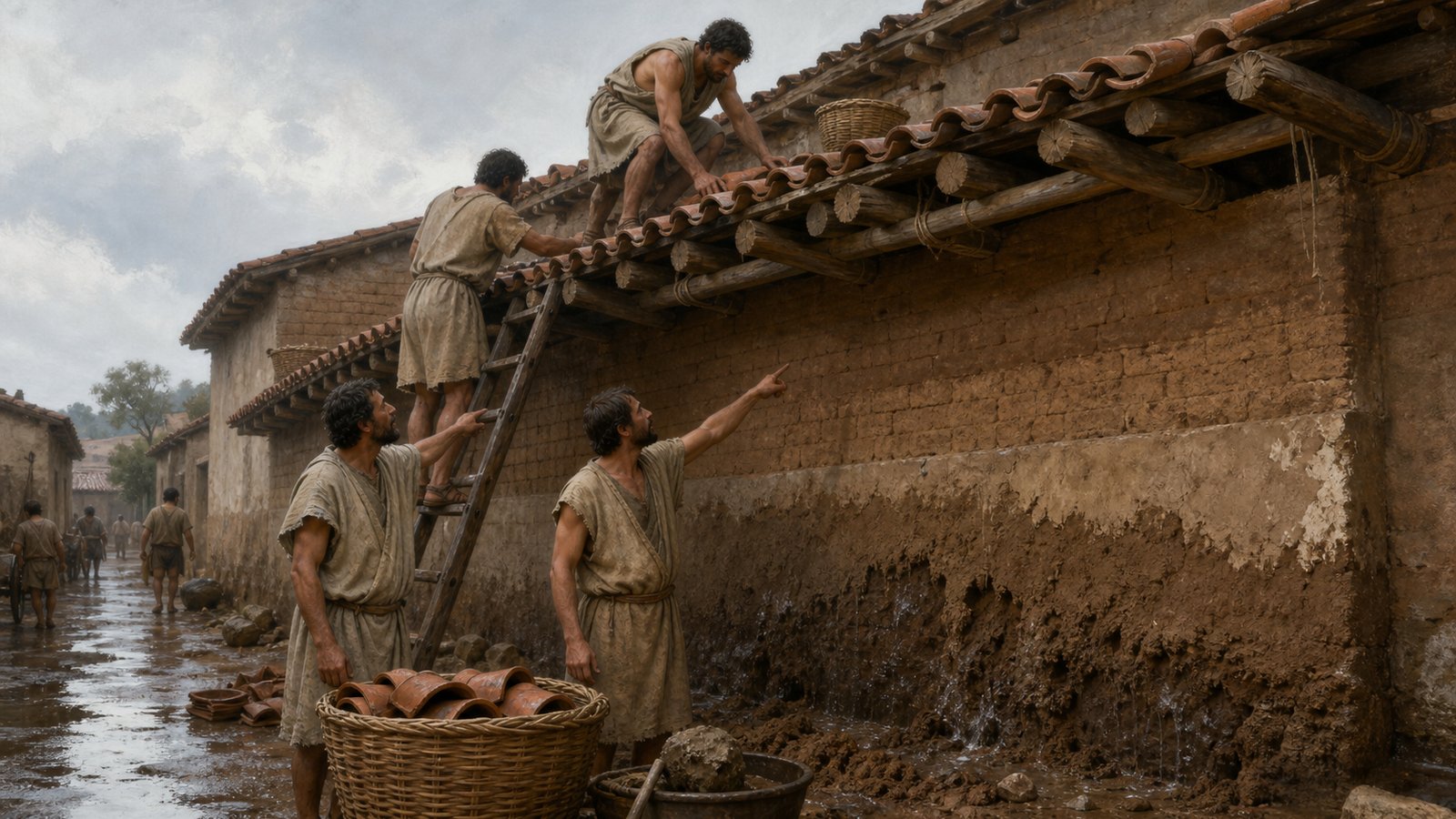
Vitruvius’s durable examples are not magic recipes. At Utica, he emphasizes the roof. Its tiles projected far enough to shelter the brickwork below. The detail makes physical sense: unfired earth survives by staying away from persistent water. A deep eave interrupts the direct path from rain to wall face and reduces the soaking that can soften edges, open joints, and carry material away.
Age alone therefore did not destroy a brick wall. Exposure mattered. A protected wall could remain useful for generations, while one with failed roof covering or poor drainage could deteriorate sooner. The difficulty for a buyer or magistrate was reconstructing that history after plaster, repairs, and occupation had hidden it.
Vitruvius praises the brickwork at Arezzo and treats the Utica wall as evidence that the material deserved more respect than Roman urban custom gave it. His argument is observational: look at what survived. But one survivor did not remove the risk attached to all the walls that had been laid with weaker bricks, poorer protection, or careless bonding.
The contrast resembles the hidden condition of Rome’s water system. Frontinus’s search for secret street pipes showed how a surface that appeared orderly could conceal unauthorized connections. Brickwork posed a quieter version of the same inspection problem. The visible face did not automatically reveal the condition inside.
Thin Masonry Bought Expensive Floor Space
Vitruvius links wall material to legal and spatial limits. He says Roman rules prevented exterior walls from exceeding one and a half feet where they bordered public space. Builders kept other walls to similar dimensions because thicker masonry consumed rooms. Every extra course taken from an interior side reduced the area available for beds, storage, stairs, workshops, or rent-producing accommodation.
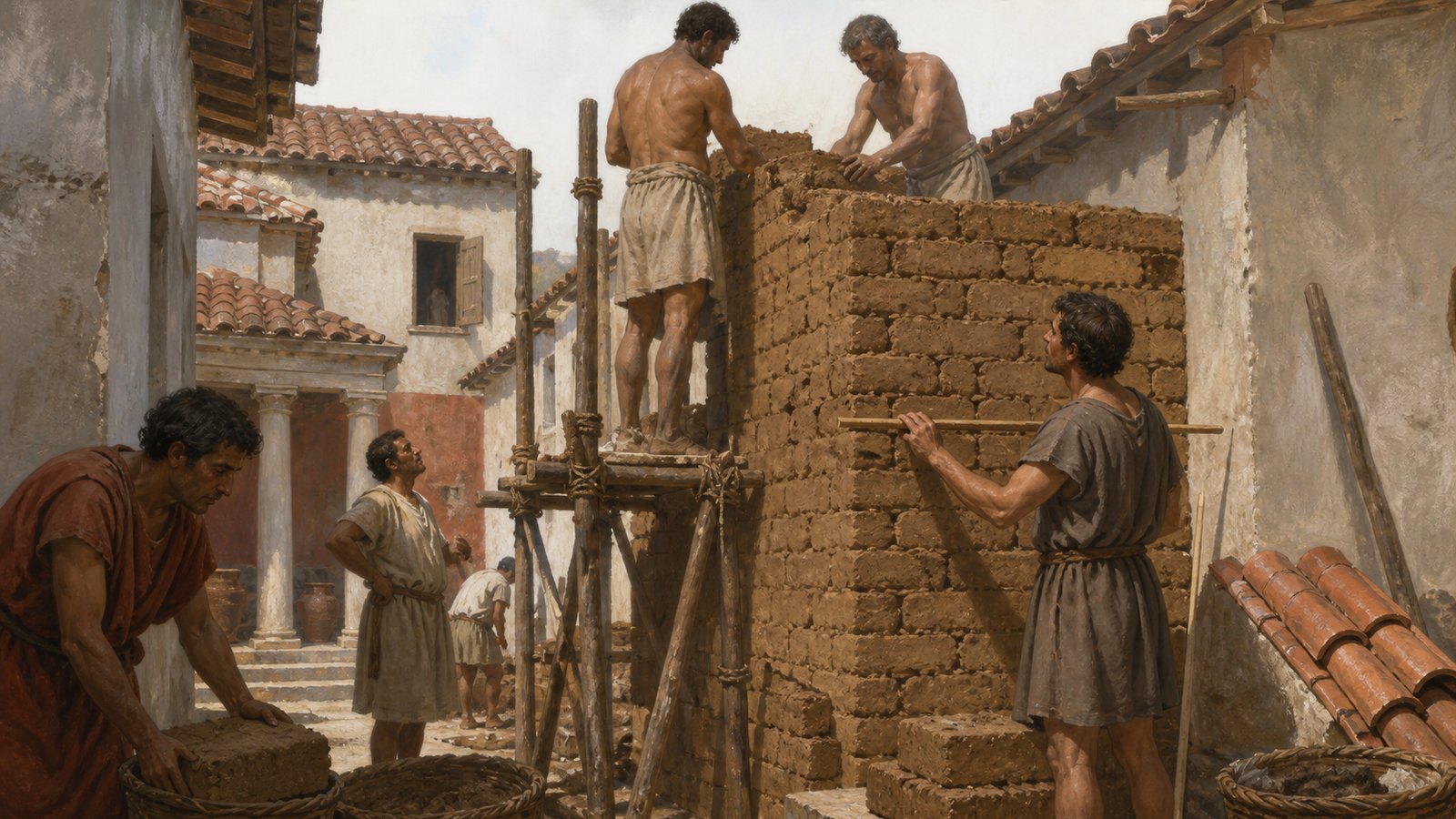
That pressure encouraged narrow solutions. Vitruvius discusses party walls made from bricks only half the ordinary width. A shared division between houses could occupy less ground, leaving more usable floor on both sides. Yet the gain came with structural demands. Bricks needed proper overlap, corners needed binding, and the wall’s thickness had to suit the weight above it.
He warns that an ordinary brick wall at the legal thickness could not simply carry storey after storey. Height multiplied load while narrow urban plots rewarded exactly that upward ambition. Special bonding and careful arrangement were not decorative refinements; they decided whether a thin wall behaved as one body or split along weak vertical lines.
Roman builders had other materials, but each compromise shifted the risk. Stone demanded quarrying, transport, skilled setting, and thicker masses in some applications. Timber and wattle saved room and weight but burned readily. Brick sat between them: locally workable and space-efficient, durable under the right roof, yet vulnerable enough to make age a financial concern.
One Eightieth Turned Wear into a Public Number
The valuation rule imposed a straight line on an irregular process. A wall did not physically lose exactly one eightieth of its strength every year. Damp could produce sudden damage; a new roof could slow it; repairs could replace the weakest sections. The deduction was an administrative model rather than a material measurement.
Its advantage was consistency. If assessors had to negotiate the unseen history of every brick wall, sellers and buyers could dispute workmanship, exposure, and repairs indefinitely. A yearly fraction gave magistrates a repeatable answer. The owner knew that declared age would reduce the amount recognized in the property calculation.
At eighty years the account reached zero, even though an actual wall might still stand. Vitruvius uses that mismatch to defend brick construction. He can point to surviving old examples and ask why the official method assumes the material has no remaining value. The rule was cautious enough to protect a purchaser, but too blunt to reward exceptional workmanship.
Roman administration repeatedly made difficult qualities governable through counts. the bronze ball used to mark each completed mile turned road progress into a repeated physical event. The brick formula did something similar to time: each year became one identical deduction, whatever weather and workmanship had actually done.
Inspection Joined Craft to Property Law
A wall belonged to several worlds at once. Masons shaped and laid its units. Roofers kept water away. Neighbours depended on a party wall without controlling everything done on the other side. Magistrates eventually assigned it a value. Failure could damage not only one owner’s room but adjoining property and public streets.
Vitruvius writes as an architect, so his complaint about valuation supports a larger defence of competent building. Sound materials and careful protection can outperform a reputation based only on category. Still, the existence of the formula shows that Roman authorities did not treat craftsmanship as a private matter once structures entered a sale or shared boundary.
The alternative could be worse. Vitruvius acknowledges that wattle walls created more room and were quick to build, then attacks their cracking and fire danger. A narrow partition might maximize rent today while transferring risk to every nearby house. Brick’s slow depreciation was at least legible compared with a light wall that could turn one flame into a neighbourhood disaster.
The one-eightieth rule should not be mistaken for a modern engineering lifespan. It did not prove that a wall became unsafe on its eightieth birthday. It priced uncertainty. Roman inspectors faced an old problem: how to value a structure when the purchaser could see the surface but not recover the choices, rainstorms, repairs, and shortcuts buried inside it.
The distinction between assessed value and physical survival is essential. A zero in the property calculation did not make the masonry disappear, and Vitruvius could cite standing old brick precisely because official accounting and observed endurance diverged. The rule instead moved the risk of an elderly wall away from the stated purchase value. A buyer might still occupy, repair, plaster, or eventually replace it, but could not treat its original construction cost as unquestioned present wealth.
Nor did the formula erase the importance of maintenance. The Utica example gives the roof an active role: projecting tiles protected what age alone had not defeated. If the covering failed, the wall faced a different future. The annual fraction could not reward each repaired tile or sound joint, yet Vitruvius’s narrative could. His complaint preserves two rival ways of knowing a building—an assessor’s calendar and a craftsperson’s reading of materials, shelter, bonding, and exposure.
Vitruvius answered as a builder by pointing to walls that survived. The magistrates answered as assessors by subtracting a fraction. Between those positions stood the house itself—occupying costly ground, carrying a roof, separating neighbours, and keeping its construction history largely out of sight.
Sources
Vitruvius, On Architecture, Book 2, chapter 8.