
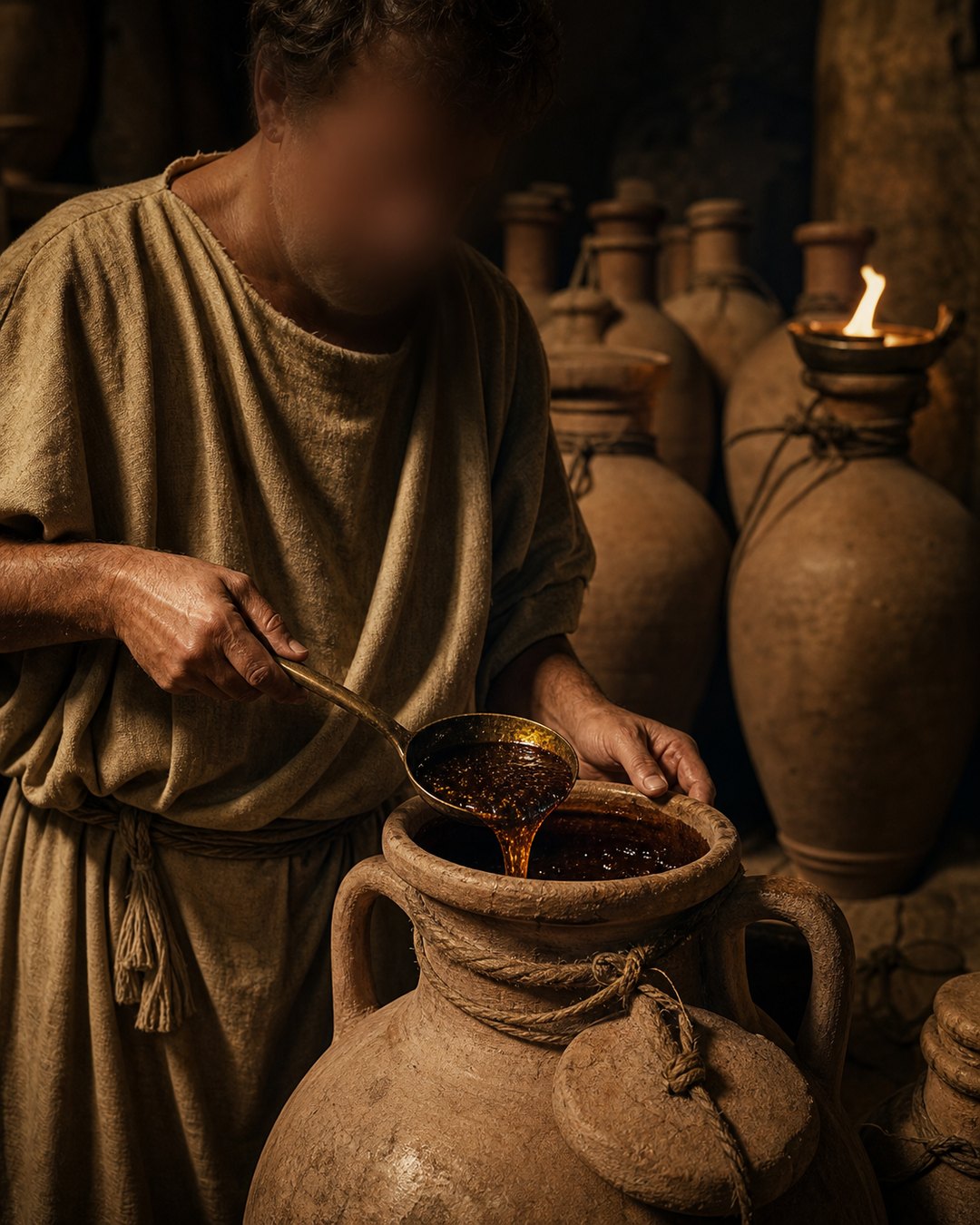
Pliny the Elder knew of wine that had outlived dynasties. It came from the consulship of Lucius Opimius, the year in which Gaius Gracchus was killed: Rome’s year 633, or 121 BCE. Nearly two centuries later, some of that vintage still survived.
It did not survive as a perfectly improved version of the young drink. Pliny says it had reached the consistency of honey and acquired a rough taste. Extremely old wine became too bitter to drink pure. It required water, and a very small quantity could be used to season other wines.
The Opimian vintage therefore crossed a curious boundary. It began as agricultural abundance under clear skies and strong sun. In the cellar it became concentration, scarcity, proof of age, and a unit in financial arithmetic. Pliny even imagined the original amphora price accumulating at six percent interest. What remained in the vessel was partly liquid and partly reputation.
The Year 121 BCE Entered the Jar
Pliny anchors the vintage to politics. Lucius Opimius held the consulship, and Gaius Gracchus died amid civic violence. The association let later drinkers name the wine through a year already charged with public memory. “Opimian” did more than identify a vineyard. It dated the contents against Rome’s political calendar.
The natural explanation was weather. Pliny describes remarkable serenity and grapes fully ripened by the sun’s heat. Ancient farmers watched the same variables any grower would recognize: rain, warmth, ripening time, and the condition of fruit at harvest. One exceptional season could affect many producers at once and give a whole year a reputation.
Vintage naming joins memory to material variation. A seal or label can claim a date, but the wine also changes because that year’s grapes differed. The strongest reputations arise when later drinkers believe the liquid confirms the story told about the season.
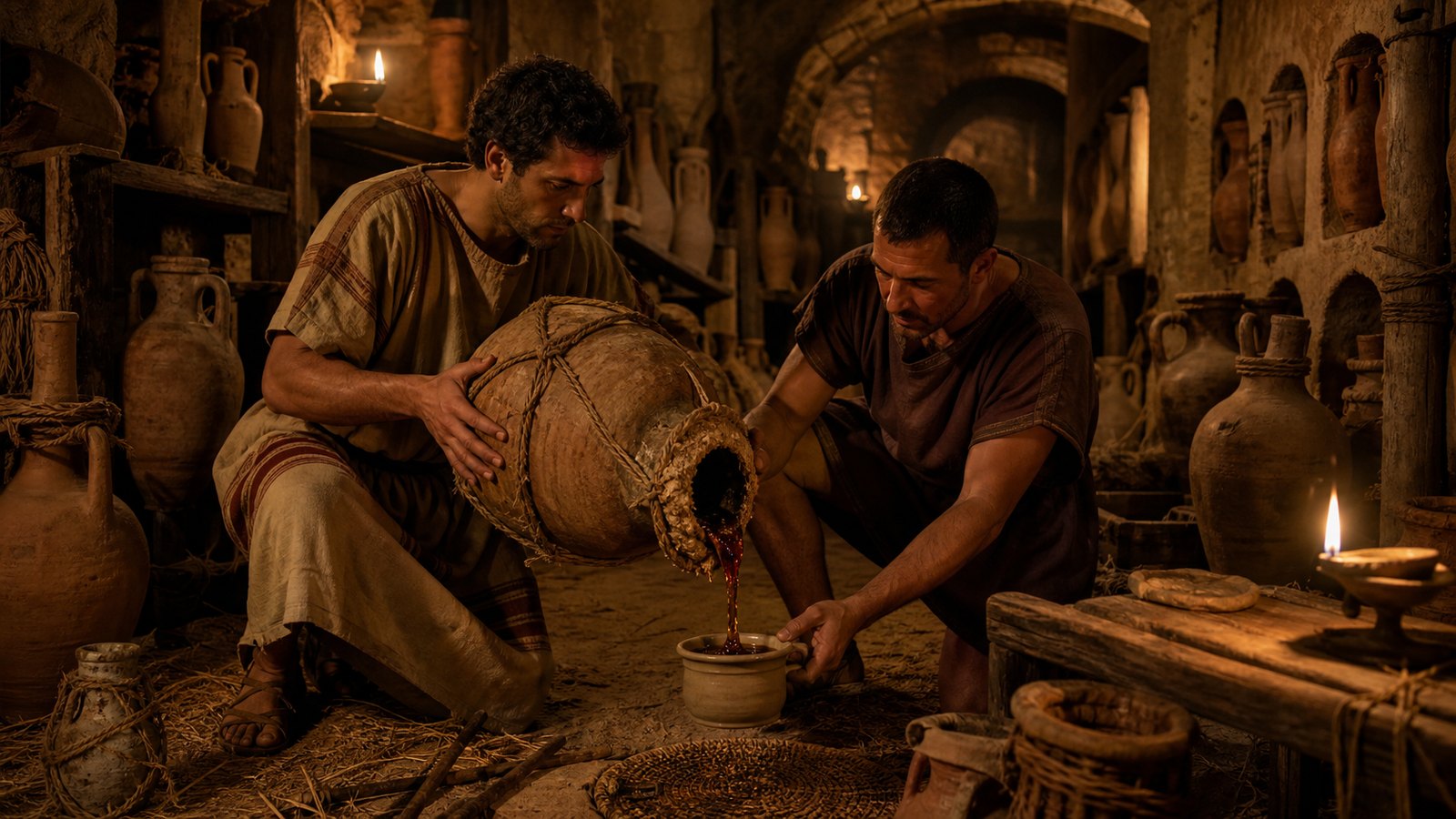
Roman wine usually entered a long chain before the table. Grapes were pressed, juice fermented, vessels were sealed, and amphorae or larger containers passed through storage and transport. Roman dolia made bulk wine into stored wealth by holding large quantities through that process. Opimian wine represents the opposite end of the scale: quantity had vanished, while named age made the remnants more conspicuous.
Age Changed the Drink into an Ingredient
Modern language about “fine old wine” can obscure Pliny’s description. The Opimian residue had not remained fresh for two hundred years. It had thickened like honey and become rough. The oldest wine, he says, could not be consumed unmixed because bitterness made it intolerable.
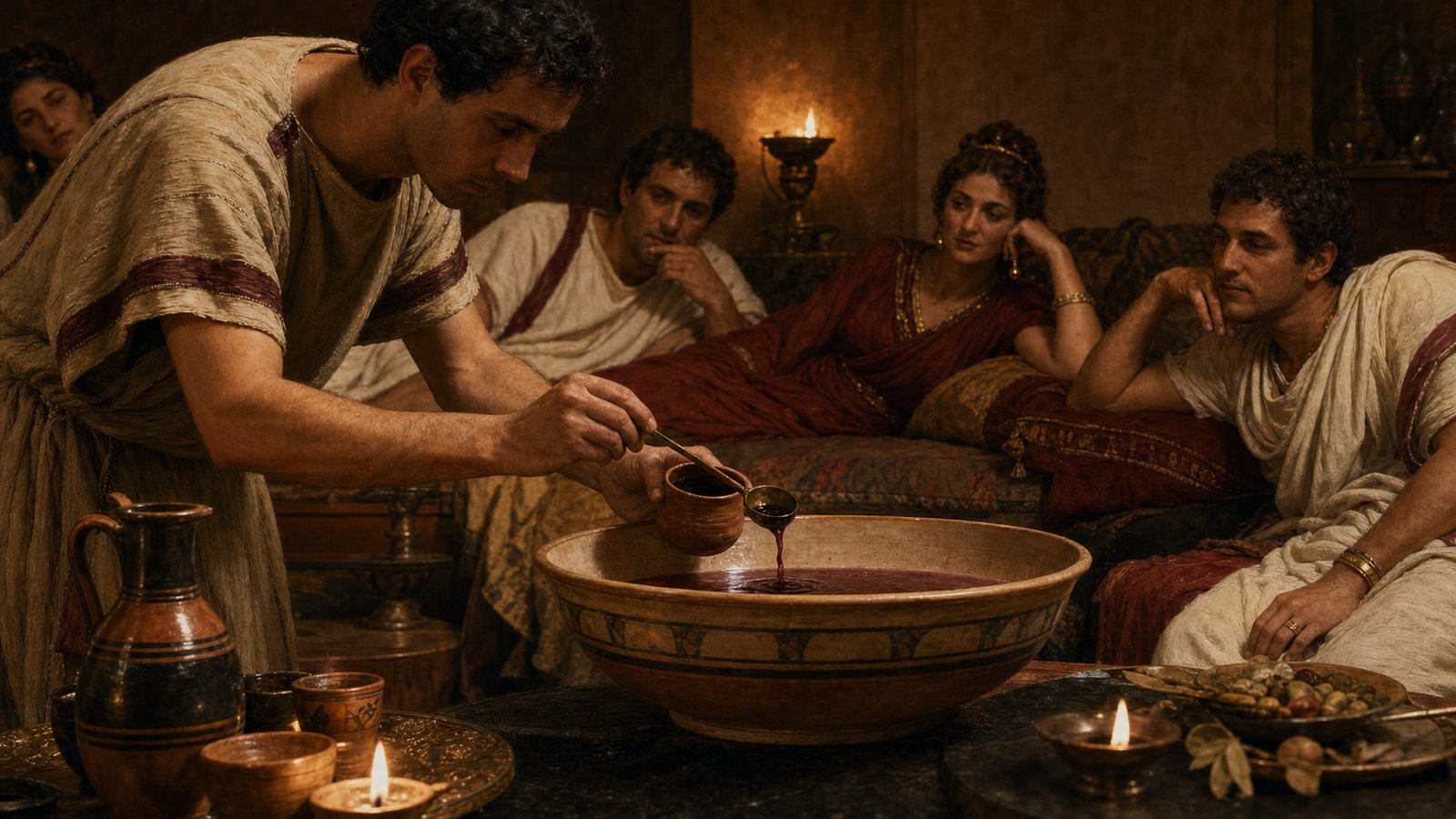
Water offered one solution, but the more revealing use was dosage. A tiny amount of Opimian wine could season other wines. The ancient vintage no longer needed to fill a cup. Its intensity and reputation could be distributed through a larger mixture.
This changed the economics of each surviving amphora. If a steward needed only a small measure for a mixing bowl, the vessel could appear at many occasions without being quickly exhausted. Scarcity became manageable through ritualized restraint. The host demonstrated access not by pouring freely, but by measuring something too old and concentrated to use like ordinary wine.
The honey comparison describes consistency, not sweetness. Pliny pairs it with roughness and bitterness. A thick stream under lamplight might look rich while tasting severe. Guests needed an explanation of why such a substance mattered, and the famous year supplied it.
Roman mixing practices already allowed hosts to control strength, temperature, aroma, and quantity. The Opimian dose added time itself to the bowl. It turned a current wine into the carrier for a fragment whose authority rested on survival.
Six Percent Turned Cellaring into Arithmetic
Pliny then stops tasting and starts calculating. He asks readers to suppose that an amphora originally cost one hundred sesterces. Add legal and moderate interest at six percent each year, he says, and the price of even one twelfth of the vessel by the beginning of Caligula’s reign becomes an extraordinary question.
This is not a surviving merchant account for a particular jar. Pliny labels the original figure as an estimate and constructs the calculation. Its purpose is to expose opportunity cost. Money tied up in wine for 160 years could be imagined as money that might otherwise have earned interest.
Compounding makes time expensive even when no physical work occurs at the jar. The cellar demands space, supervision, sound containers, protection from theft, and confidence that future drinkers will care about the name. Every year of survival increases rarity while also increasing the gap between the original purchase and the capital it represents.
Pliny’s phrase about capital buried in cellars captures the tension. Storage preserves an asset, but it also immobilizes value. A sealed amphora cannot fund another purchase unless it is sold or pledged. Its owner waits for reputation to outrun leakage, spoilage, broken seals, and changing taste.
The calculation belongs beside Rome’s other attempts to make value visible through measures and records. the bronze law from Irni fixed procedures in durable text; Pliny fixes an imagined cellar investment in rate, years, and fractions of a jar. Different objects become governable when time is translated into a count.
A Banquet Consumed History by the Spoonful
Pliny connects the old wine with Pomponius Secundus, a poet who gave a banquet for Caligula. The reference supplies a social setting for the calculation. This was not only a collector privately inspecting residue. An imperial guest made the act of opening, measuring, or mentioning the wine politically visible.
A host serving Opimian wine could claim several forms of distinction at once. He possessed something scarce, understood its proper treatment, could date it to a famous consulship, and was willing to consume at least part of an asset that had survived generations. The smaller the dose, the more explanation and ceremony might gather around it.
The liquid’s condition made expert handling part of the display. Pouring it neat would not prove sophistication if the result was intolerably bitter. Dilution or seasoning demonstrated that the steward knew how an ancient wine behaved. Knowledge protected the host from turning rarity into an unpleasant mistake.
There is irony in the scale. The political violence attached to 121 BCE had affected the republic. At the later banquet, that year returned as a trace in a cup for an emperor and elite guests. Public chronology became private consumption, while the cellar owner captured the prestige of having kept the connection intact.
Reputation Outlived the Beverage’s Ordinary Curve
Pliny offers a general rule after the extraordinary example. Wine, he says, could increase markedly in value up to about twenty years and then decline rapidly unless some unusual quality had raised its reputation. Opimian wine survived outside that ordinary curve because it had become more than a beverage judged only by immediate pleasure.
Its name fused weather, date, political memory, rarity, and the testimony of previous drinkers. Physical deterioration did not erase that package. In a paradox, the honey-like bitterness could strengthen authenticity: the strange condition made extreme age perceptible.
Still, survival required belief. A jar needed a trustworthy chain of custody, recognizable sealing, and owners willing to preserve it. Pliny does not give us a modern provenance file, so we cannot verify every surviving vessel. His confidence tells us that elite Roman culture accepted some amphorae as carriers of a named second-century-BCE vintage.
The Opimian story is therefore not evidence that Romans had discovered limitless wine improvement. It records a change of category. Ordinary wine was expected to be drinkable. Two-hundred-year wine could be valuable because it was barely drinkable, used in tiny quantities, and surrounded by arithmetic and narrative.
A harvest became a vintage, the vintage became a relic, and the relic became seasoning. The cellar did not stop time. It concentrated what owners and guests wanted time to mean.
Sources
Pliny the Elder, Natural History, Book 14, chapter 6.