
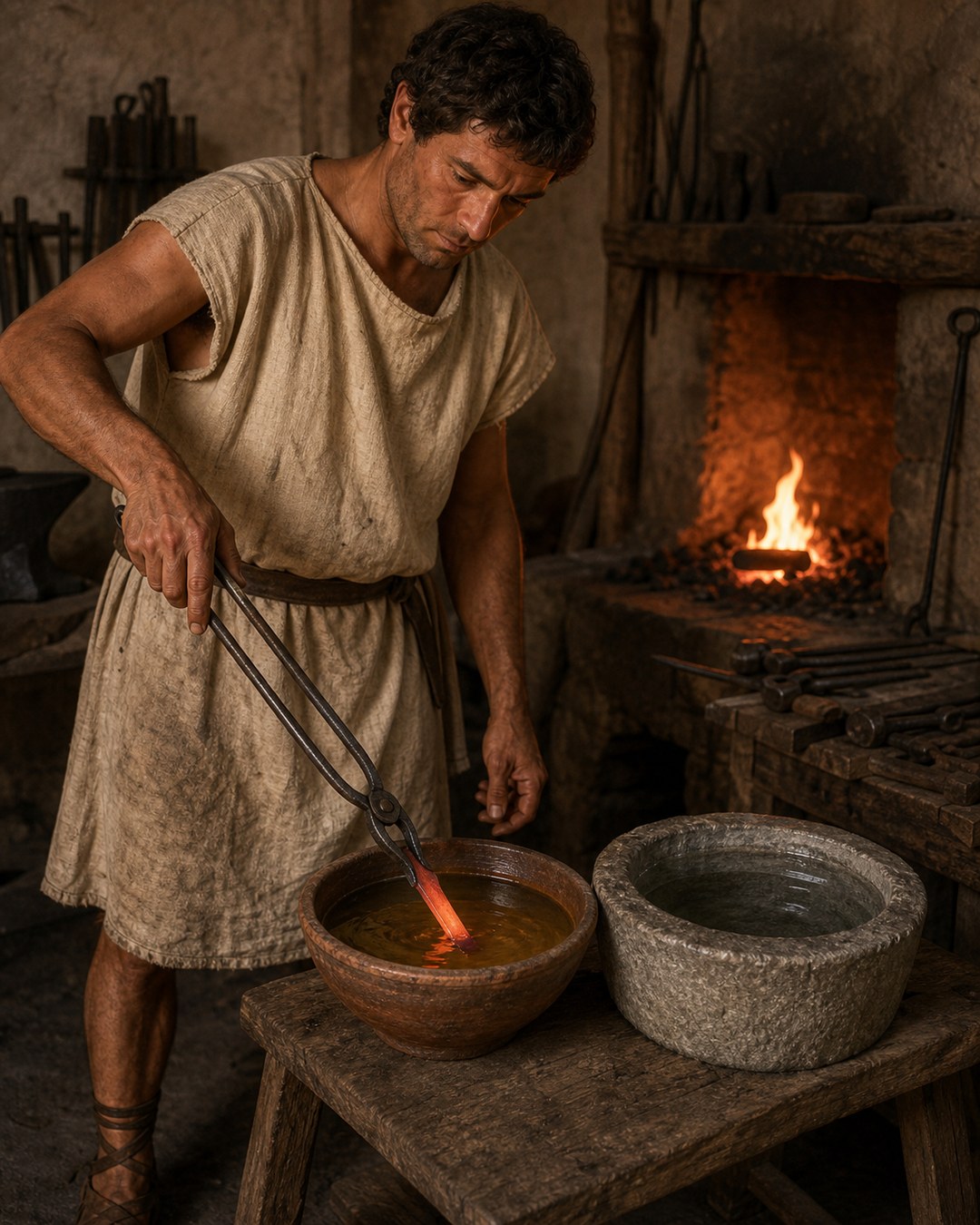
The small iron object left the fire glowing, held at a distance by tongs. A basin of water could cool it fast and leave it hard. That was not always the finish a smith wanted. Pliny the Elder says workers quenched smaller iron articles in oil because hardening them in water might make them brittle.
One sentence preserves a consequential workshop decision. The question was not simply whether an edge became hard, but whether the finished object could survive use. A tiny tool, fastening, or blade could gain hardness and lose toughness in the same plunge. Oil offered a different route through that risk.
Pliny places the choice inside a wider survey of iron. Ore varied by soil and climate. Smelting produced different working material. Hard and soft metal could be welded together. Some waters gave towns reputations for excellent iron, while oil and water on a whetstone produced different edges. Quality emerged step by step, and each step had to suit the object being made.
The Ore Did Not Decide the Finished Tool by Itself
Pliny begins with abundance and variation. Iron ore, he says, existed almost everywhere. On Ilva, the island better known today as Elba, its presence could be recognized through the iron-coloured earth. Wide distribution did not mean uniform performance. Soil and climate produced different kinds.
One earth yielded metal so soft that Pliny compared it to lead. Another produced brittle, coppery iron. The second kind, he warns, should not be used for wheels or nails; the softer iron served those purposes better. Another variety became useful when cut into short lengths for hobnails. Still another was especially liable to rust.
This catalogue is not a modern classification of alloys. Pliny organizes material by appearance, origin, handling and use. Even so, it records an essential craft habit: iron had to be judged against a task. A wheel fitting met repeated shock. A nail had to bend or hold without snapping. A hobnail needed a form that could be repeated in small pieces. The useful property changed with the job.
Smelting added another division. Some results were suitable for hardening into steel; other material could become thick anvils or hammer heads. The same broad name, iron, therefore covered multiple workshop futures. Ore selection opened the sequence, but firing, consolidation and later treatment determined where the material could go.
The forge supplied the heat that made those decisions possible. Roman bellows drove air toward the hottest coals and made the fire answer the craftworker’s rhythm. Pliny’s quenching passage begins at the other end of that cycle, when heated iron had to leave the fire without losing the qualities the object required.
Three Towns Built Iron Reputations Without Iron Mines
For Pliny, the main difference in tempering came from the water into which red-hot metal was plunged from time to time. He believed the water of some places was better than others. Bilbilis and Turiasso in Spain, and Comum in Italy, became celebrated for excellent iron even though, he says, they had no iron mines.
The claim relocates value from extraction to finishing. A town did not need ore beneath its streets to become associated with superior ironwork. Material could arrive from elsewhere and acquire distinction through local treatment. In Pliny’s explanation, water belonged to the reputation of the product as surely as ore did.
He offers another contrast between Noricum and Sulmo. A rich vein could yield unusually fine material, as at Noricum; elsewhere, as at Sulmo, value came from the mode of working and the nature of the water. Origin and technique stood beside one another rather than collapsing into a single hierarchy.
Modern metallurgy would not accept every ancient causal explanation without testing composition, temperature and procedure. Pliny provides no measurements for the water, no time in the quench, and no temperature scale for the metal. His account should not be expanded into a recipe it does not contain. What it securely shows is that craftspeople and consumers distinguished iron by processing place as well as mining place.
That distinction also suggests knowledge that travelled imperfectly. Ore could be shipped. A town’s water could not. A worker might copy a sequence of heating and plunging yet still believe the result depended on a local resource. The reputation of Bilbilis, Turiasso or Comum joined landscape to technique and made a finishing stage part of geographic identity.
A Fast Quench Could Exchange Toughness for Brittleness
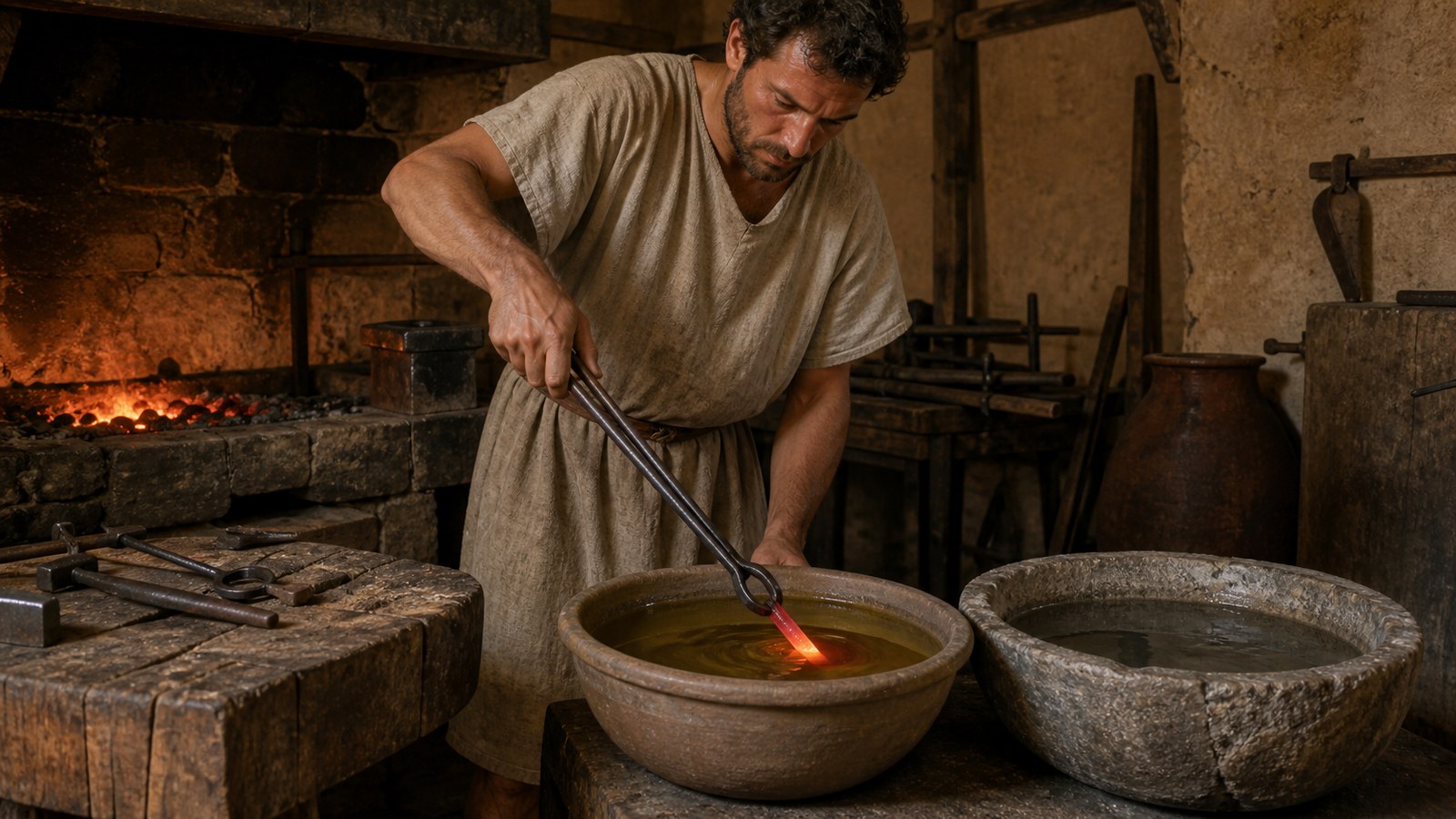
The small-object rule sharpens Pliny’s broader point. Water was important precisely because it hardened iron. Yet hardness could go too far for a slight object. Plunged into water, the piece might emerge capable of taking an edge but vulnerable to breaking. Workers used oil to avoid that outcome.
Pliny does not name the small articles in this final sentence, and the omission matters. It would be tempting to fill the basin with a specific surgical instrument, needle, chisel or knife. The source supports none of those identifications here. The safe reconstruction is a scale problem: smaller ironwork received oil when water-hardening threatened brittleness.
The difference would become visible only after labor had accumulated in the object. Ore had been smelted, iron worked, a form established and the piece reheated. A bad final plunge could waste those earlier stages. Quenching was brief in time but late in the chain, giving a few seconds unusual economic weight.
The craftworker therefore watched two transformations at once. The hot object needed enough change to hold its intended form and working surface. It also needed to remain intact under later pressure. Maximum hardness was not the same as maximum usefulness. The medium in the vessel moderated the compromise.
This is a different mechanical story from the spring and paired edges that made Roman shears operate as one tool. Shears explain how shaped metal moved in use. Pliny’s oil quench explains a prior decision that helped small ironwork reach use without becoming dangerously brittle during finishing.
Oil Appeared Again Where the Edge Met the Stone
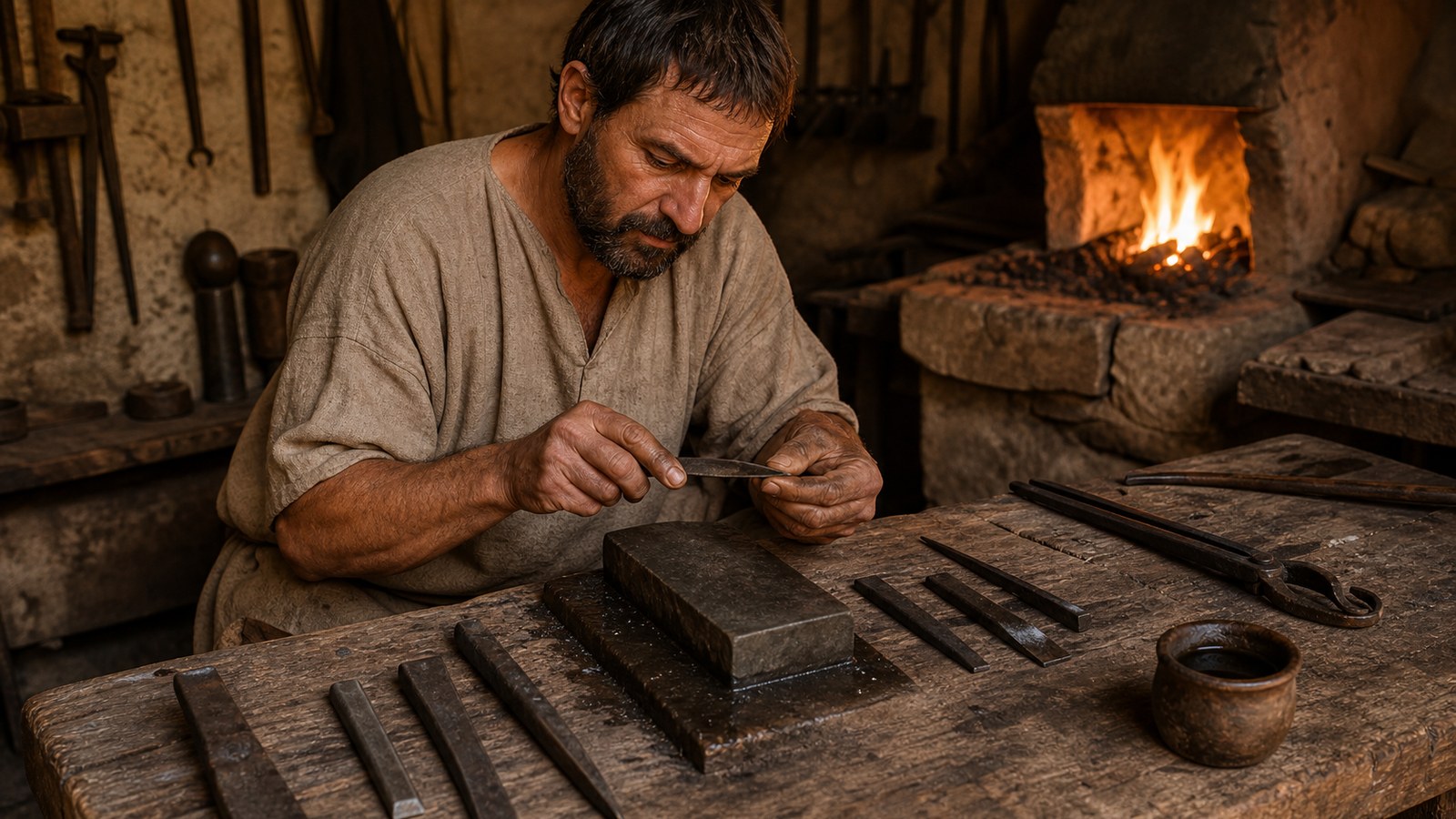
Pliny also distinguishes oil-whetstones from water-whetstones. Oil, he says, produced a much finer edge. Quenching and sharpening were separate operations, but both paired a liquid with iron at a decisive surface. One managed the condition of the heated object; the other managed abrasion as an edge was formed or renewed.
The repetition of oil should not be turned into one universal formula. Pliny does not say that every piece quenched in oil was then sharpened on an oil-whetstone, nor does he specify the stone, angle or stroke. He records two comparisons: small iron objects could be quenched in oil to avoid water-induced brittleness, and oil on a whetstone could make a finer edge than water.
Those comparisons reveal finishing as its own field of judgment. A tool was not complete when it possessed the right silhouette. The working edge had to be brought to an appropriate fineness and then maintained. A coarse, durable edge and a very fine edge answered different demands, just as a thick hammer head and a small article demanded different material behavior.
Workshop knowledge lived in these choices of degree. The smith or sharpener needed to know when a surface was hot enough to leave the fire, which vessel suited the object, and how far an edge should be refined. Pliny’s prose is compact because the repeated gestures belonged to craftspeople, not because the decisions were simple.
The oil itself would have been physically obvious: slower movement in the vessel than water, a darker film on the object, heat carried into the liquid, and a surface requiring cleaning before the next operation. These are cautious sensory consequences of placing hot iron into oil, not evidence for a particular Roman shop layout. The text names the materials and purpose; it does not provide a floor plan.
Roman Iron Quality Was a Chain of Matched Decisions
Pliny ranks iron from the Seres first and Parthian iron second. He also says other products joined hard metal to softer alloy by welding. Those statements show that Roman readers could imagine quality coming from distant origin, exceptional ore and composite construction. Yet his local examples prevent prestige from being reduced to import alone.
An iron object moved through decisions that could amplify or spoil one another. The ore had tendencies. Smelting created workable material. Welding could combine hard and soft sections. Heat prepared the shape for its final condition. Water or oil altered how that condition was reached. A whetstone established the edge that met wood, leather, food, fibre or another material.
No single stage deserved all the credit. Fine ore could be mishandled. Ordinary material could gain value through skilled working. Water famous for tempering could still be the wrong medium for a small piece if brittleness followed. An extremely fine edge could be inappropriate where impact mattered more than delicacy.
This chained view also explains why workshop failures resist simple diagnosis. If a small tool broke, the cause might lie in the original material, the weld, the object’s proportions, the heating cycle, the cooling medium or later use. Pliny cannot isolate those variables with modern testing, but he does not treat iron as inert substance merely hammered into shape. Process remains inside the finished result.
The basin beside the forge was therefore more than a place to cool metal. Choosing between water and oil was a judgment about the object’s future. The best finish was not the hardest one a smith could force from iron. It was the one that left an edge useful, a body resilient enough, and all the earlier work still unbroken.
Sources
Pliny the Elder, Natural History, 34.41.