
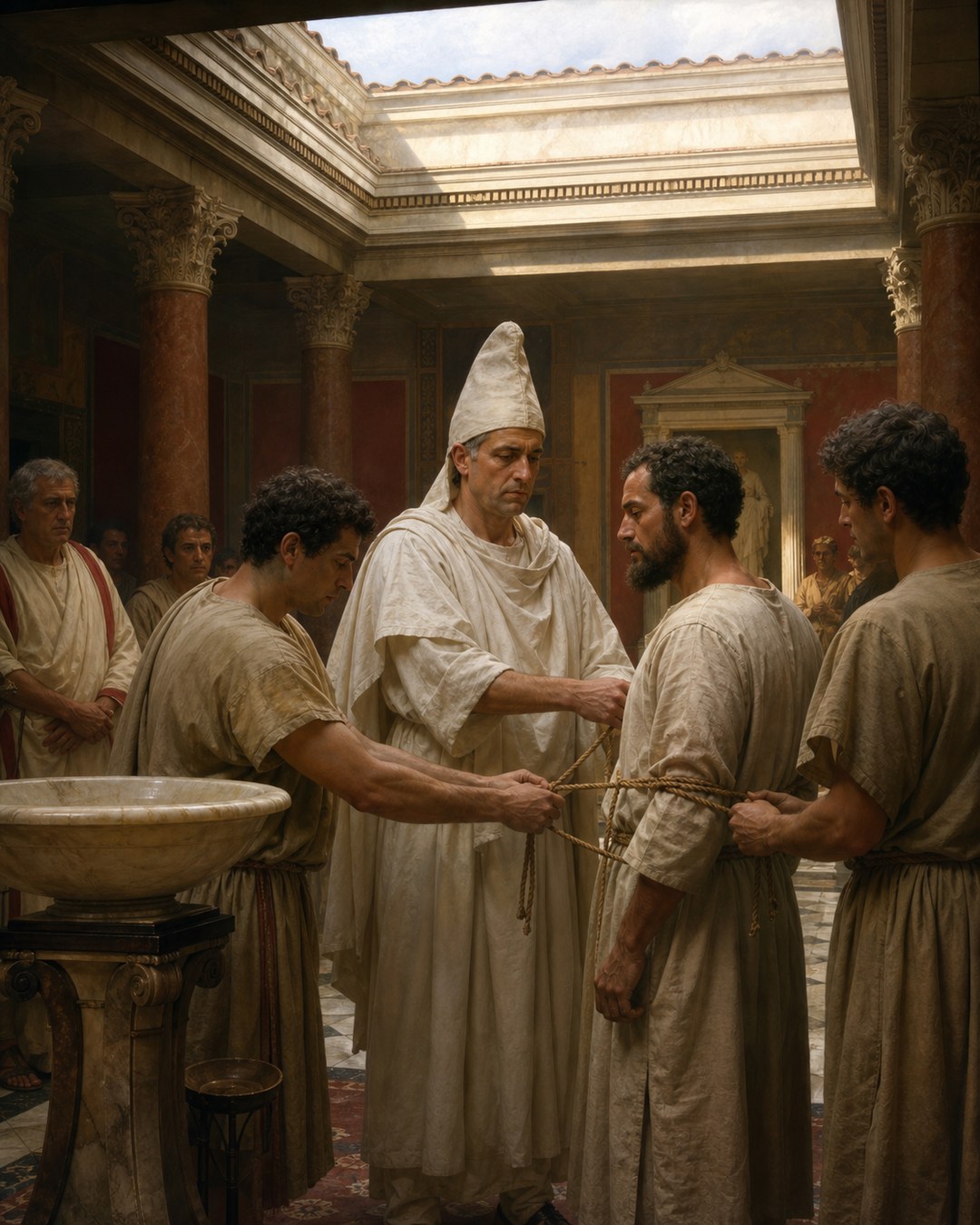
No knot could remain on the clothing of Jupiter’s priest. Not in his head-dress, not in his girdle, not anywhere else on what he wore. The prohibition followed him through ordinary movement because it was built into the things resting against his body.
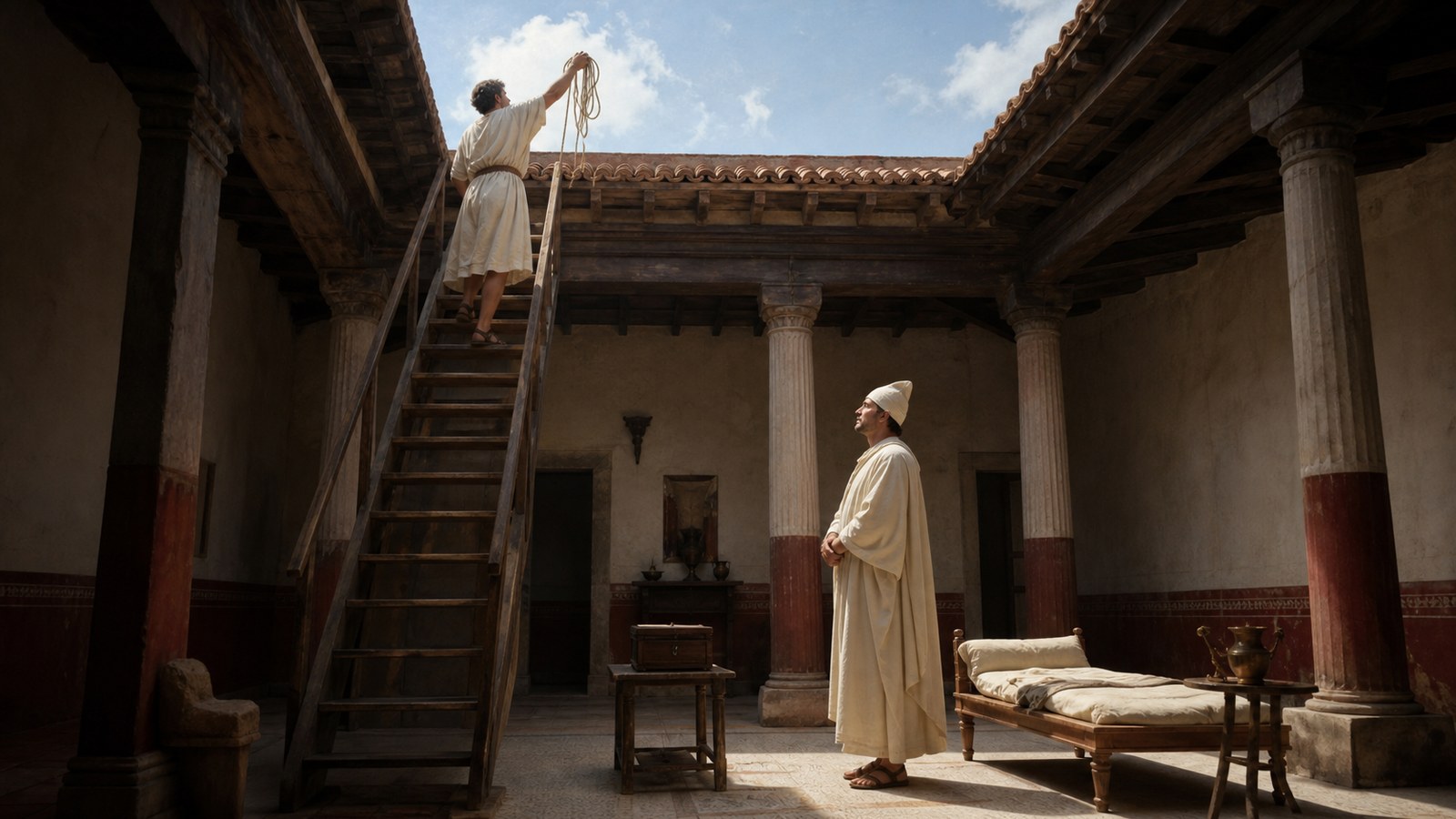
Aulus Gellius records an even stranger consequence. If a person in fetters entered the house of the flamen Dialis, the person had to be released. The empty bonds could not simply remain by the door. They were drawn upward through the atrium’s roof opening and lowered outside into the street.
The paired rules turned binding into a spatial problem. Knots stayed off the priest; fetters could not remain closed inside his house; the bonds left by a route that avoided carrying them back through the doorway. Yet the man at the centre of this ritual freedom lived under extraordinary restraint. Horse, army, oath, ring, bed, marriage, death and daily clothing all carried conditions.
Jupiter’s Priest Wore the Rule on His Body
Gellius introduces the flamen Dialis through abundance. Ceremonies in great number and many abstentions surrounded him. The author says he was recalling material found in books about public priests and in Fabius Pictor. His chapter is a gathered catalogue, not a diary of one priest’s day.
The knot rule is unusually intimate. Public office often announces itself through visible objects: a chair, staff, escort, border on a garment or place in a procession. Here distinction also depended on an absence. The head-dress and girdle could be present, but no tied fastening could close upon itself.
Gellius does not explain every prohibition’s origin, and a responsible reading should not invent a single secret code that solves them all. The no-knot requirement can be described securely as part of the office’s ritual condition. It kept a common physical form of binding away from the priest’s dress.
That condition had to be remade each morning. Clothing was handled, checked and arranged. An unnoticed tie would not be a remote theological abstraction but an error in dressing. The household around the priest therefore shared responsibility for maintaining an office that appeared through exact details.
Roman sacred service could make a practical container equally exact. A pointed vessel prevented the Vestals’ sacred water from simply being set down like an ordinary household jar. The flamen’s clothing worked through a related discipline: an everyday object remained recognizable while one ordinary feature was deliberately denied.
Fetters Entered the Atrium and Left Through the Roof
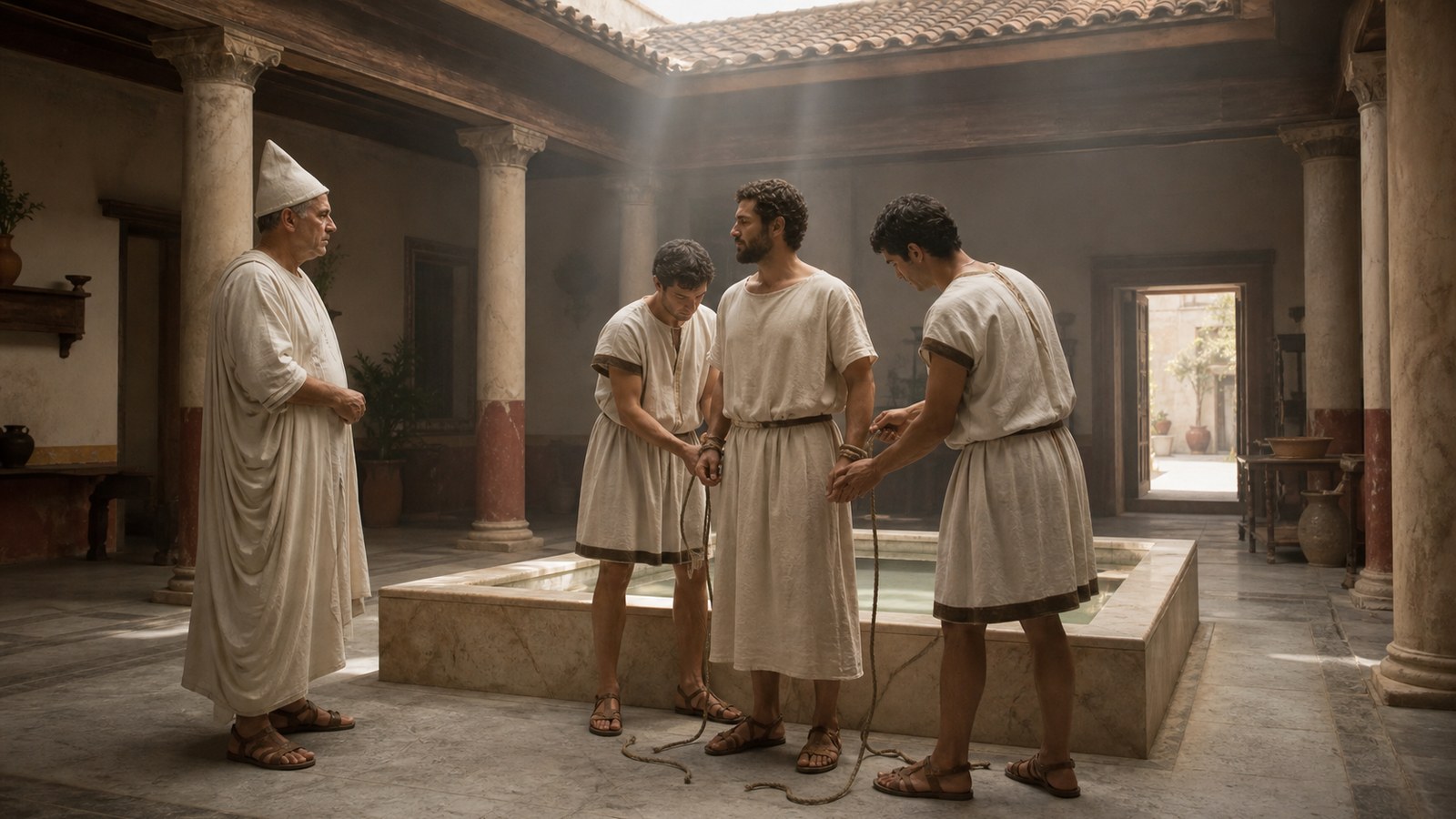
The visitor in bonds transformed the house at once. Gellius says the fettered person must be loosed. The rule did not wait for a court hearing or ask why the bonds had been imposed. Entry into the flamen’s domestic-sacred space triggered release.
Then came the choreography of removal. The bonds were drawn through the impluvium to the roof and from there let down into the street. In the Roman atrium, the impluvium was the basin beneath the opening that admitted light and rain. Gellius’s wording uses that vertical route to take the offending bonds out.
The doorway that admitted the bound visitor was not used to return the fetters. Instead, the restraints rose through the centre of the house, crossed the roofline and descended outside. That sequence made their exclusion visible to attendants and anyone positioned in the atrium. Release was not complete while the bonds remained indoors.
The rule did not abolish imprisonment in Rome. It created a sharply bounded exception around one priest and one house. Once outside, the text tells us nothing about whether the person was rebound, arrested again or allowed to leave. The surviving claim is narrower and more revealing: closed fetters and the flamen’s interior space were ritually incompatible.
A second interruption applied to punishment. If someone being taken for flogging fell at the priest’s feet as a suppliant, Gellius says the person could not be flogged that day. Again the protection was limited in time and circumstance. Contact with the priest’s presence suspended an action without rewriting Roman punishment as a whole.
The Office Restricted Movement, Speech and Rank
Freedom from knots did not make the flamen free to move as he pleased. He could not ride a horse. He could not look upon an army arrayed outside the pomerium, Rome’s sacred boundary. Gellius links the latter condition with the rarity of a flamen Dialis becoming consul, because consuls were entrusted with war.
The restriction joined religion to political career. A man occupying one of Rome’s highest priestly roles could not easily perform the military command expected from its highest annual magistracy. The incompatibility was practical before it was symbolic: an army outside the boundary created a sight his office forbade.
Speech was constrained too. The flamen could not take an oath. Gellius later quotes a praetor’s edict promising not to compel either Jupiter’s priest or a Vestal Virgin to swear within his jurisdiction. A sacred status therefore changed what a magistrate would demand in a legal setting.
Even a ring required an opening and no gem. Like the absent knot, the permitted ring avoided complete closure or a conventional mounted stone. Gellius lists the rules rather than spelling out a theory that unites them. Their cumulative effect is clearer than any speculative origin: ordinary dress and civic action had to be altered around the priest.
These limits made rank paradoxical. At table, only the rex sacrificulus could take a place above him. High precedence did not translate into wider personal choice. The office elevated the priest by surrounding him with exceptions that narrowed his ordinary conduct.
His House, Bed and Marriage Became Parts of the Priesthood
The ritual perimeter extended past clothing and public appearances. The couch on which the flamen slept had its feet coated with a thin layer of clay. He could not sleep away from that bed for three nights in succession, and no one else could sleep in it. A box of sacrificial cakes stood at its foot.
Sleep therefore did not suspend the office. The bed was assigned, marked and provisioned. Travel could not become indefinite because the third consecutive night imposed a return. Gellius’s statement that every day was holy for the flamen Dialis makes sense beside this arrangement: sacred time did not arrive only with a festival.
Hair and nails were managed after leaving his body. Only a free man could cut the hair, and the cuttings from hair and nails had to be buried beneath a fruitful tree. These small remnants could not be swept out with workshop dust or household refuse. The rule followed the priest’s physical material into the earth.
Marriage entered the structure just as deeply. If the flamen lost his wife, he abdicated. Their marriage could be dissolved only by death. The priestess of Jupiter observed related and additional ceremonies of her own. The office was not attached to an isolated male holder; it depended upon a marital pair whose continuity sustained the position.
Roman marriage could also be constructed through tightly witnessed ritual. Confarreatio joined a spelt cake and ten witnesses to one elite form of union. For Jupiter’s priest, marriage went further: the wife’s death ended his capacity to remain in office.
Release from Knots Required a Life of Other Bonds
Gellius’s catalogue is tempting material for a list of bizarre Roman taboos. Read as a system, it shows something more demanding. The priest represented continuity with Jupiter not only while sacrificing but while dressing, travelling, entering court, sleeping, cutting hair, remaining married and encountering death.
Some prohibitions separated him from military violence and burial. Others shaped household space and bodily care. The knot and fetter rules placed release at the centre of dress and entry. They did not make the office easy or liberating. They made one kind of binding unacceptable while fastening the office-holder to recurring obligations.
The chapter also preserves change. Gellius says the pontiffs had only recently decided that the priest might go without his cap indoors, and that other ceremonies had been relaxed. Ritual discipline was inherited, remembered, interpreted and sometimes remitted. Continuity required authorities to decide what still counted.
That adjustment warns against imagining every rule as timeless from Rome’s foundation. Gellius wrote from a later world and cited earlier authorities. His list is evidence for Roman memory and learned discussion as well as practice. The names of sources, the praetor’s edict and the note about recent relaxation show rules moving through texts and institutions.
The image that endures is vertical: a person enters tied, attendants loosen the bonds, and the rope rises toward the square of sky above the atrium before descending into the street. Below it stands a priest whose own garments contain no knot. The bonds leave the house, but obligation remains everywhere.
Sources
Aulus Gellius, Attic Nights, 10.15.