
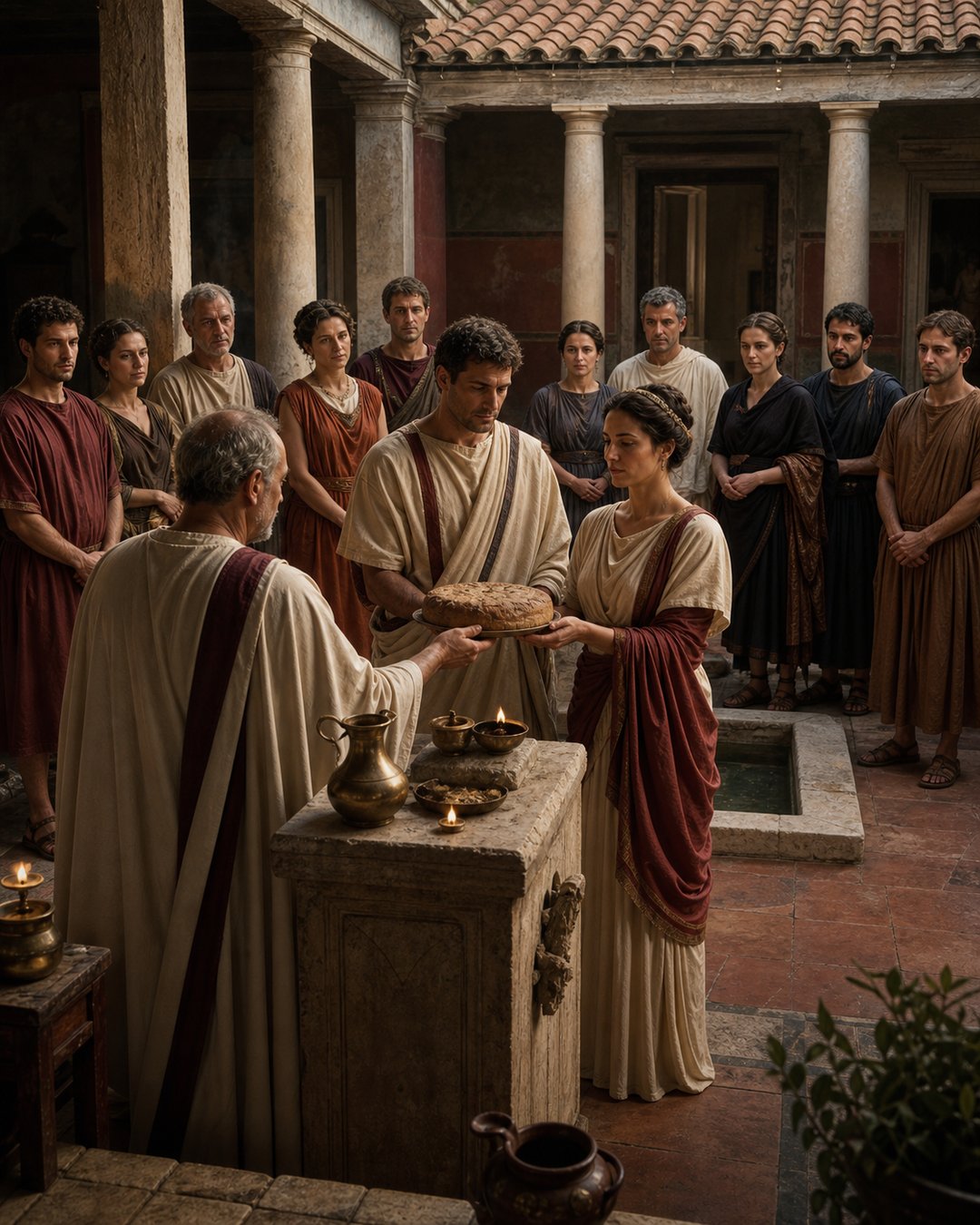
Ten witnesses stood around a small cake of spelt. A sacrifice was offered to Jupiter Farreus. Traditional words were spoken, although the jurist Gaius does not preserve them for us. Nothing in his compressed description sounds like a private exchange of affection. The surviving outline is spare, formal and crowded: food, god, formula and witnesses all had work to do.
This ceremony was confarreatio, the most religiously charged of the old Roman routes into marriage under manus. The cake supplied its memorable name, but the grain was not the whole story. The rite altered a woman’s legal position and helped determine whether future children could enter several of Rome’s highest priesthoods. Centuries later, that connection became a practical problem. Families increasingly avoided the ancient form, while the state still expected its priests to descend from it.
The cake belonged to a legal change
Gaius begins his explanation by separating two Roman powers that modern summaries often blur. Potestas, he says, could extend over males as well as females. Manus related exclusively to women. He then lists three older ways by which a woman might enter that marital power: usus, confarreatio and coemptio. They reached a related legal result through very different machinery.
Under usus, a full year of uninterrupted cohabitation could bring a wife into her husband’s family with the legal standing of a daughter. Gaius connects this result to a kind of acquisition through continued possession. He also preserves the famous escape built into the Twelve Tables: a wife who wished to interrupt the process could stay away from her husband’s roof for three nights in the year. By Gaius’s own time, he says, that rule had been partly abolished or lost through disuse.
Confarreatio did not wait for a year to pass. It staged the change as a sacrifice to Jupiter Farreus. Gaius identifies a cake of spelt and says the ceremony took its name from it. He also mentions additional traditional acts, a fixed form of words and the presence of ten witnesses. The food therefore cannot be peeled away from the legal and religious performance. It sat at the visible centre of a rite whose force depended on much more than eating.
That distinction matters when imagining the scene. Gaius gives no flowers, music or sentimental speech. He gives a god, a grain cake, prescribed action, inherited language and ten observers. Like the public ceremony that could make an enslaved Roman free, confarreatio made a change in status legible through controlled acts before other people.
Why ten witnesses had to see it
The witnesses were not decorative guests in the jurist’s account. Their required presence placed the union beyond the couple’s private memory. Ten adults could see that the sacrifice, object and formula had been brought together. The ceremony created a social record in bodies and recollection even when no surviving document describes a certificate.
We should resist filling Gaius’s silence with a complete modern wedding timetable. He does not tell us where every witness stood, who cut the cake or whether the couple ate it in the manner of a later custom. What he does establish is precise enough: a spelt cake was used in a sacrifice to Jupiter Farreus; traditional words and further acts accompanied it; and ten witnesses were present. Those are the load-bearing details.
The number also distinguishes confarreatio from Gaius’s description of coemptio. In the next section he describes that route through the language and procedure of an imaginary sale, performed before at least five adult male Roman citizens and a holder of the scales. The comparison is revealing without making the rites interchangeable. Roman household law could become real through different public scripts, each with its own personnel, objects and words.
For the people in the atrium, the sensory markers would have been difficult to miss. Coarse grain was shaped into a cake. A sacrifice focused attention on Jupiter. A traditional verbal formula distinguished this act from ordinary conversation. Ten witnesses turned the room into an audience with a legal memory. The material was humble; the consequence was not.
A marriage could decide a priest’s eligibility
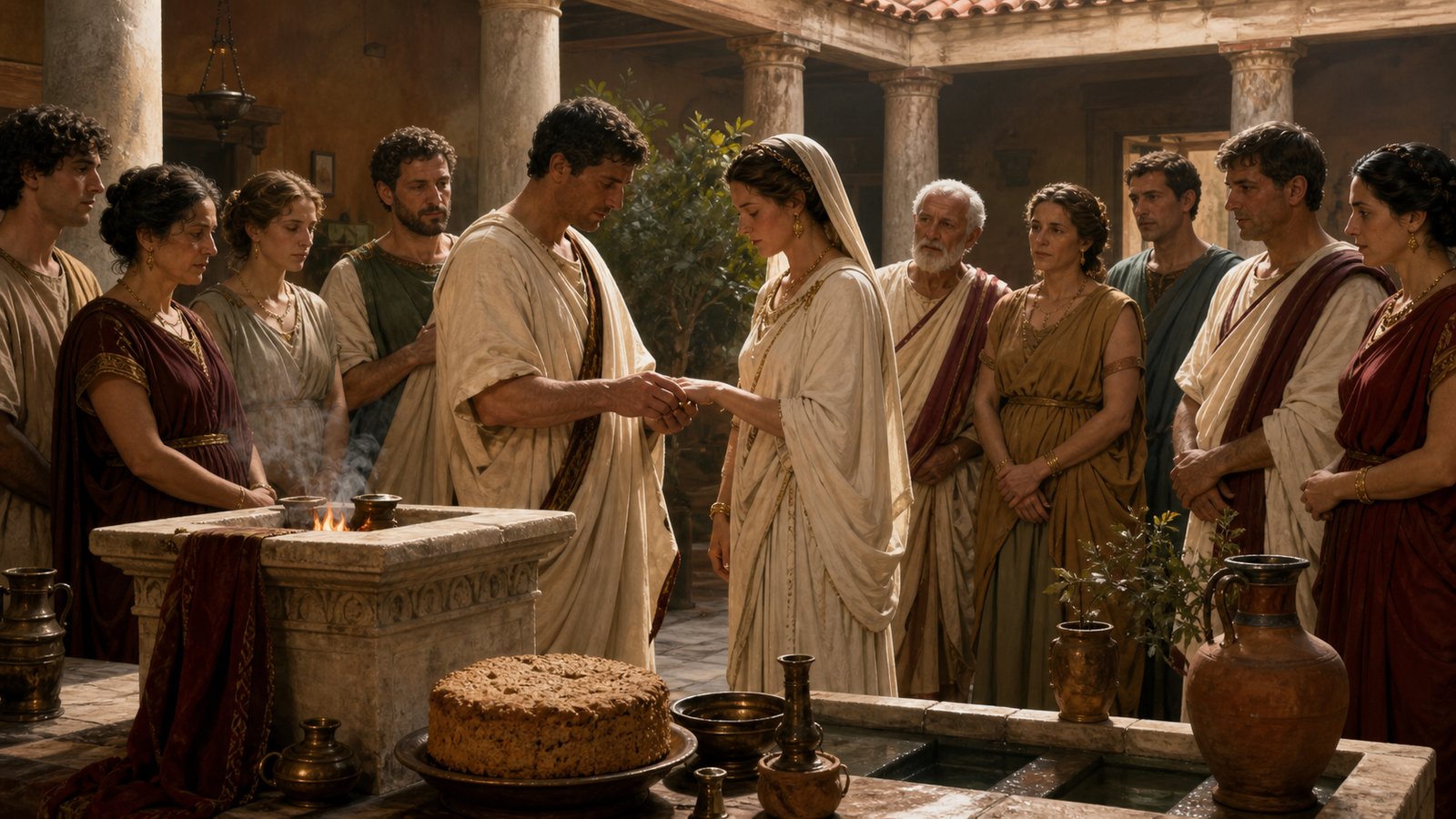
Gaius explains why confarreatio remained relevant even after other parts of the old law had faded. The greater flamines—the priests of Jupiter, Mars and Quirinus—and the ritual king had to be born from marriages celebrated in this form. They also had to marry through confarreatio themselves. The state’s sacred offices therefore depended on a chain of qualifying marriages across generations.
This was not merely a rule about the wedding day of one priest. Parents had to choose the old rite before their child’s future office was known. The child’s eligibility later depended on that parental decision. If fewer patrician households accepted confarreatio, the pool from which Rome could draw certain priests narrowed. A private household’s reluctance accumulated into a public religious shortage.
The Flamen Dialis shows the pressure most clearly. His office carried a dense field of restrictions, explored in our account of how one knot could stop Jupiter’s priest at the door. Confarreatio added another boundary before a candidate even entered the office. He needed the correct parental marriage behind him and the correct marriage of his own.
The result tied household continuity to civic ritual. A spelt cake at one generation’s ceremony could affect which descendant was available to serve Jupiter. Rome’s religious constitution did not float above family choices. It passed through them.
Tiberius faced a shortage created by old rules
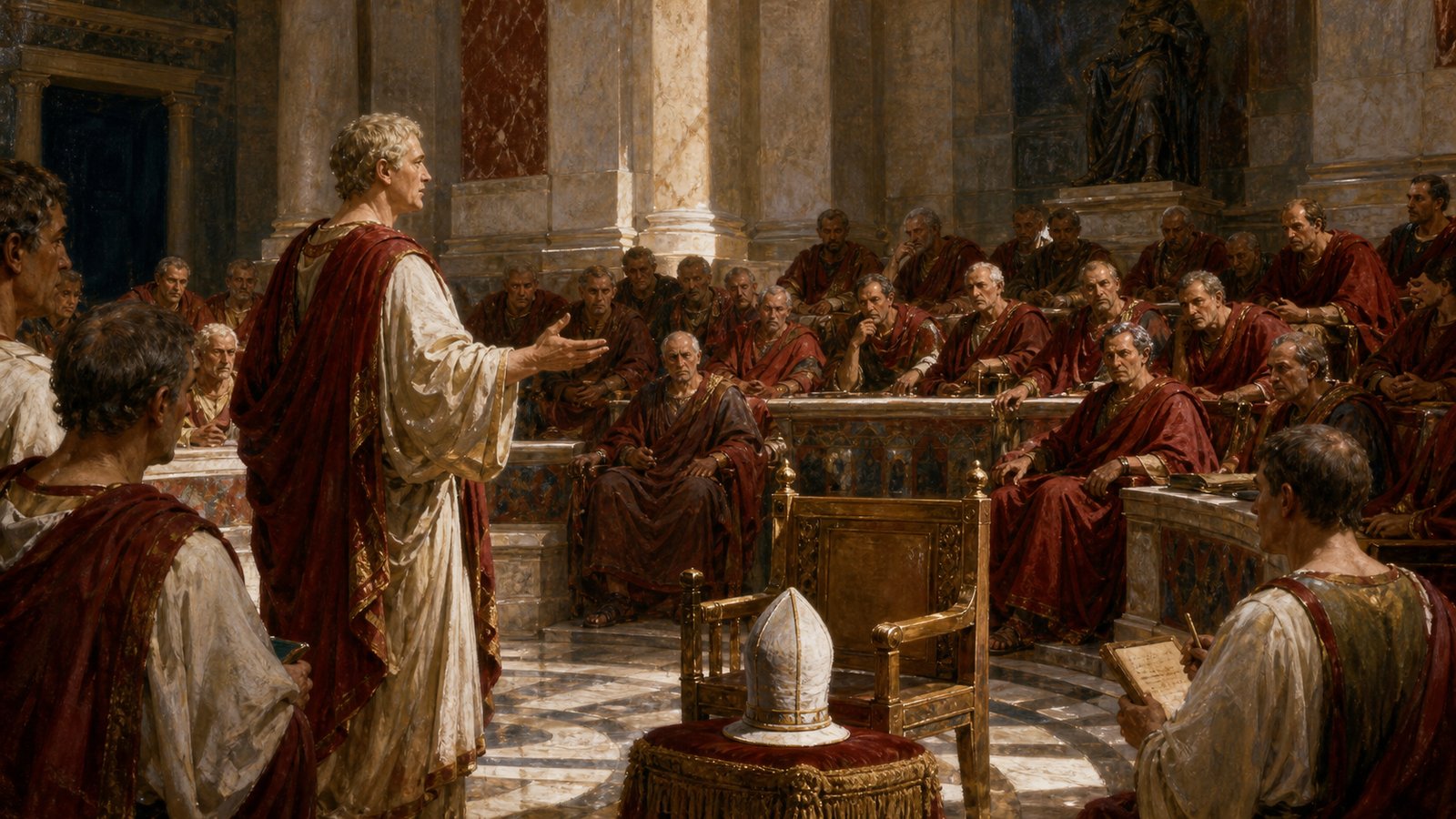
Tacitus lets us watch the system strain in the reign of Tiberius. After the death of Servius Maluginensis, the emperor addressed the problem of choosing a new Flamen Dialis. The old custom, he said, required the nomination of three patricians whose parents had been married by the primitive ceremony. One of the three would then be selected.
By this point, the expected choice was hard to assemble. Tacitus says the marriage form had been abandoned or was observed by only a few. His account gives several reasons: indifference among men and women, the difficulties of the ceremony, and deliberate avoidance of its consequences. The rule had not changed at the same pace as elite family practice.
One consequence drew particular attention. The man who obtained the priesthood left his father’s authority, while his wife passed under her husband’s control. This was not an antiquarian inconvenience confined to costumes and formulas. It reached into living family law. The office required a married pair to accept an arrangement that many contemporaries no longer found attractive.
The Senate’s answer was adjustment rather than abolition. The priestly institution remained. A law provided that the priestess would be under her husband’s control for sacred functions, while otherwise retaining the ordinary legal position of women. The younger Maluginensis was then chosen to succeed his father. Rome preserved the ritual lineage while reducing one part of the legal burden that made it difficult to sustain.
The old ceremony survived by becoming narrower
The episode changes the meaning of the spelt cake. In Gaius’s legal outline, it marks a solemn path into manus. In Tacitus’s political narrative, the fading rite has become a bottleneck. Rome wants an ancient priestly qualification but has fewer families willing to produce it under the old terms.
There is no need to describe this as a simple victory of modernity over superstition. The Senate did not discard the Flamen Dialis or erase confarreate ancestry. It separated sacred subjection from a woman’s ordinary legal position. The change was conservative in its goal and selective in its method: preserve the office, preserve the qualifying tradition, soften a consequence that was starving the system of candidates.
Confarreatio therefore reveals Roman tradition at work rather than standing still. Its authority depended on exact repetition—grain, sacrifice, formula, witnesses—but its institutional survival eventually required legal adjustment. A rite could look immovable in the atrium and still be renegotiated in the Senate.
The ten witnesses saw one marriage. The state saw much further. It saw future priests, patrician pedigrees and the continuity of public worship. That is why a small cake of spelt could carry a burden far heavier than its ingredients.
Sources
Gaius, Institutes, 1.109–113
Tacitus, Annals, 4.16