
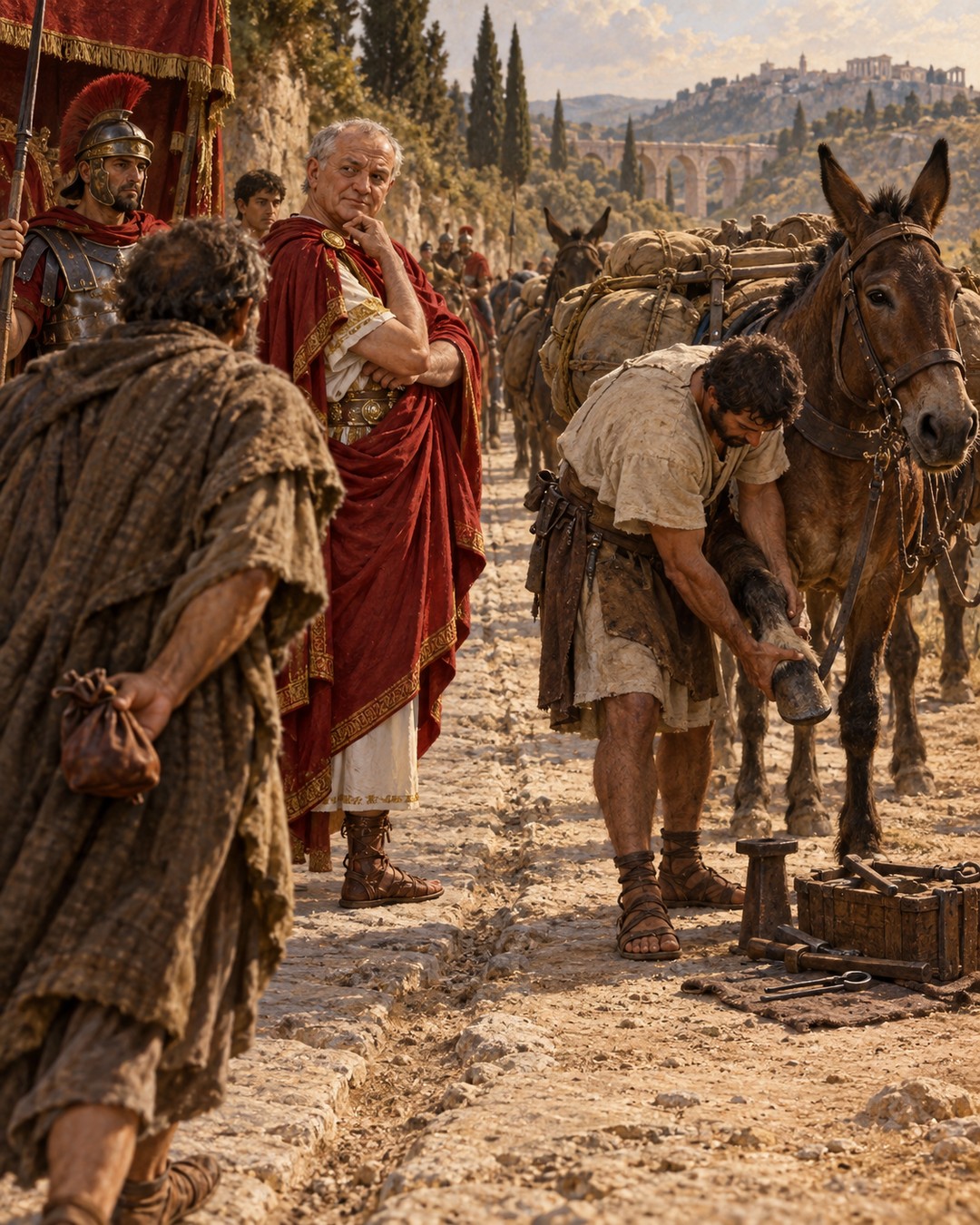
The mule did not choose the moment. Its handler did.
On a journey with Vespasian, the imperial muleteer climbed down and began shoeing the animals. The pause lasted just long enough for a man with a lawsuit to reach the emperor.
Vespasian asked what the repair had paid—and demanded a share.
A Halt on the Road Opened a Moving Court
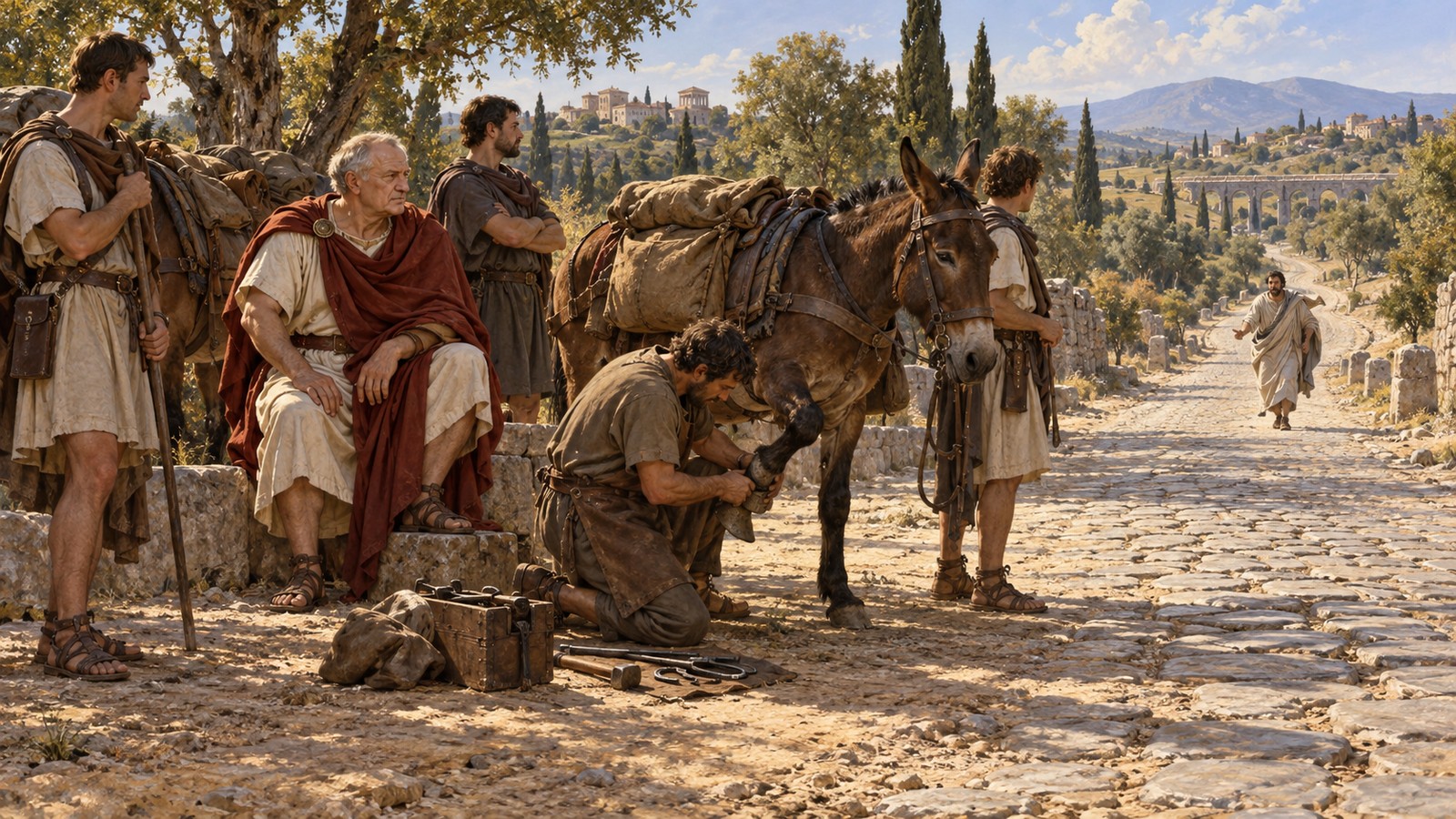
Suetonius tells the incident in a few compact lines. Vespasian was travelling, his muleteer got down to shoe the mules, and a litigant used the delay to approach.
The setting matters. An emperor on the road was not simply a private traveller changing location. He carried attendants, messages, decisions and the possibility of access with him.
A man who wanted to present a lawsuit could not assume that he would be received merely because he caught sight of the party. Pace, escorts and protocol all separated an approaching petitioner from the person whose attention he needed.
The muleteer occupied an unusually useful position inside that moving arrangement. He did not control the emperor’s judgment, but he could interrupt the vehicle that carried the emperor.
Shoeing supplied an ordinary reason to stop. Mules required care, and a problem at the hoof could not be solved while the party continued at speed. The pretext converted a servant’s choice into what looked like practical necessity.
Suetonius says Vespasian suspected that the man had got down merely to create delay. The wording leaves no need to invent a visibly loose shoe, a broken nail or a whispered negotiation beside the road. What survives is the emperor’s inference about timing.
The litigant arrived while the party was stationary. That coincidence made the repair legible as a transaction.
Imperial access elsewhere relied on rooms, queues and recognised intermediaries. A Roman nobleman’s front door could turn a household entrance into a route for public business. Here the gate moved on four legs, and the person tending those legs could briefly hold it open.
The Muleteer Sold Time, Not a Verdict
The story does not say that the servant promised a favourable legal outcome. It does not even say that Vespasian heard the case to completion.
What the payment could reliably buy was opportunity: enough stationary time for the litigant to approach and attempt to speak.
That distinction explains the scale of the muleteer’s power. He could not issue a ruling in the emperor’s name. He could alter the conditions under which a request became visible.
Access is often valuable before any decision is made. A grievance unheard has no chance to persuade. A petition presented at least enters the field of attention.
The muleteer monetised a piece of infrastructure that belonged to his work. His knowledge of the animals made it difficult for outsiders to challenge a claim that shoeing was required. His place within the travelling party let him impose the pause without first requesting an audience of his own.
The litigant, meanwhile, paid for uncertainty. He could reach Vespasian, but the source gives no assurance that he would win. The hidden bargain was narrower than bribing a judge and more practical than waiting for chance.
This makes the episode different from the courtroom performance that three denarii could amplify. There money changed the sound surrounding an argument. On the road it changed whether an argument could arrive at all.
Suetonius does not preserve the litigant’s name, the legal dispute or the amount. Those absences keep the account focused on the mechanism rather than the merits of the case.
The useful commodity was a delay plausible enough to look accidental until its beneficiary appeared.
Vespasian Priced the Pretext with a Joke
Once the emperor suspected the arrangement, he did not respond in Suetonius’s account with an inquiry, dismissal or formal prosecution.
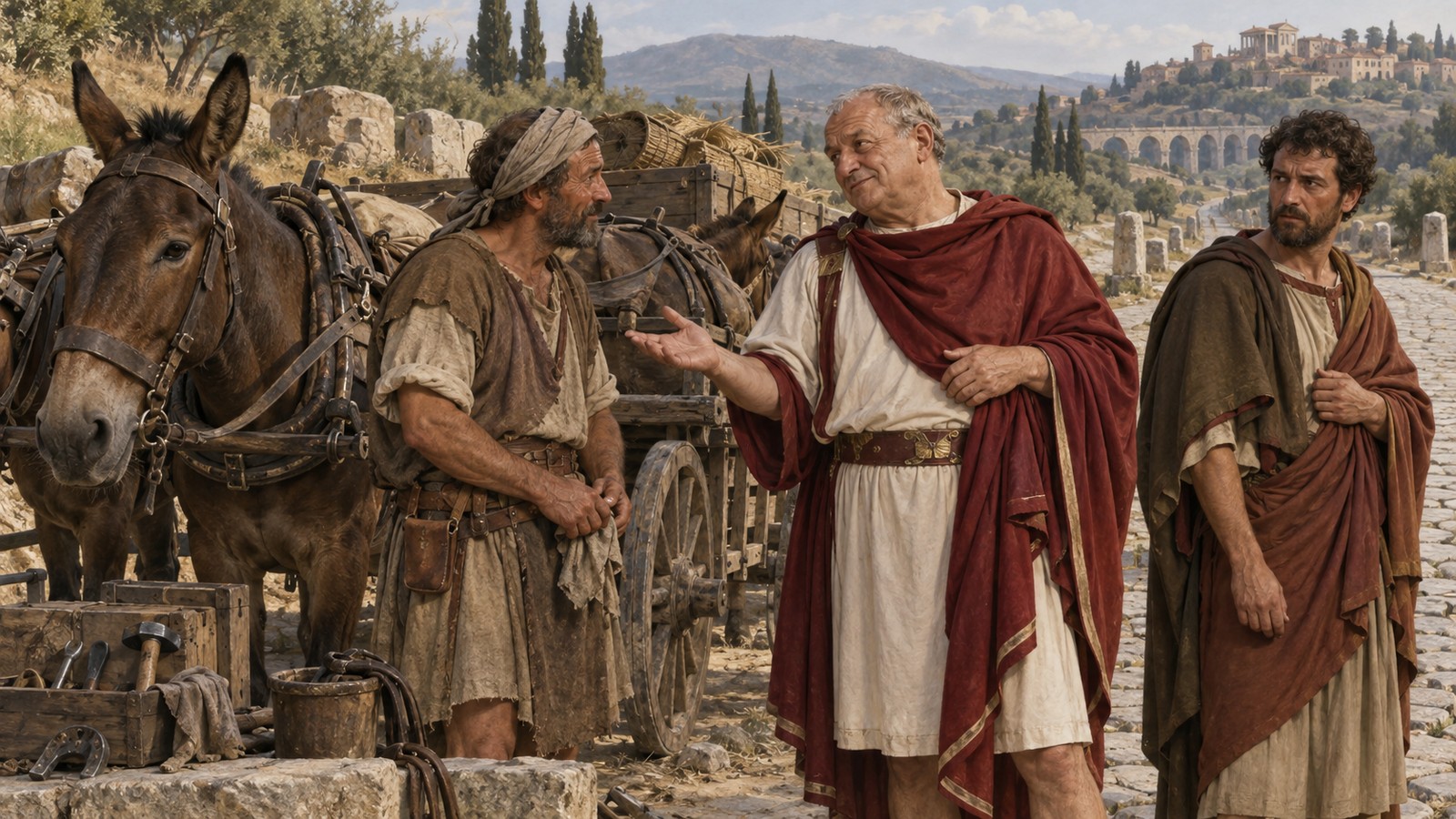
He asked how much the muleteer had received for shoeing the animals.
The question collapsed the servant’s cover story. If the stop were merely maintenance, the payment would be ordinary wages or nothing beyond them. Asking for the price treated the repair as the product sold to the litigant.
Vespasian then insisted on a share.
The demand worked as exposure. It told the muleteer that the emperor had linked four things: the decision to stop, the prolonged task, the convenient arrival and the private payment.
It also suited the portrait Suetonius was constructing. The biographer groups this scene with Vespasian’s jokes about methods of gain that contemporaries considered undignified.
That literary placement matters. Suetonius is not supplying an administrative record of confiscated money. He is illustrating a reputation through a sharp exchange in which the emperor recognises another person’s small revenue scheme and inserts himself into it.
The famous wit can distract from the information contained in the joke. Vespasian understood that access around him had acquired a market price. By requesting a cut, he named the transaction without needing the muleteer to confess it first.
There is an uncomfortable double edge. The emperor appears observant and funny, yet the joke does not restore a transparent system. It turns the illicit fee into a revenue to be divided.
Suetonius does not tell us whether the share was actually handed over. The insistence is enough for the anecdote’s point: Vespasian would not let even a servant’s hidden profit escape his notice.
A Servant’s Routine Became an Imperial Bottleneck
The entire arrangement depended on the distance between formal authority and practical control.
Vespasian possessed the authority to hear, refuse or decide. The muleteer possessed control over a mundane interruption. For a few minutes on a road, the second power affected access to the first.
Roman elite households and courts were full of such bottlenecks. Doorkeepers, secretaries, attendants and messengers could not replace the patron or emperor, but they shaped who arrived, when a document was seen and whether a voice entered the room.
The muleteer’s version was unusually physical. A hoof, harness and travelling pace made the schedule visible. The servant needed no written appointment list. He needed only a credible reason not to move.
The risks were equally specific. Too brief a stop would not help the litigant. Too long or too perfectly timed a stop would invite suspicion. The scheme had to resemble competent animal care while producing enough delay to matter.
Vespasian’s detection shows why intermediaries could never assume that routine made them invisible. The emperor knew what normal travel looked like well enough to notice when maintenance aligned too neatly with a petitioner’s approach.
The anecdote should not be enlarged into proof that every roadside audience was bought. Suetonius preserves one memorable case because its mechanism and punchline were compact.
Nor does it establish what happened to the lawsuit. The legal claim disappears from the narrative as soon as the access fee is exposed.
What remains is a map of power at small scale. The litigant had money and urgency. The muleteer had control of a pause. Vespasian had the authority everyone was trying to reach and the perception to identify the exchange.
The shoeing tools were ordinary. Their value came from where they were used: under the animals carrying an emperor who would otherwise keep moving.
The road also left fewer alternative explanations than a palace corridor might have done. The petitioner did not emerge from a recognised reception room or scheduled hearing. He reached the party during the exact interruption created by the servant positioned to create it. Vespasian’s inference joined location, sequence and benefit without requiring a surviving receipt.
For the muleteer, the opportunity was perishable. Once the animals moved again, the litigant’s purchased opening vanished. Access here was not a permanent office to be sold repeatedly from a fixed doorway, but a brief control over speed that acquired value only because the right person was approaching at the right moment.
A purchased minute became an audience. Then the emperor priced the minute himself.
Sources
Suetonius, Vespasian, section 23.2.