
No vessel was allowed onto the sacred water, but the islands sailed anyway.
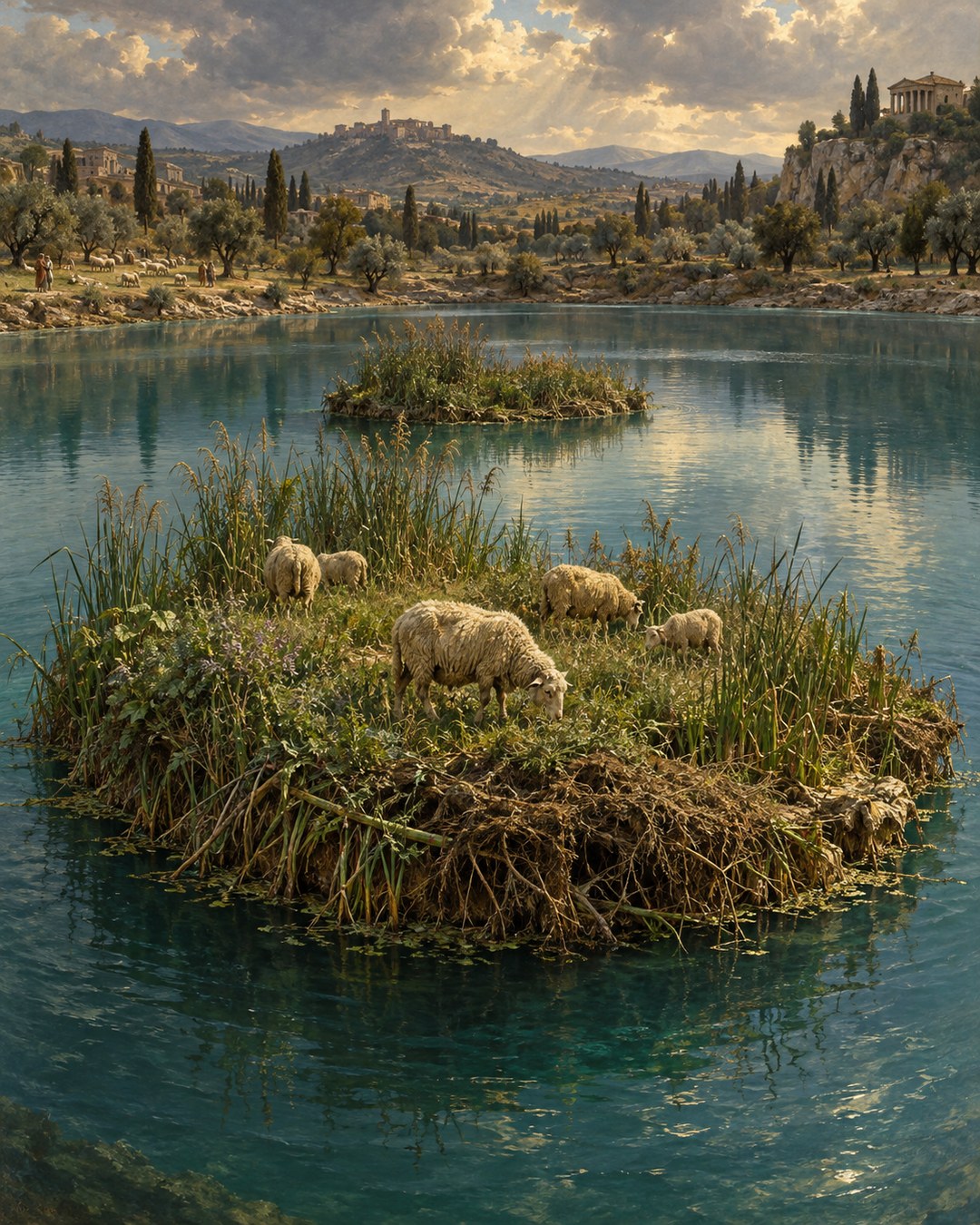
At Lake Vadimon, Pliny watched mats of reeds, rushes and turf gather, separate and cross blue-green water under the wind. Sheep sometimes grazed aboard before the ground detached from shore.
They noticed the lake only after it had formed around them.
A Perfect Circle Made an Unstable Shore More Striking
Pliny says he learned of Lake Vadimon while inspecting land belonging to his wife’s grandfather near Ameria. Its proximity embarrassed him slightly: Romans travelled for distant marvels while overlooking wonders within reach.
The lake first appeared almost artificially regular. Pliny compares it to a wheel laid flat on the earth.
Its shore had no conspicuous curve or projection. The circle seemed cut to shape, an orderly boundary around a moderate body of water.
Inside that boundary, nearly everything moved.
The water was clear blue with a greenish tinge. It smelled of sulphur, and local belief credited it with medicinal power, especially for fractured limbs.
Pliny records the claim rather than supplying a test. His letter is an account of what he saw and what people said about the place, not a modern chemical analysis.
Wind could agitate the lake violently despite its moderate size. That responsiveness supplied the force that reorganized the floating vegetation.
The visual contradiction begins there. A shore so geometrically calm enclosed water capable of shifting its apparent internal geography from one hour to another.
Roman sacred landscapes often made handling rules as important as appearance. The Vestals’ pointed water vessel prevented sacred water from being set casually on the ground. At Vadimon, the rule concerned entry: vessels were not permitted to sail.
The Lake Was Sacred, but Its Vegetation Behaved Like Boats
Pliny states the restriction plainly. No vessels were allowed because the water was held sacred.
The prohibition makes his next description sharper. Several floating islands moved across the same surface denied to boats.
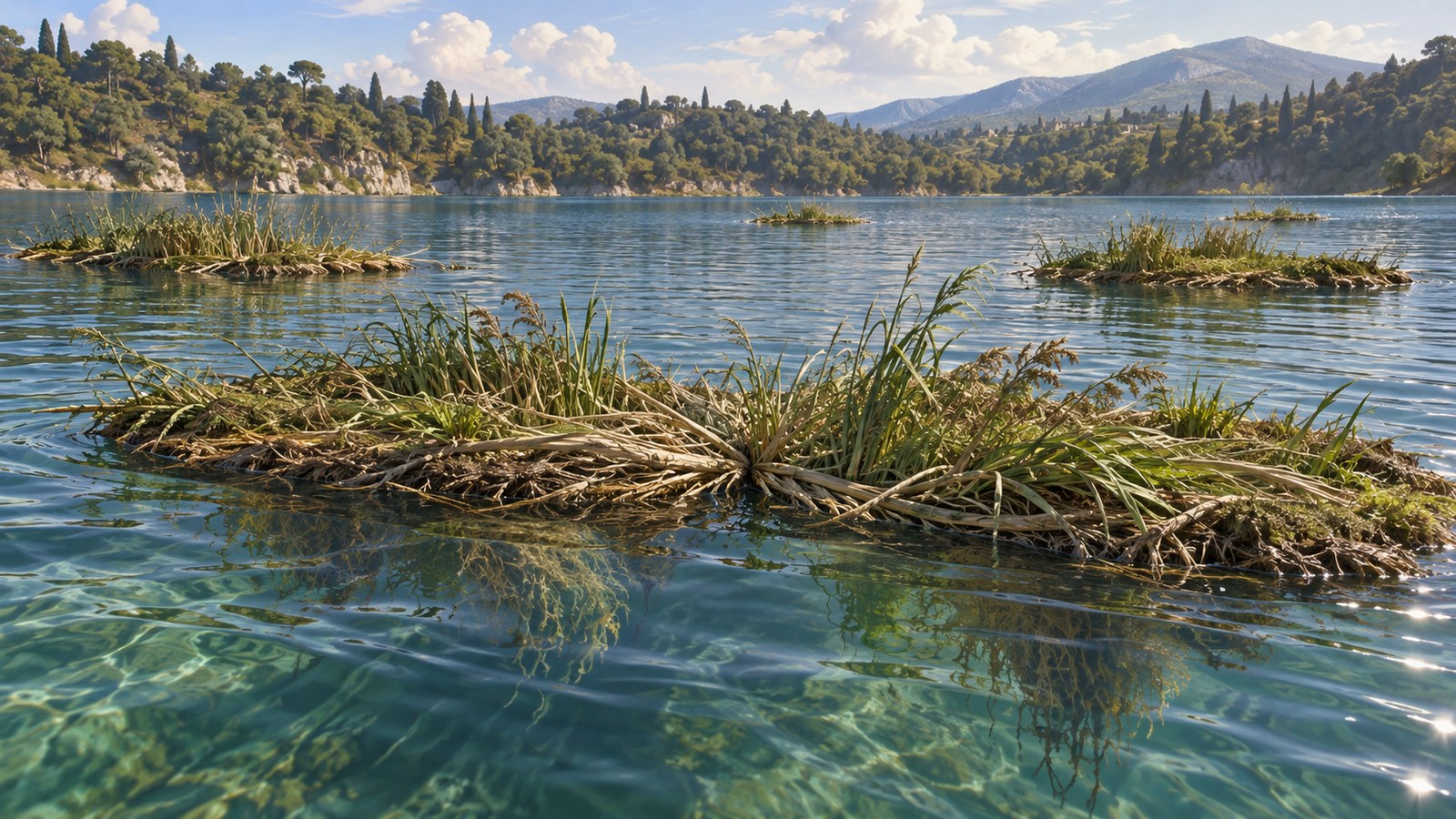
These were not stone outcrops wandering through fantasy. Pliny describes vegetated masses carrying reeds, rushes and the plants that grew abundantly in the marshy margin.
The roots hung into the water at roughly equal depth whichever side an observer stood on. He compares their shape to the keel of a boat.
That submerged structure explains the visible stability. A mat could support plants above water while a connected root mass extended below it.
The islands did not share one outline. Each had its own shape and size. Their edges were worn by repeated collisions with the shore and with one another.
Movement therefore altered the movers. Contact frayed boundaries and made each circuit through the lake part of the island’s physical history.
Pliny watched them collect into what looked like a small continent, scatter into different quarters under wind, and drift separately in calm weather.
A larger island might carry a smaller one beside it like a ship and its boat. The comparison kept returning to navigation even though human navigation was forbidden.
Sacred status did not freeze nature. It changed the human use of the surface while wind and roots continued to produce their own traffic.
Sheep Crossed the Boundary Before They Could See It
The most vivid passengers were sheep grazing at the lake’s edge.
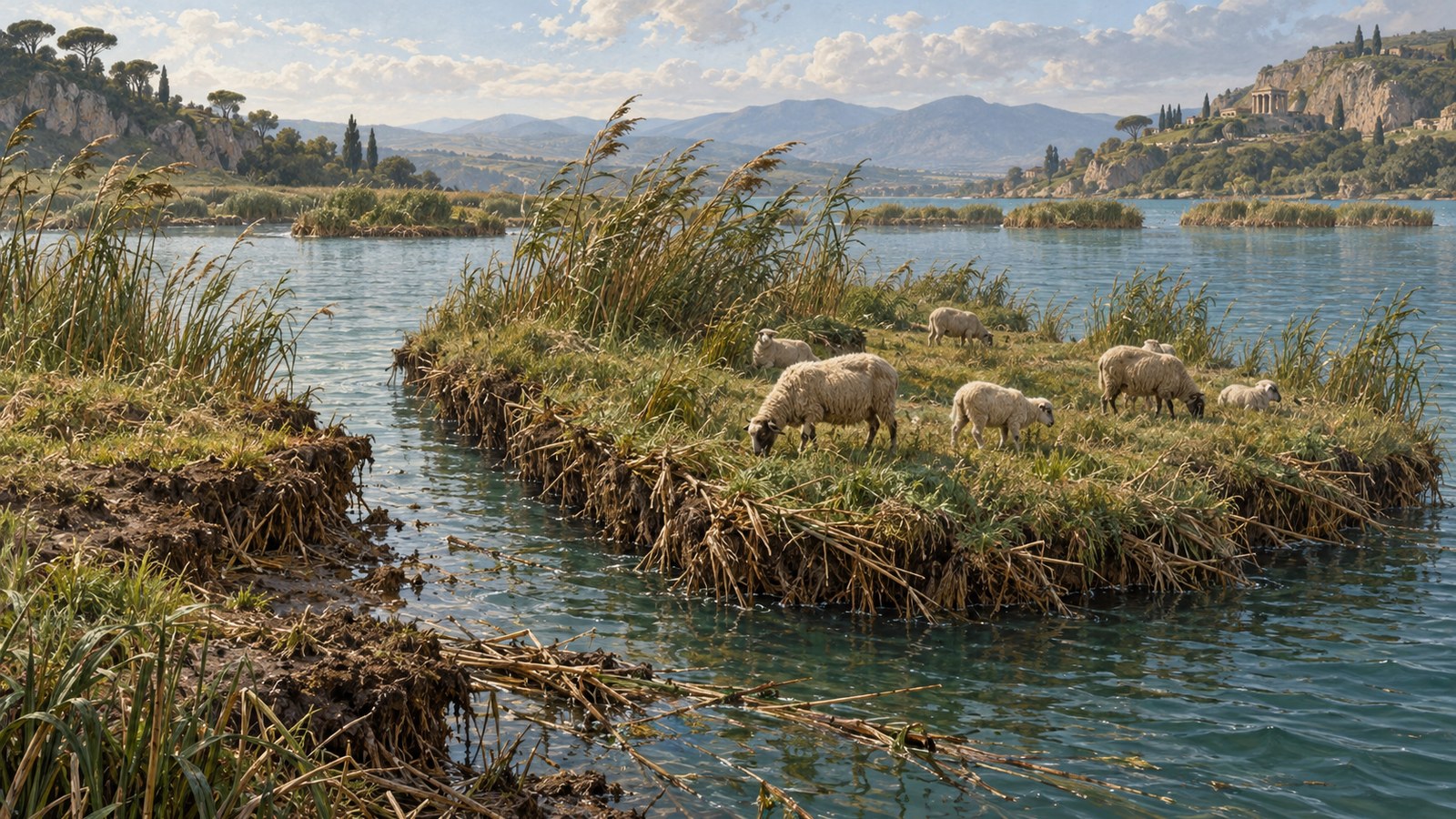
When an island touched the bank, vegetation on solid margin and vegetation on floating roots could form one continuous feeding ground. An animal following grass had no reason to recognize a join hidden beneath its feet.
Then wind moved the mat. Water opened between island and shore.
Pliny says sheep sometimes realized only then that they had left land. The surprise did not require a dramatic launch. It came from a gradual separation beneath ordinary grazing.
The return could be equally quiet. When wind drove the island back, the sheep perceived the recovery of shore no more clearly than the departure.
This small scene makes the lake’s mechanism legible. A human observer could compare positions over time; an animal occupied only the apparently firm surface carrying it.
The episode also turns the category of “island” inside out. An island usually marks fixed land against moving water. Here water moved the land-like object, while grazing continued on top.
The archive contains another sacred animal journey with a very different direction. A snake leaving a ship helped Romans identify the Tiber Island as a divine destination. Vadimon’s sheep chose nothing. They revealed mobility by failing to perceive it.
Their alarm, once surrounded, supplied a scale Pliny’s readers could imagine. The islands were substantial enough to bear flock animals and coherent enough to move without immediately breaking apart.
Yet their edges wore away. Stability was temporary, maintained by roots and turf rather than bedrock.
An Underground Exit Completed the Moving Geography
The islands repeatedly changed how much open water appeared beside each shore. When they collected at one side, Pliny says they seemed to reduce the lake there; when they moved away, they restored it.
At times the mats joined in the centre and returned the lake’s apparent outline to its usual balance. The perfectly circular basin remained, but its visible divisions changed.
Water also refused to keep a simple path after leaving.
Pliny says the lake emptied into a river. After running a short distance, that river sank underground.
Objects thrown into the stream could reappear where it emerged again. The claim extends the letter’s recurring pattern: disappearance does not mean an end, and a boundary crossed out of sight can become visible somewhere else.
That pattern links shore, island and outlet without making them identical. Floating mats vanish into the bank and separate again. Sheep leave land without a perceptible embarkation. Water leaves daylight, travels below ground and returns.
Pliny’s account deserves the limits he gives it. He does not measure the lake, identify the plants botanically or test the healing reputation. His precision lies in observed forms and motions: colour, smell, roots, collisions, wind and animals.
The sacred rule belongs inside that physical account. Because boats stayed off the water, the moving islands occupied the lake as the most conspicuous vessels permitted there.
The collisions Pliny mentions kept those vessels from seeming supernatural or indestructible. Their edges wore down when they struck land or one another. They were held together strongly enough to carry plants and sheep, yet softly enough for repeated contact to reshape them.
Wind supplied several outcomes rather than one fixed circuit. It could press mats together, scatter them to separate quarters or leave them drifting independently when calmer conditions returned. The same force that alarmed the lake’s surface also edited the pattern of apparent land.
Even Pliny’s ship-and-longboat comparison is observational rather than a claim that someone steered the islands. A large mat and a small mat could travel joined, borrowing the visual grammar of navigation while remaining root, reed and turf.
The underground river provides a final check on any temptation to treat the letter as scenery alone. Pliny was attentive to routes: where the islands went, where animals found themselves, where water vanished and where carried objects returned. His marvel is organized by movement through spaces whose connections are not obvious at first sight.
They carried no oars and followed no human course. Wind assembled and separated them, while hanging roots kept the surface together.
Vadimon’s wonder was not that nature ignored boundaries. It was that boundaries remained visible while changing underneath anyone who trusted them.
The sheep grazed from shore onto island. By the time water disclosed the difference, the crossing had already happened.
Sources
Pliny the Younger, Letters, book 8, letter 20.