
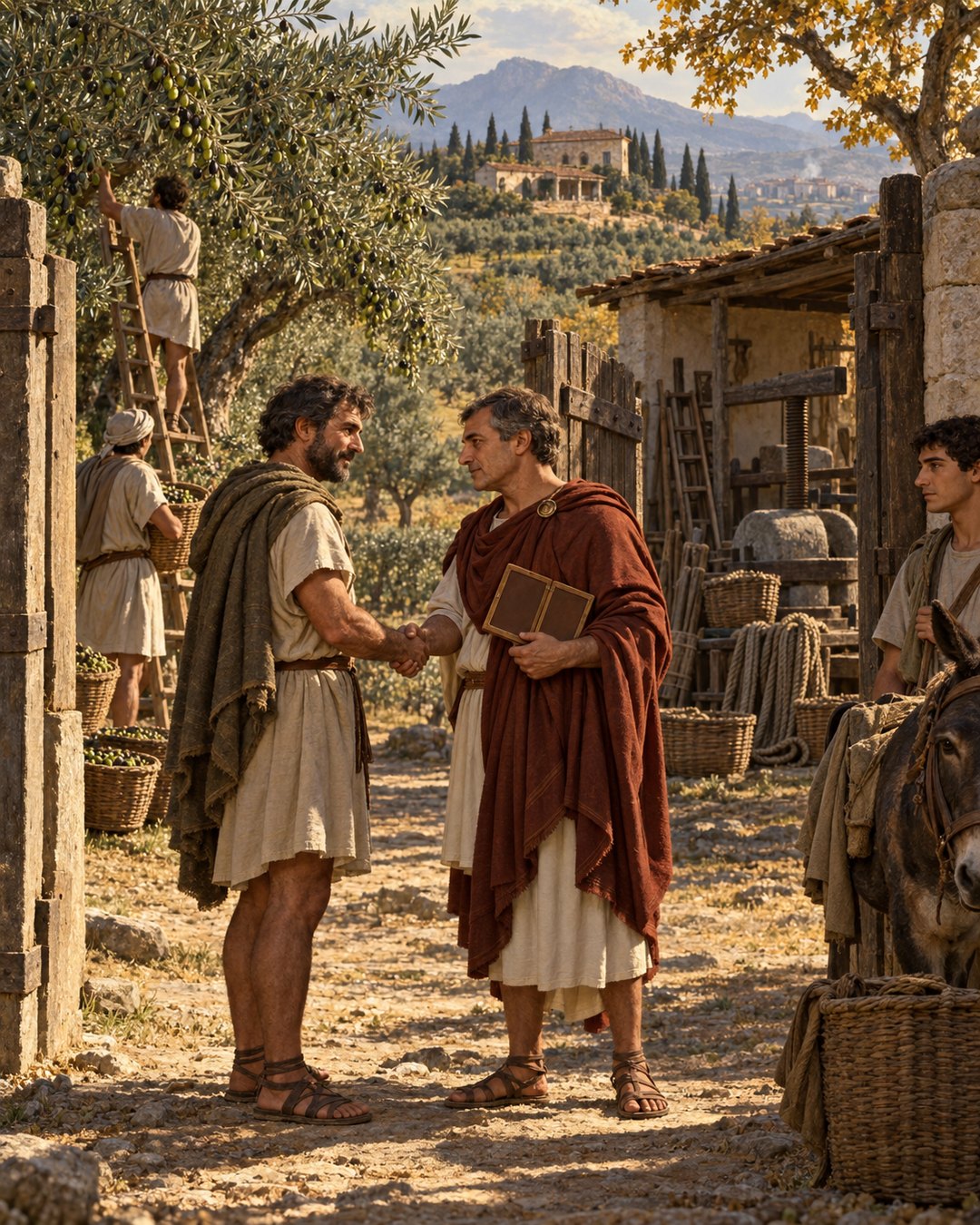
The buyer acquired olives that had not yet left their branches. He did not acquire freedom from the estate.
Cato’s model terms for a sale near Venafrum added fees, measured produce, a payment deadline, responsibility for workers, and a pledge over property brought onto the farm.
If the buyer removed that security too soon, it became the owner’s.
The Auction Price Opened a Longer Account
Cato labels the document as terms for the sale of olives on the tree. The location is an estate near Venafrum, a district associated with valued Italian oil.
Selling the crop before gathering separated ownership of the harvest from ownership of the land. The buyer took the commercial chance represented by fruit still exposed to labour, weather, handling, and processing.
The winning price did not close the calculation. Cato says the purchaser added one percent on money above the purchase price and paid an auctioneer’s fee of fifty sesterces.
The agreement then moved from money to produce. The purchaser owed 1,500 pounds of Roman oil and 200 pounds of green oil.
He also owed fifty modii of windfall olives and ten modii of picked olives, measured by an olive measure. Ten pounds of lubricating oil completed another practical obligation.
Two cotylae of the first pressing were due for use of the owner’s weights and measures. Even the equipment that made quantity verifiable entered the settlement.
These clauses prevented the sale from being reduced to one number called a price. Different goods answered different needs: sale proceeds, auction cost, usable oil, fruit sorted by how it was gathered, lubricant, and a small return for measuring equipment.
The distinction between windfall and picked olives also shows that the contract followed the crop into the work of harvest. Fruit gathered from the ground was not treated as identical to fruit taken deliberately from the tree.
Cato’s farm writing repeatedly turns production into counted obligations. His model for hiring an olive harvest crew specified workers, conduct, and deductions. Chapter 146 approaches the same season from the sale side: who bought the crop, what accompanied the bid, and what remained exposed if performance failed.
Ten Months Separated Harvest from Final Payment
The buyer did not necessarily hand over the entire contract price when the olives were sold.
Cato sets a term of ten months from the first of November for payment connected with gathering and working up the olives. The arrangement therefore survived well beyond the moment of auction.
That delay made security important. The estate had transferred the opportunity to exploit the crop while cash and other obligations remained outstanding.
The purchaser had to sign a contract and give bond to the satisfaction of the owner or the owner’s representative. The language placed judgment about adequate security with the estate side of the transaction.
Good faith appears in the promise, but the document did not rely on good faith alone. It paired the promise with assets that could be held.
Until payment had been made or acceptable security given, all property of the purchaser on the place remained pledged.
The farm itself became the boundary of the guarantee. Baskets, ropes, ladders, press gear, carts, or other property brought in for the work could support enforcement because they were physically present where the owner could observe them.
The ten-month term thus did not mean ten months of unsecured waiting. Time for the buyer was balanced by control for the owner.
The arrangement also reduced the value of a quick exit after removing the crop. A purchaser could not finish pressing, load every movable asset, and leave the estate while the account remained unsettled.
This was credit anchored to place. The olives might flow outward as oil, but the buyer’s property remained caught inside the legal perimeter until payment or bond released it.
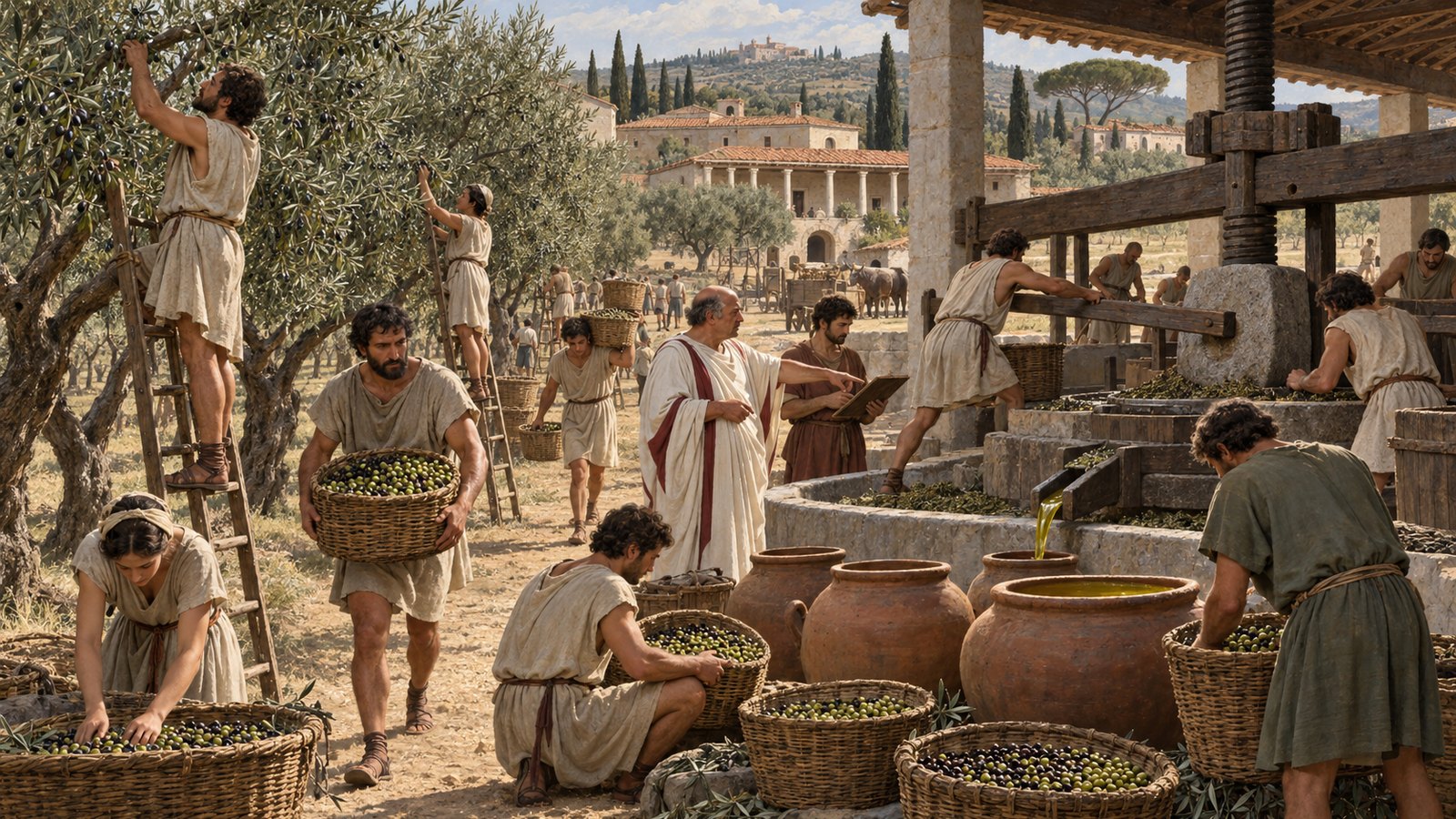
Removing the Pledge Triggered a Hard Transfer
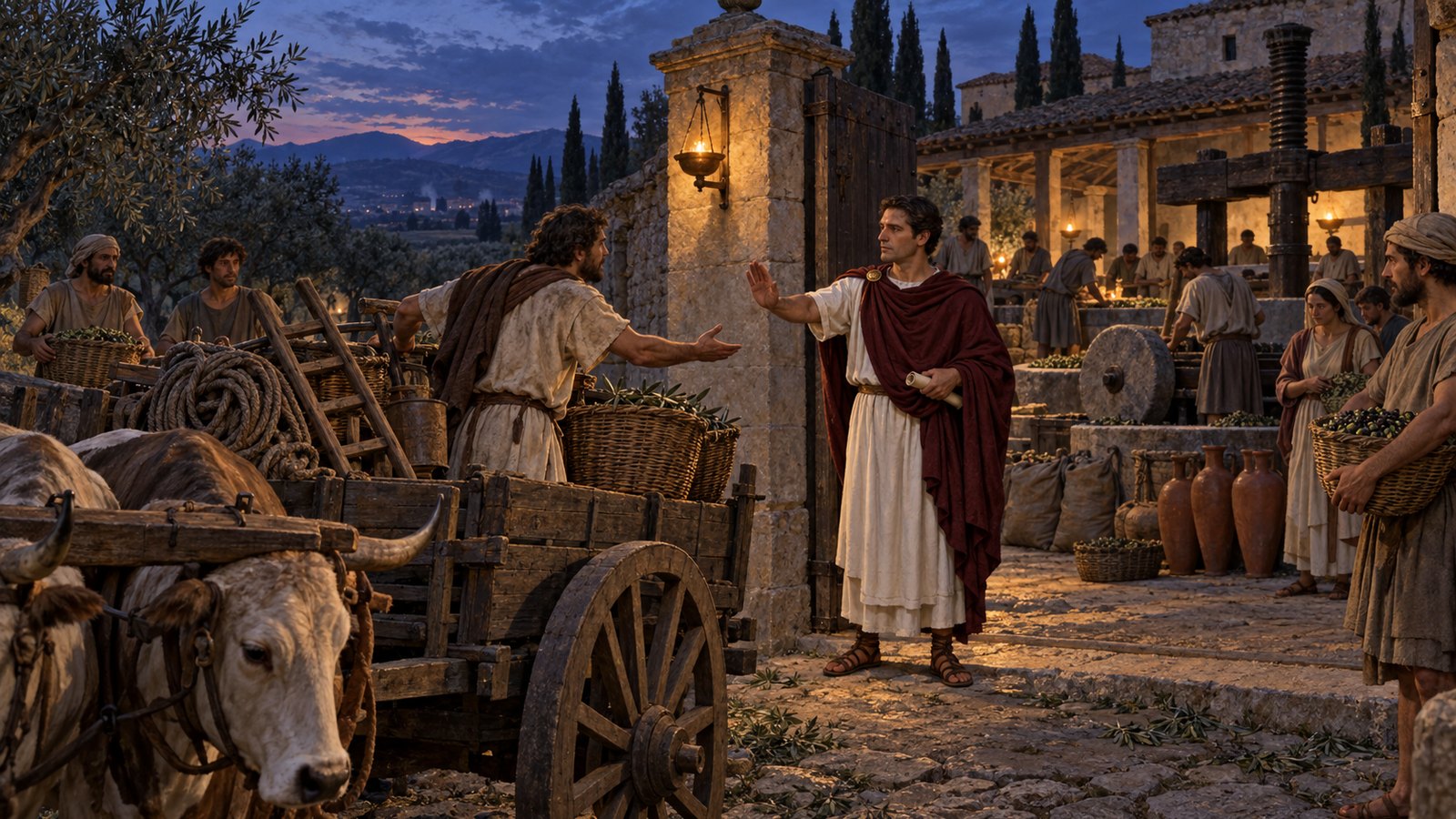
Cato’s clause for unauthorised removal is blunt. Whatever pledged property was taken from the place became the owner’s.
The rule transformed movement into a decisive event. Ownership did not depend only on what an object was; it depended on whether the buyer tried to carry it beyond the estate while obligations were unsecured.
That gave the owner a remedy that did not require recreating the entire harvest account after the buyer disappeared. The assets were already identified by their presence on the property.
The clause would also have been visible to workers and agents. A cart passing through a gate with ladders or ropes was easier to notice than a private intention not to pay months later.
Cato separately addresses equipment furnished by the owner. Presses, ropes, ladders, mills, and anything else supplied for the job had to return in the same good condition.
Age created an exception. Breakage caused by age did not carry the same consequence as loss or damage attributable to use.
For items not returned, the purchaser paid a fair price. The farm’s productive apparatus therefore stayed inside the account even when individual pieces could no longer be handed back.
That detail mattered because an olive sale required more than permission to pick. It mobilised expensive fixed and movable tools whose absence could impair the next season.
Cato’s mill adjustment shows how precise the relationship among millstones had to be. Chapter 146 protects that productive system contractually: borrowed equipment was not disposable simply because the crop belonged to another buyer.
The pledge and return clauses worked together. One restrained the purchaser’s own assets; the other protected the owner’s tools.
Workers Could Be Paid over the Buyer’s Head
The agreement did not leave gatherers and mill workers entirely dependent on the purchaser’s willingness to settle wages.
If the purchaser failed to pay them, the owner could choose to pay the amount due.
That option kept work claims from becoming a disorder inside the owner’s estate. Labourers had performed the gathering and milling there, even though the crop buyer had engaged or owed them.
The owner’s intervention did not erase the buyer’s liability. The purchaser became liable to the owner for the wages advanced.
That reimbursement was supported by bond and by the property pledge already described.
The clause linked labour payment to the same enforcement architecture as the crop price. It did not create a separate moral appeal detached from the commercial bargain.
For the owner, paying workers could protect the estate’s reputation, complete the harvest, and prevent equipment or processed oil from being trapped in a wage dispute. For workers, it created another solvent party who could act, though Cato phrases that action as the owner’s choice.
The contract therefore managed several relationships at once: owner and buyer, buyer and workforce, owner and workforce, and both parties’ relationship to tools and produce.
Its strength came from overlap. A missed wage became a debt to the owner; a missing ladder became a priced loss; an attempted removal activated forfeiture; delayed payment demanded a bond or pledge.
No single clause guaranteed a successful harvest. Together they made several forms of failure expensive and visible.
The standing olives began as biological uncertainty. Cato’s terms converted that uncertainty into measured categories and secured duties.
The document also made supervision portable. The owner’s representative could approve security, judge performance, and preserve the estate’s position without requiring the owner to stand beside every basket. Honest-person valuation handled damage where a fixed figure could not anticipate condition. Measurement, delegated judgment, and possession each answered a different kind of uncertainty.
At auction, the buyer purchased fruit on branches. For the next ten months, the estate still held the ropes that made the bargain enforceable.
Sources
Cato, On Agriculture, chapter 146.