
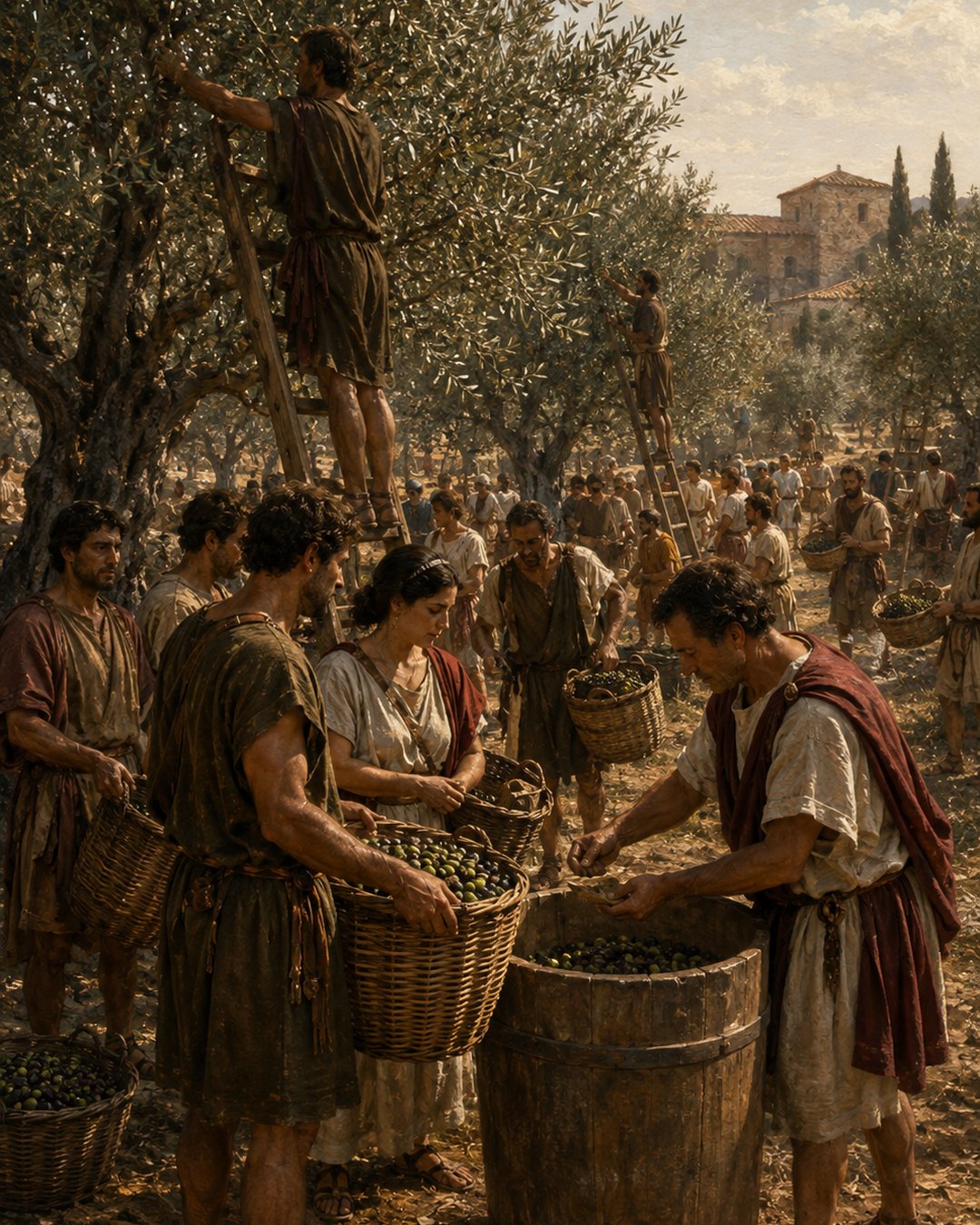
The olive trees were ready, but the first act in Cato’s harvest was not picking. It was control. Nobody was to pluck or beat down fruit without an order from the owner, his representative or the purchaser of the crop. Work done against that instruction would not be paid for the day.
Then came an oath. Every gatherer had to swear that neither the worker nor anyone acting with that worker’s connivance had stolen olives from the estate of Lucius Manlius. Refusal carried its own answer: no pay for the gathering.
De Agricultura 144 is not a lyrical tour of an orchard. It reads like a compact bundle of risks. Fruit might vanish. A ladder might return broken. Too few workers might appear. Contractors might combine to lift the price. Cato answers each possibility with orders, measurements, security, arbitration or deductions.
The result is an unusually sharp view of seasonal labor. This document does not describe every Roman farm, and its named estate warns against treating it as a universal code. What it does preserve is one owner’s effort to pin responsibility to people, objects and quantities while a valuable crop moved rapidly from tree to measure.
The Fruit Could Not Move Until Someone Gave the Order
The contractor promised to gather the entire crop carefully. Yet “carefully” was not left as a warm general instruction. Cato’s terms define authority at the tree. The owner, the owner’s representative or the crop purchaser directed the operation, and no worker could decide independently when to pick or beat down olives.
That rule protected more than ripeness. Harvesting had to be coordinated across people who climbed, picked, carried and measured. If workers stripped a section before the authorized moment, the clause made the financial consequence immediate. Nobody owed payment for what had been gathered that day in violation of the order.
Cato therefore tied obedience to the smallest useful unit of accounting: a day’s work. The threat did not dissolve the whole agreement. It isolated the breach and made the disputed labor non-payable. We should not assume that every threatened deduction was applied. The wording shows what the contract writer wanted available when control failed.
A Lost Eagles article on Cato advising buyers to inspect a farm repeatedly follows attention before purchase. Here the same appetite for inspection enters the harvest itself. The grove was not expected to run on good intentions; direction had to remain visible while the crop moved.
Every Gatherer Faced the Same Theft Oath
The oath reaches beyond a simple promise that “I did not steal.” Each gatherer swore that no olives had been taken by the worker or with that worker’s connivance. The clause widened responsibility from the hand that carried fruit away to a person who knowingly helped someone else do it.
The setting mattered. The oath was made before the owner or representative and named the estate of Lucius Manlius. This was not an abstract moral statement. It belonged to one harvest, one place and one chain of supervision. A worker who refused to swear would not be paid for gathering.
Alongside the workers’ oaths stood the contractor’s security. The contractor had to provide assurance for proper harvesting that satisfied Lucius Manlius. Individual conduct and overall performance were therefore covered differently: gatherers swore about theft, while the contractor backed the quality of the operation.
Olives and firewood were both protected from removal. If any gatherer carried them off, two sesterces were deducted for each load. The load made loss countable. Rather than relying only on a broad accusation of dishonesty, the terms attached a stated amount to a physical unit leaving the farm.
Nothing in the passage tells us how disputes over a load were proven. Cato gives the sanction, not the hearing. That silence is a useful limit. The surviving form exposes the owner’s anxieties more clearly than it reveals a worker’s opportunity to answer them.
Ladders, Labor and Clean Measures Made Loss Visible
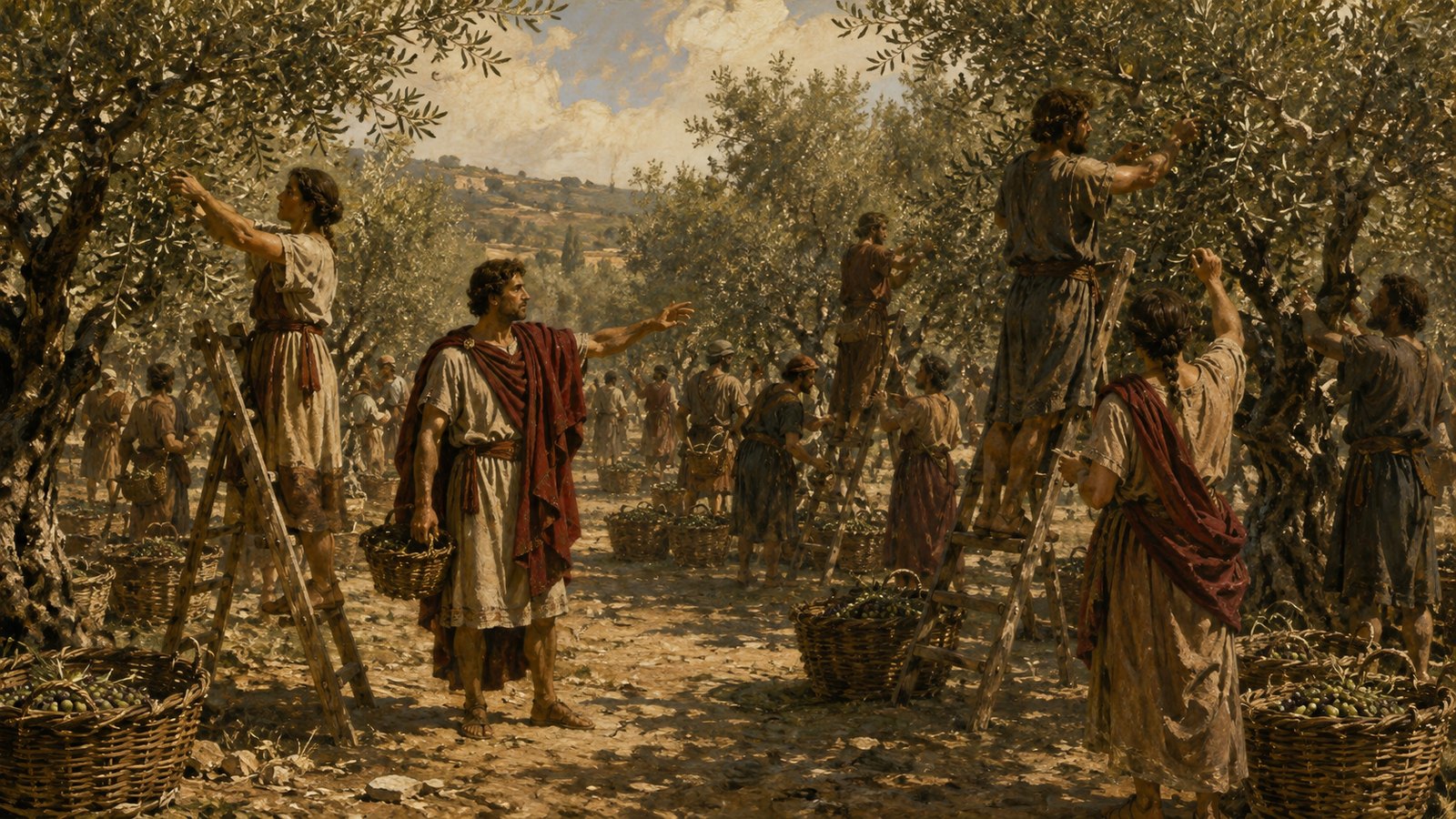
Harvest equipment came under the same discipline as fruit. Ladders had to return in as good a condition as when they were issued, with an exception for breakage caused by age. The distinction mattered because not every snapped rung proved negligence. Wear had to be separated from damage attributable to the contractor.
When a ladder did not return properly, an “honest man” could arbitrate a fair deduction. The same principle applied to damage caused to the owner through the contractor’s fault. The form combines a hard right to deduct with a third person’s judgment about amount. It is both severe and practical: the contract anticipates disagreement over causes and value.
Labor supply was also the contractor’s problem. He had to furnish as many gatherers and pickers as needed. If he failed, the expense of hiring replacements or making another contract would come off the total. The owner shifted the cost of a short crew back toward the person who had promised to assemble it.
Cato then gives a concrete baseline: fifty active workers, two-thirds of them pickers. The proportion distinguished the hands taking fruit from the tree from the rest of the workforce carrying out other harvest tasks. It also made “enough people” something that could be checked rather than argued after the crop suffered.
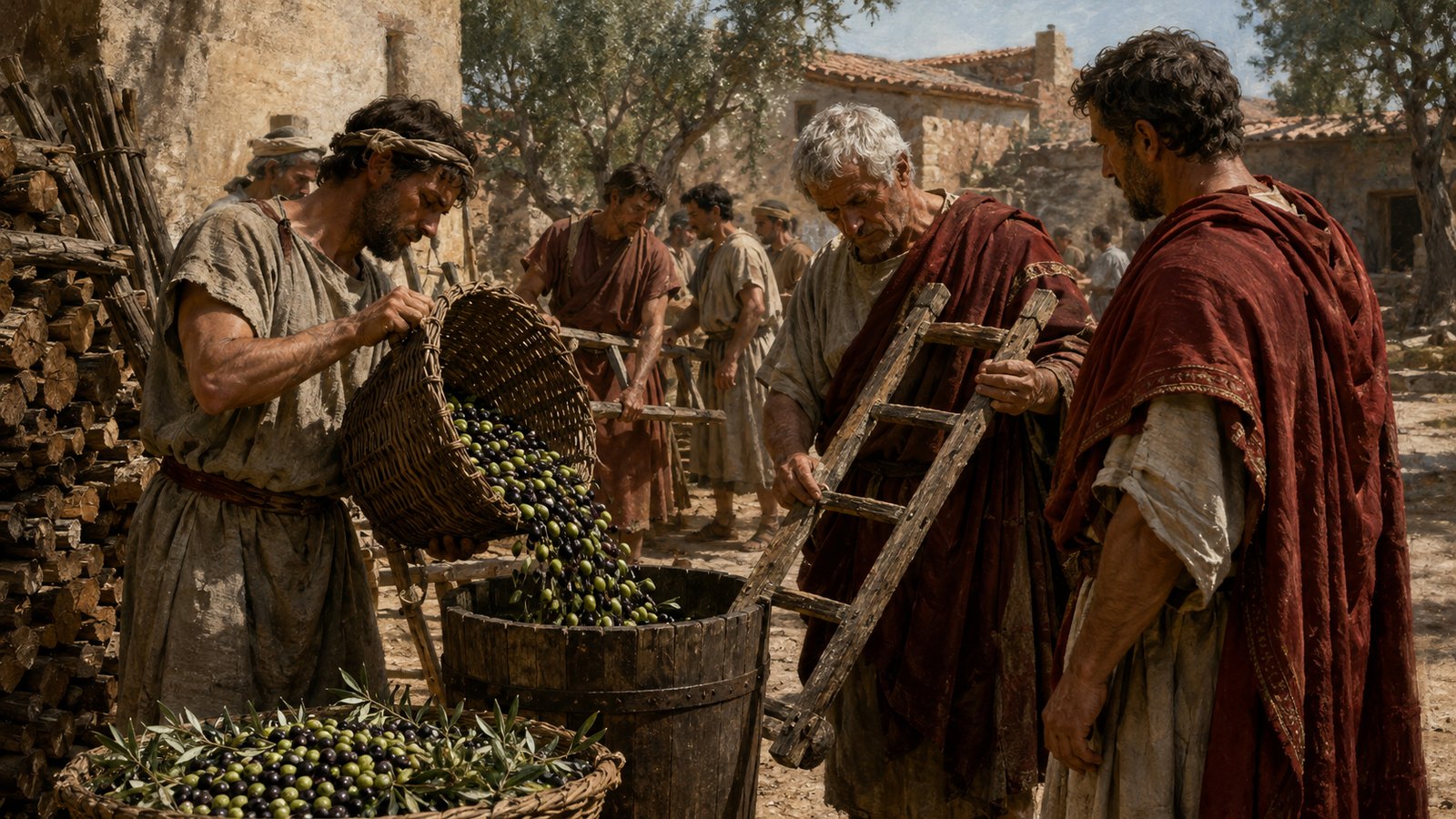
All olives were to be measured clean in an olive measure. Leaves, twigs and dirt could make a basket look fuller without adding saleable fruit. The adjective “clean” placed quality inside quantity. A standard vessel meant little if debris could inflate what entered it.
That measured movement complements Cato’s one-finger setting for olive millstones. The mill article concerns the spacing of machinery after harvest. Section 144 shows an earlier control point: workers, baskets and measures had to deliver an accountable crop before pressing began.
A Bonus and an Anti-Collusion Clause Closed the Harvest
The contract did not rely only on punishments. A harvest reaching 1,200 modii carried an extra allowance: five modii of salted olives, nine pounds of pure oil and five quadrantals of vinegar for the whole operation. If the salted olives were not taken during the harvest, the form allowed five sesterces for each modius instead.
These details put compensation in the products of the farm as well as in money. They also prevent us from reducing the workforce to a row of penalties. A large harvest generated a specified bonus, measured with the same insistence that governed deductions.
One final clause aimed at the market for the contract itself. Nobody was to form an undeclared combination to raise the price of harvesting and milling. An associate could be named at the time, but concealed cooperation invited another round of oaths and possible non-payment. The owner feared coordination among bidders as well as disorder among pickers.
The surviving page therefore follows the crop through several thresholds. Permission released it from the tree. Oaths guarded it against hidden removal. Loads, clean measures and ladder returns turned losses into visible units. Staffing rules protected speed. Arbitration priced damage, while the bonus acknowledged successful volume.
That chain is the story. Cato does not present a frictionless estate under one commanding voice. He presents a harvest vulnerable at every transfer, then tries to close the gaps with a contract. Fifty workers entered the grove, but orders, measures and sworn responsibility were meant to make their collective labor legible to the person paying for it.
Sources
Cato the Elder, De Agricultura 144.