
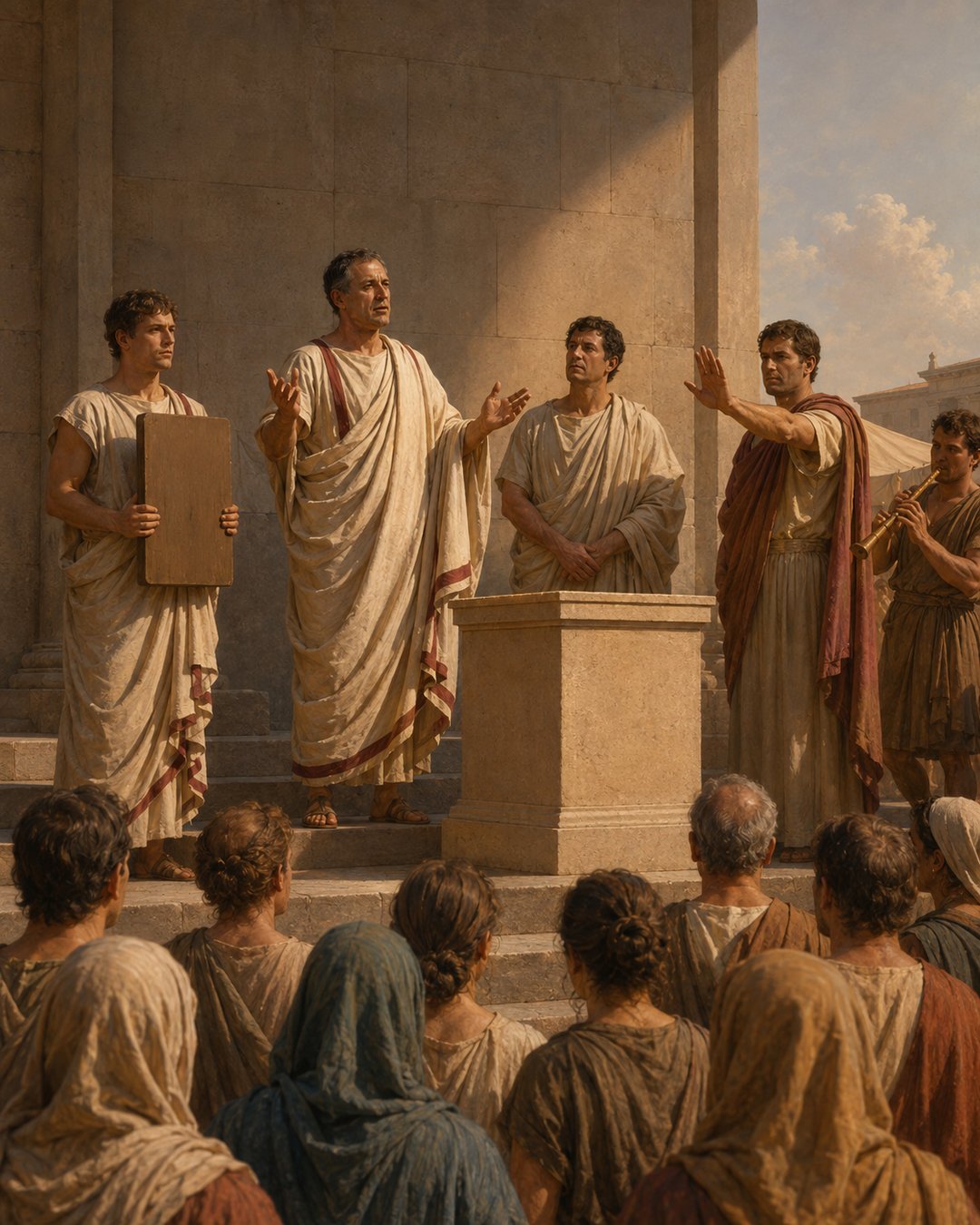
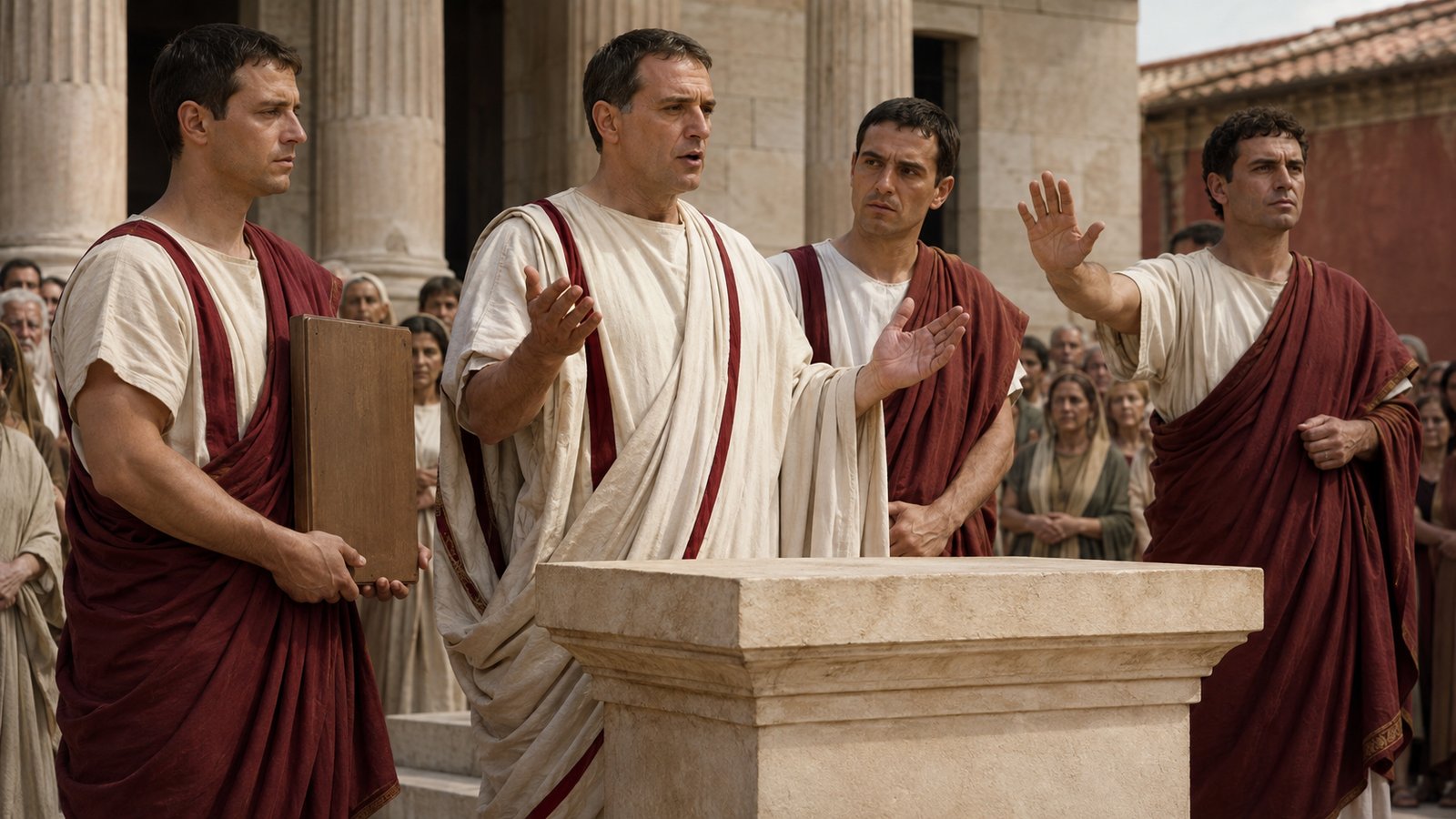
A magistrate began a public prayer, but the voice was not his alone. One attendant read the formula ahead of him from a written ritual. A second listened for every word. A third guarded the silence around them. At the edge of the ceremony, a musician played the flute so that stray speech could not intrude.
Pliny the Elder records this arrangement while asking whether words themselves possessed power. His answer is less tidy than simple belief or disbelief. Educated people might deny charms and incantations, he says, yet Roman public life repeatedly behaved as if exact verbal forms mattered.
The four-person scene reveals the practical consequence. A prayer that could fail through omission, displacement or interruption required more than reverence. It required roles, a written prompt, live checking, crowd control and sound. Civic religion turned correct speech into a coordinated procedure.
The Magistrate Repeated Words That Another Person Read
Pliny starts from a familiar ritual assumption: sacrificing a victim without the proper form of prayer was thought useless. The material offering did not complete the exchange by itself. Words addressed the deity, identified the purpose and placed the act within a recognized form.
There was not merely one all-purpose address. Pliny distinguishes formulae for entreating a deity, averting divine anger and offering commendation. The verbal route changed with the intended action. Precision therefore included selecting the right kind of speech before anyone began to pronounce it.
For the prayers of Rome’s supreme magistrates, one person went before the speaker by reading from a written ritual. The magistrate followed. This division protected the ceremony from the limits of memory without transferring public authority to the reader. The officeholder still uttered the prayer; the assistant supplied its exact sequence.
Pliny explains the purpose directly: no word was to be omitted and none pronounced out of its place. Order mattered alongside completeness. A formula was not a bag of pious phrases that could be rearranged at will. Its sequence was part of what made it the required formula.
The procedure resembles neither private improvisation nor silent reading. It was prompted speech performed in real time before others. Another Lost Eagles article follows the spoken and physical structure of a Roman treaty oath. Here, the same Roman concern with binding words appears not at an international agreement but inside the management of prayer itself.
A Second Listener Audited the Formula as It Happened
The reader did not provide the only safeguard. Pliny assigns another person to keep watch on every word. That listener turned correctness into a separate duty rather than assuming that the speaker and prompter would notice their own mistakes.
We should resist filling in details Pliny does not give. He does not name these attendants, describe a correction signal or tell us how often a prayer restarted. What he preserves is the distribution of attention. One person supplied the formula, the magistrate pronounced it, and another checked the performance.
That separation makes sense because live repetition creates several possible failures at once. A reader might move too quickly. A speaker might skip or transpose a word. Both could believe the sequence remained intact. The watcher’s role existed because authority did not make anyone immune to error.
Roman legal procedure could show a similarly severe sensitivity to prescribed wording. In the early lawsuit lost through the word “vine”, an apparently sensible substitution failed against the demanded formula. Pliny’s prayer scene belongs to religion rather than litigation, but both expose a culture in which correct intention did not always rescue incorrect words.
The checker also changed the social shape of the ceremony. What looked to spectators like one magistrate addressing the gods depended on an unobtrusive team. Public authority occupied the center, while accuracy was produced around it.
Silence Had an Officer and Noise Had a Flute
A third person was charged with preventing an ominous break in silence. This was not the same task as checking the magistrate’s words. It directed attention outward, toward everyone and everything capable of adding an unwanted voice to the ritual space.
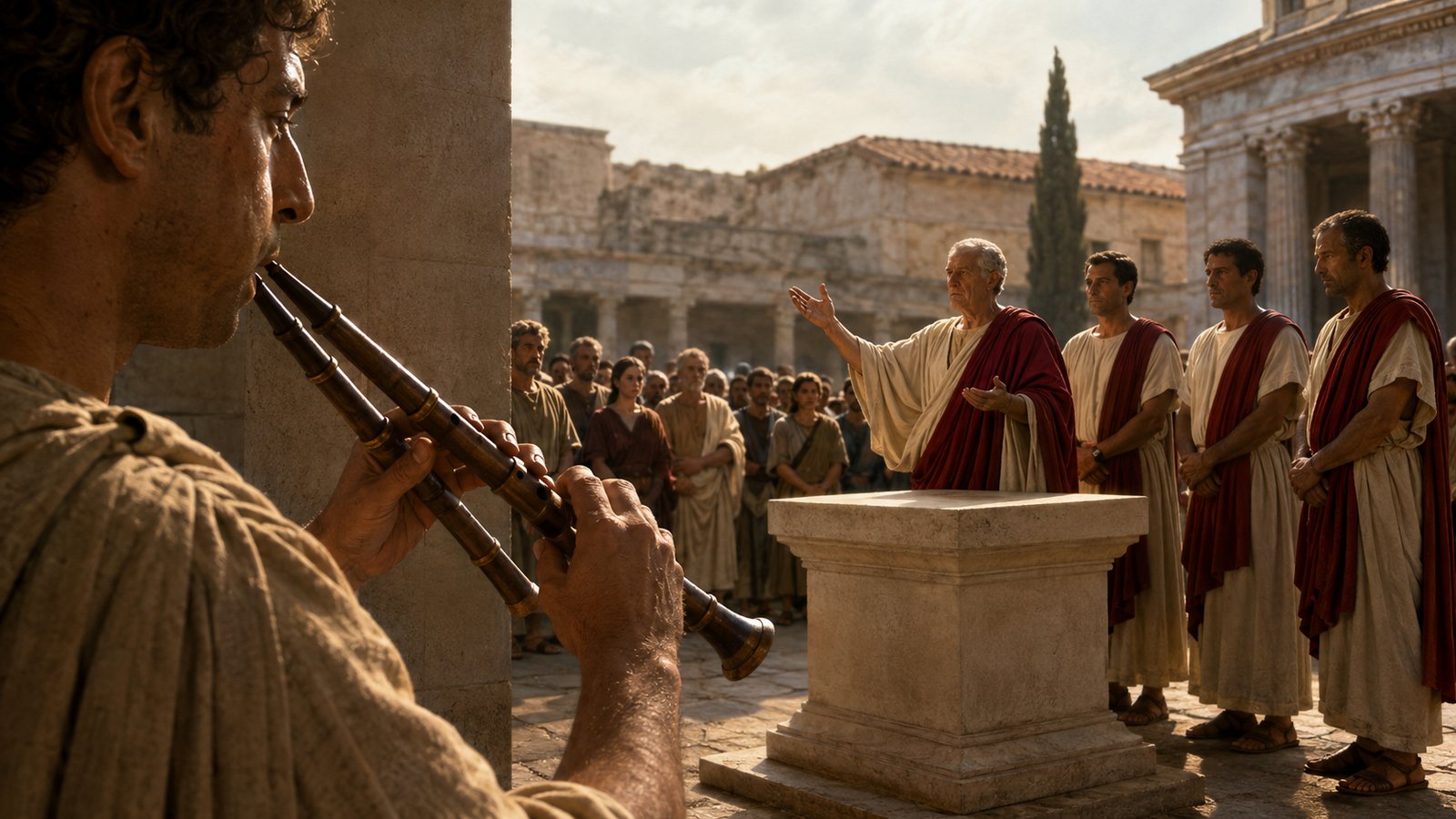
Pliny then adds the flute player. The musician performed so that other words would not be heard. Music did not simply decorate the sacrifice. In his explanation it formed an acoustic barrier, filling the surrounding air with controlled sound while the authorized formula continued.
The two measures worked on different sides of the same risk. The silence-keeper regulated the people present. The flute reduced the chance that an uncontrolled utterance would reach the ritual center. One sought quiet through conduct; the other protected the prayer through masking.
This gives Roman ritual a striking soundscape. The desired condition was not absolute silence, because the magistrate, prompter and flute all produced sound. It was selective audibility. The right words had to remain intelligible to the participants, while irrelevant or hostile words were denied ritual presence.
Pliny mentions annalistic stories in which imprecations interrupted sacrifices and made them defective. He also reports stories connecting mistaken prayers with impossible changes in a victim’s organs. Those marvels belong to the claims he inherited, not to observations we can verify. Their narrative function is clear: they made verbal failure visible in the sacrificed body.
Preserved Formulae Carried Authority across Generations
Pliny supports his discussion by pointing to prayers remembered from Roman history. He names the formulae of the Decii, father and son, who devoted themselves in battle. Their words survived as evidence that a public act of the highest consequence required a recognizable verbal form.
The archive has already examined the elder Decius speaking his self-devotion formula before riding into the Latin line. Pliny uses that tradition for a different question. He is not narrating the battle in detail; he is assembling examples for the endurance and supposed force of set speech.
He also cites the Vestal Tuccia. After an accusation of sexual misconduct, she was said to have carried water in a sieve while uttering a preserved prayer. Pliny dates the episode to year 609 of the city. The story joined an exact verbal appeal to an impossible-looking physical demonstration.
A darker example comes from a live burial ceremony in the Forum Boarium. Pliny says its prayer was first pronounced by the master of the Quindecimviri. His discussion treats long use as evidence of efficacy. Modern readers need not accept that reasoning, and his compressed account should not turn the victims into ritual scenery. The passage nevertheless shows a specialist college preserving words that authorized a terrifying public act.
Finally, Pliny records a belief from his own day that Vestal virgins could halt a runaway enslaved person by prayer, provided the fugitive had not gone beyond the city limits. The condition gave spoken power a mapped boundary. The claim also reminds us that ritual efficacy, as Romans imagined it, could serve coercion as readily as protection.
Exact Speech Became a Civic Technology
Pliny never resolves his opening problem through a controlled test. He notices instead a contradiction between stated skepticism and repeated practice. People who rejected verbal magic still participated in institutions built around the assumption that certain words, said in the proper way, changed what an action meant.
The magistrate’s team is the strongest evidence because it does not depend on accepting a miracle. Whatever the gods heard, Romans assigned labor to prevent verbal error. A written ritual externalized memory. A reader maintained sequence. A checker audited delivery. A silence-keeper and musician managed the acoustic environment.
Each role answered a different failure mode. Combining them made the ceremony more resilient, but it also advertised how vulnerable formal prayer was believed to be. The greater the public stakes, the less acceptable improvisation became.
This is why the flute belongs at the center of the story rather than in the background. Its music made a boundary that architecture alone could not provide. A crowd could be physically present while its accidental words were kept outside the formula.
Roman prayer in Pliny’s account was therefore not simply a statement of inward belief. It was a public performance whose validity depended on controlled language. Four people gathered around one formula because civic religion treated speech as something that had to be prompted, checked, protected and heard under carefully managed conditions.
Sources
Pliny the Elder, Natural History 28.3.