
Before six brothers fought for Rome and Alba Longa, a Roman priest asked his own god to punish Rome if it broke its word.
Livy places the treaty before the combat of the Horatii and Curiatii. Three champions from each community would decide which people submitted to the other. Yet the duel did not rest on a spoken bargain between commanders alone. The agreement passed through a sequence of questions, pure grass from the Citadel, a designated oath-speaker, a long formula and a swine struck with flint.
The final act made the threat unmistakable. If the Roman people were first to abandon the conditions through public decision and fraud, Jupiter should strike them as the priest struck the animal—only harder, because divine power exceeded human strength.
Livy calls this the earliest treaty in his narrative and says he describes the traditional form. The account is not a transcript produced in Rome’s regal age. It is Livy’s later preservation of how Romans imagined authoritative treaty-making: obligation became credible when a community publicly called destruction upon itself for deliberate breach.
A duel needed more than an agreement between armies
Rome and Alba faced a dangerous problem. Their dispute would be settled not by a full battle but by representatives. The nation whose champions prevailed would receive the peaceful submission of the other. That outcome required both sides to accept in advance that the combat’s result would bind everyone.
A commander’s handshake could announce consent, but the stakes reached beyond two men. Livy’s ritual gave the agreement a structure that spoke for the Roman people. The fetial asked King Tullus whether he ordered a treaty with the Alban pater patratus. Only after an affirmative answer did the next step begin.
Livy pauses the story to describe this process because he regards the treaty as a precedent. Conditions might differ from one agreement to another, he says, while the forms remained traditional. His claim concerns remembered procedure, not proof that every historical treaty was performed without variation. Still, it shows what he considered the grammar of a binding pact.
The procedure’s relation to war is clearer beside the fetial spear that turned an unanswered grievance into a declaration of war. That separate rite moved from demand to authorized hostility. The Alban ceremony moved in the opposite direction: from armed confrontation to a limited contest whose consequences both sides promised to accept.
In each case, force was surrounded by words and roles. Rome did not imagine war and treaty as conditions that existed merely because leaders felt them. A public sequence identified who could speak, what had been demanded and which divine witness heard the result.
Grass from the Citadel created the oath-speaker
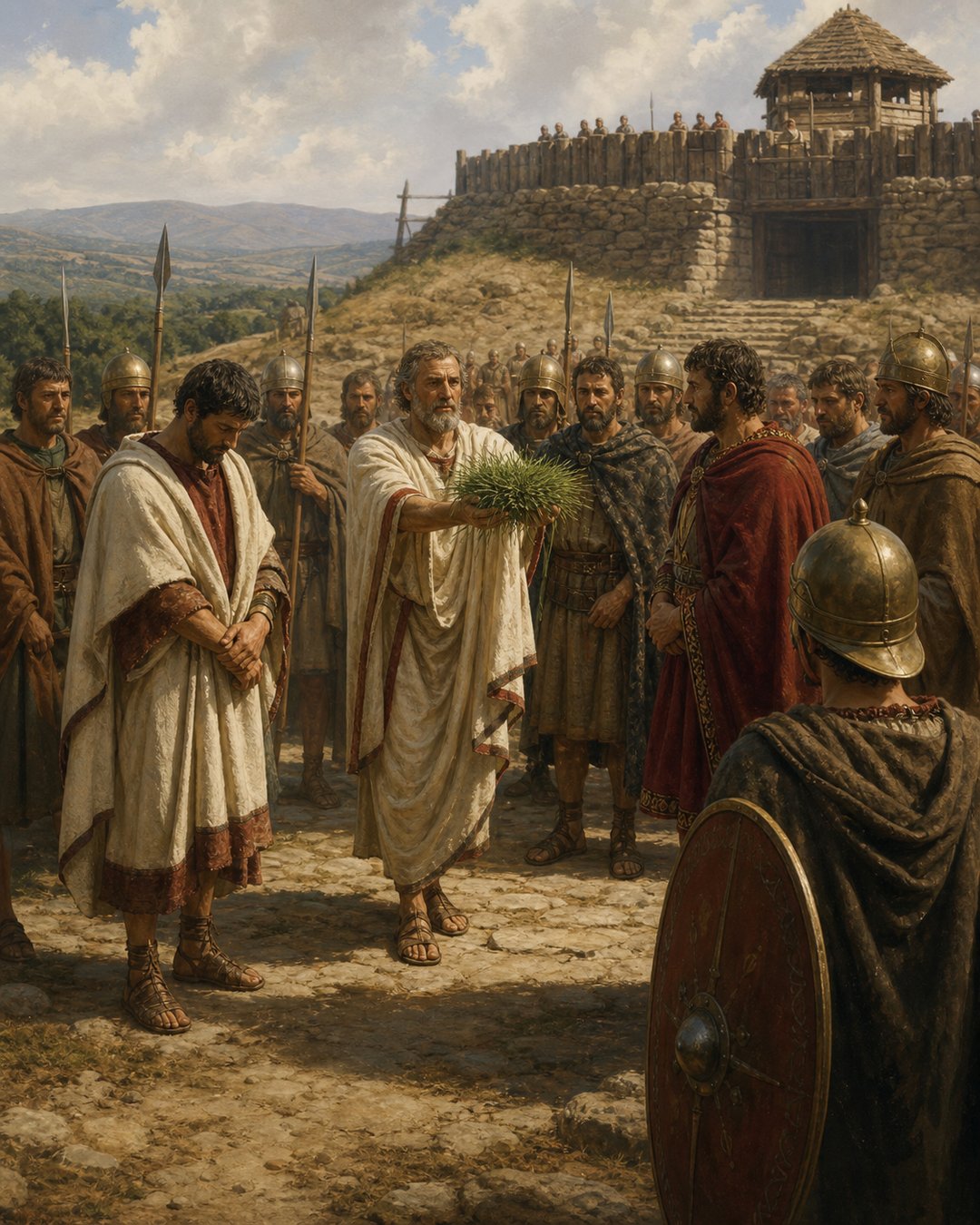
After asking for authority to negotiate, the fetial demanded pure tufts of grass. The king told him to take what was pure, and the grass came from the Citadel. A common plant became a controlled ritual material because its place and condition mattered.
The fetial then asked to be constituted the plenipotentiary of the Roman people, the Quirites, with his vessels and comrades sanctioned. The exchange prevented him from appearing as a private traveler who happened to know a formula. His authority was requested, answered and bounded through public speech.
Livy names the fetial as Marcus Valerius. Valerius made Spurius Furius the pater patratus by touching his head and hair with the grass. The plant therefore did more than decorate the scene. It participated in creating the person who would give the agreement religious sanction.
The act shows why translating every role into a modern office can mislead. The pater patratus was not simply a notary, diplomat or priest in isolation. Within Livy’s sequence, he was the specially constituted speaker who carried the oath. His capacity emerged from royal authorization, fetial procedure and contact with grass taken from Rome’s sacred-political center.
Material from the Citadel linked the traveling representative to the community he represented. The treaty would be spoken at the boundary between peoples, but the grass carried a point of origin. Rome’s authority was not left behind when the delegation moved outward.
The formula made deliberate breach the central danger
Livy does not reproduce the entire long metrical formula. He gives enough of the oath to reveal its logic. The speaker called Jupiter to hear. He declared that the Roman people would not be the first to depart from the conditions understood there that day.
The qualification mattered. The curse addressed a breach made by public counsel and wicked fraud. This was not a prayer that every misfortune should trigger Roman destruction. It identified collective, intentional bad faith: the people, acting through public decision, becoming first to abandon what had been agreed.
By speaking the conditions before the curse, the ritual connected obligation with memory. The parties needed to know what action would count as departure. The formula did not make interpretation impossible, but it prevented the oath from floating free of specified terms.
The arrangement recalls the restrictions that made Jupiter’s priestly office visible in daily movement. Roman religion could attach divine relationships to exact physical acts and prohibitions. In the treaty, however, the rule applied to the political community: a future public decision could expose Rome to the punishment it had invoked.
This gives the oath a sharp edge. Rome did not only ask Jupiter to witness Alban fidelity. It offered Rome itself as the object of enforcement. The ritual’s credibility depended on accepting that the god was not a partisan accessory who could ignore Roman fraud.
Flint translated a future curse into a present blow
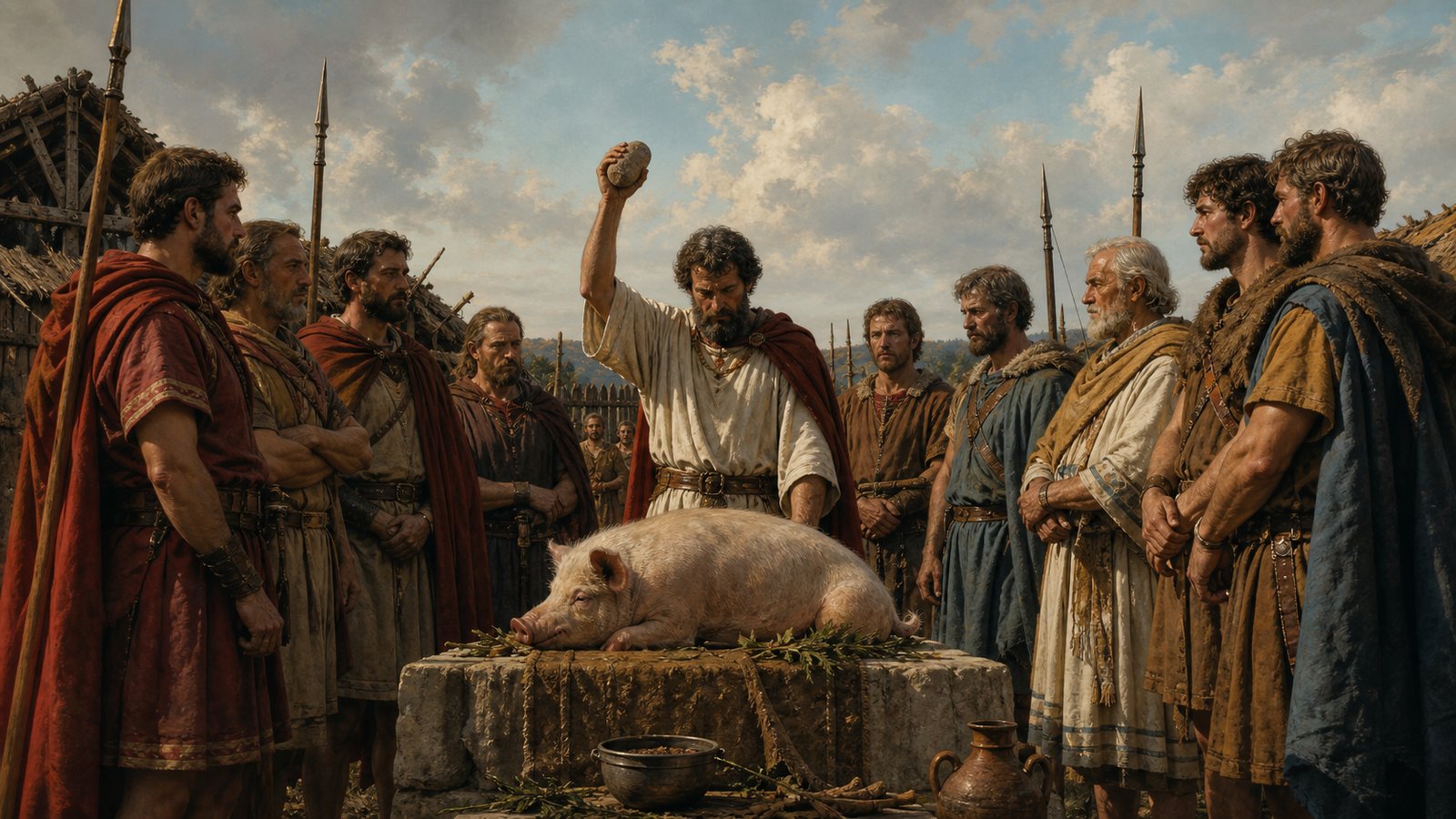
The oath reached its visible climax with the swine. The pater patratus asked Jupiter to strike the Roman people on the day of breach just as he was about to strike the animal, and to strike with greater force because Jupiter was greater in power.
He then used a flint stone. Livy’s wording makes the blow a comparison enacted before witnesses. The animal’s fate did not mechanically cause a future punishment. It supplied a present image for what the community had requested if it betrayed the pact.
Flint gave the comparison weight. It was held, seen and brought down. Spoken conditional language—if Rome acts first, if it does so publicly, if fraud guides the choice—ended in an irreversible physical act. Everyone could understand the direction of the analogy even if the full metrical formula was difficult to remember.
The scene should not be embellished into a bloody spectacle. Livy’s focus is procedural. He moves from authorization to grass, from constituted speaker to conditions, from oath to blow. The sacrifice closes a chain in which each element confirms the next.
The Albans then performed their own form and oath through their dictator and priests. Reciprocity matters. The Roman action did not bind Alba by unilateral magic. Each community furnished its own authoritative speakers and undertook its own obligation before the champions armed.
The treaty converted spectators into a bound community
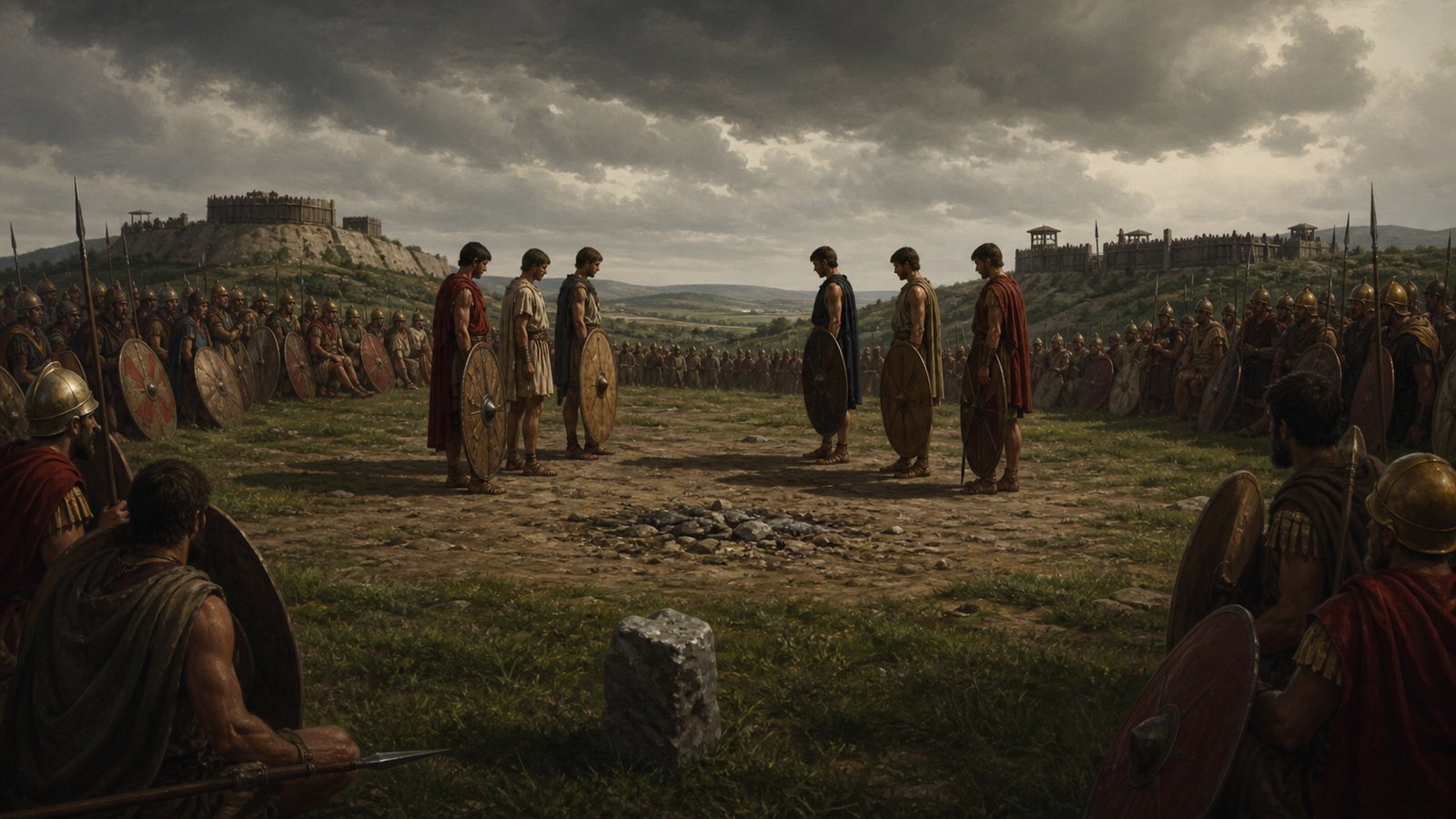
Once the treaty was concluded, the six brothers armed. The armies sat before their camps and watched. They had escaped the immediate danger of a general battle, but Livy stresses their anxiety: rule depended on the courage and fortune of a few young men.
The treaty made that extraordinary arrangement politically usable. Without prior acceptance, the losing army could dismiss the duel as one unfortunate encounter and resume the war. With the oath, the champions’ result had already been assigned a communal consequence.
The rite also distributed responsibility. Tullus authorized. Marcus Valerius acted as fetial. Spurius Furius became pater patratus and spoke the oath. Jupiter heard and was asked to punish. Alban officials completed their corresponding form. The fighters then carried the military burden. No single action bore the whole agreement.
Livy’s early-Rome narrative blends tradition, moral explanation and dramatic reconstruction. Readers should not treat every named gesture as independently verified evidence from the seventh century BC. What can be read securely is the Roman idea preserved in the text: treaties belonged to law, religion, performance and collective memory at once.
That idea explains why grass and flint occupy so much narrative space. Neither material was valuable in the way gold or silver was valuable. Their worth came from use. Grass from the Citadel created a sanctioned voice; flint made the treaty’s self-curse visible.
The ritual did not promise that Romans would never break agreements. It defined breach as more than strategic convenience. A people that chose fraud after calling Jupiter to witness would violate terms, procedure and a punishment spoken in its own name.
Before the swords rose, Rome had therefore staged a different kind of force. The king’s answer authorized the delegation. The grass carried civic-sacred legitimacy. The oath exposed the community to judgment. The flint demonstrated the blow. Only then could six men decide which army would submit without a general battle.
Sources
Livy, History of Rome 1.24–25