
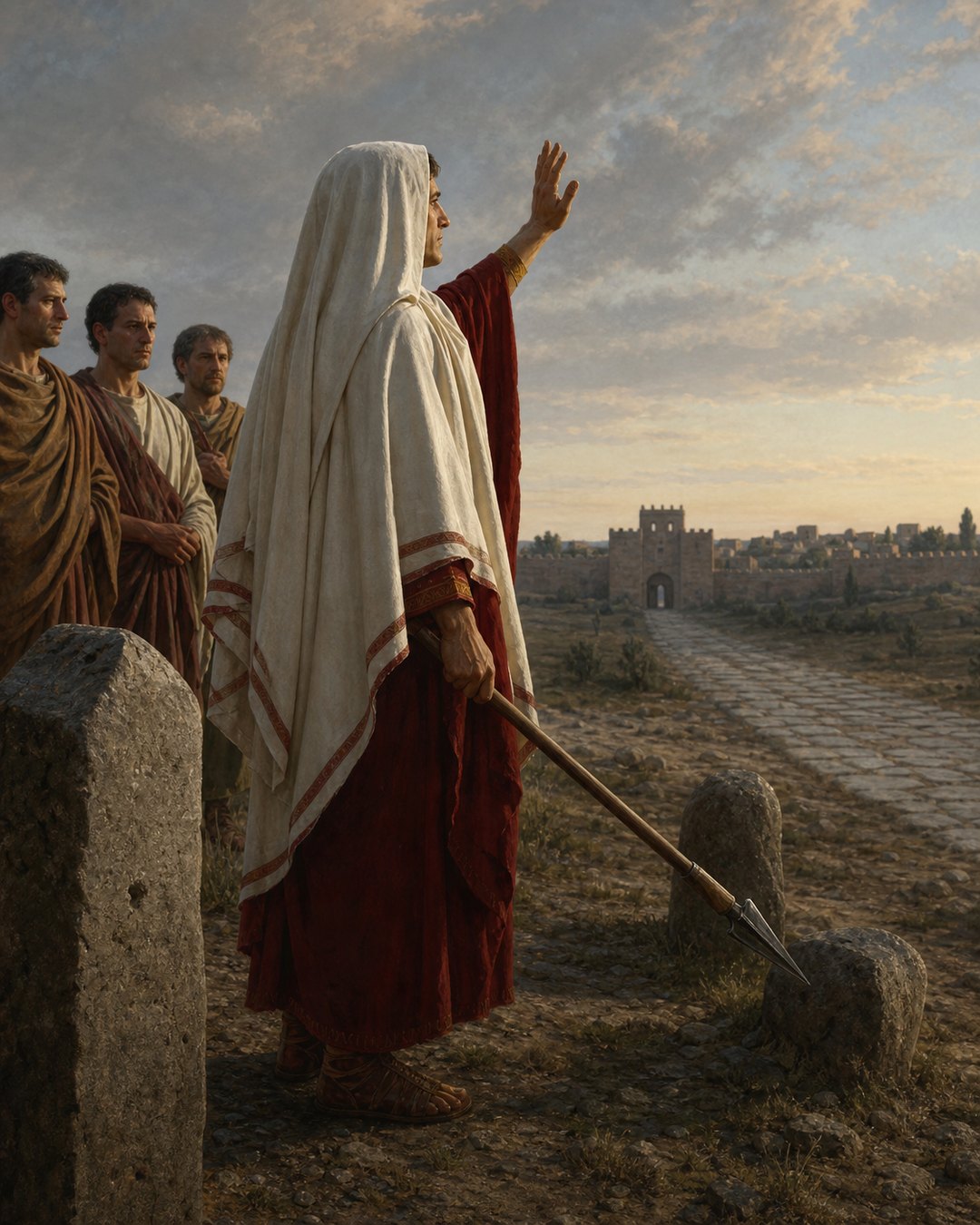
Before an army crossed a frontier, a sentence had to cross it. In Livy’s account, a wool-covered envoy stood at another people’s boundary and called Jupiter, the boundary itself and righteousness to hear him. He repeated his demand to the first person he met, at the gate and in the forum. Only after waiting, returning and consulting Rome’s political authorities did a spear enter foreign soil.
This is not a transcript from Rome’s regal age. Livy wrote centuries after the kings he describes, and his own notes preserve incompatible traditions about who founded the fetial institution. Dionysius of Halicarnassus assigns it to Numa; Livy’s chapter credits Ancus Marcius with taking the procedure from the Aequicoli, while another Livian passage connects fetials to Tullus Hostilius. The contradictions are part of the evidence.
What both authors offer is a Roman theory of controlled escalation. Religion did not sit outside law and diplomacy as decoration. Oaths, repeated locations, fixed delays, deliberation and voting made a claim of justice visible before violence. The ritual could not establish that Rome’s grievance was true. It could establish who had asserted it, before which gods, after what opportunity for redress, and with whose authorization.
The Envoy Made Himself Liable First
Livy places the ceremonial in his reign of Ancus Marcius. He says Latin raiders entered Roman territory and refused restitution. Ancus, remembered as Numa’s descendant yet unwilling to let religious care become passivity, wanted wars not only fought but formally declared. Livy says he adopted from the Aequicoli the law by which fetials demanded redress.
The envoy reached the frontier with his head covered by wool. He called Jupiter, the named boundary and righteousness to listen, identified himself as the public herald of the Roman people, and asserted that he came duly and religiously commissioned. Then he recited the demands. The sequence made office, place and claim audible together.
The oath carried a penalty aimed at the speaker. If he demanded the surrender of people or things unjustly and contrary to religion, he asked that he never again enjoy his homeland. Dionysius similarly says the fetial called the gods to witness and uttered severe imprecations against himself and Rome if the allegation of injury was false.
This self-exposure is the first restraint in the literary design. The envoy does not begin by cursing the foreign city. He makes his own truthfulness answerable to divine judgment. That differs from the failed auspices in the sacred-chicken scandal before a naval defeat: here the religious act constructs the diplomatic claim before a campaign is approved.
The Same Demand Occupied Four Places
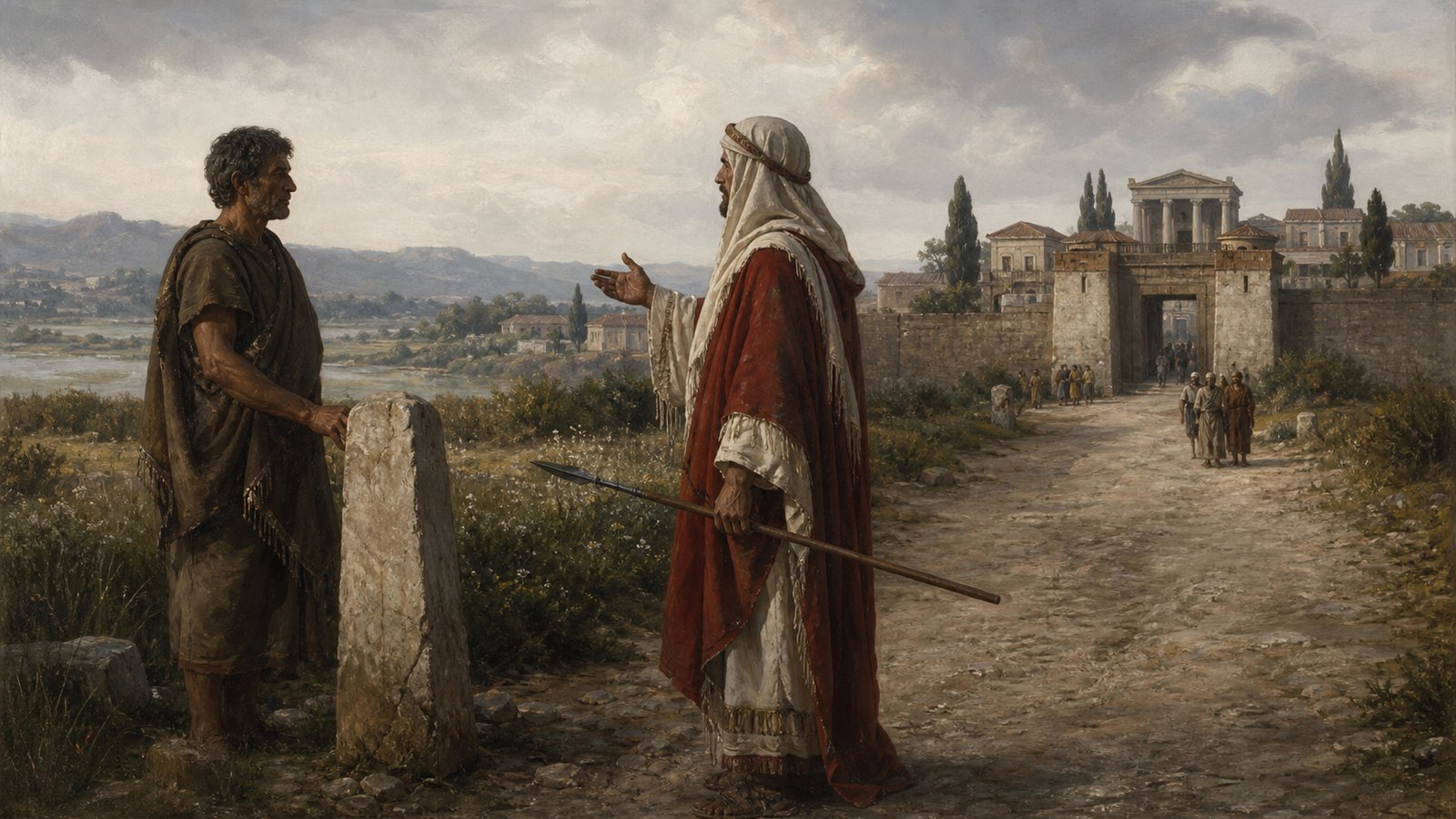
Livy’s herald repeated his words when he crossed the boundary, to the first person encountered, at the city gate and in the marketplace, changing only small parts of the formula. The message therefore advanced in stages. It was not delivered once behind closed doors and later summarized. Different locations and witnesses marked its progress toward the political centre.
Dionysius preserves a closely related itinerary. A fetial chosen by his colleagues wore sacred clothing and insignia, stopped at the border, invoked the gods, addressed the first rural or urban person he met, called a gatekeeper or another person at the gate to witness, and finally discussed the grievance with magistrates in the forum.
The repetition reduced the possibility that refusal could be portrayed as ignorance. It also made the envoy’s oath harder to detach from the demand. At each threshold the claim arrived with the same divine liability. Boundary, passer-by, gate and forum formed a chain of public notice before Rome could represent the other community as persistently unjust.
Neither author gives us the foreign side’s archive. The procedure is narrated from Rome’s perspective, with Roman priests deciding that a treaty partner has injured Rome and Roman language defining satisfaction. Its value as evidence lies in that asymmetry. A state preparing for force wanted its own account to appear patient, repeatable and witnessed.
Delay Turned Refusal into a Political Fact
Livy gives the conventional waiting period as thirty-three days. If the demanded people or things had not been surrendered by then, the envoy called heavenly, earthly and underworld gods to witness that the named people were unjust and had not made proper reparation. He then announced that Rome would consult its elders about obtaining its right.
Dionysius describes a similar but not identical schedule. The other city could ask for ten days to deliberate, and the envoy could allow that request three times. After thirty days without satisfaction, he invoked the celestial and infernal gods and withdrew so that Rome could deliberate. The difference—thirty-three in Livy, thirty in Dionysius—warns against flattening the accounts into one exact manual.
The pause mattered because it separated grievance from battle. A failed demand did not itself launch troops. Time had to pass, the refusal had to be declared before divine witnesses, and the envoy had to return. Within the authors’ logic, delay converts a disputed incident into a completed sequence that Rome can bring before its decision-makers.
This procedure should not be romanticized as neutral mediation. The same institution that carried demands also sanctioned war if compliance did not follow. Dionysius calls the fetials arbiters of peace and assigns them treaty duties, but their authority helped Rome say when negotiation had ended. The clock was both an opportunity and a path toward authorization.
The Senate Supplied the Missing Consent
Back in Rome, Livy’s king consulted the Fathers. He summarized the things, suits and causes demanded by the pater patratus of the Roman people from the Ancient Latins and asked the first senator for his opinion. The answer endorsed seeking those things through just and righteous war. Other senators were questioned in order.
War was agreed when a majority supported that position. The ritual envoy could certify demand and refusal, but he did not replace political decision. Divine witness, priestly procedure and senatorial consent occupied separate links. Livy’s formula carefully repeats that the Roman people commanded war and the senate approved, agreed and voted for it.
Dionysius makes the dependency sharper. After completing the ordained steps, the fetials reported to the senate that nothing in sacred law obstructed a vote for war. If required actions had been omitted, he says, neither senate nor people possessed power to authorize it. This is Dionysius’s account of ancestral law, not proof that every Roman conflict obeyed it.
The contrast with the senate’s detailed regulation of Bacchic meetings is revealing. Both narratives make a public decision through counted authority, but the fetial sequence builds an external case before voting. Rome first narrates injury across the frontier, then narrates completed restraint at home.

The Spear Condensed the Whole Procedure
Livy says the fetial carried a cornel-wood spear to the other people’s boundary. Its point could be iron or hardened in fire; the declaration required at least three adult witnesses. In the spoken formula, the envoy named the offences, the Roman people’s command, and the senate’s approval before declaring and making war.
After speaking, he hurled the spear into the other territory. The weapon was therefore not the first message. It was the final compact gesture after demand, repetition, delay, consultation and vote. Its crossing announced that the prior forms were complete. A small object condensed a long administrative and religious sequence into visible movement.
The popular image of a blood-tipped spear comes from the Latin description of the point, which can be translated as iron-tipped or bloodied and fire-hardened. The important caution is functional: Livy’s text offers alternatives in the spear’s construction while being exact about witnesses and authorization. Material detail serves procedure, not theatrical gore.
Livy closes by saying this was how redress was sought from the Latins and how war was declared, a custom received by later generations. Dionysius, meanwhile, assigns the college to Numa and admits uncertainty over whether its model came from the Aequicoli or Ardea. The origins remain unstable; the desired lesson is stable. Roman writers wanted war to begin after a publicly staged exhaustion of alternatives. That claim could legitimize expansion, restrain haste, or do both at once. The spear’s flight did not prove justice. It made Rome’s declared version of justice impossible to miss.