
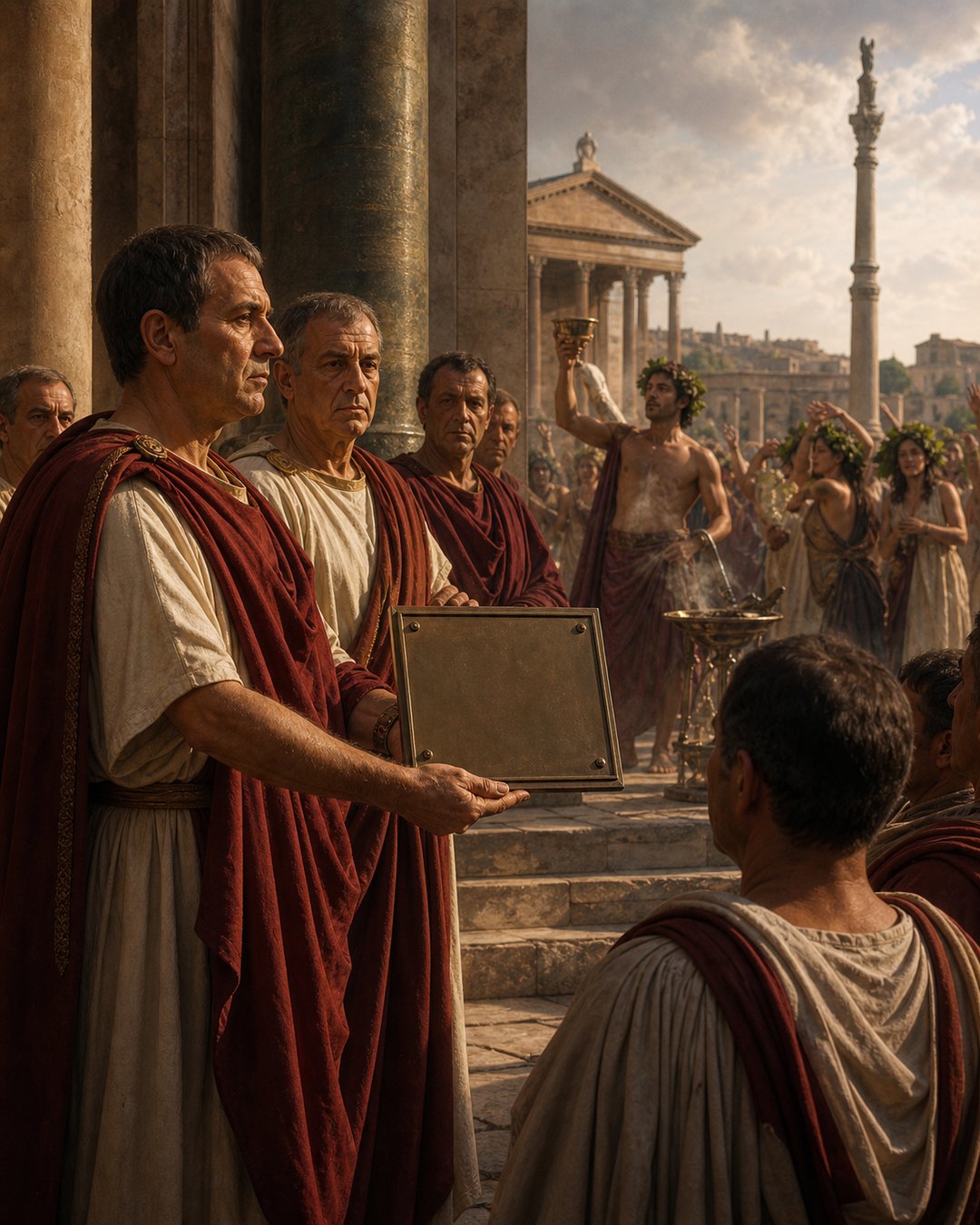
Five people could still meet. Six could not. Even among the permitted five, no more than two could be men and no more than three women. A priest, a presiding officer, a common treasury or a mutual oath could turn the gathering from tolerated worship into a capital case. The surviving order is so exact that it reads less like a burst of panic than a set of instructions for taking an organization apart.
The order concerns the Bacchanalia, rites associated with Bacchus, and dates to 186 BC. Rome’s literary account comes from Livy, who frames the affair as a domestic conspiracy filled with nocturnal excess and hidden crime. The bronze text is a different kind of witness. It does not preserve drums, rumours or a witness trembling before a consul. It preserves thresholds: who may assemble, who may lead, what participants may promise, where rites may occur and how local magistrates must publish the decision.
That distinction matters. The Senate did not merely tell Italy to stop believing in a god. It made unsupervised Bacchic worship administratively expensive and socially fragile. Permission had to come through the urban praetor and a large senatorial quorum. The structures that could carry a group from one meeting to the next were forbidden. The decree’s real instrument was not a single prohibition but a sequence of deliberate disconnections.
The Bronze Copy Was an Order Sent South
The document known as the Senatus consultum de Bacchanalibus survives through a bronze tablet found at Tiriolo in southern Italy in 1640. The translated text identifies itself as a communication to the Ager Teuranus. It was not simply a master copy sitting in a Roman archive. It carried the Senate’s decision outward to allied territory, where local officials had to turn it into a public and enforceable rule.
The opening fixes the decision in institutional time. Quintus Marcius, son of Lucius, and Spurius Postumius, also son of Lucius, consulted the Senate on 7 October in the Temple of Bellona. Marcus Claudius, Lucius Valerius and Quintus Minucius assisted in drafting. Those names are not decoration. They show a resolution passing through consuls, senators, drafters and local magistrates rather than arriving as an anonymous religious warning.
This administrative chain resembles, while remaining much earlier than, the six bronze tablets that preserved municipal law at Irni. Bronze could give rules durability, but metal alone did not make law effective. Someone had to receive the text, announce it, display it and enforce its deadlines. The Tiriolo copy lets us watch a senatorial decision become a provincial task.
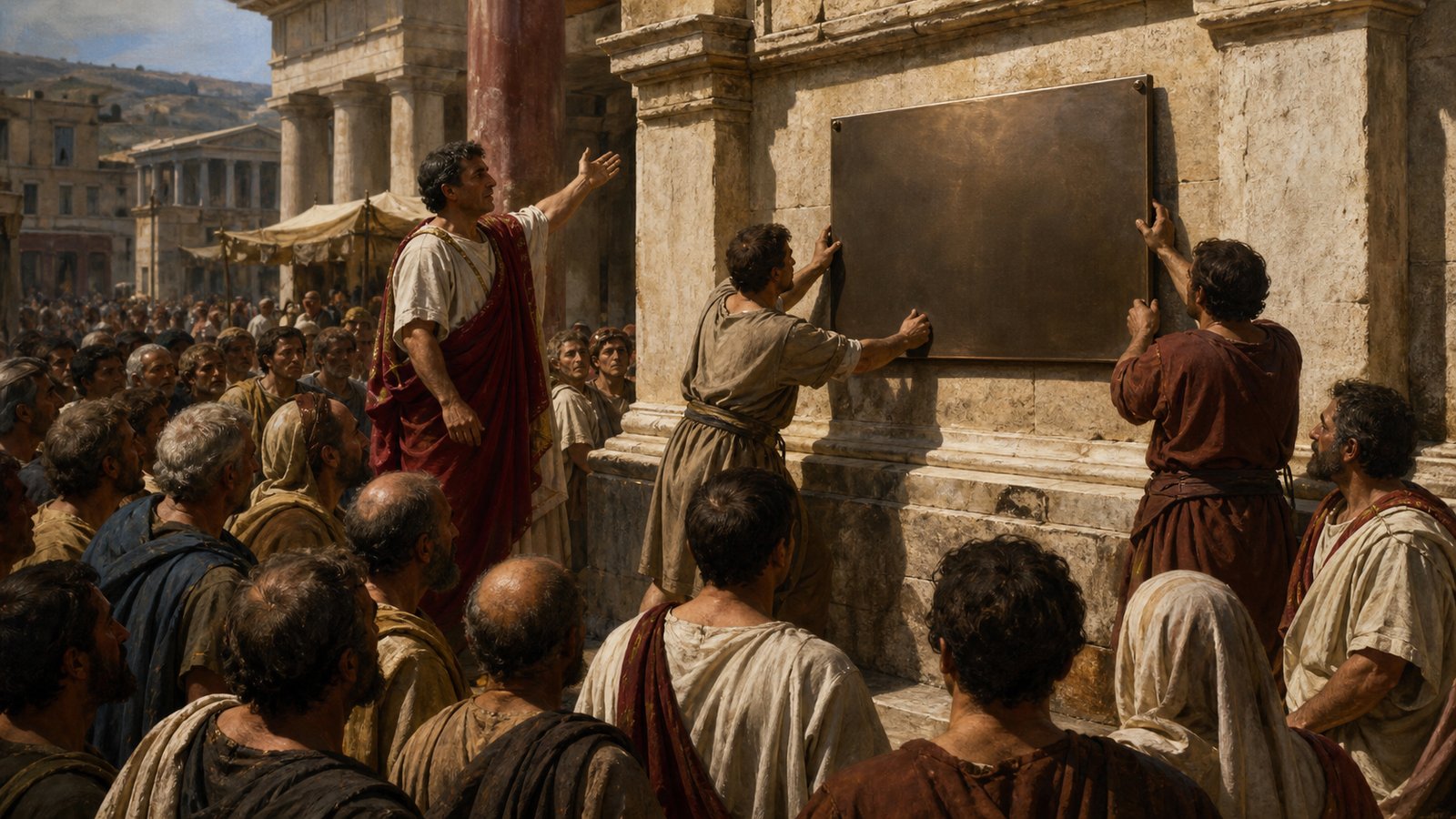
The decree ordered local officials to publish its terms in an assembly for at least three market days. It then required the words to be cut on bronze and posted where they could be read most easily. Repetition before a crowd and permanence in metal worked together. The Senate wanted neither a private instruction nor an excuse that the order had remained unknown.
Permission Required One Hundred Senators
The first rule did not erase every possibility of Bacchic worship. It forbade anyone to maintain a place devoted to Bacchus unless a person claiming that such a place was necessary travelled to Rome and appeared before the urban praetor. The Senate would decide only after hearing the request. An exception therefore existed, but the route to it ran through the capital.
The quorum made that exception unusually heavy. At least one hundred senators had to be present when the case was discussed. The same requirement appears again when the decree addresses participation by Roman citizens, people with Latin rights and Rome’s allies. None could associate with the Bacchae without praetorian permission backed by a senatorial decision reached in the presence of one hundred members.
A local group could not regularize itself through a friendly magistrate or an informal understanding. It had to expose its claimed necessity to Roman scrutiny. Distance became part of control: a community in southern Italy faced the cost, delay and uncertainty of a hearing at Rome before it knew whether its ritual place or meeting was lawful.
The breadth of the wording is equally revealing. Romans, Latins and allies are named separately, then placed under the same route of approval. The decree crossed the gradations of status through which Rome governed Italy. It did not leave allied communities free to treat the Bacchanalia as somebody else’s civic problem.
The Senate Removed the Parts That Made a Group Last
After controlling place and access, the decree turns to organization. No man was to serve as priest. No man or woman was to act as master. Participants could have no common fund. They could not appoint anyone to preside or to act as though presiding. The language strips away both office and the resources through which an office could continue between ceremonies.
Money mattered because a shared treasury gives a group memory. Contributions can pay for space, equipment, food and future rites. An officer can call the next meeting, assign roles and speak for members. By forbidding both, the Senate targeted continuity rather than a single night’s performance. A gathering might disperse; an association with funds and recognized leaders could return.
The resolution then reaches into promises. Participants were not to swear a common oath, make common vows, enter stipulations, exchange pledges or give one another surety. In the decree’s own translated sequence, these are separate acts, not one vague ban on loyalty. Rome was cutting the formal and personal bonds by which members could become answerable to one another.
That focus gives the bronze text a different narrative engine from the bronze law that secured Vespasian’s earlier acts. Vespasian’s law assembled authority around one ruler after civil war. The Bacchanalia order works in the opposite direction: it prevents a dispersed religious network from assembling authority around its own offices, purse and commitments.
Secrecy and Numbers Became Legal Boundaries
The decree says that no one should perform the rites in secret. It immediately broadens the rule: rites were not to occur in public, in private or outside the city without the approved praetorian and senatorial process. Changing the setting could not evade the order. A house, an open space or a rural sanctuary all fell inside the same net.
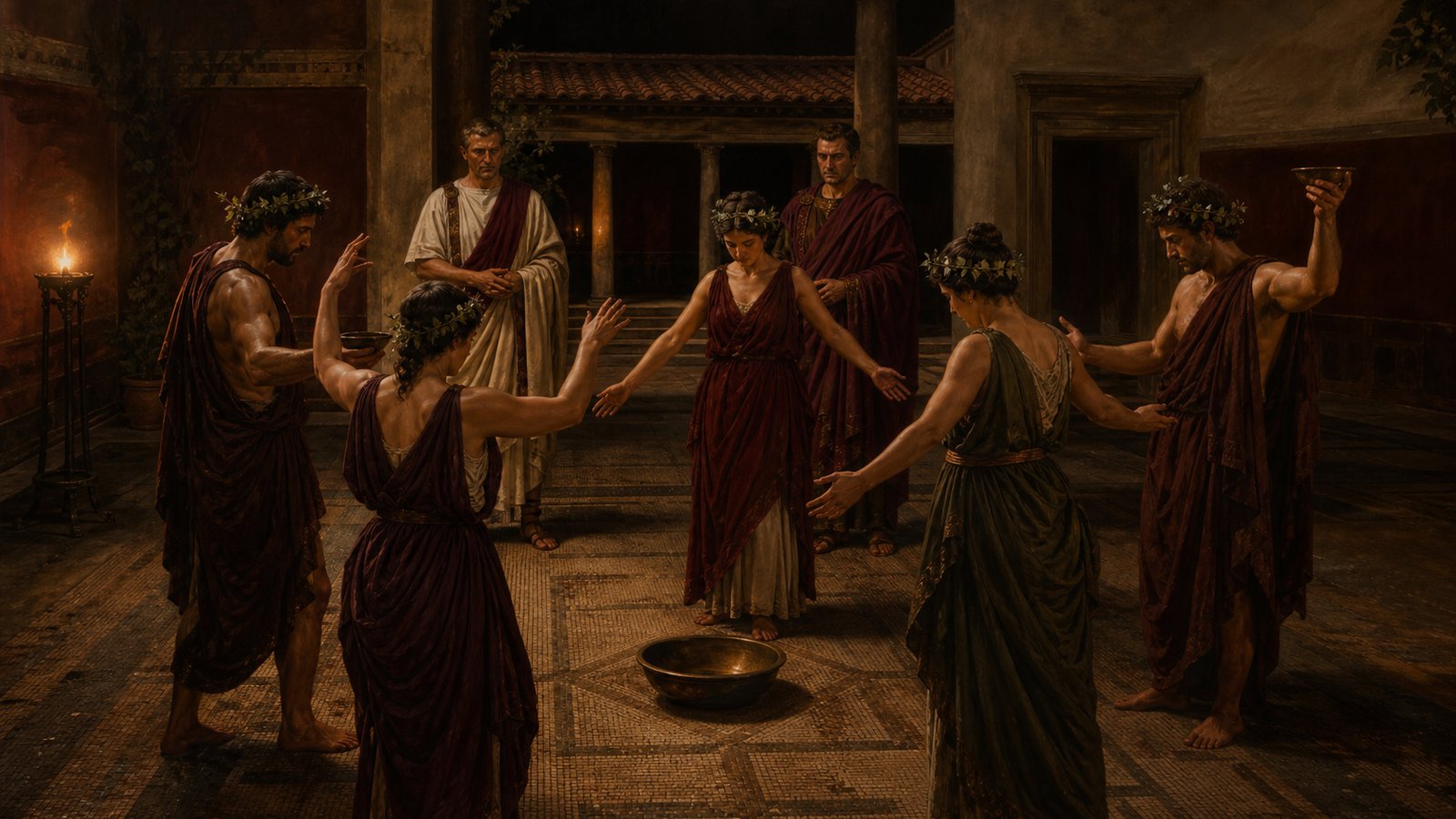
Then comes the number that makes the policy visible at human scale. Without special permission, no company of more than five men and women together could conduct the rites. Within those five, no more than two men and three women could be present. The state was not merely regulating a crowd. It was fixing the maximum size and gender composition of the smallest lawful circle.
The rule did not make a five-person meeting organizationally free. The prohibitions on a priest, a master, a treasury, mutual oaths and secret rites still applied. Five is therefore not a miniature licence for an intact Bacchic association. It is the ceiling for a gathering already deprived of the institutions that might bind it into a durable body.
Livy’s Book 39 supplies the charged atmosphere around these clauses. He introduces the consuls’ work as an investigation of secret conspiracies and describes wine, night meetings, drums and cymbals, forged documents, poisonings and murders. Those allegations belong to Livy’s literary account and should be attributed to it, not silently converted into proven facts about every worshipper. The bronze decree confirms the state’s intense concern with secrecy and association; it does not independently prove every crime in Livy’s catalogue.
Publication Ended with a Ten-Day Clock
The closing instructions turn policy into a countdown. Officials were to announce the decree over at least three market days. Anyone acting against it faced proceedings for a capital offence. The resolution had to be inscribed on bronze and placed where it could be read easily. Publicity was followed by a deadline, not an indefinite request for local adjustment.
Within ten days after the tablets were delivered, places devoted to Bacchic worship had to be dismantled. The text preserves one careful exception: something sacred involved in the place could alter what was removed. Even while attacking the association’s infrastructure, the Senate distinguished the physical destruction of a meeting place from the treatment of sacred matter.
This is why ‘Rome banned the Bacchanalia’ is both broadly understandable and too blunt. The order allowed a supervised path to permission, yet made that path pass through the urban praetor and one hundred senators. It tolerated tiny groups only after leadership, money, oaths, secrecy and larger attendance had been denied. The surviving machinery is administrative, social and spatial all at once.
The Tiriolo tablet ultimately preserves more than fear of an unfamiliar rite. It shows how a republic could govern association without arguing about every belief held by every participant. Rome controlled the room, the purse, the titles, the promises, the headcount and the clock. A cult might remain in name, but the decree tried to ensure that it could not easily organize itself into a body capable of surviving the next meeting.