
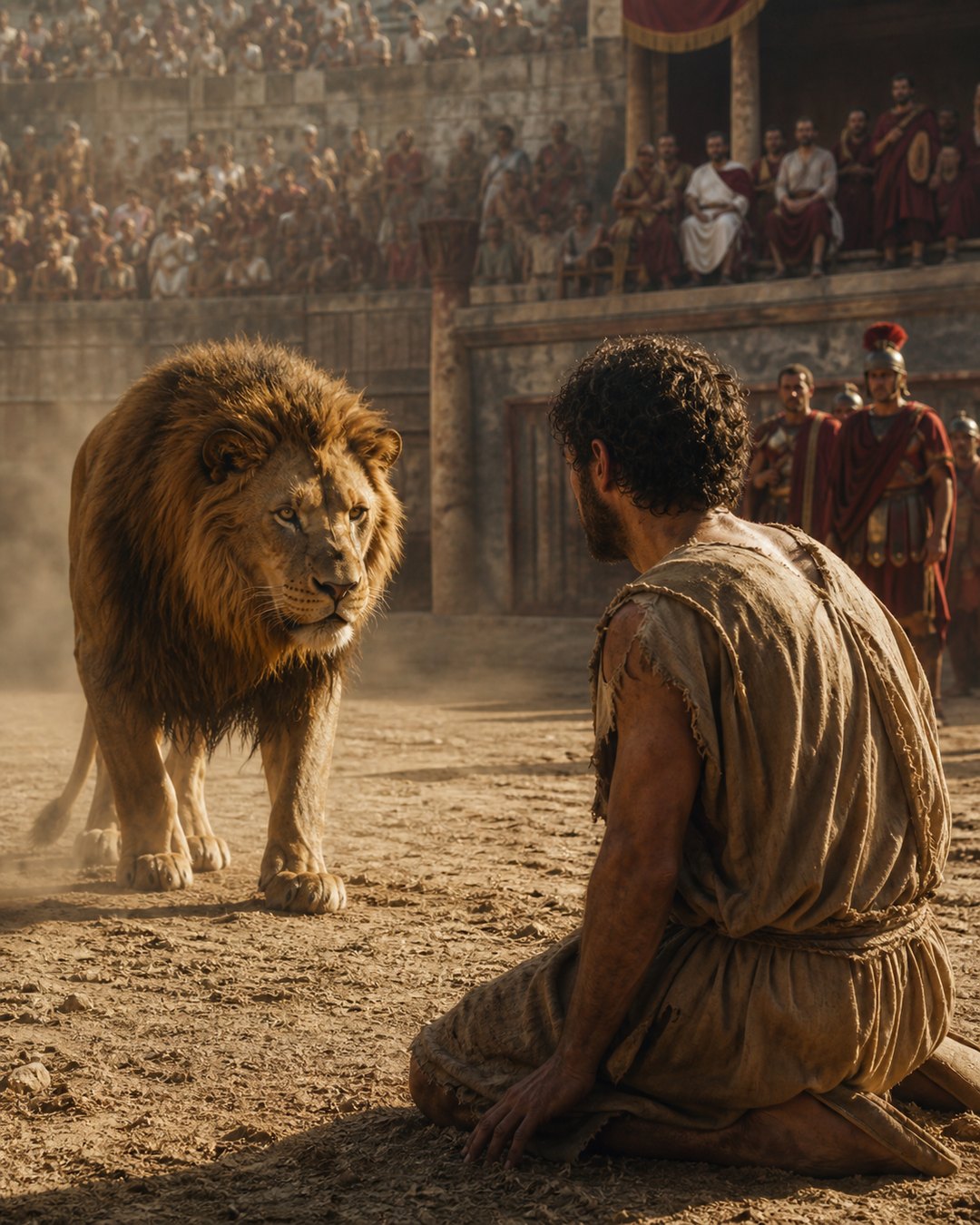
The condemned man had every reason to watch the lion’s mouth. Instead, the story asks us to watch the animal stop. In Aulus Gellius’s telling, the largest lion in a Roman beast show halted at the sight of one enslaved prisoner, approached quietly, and licked his hands and feet. The expected killing became a problem that the arena could not explain by itself.
Gellius did not claim to have witnessed the encounter. He said he found it in the fifth book of Apion’s Wonders of Egypt. Apion, in turn, insisted that this particular marvel was neither hearsay nor something read: he claimed that he had seen it at Rome. The chain matters. We possess Gellius reporting Apion reporting a spectacle and the prisoner’s speech within it, not an independent record of animal behaviour.
Read with that distance intact, the episode becomes more interesting, not less. Its machinery resembles a public inquiry. An interruption demands a cause; an authority questions the condemned man; his narrative reconnects the lion to an earlier wound; a written tablet carries the explanation around the Circus; the crowd changes the sentence. Recognition does not merely save a life. It makes an enslaved speaker temporarily necessary to Rome.
Apion Put His Own Eyes on Trial
Gellius introduces Apion as learned, widely read and knowledgeable about Egypt, but also as verbose and fond of displaying his learning. That mixed appraisal warns the reader before the marvel begins. Gellius neither dismisses Apion nor grants him effortless trust. He identifies the author’s appetite for attention and then records the stronger claim Apion attached to this one event: personal sight in Rome.
The distinction between hearing, reading and seeing gives the chapter its first evidentiary ladder. Apion’s claimed presence does not prove every remembered word, but it makes eyewitness status part of the performance. The narrator steps into the Great Circus alongside the audience and asks the reader to accept not an anonymous wonder but a wonder vouched for by a named, if self-promoting, observer.
Apion describes a large-scale beast exhibition containing many animals remarkable for size, appearance or ferocity. One lion exceeded the others and drew collective attention through its body, mane, roar and movement. The detail is not neutral decoration. It raises the expected danger before Androclus appears. The animal that refuses the script is first established as the animal most capable of fulfilling it.
This framing belongs beside Rome’s astonishment at an unfamiliar giraffe, but the mechanism is different. The giraffe invites naming; this lion creates contradiction. Spectators know what a condemned prisoner and a large predator are supposed to do in the same arena. Apion’s story begins when neither behaves as expected.
A Refusal to Attack Became a Question
The prisoner is introduced through legal and social reduction: he was the slave of a former consul and had been condemned to face wild beasts. Gellius gives the name Androclus; later tradition often renders it Androcles. In the arena, however, status initially matters more than spelling. The man has entered as someone whose death is scheduled entertainment.
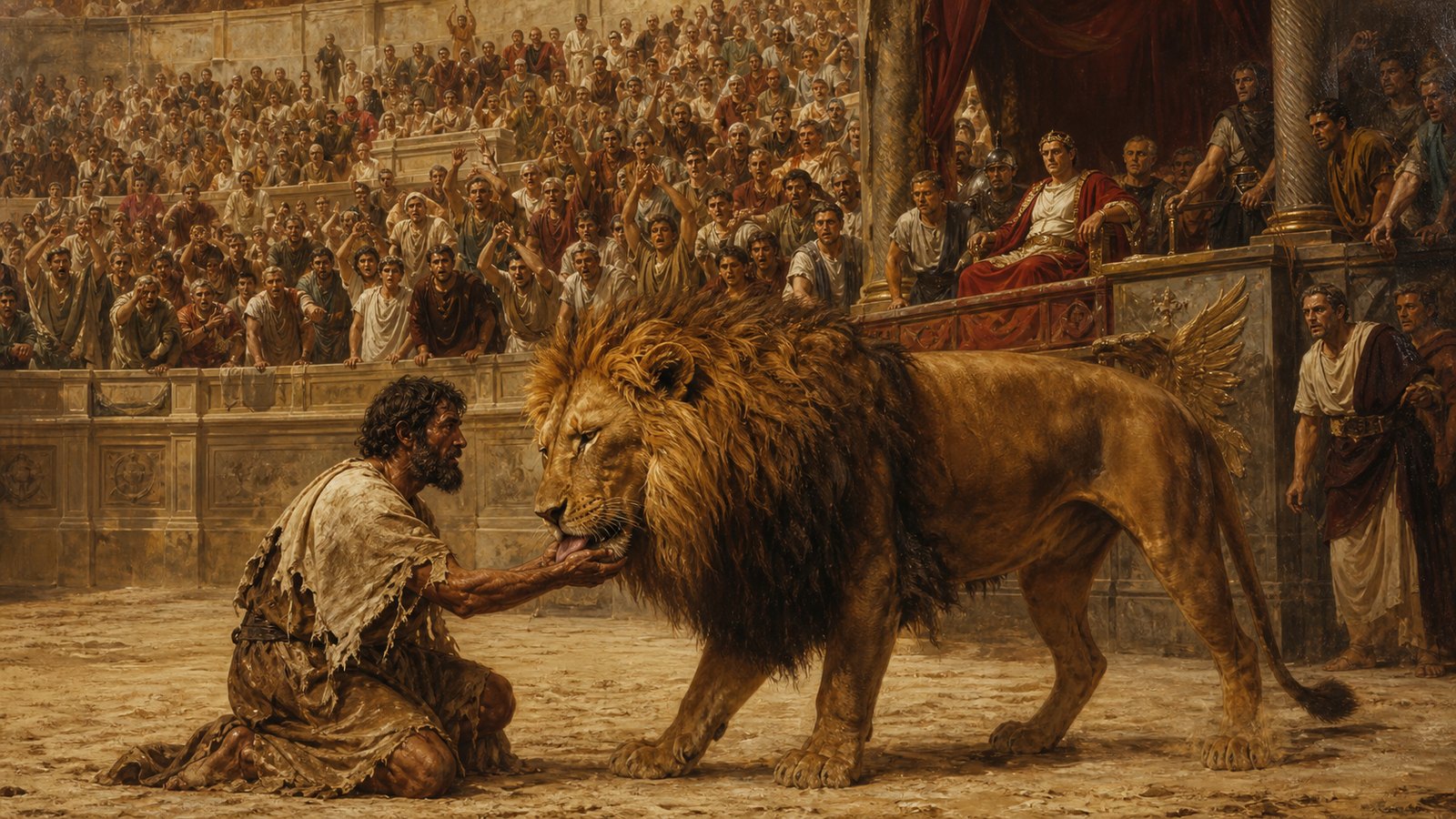
According to Apion’s account, the lion saw Androclus from a distance, stopped as though amazed, and approached slowly. It wagged its tail, came close, and licked the prisoner’s feet and hands. Androclus was initially almost dead with fear. Only while the animal continued its gentle contact did he recover enough courage to look back.
Apion interprets what followed as mutual recognition, almost a joyful greeting. That is his language for the scene, not access to the lion’s thoughts. The observable sequence inside the story is narrower: halt, approach, contact, a frightened man’s recovery, and sustained non-violence. The interpretation is powerful because it gives those movements a past before the past has been told.
The crowd shouted, and Gaius Caesar summoned Androclus to explain why this lion had spared him alone. The arena therefore changes function. The same space examined in the politics of gladiatorial entertainment becomes an improvised hearing. The prisoner’s survival cannot be processed as spectacle until his voice supplies a reason.
A Wounded Paw Rewound the Story
Androclus’s explanation begins in Africa, where, he said, his master held proconsular authority. He claimed that undeserved daily beatings drove him to run away. Because his owner governed the province, ordinary hiding places seemed unsafe, so he sought remote plains and desert. This is testimony within Apion’s report within Gellius’s retelling; its force comes from its placement, not independent corroboration.
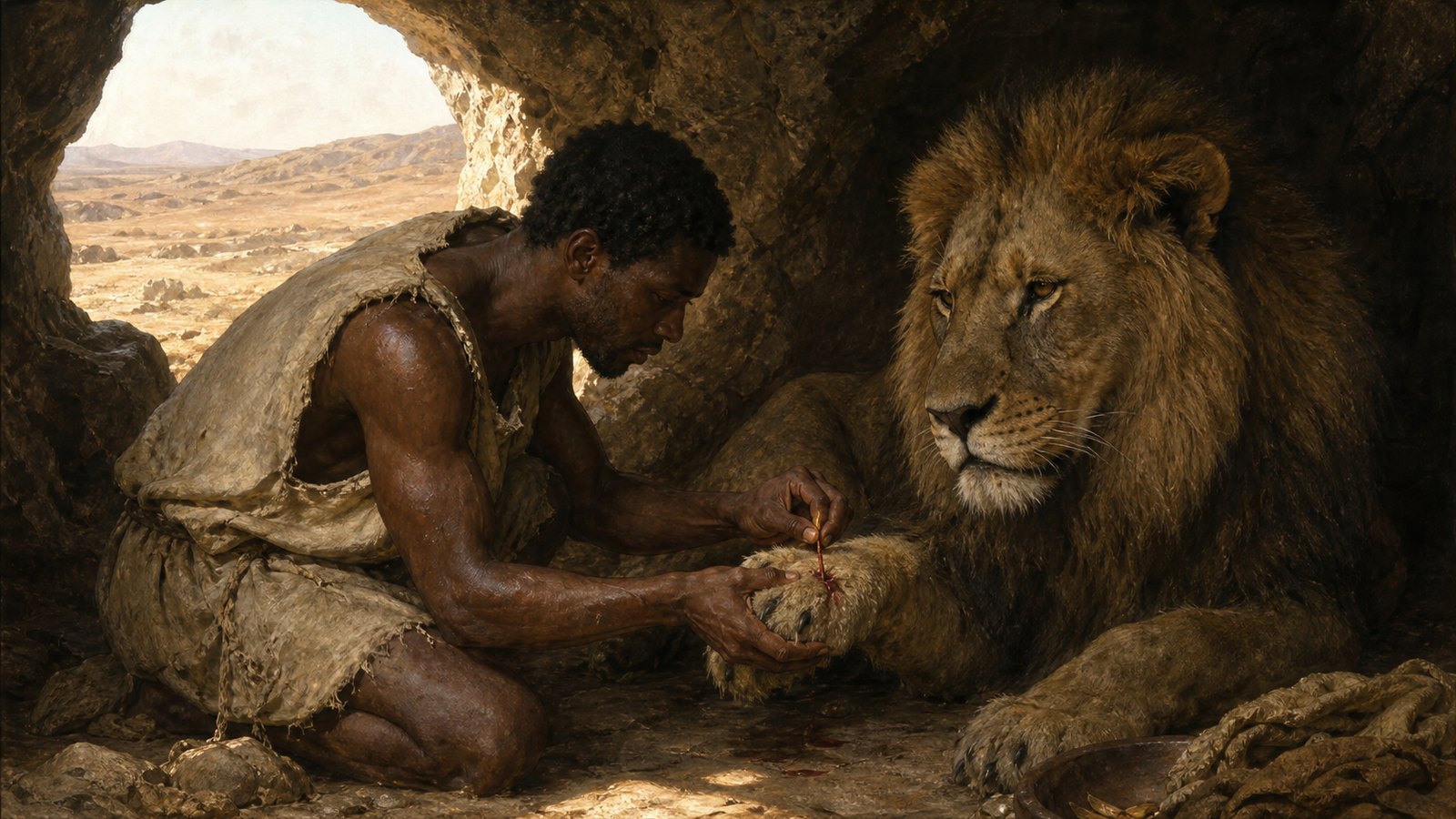
At midday he entered a secluded cave. A lion later came to the same place with one paw lame and bleeding, groaning from pain. Androclus first experienced terror. The lion then approached gently and held out the injured foot as though requesting assistance. Again the narrative translates movement into intention, allowing the human speaker to describe help before any shared language exists.
Androclus said he removed a large splinter from the sole, pressed pus from the wound, wiped away blood, and dried the paw. The specificity turns the recognition scene into repayment for manual care. His useful knowledge is not presented as formal medicine. It is attention under danger: locating an embedded object, cleaning the wound, and remaining close enough for the animal to rest its paw in his hand.
The lion lay down and slept. Androclus claimed that they then occupied the cave for three years and shared food: the lion brought selected portions from its hunting, while the man, lacking fire, dried meat in the midday sun. The episode stretches a single cure into prolonged coexistence, making the arena meeting a reunion rather than an isolated act of tameness.
The Tablet Made a Slave's Account Public
Androclus eventually tired of life in the cave and departed while the lion was hunting. After nearly three days of travel, soldiers found him and returned him from Africa to his master in Rome. His owner had him condemned to the beasts. Androclus concluded that the lion too had been captured after their separation and was now repaying the earlier cure.
Nothing in the chapter lets us verify that sequence outside the story. Its structure nevertheless explains every visible surprise in reverse. Why does the lion spare one man? Because the man treated its paw. Why are both in Rome? Because each was captured separately. Why can the prisoner identify this animal? Because the creature’s behaviour reopens a shared history before the crowd.
Apion says Androclus’s account was written out in full on a tablet and carried around the Circus. This is the decisive transfer. Speech addressed to Caesar becomes text presented to spectators. The prisoner no longer depends only on how far his unaided voice can travel. Rome’s audience receives an authorized explanation for the stalled execution.
The tablet also fixes a version quickly enough to support action. The public asked for release; Androclus was freed and acquitted, and the lion was given to him by popular vote. The narrative does not describe a normal legal appeal. It presents an extraordinary reversal produced by spectacle, explanation, writing and acclamation acting together.
Freedom Became Another Spectacle
The chapter does not end when the arena gate opens. Apion claimed that he later saw Androclus and the lion moving among Rome’s shops, connected by a slender leash. People gave the man money and sprinkled the lion with flowers. The former instruments of punishment had become a recognizable pair who attracted gifts and attention.
Onlookers repeated a balanced slogan: the lion was a man’s friend, and the man was a lion’s physician. The phrasing compresses the long cave narrative into two reversible identities. Friendship answers medicine; animal answers human. A story that required a full tablet in the Circus can now travel in a sentence spoken at street level.
That ending prevents a simple claim that compassion liberated Androclus from display. He is freed from his owner’s sentence, but the pair continue to be seen, named and rewarded through public curiosity. The spectacle changes from compulsory execution to itinerant marvel. The man’s survival and livelihood remain attached to the animal that made his account valuable.
Gellius preserves the episode because its recognitions are nested. Lion recognizes man; man recognizes lion; the audience recognizes a cause; later crowds recognize the famous pair; readers recognize how a narrative claims authority. Whether every event occurred as Apion said cannot be recovered from this chapter. What can be recovered is the ancient story’s precise argument: in an arena built to make a condemned body disposable, remembered care became the evidence Rome wanted to hear.